Ways to Stop Hair Breakage Due to Damaged Cuticle?: Science-Based Solutions
11 min read ·
Discover practical ways to stop hair breakage due to damaged cuticle using pH balancing, friction reduction, heat management, and targeted fibre reinforcement.
Quick answer: Proven ways to stop hair breakage due to damaged cuticle? include reducing wet grooming friction, keeping cosmetic chemical processes at an acidic pH (3.5 to 5.5), using conditioning lubricants like silicones or cationic surfactants, and lowering heat styling below 185°C. Because the outer cuticle cannot biologically regenerate once chipped or stripped, these interventions focus on reducing friction and patching the fibre. The main limitation is that severely fractured cuticles cannot permanently heal; broken ends require mechanical trimming to prevent further longitudinal splitting.
Key takeaways
- Cuticle damage exposes the delicate inner cortex, drastically increasing surface friction and causing the hair fibre to snap under routine combing tension.
- Once damaged, dead cuticle cells cannot regenerate; management relies on temporary lipid replacement, acidic pH balancing, and film-forming protective agents.
- Water weakens keratin by temporarily breaking hydrogen bonds, which makes wet hair up to 30 percent more prone to mechanical snap than dry hair.
- Using heat tools above 185°C degrades the cuticular protein matrix and vaporises internal moisture, accelerating structural fracture.
- Clear distinctions must be made between follicular shedding (hair coming from the root) and cuticle-driven hair breakage (fibres snapping along the shaft).
Ways to stop hair breakage due to damaged cuticle?: what the evidence shows
When researching ways to stop hair breakage due to damaged cuticle?, cosmetic science demonstrates that physical friction management and surface lubrication produce the most measurable reduction in snapped fibres. The outer cuticle consists of 5 to 10 overlapping layers of flattened, keratinised cells. In healthy hair, these tiles lie flat, bonded by the cell membrane complex (CMC) and shielded by an ultra-thin layer of 18-methyleicosanoic acid (18-MEA).
Chemical bleaching, alkaline relaxers, excessive ultraviolet exposure, and aggressive brushing strip this 18-MEA lipid layer. Without this natural hydrophobic coating, cuticle edges lift, curl, and break away. Peer-reviewed studies in cosmetic dermatology demonstrate that bare or lifted cuticles dramatically increase inter-fibre friction. When you pull a comb through damaged hair, high friction snag points exert more tensile stress than the compromised cortex can bear.
Effective evidence-based interventions centre on four key pillars:
- Acidic pH maintenance: Products formulated between pH 3.5 and 5.5 help contract the hair fibre, encouraging lifted cuticle shingles to lie flatter against the shaft.
- Cationic conditioning agents: Ingredients such as behentrimonium chloride or polyquaterniums carry a positive charge. They adhere electrostatically to the negatively charged, damaged sites along the cuticle, temporarily smoothing the surface and reducing combing force by up to 50 percent.
- Film-forming sealants: Dimethicone, amodimethicone, and plant-derived triglycerides deposit a protective microscopic film over exposed cortex zones, preventing moisture loss and resisting mechanical abrasion.
- Thermal restraint: Operating thermal styling tools below 185°C prevents thermal denaturation of cuticular proteins, preserving the physical integrity of the outer sheath.
What the evidence does not show
The scientific literature does not support the claim that damaged cuticles can be permanently repaired, rebuilt, or regenerated. Hair fibre is biologically dead tissue once it emerges past the follicular infundibulum. No topical serum, oil, or vitamin treatment can restore living cellular architecture to chipped cuticle scales.
Furthermore, evidence does not show that natural, raw kitchen oils (such as unrefined olive oil or unrefined coconut oil) behave identically to formulated cosmetic emulsions. While pure coconut oil can penetrate the cortex to reduce protein loss during wash cycles, it lacks the charged surface-active properties needed to flatten lifted cuticle edges or eliminate static flyaway friction. Finally, cutting out washing entirely does not protect the cuticle; accumulated sebum and environmental particulates increase fibre-on-fibre grit, compounding abrasive friction when brushing.
Mechanism: how a compromised cuticle leads to snapping
Hair breakage from cuticle loss is fundamentally a failure of mechanical shielding. The cortex makes up roughly 85 to 90 percent of the hair's dry weight and provides all of its tensile strength through tightly bundled, alpha-helical keratin intermediate filaments. However, the cortex is physically fragile when subjected to shear stress and friction.
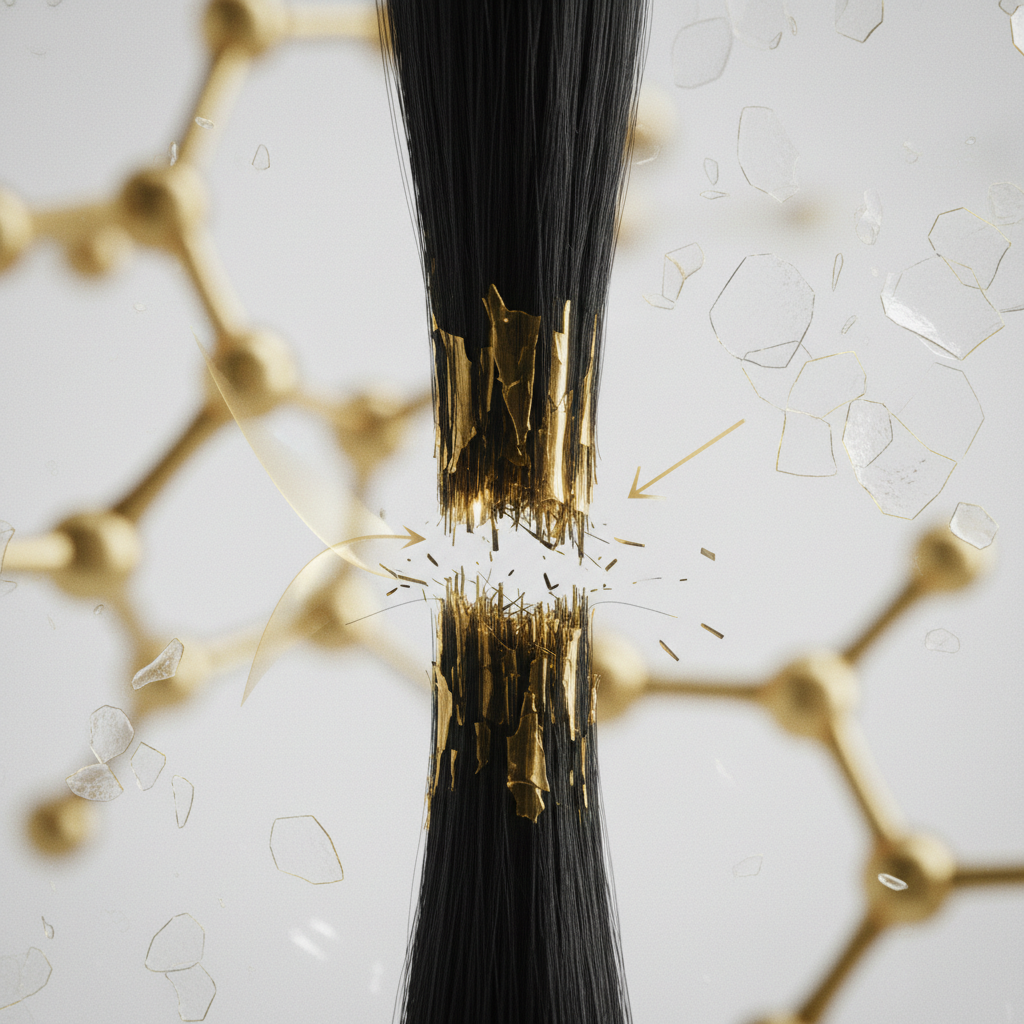
The cuticle functions as a protective armour. When mechanical, chemical, or thermal aggressors strip away the exterior lipid layer, the underlying cuticular scales crack, erode, and eventually slough off entirely. This structural loss triggers a cascading sequence of events:
Loss of 18-MEA Lipid Layer
 │
 ▼
Cuticle Scales Lift & Crack
 │
 ▼
Increased Surface Roughness & Friction
 │
 ▼
Combing / Styling Tensile Force Magnified
 │
 ▼
Exposed Cortex Develops Micro-Fractures
 │
 ▼
Fibre Snaps (Breakage)
Without the protective cuticle, water enters and exits the cortex unchecked. Excessive moisture absorption causes the cortex to swell radial-wise, a cycle known as hygral fatigue. Over repeated wet-dry cycles, this radial swelling pushes remaining cuticle tiles upward. When dry, the brittle, exposed keratin fibres catch on adjacent strands, knotting easily and snapping under minor physical tension.
Signs your breakage is cuticle-driven
Before applying interventions, you must determine whether hair fall is originating at the follicle or snapping along the mid-lengths.
Look for these diagnostic signs of cuticle-driven breakage:
- Short, fragmented strands: Discarded hairs found on your shoulders, sink, or brush that are noticeably shorter than your total hair length.
- Absence of a white root bulb: Broken hairs lack the tiny, pale, keratinised bulb characteristic of naturally shed telogen hairs.
- Rough, raspy tactile texture: Running your fingers upwards from the tip to the root creates a gritty, sandpaper sensation, signifying lifted or absent cuticle scales.
- Spontaneous knotting and tangling: Strands catch on each other almost immediately after detangling due to microscopic cuticle jaggedness.
- Trichoptilosis (split ends): The distal ends of the hair separate into two or more distinct branches, indicating that the cuticle has worn away completely and exposed the cortex to longitudinal splitting.
Comparison: Cuticle-driven breakage vs. Follicular shedding
To choose the right treatment path, you must correctly identify whether your hair is breaking along the shaft or shedding from the scalp.
| Diagnostic Marker | Cuticle-Driven Breakage | Telogen Hair Shedding |
|---|---|---|
| Primary Location | Along the mid-lengths or ends | At the scalp surface / follicle |
| Length of Lost Fibre | Irregular, short fragments | Full-length strands matching hair length |
| Root Bulb Present? | No; ends appear blunt, frayed, or split | Yes; visible tiny white keratin bulb at tip |
| Underlying Cause | Mechanical, chemical, or thermal wear | Hormonal, systemic, stress, or nutritional shifts |
| Fibre Surface Texture | Rough, dry, prone to tangling | Normal, smooth (unless separately damaged) |
| Primary Solution | Acidic care, lubrication, trims | Scalp support, diet, medical consultation |
Practical steps to prevent cuticle snapping
Stopping cuticle-related breakage requires practical, repeatable changes to your daily hair maintenance routine.
1. Re-engineer your detangling technique
Never pull a fine-toothed comb through dry, damaged hair. When detangling, apply a leave-in conditioner containing cationic polymers or silicones to saturate the fibre. Use a wide-toothed comb or a flexible-bristle detangling brush, working methodically from the ends upwards to the roots in small sections. This prevents compounding multiple small tangles into a single, high-tension knot that snaps the cortex.
2. Lower the heat and use thermal buffers
Always reduce your styling irons below 185°C. When hair is heated beyond this threshold, moisture inside the shaft superheats and can form microscopic bubble deformities within the cortex, blowing the cuticle tiles off the surface. Always apply a silicone-rich heat protector beforehand; these polymers form a thin, protective barrier that slows direct heat transfer.
3. Balance formulation pH
Shampoos with an alkaline pH (greater than 6.0) induce electrical repulsion between keratin proteins, forcing the cuticle to swell and flare. Use balanced shampoos and conditioning rinses formulated between pH 4.5 and 5.5. An acidic environment neutralises surface charges, smoothing down cuticle shingles and keeping the fibre resilient.
4. Minimise wet manipulation
Keratin absorbs up to 30 percent of its weight in water, which temporarily weakens its internal hydrogen bonds. Hair stretches much more easily when wet, but its elasticity threshold drops significantly, causing it to snap at lower tension levels. Pat your hair dry with a soft microfibre towel or cotton cloth; avoid rubbing vigorously.
5. Mechanical trimming
When cuticle scales are completely stripped, split ends form. Left unchecked, splits travel upward along the cortex like a run in a pair of tights. Trimming 5 to 10 millimetres off damaged ends every 8 to 12 weeks removes the unravelling sections, preventing splits from moving up into healthier parts of the hair shaft.
Scalp and fibre support: the Watermans approach
Maintaining structural resistance to hair snapping requires a balanced approach that supports both the hair fibre and the scalp environment from which new hair emerges. While cuticle management protects existing lengths, a healthy follicular foundation ensures newly produced cuticle cells develop uniformly without congenital weakness.
Products such as Watermans Grow Me Shampoo and Condition Me Conditioner provide a targeted, dual-action routine. Watermans Grow Me contains a nourishing blend of biotin, rosemary, caffeine, argan oil, and lupin protein designed to revitalise and invigorate the scalp environment.
Complementing this, Watermans Condition Me is formulated with cholesterol, niacinamide, and caffeine to condition the hair surface. The inclusion of cholesterol acts as an essential lipid replenisher, assisting in softening the hair shaft and restoring surface suppleness to cuticles stressed by thermal or mechanical styling. Integrating these products helps maintain hair that feels stronger and displays reduced breakage during daily brushing.
When the cause may be something else
If your hair breaks despite gentle handling, or if snapping is accompanied by noticeable loss of density across the scalp, the issue may not be simple cuticle wear.
Consider alternative possibilities:
- Severe protein deficiency or malnutrition: Extreme calorie restriction or low dietary protein intake impairs the follicle's ability to synthesise robust keratin chains.
- Endocrine conditions: Hypothyroidism frequently makes hair shafts exceptionally brittle, coarse, and prone to spontaneous breaking along the shaft.
- Acquired trichorrhexis nodosa: A structural defect characterised by node-like swelling points along the shaft where the cuticle is absent and cortex fibres splay out like miniature paintbrushes.
- Underlying follicular hair loss: If you notice round bald patches, diffuse widening of your natural parting, or excessive daily shedding exceeding 100 strands complete with root bulbs, this is telogen shedding or alopecia, not physical breakage.
When to seek professional advice
Consult a qualified trichologist or dermatologist if you observe:
- Significant thinning, patchy bald spots, or visible scalp inflammation and redness.
- Sudden, catastrophic hair breakage occurring within days of a salon chemical procedure, which can point to severe chemical overprocessing.
- Rapid hair fragmentation accompanied by systemic symptoms like unexplained weight fluctuations, chronic fatigue, or joint pain.
- An absence of improvement after 8 to 12 weeks of gentle, evidence-based hair practices and regular trims.
A professional can perform a trichoscopy or polarised light microscopic analysis of your hair shafts to verify whether breakage stems from outer cuticle erosion, internal structural dystrophies, or follicular disruptions.
Frequently asked questions about Ways to stop hair breakage due to damaged cuticle?
Can natural oils repair cuticles that have already chipped off?
No. Once individual cuticle scales have fractured or detached from the hair fibre, plant oils cannot rebuild or regenerate them. While oils like argan, jojoba, and coconut can smooth down remaining lifted scales, reduce static electricity, and coat the exposed cortex with a lubricating lipid film, they cannot regrow the biological cuticle architecture. Trimming remains the only permanent fix for split, unravelling ends.
How does acidic rinse water prevent cuticle-related hair snapping?
Washing hair in slightly acidic conditions (pH 4.5 to 5.5) keeps the cuticle scales lying tight and flat against the cortex. Alkaline environments (such as hard tap water or high-pH soaps) cause the hair shaft to swell and the cuticles to lift, vastly increasing friction during washing. Keeping hair care products mildly acidic prevents swelling and lowers friction-induced mechanical snapping.
What are the fastest ways to stop hair breakage due to damaged cuticle??
The fastest ways to stop hair breakage due to damaged cuticle? involve immediately switching to a low-friction routine: apply a silicone or cationic leave-in conditioner to wet hair, switch to a wide-tooth detangling comb, cease all heat styling above 185°C, and cut off split ends with a professional trim. These steps provide instant surface slip, eliminating the snags that cause weakened, cuticle-depleted fibres to break.
Why does my hair snap more when it is wet compared to dry?
Water breaks down the temporary hydrogen bonds that give dry keratin its structural rigidity. Although wet hair stretches more than dry hair, its yield point and ultimate tensile strength drop considerably. Without a smooth, intact cuticle layer to glide through combing, wet hair easily overextends past its elastic limit, causing the internal cortex fibres to rupture and snap.
Final thoughts on cuticle preservation
Successfully implementing ways to stop hair breakage due to damaged cuticle? comes down to friction reduction, consistent lipid replenishment, and physical preservation. Because the cuticle is an acellular structure that cannot biologically heal once fractured, your goal is to seal and protect what remains while shielding new growth from repeating the same damage cycle. By keeping styling temperatures low, detangling gently with charged conditioning agents, maintaining acidic pH balance, and regularly trimming fractured tips, you can stop shaft breakage, maintain your length, and protect your hair's natural strength over the long term.
Sources and references
- British Association of Dermatologists. Hair breakage and structural hair disorders. 2021.
- Gavazzoni Dias, M. F. Hair cosmetics: an overview. International Journal of Trichology, 2015. DOI: 10.4103/0974-7753.153450.
- Robbins, C. R. Chemical and Physical Behavior of Human Hair. 5th ed., Springer, 2012.
- Evans, T., & Wickett, R. R. Practical Modern Hair Science. Allured Business Media, 2012.
- Sinclair, R. D. Healthy hair: what is it? Journal of Investigative Dermatology Symposium Proceedings, 2007. DOI: 10.1038/sj.jidsymp.5650046.
Find these ingredients in Watermans products
- Niacinamide: you will find this ingredient in our Hair Mask.