Thermal Heat Protection for Hair: Science, Mechanisms, and Best Practice
8 min read ·
Learn how thermal heat protection for hair shields keratin bonds, prevents bubble hair deformities, and protects cuticles from temperatures up to 230°C.
Quick answer: Applying Thermal Heat Protection for Hair forms a physical barrier that slows heat transfer, reduces moisture loss, and shields the hair shaft from temperatures up to 230°C. These formulas use cross-linked silicones, hydrolysed proteins, and polymers to buffer the fibre against structural degradation. However, the main limitation is that no thermal product provides complete immunity. Severe structural denaturation still occurs if styling tools exceed the protective threshold or dwell too long on a single section of hair.
Key takeaways
- Heat above 150°C degrades the structural alpha-keratin in the cortex, converting it irreversibly into beta-keratin.
- Direct contact with hot styling tools without a barrier causes moisture inside the cortex to boil, leading to irreversible internal gas pockets called bubble hair.
- Thermal protectants work by lowering thermal conductivity, distributing heat evenly, and reducing moisture evaporation.
- Ingredients such as dimethicone, amodimethicone, and hydrolysed wheat protein provide measurable mitigation against cuticle erosion.
- Heat protection reduces hair breakage along the shaft; it does not alter follicular hair shedding or genetic hair loss.
Thermal Heat Protection for Hair: what the evidence shows
Using Thermal Heat Protection for Hair is scientifically validated to mitigate surface ablation, lipid loss, and tensile weakness caused by heated styling tools. Research published in cosmetic science literature confirms that unshielded hair subjected to flat irons at 185°C to 230°C suffers rapid stripping of the 18-methyleicosanoic acid (18-MEA) lipid layer. This protective fatty acid coating naturally shields the cuticle from friction and moisture penetration.
When you apply an effective thermal shield, polymers and silicones coat the cuticle scales. Spectroscopic studies show that these polymers absorb and disperse radiant heat, reducing the rate at which thermal energy transfers into the inner cortex. Consequently, the rate of cystine breakdown (the critical amino acid providing hair with tensile resilience) drops significantly compared to untreated controls. Treated hair displays smoother cuticle profiles under scanning electron microscopy, lower porosity, and substantially higher resistance to snapping during combing.
What the evidence does not show
Thermal protectants are often marketed as total heat shields, but the laboratory evidence reveals clear boundaries:
- They do not make hair invincible: A thermal spray cannot prevent structural denaturation if flat irons or curling wands sit on the hair shaft for extended periods. Heat transfer still occurs; the product merely slows the rate.
- They cannot repair dead or broken fibres: Split ends and fractured shafts cannot be welded back together permanently by applying a heat protectant. Silicone polymers temporarily smooth over fractures, but the underlying structural breach remains until trimmed.
- They do not influence the follicle: Applying thermal products to your lengths has no bearing on biological hair shedding or conditions like androgenetic alopecia. They protect against hair breakage, not follicle-level thinning.
The biological and physical mechanism of heat damage
Hair consists of roughly 85% keratin protein, 10% water, and 5% structural lipids and minerals. The exterior cuticle is composed of overlapping, shingle-like scales that protect the fibrous inner cortex.
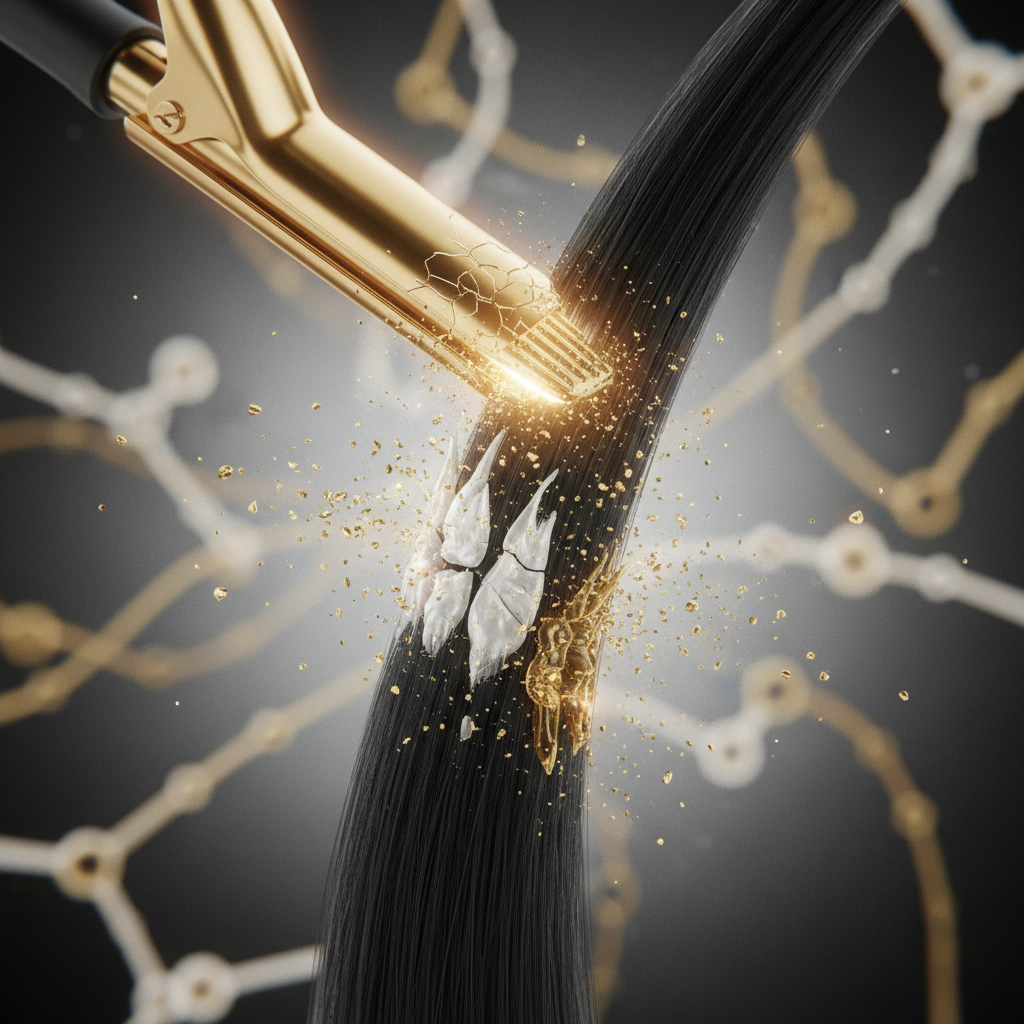
When you apply heat tools:
- Moisture flash-off (100°C to 130°C): Bound water within the cortex rapidly converts to steam. If hair is damp when touched by a tool above 100°C, the rapid expansion of water vaporises inside the shaft, exploding through the cuticle and forming macroscopic voids known as bubble hair deformity.
- Lipid degradation (130°C to 160°C): The free fatty acids and 18-MEA outer layer melt and oxidise, removing the hair's natural hydrophobicity and leaving it porous, rough, and vulnerable to environmental humidity.
- Keratin denaturation (above 160°C): The stable, helical alpha-keratin chains unwind and collapse into disordered beta-sheet configurations. This causes permanent loss of elasticity, meaning the hair stretches without snapping back, leading to immediate fracture under mechanical stress.
- Melanin oxidation (above 190°C): Natural and synthetic pigment molecules oxidise, resulting in yellowing, brassiness, or rapid fading of salon colour.
Heated Styling Tool (180°C - 230°C)
 │
 ▼
 [Thermal Protectant Layer]
 (Absorbs & redistributes heat energy)
 │
 Reduces Heat Flux
 ▼
 ┌──────────────────────────────┐
 │ Cuticle scales remain sealed │
 │ 18-MEA lipid layer preserved │
 │ Alpha-keratin helix protected│
 └──────────────────────────────┘
Signs of thermal damage to look for
Thermal damage presents differently from standard mechanical or chemical stress. Check your hair for these distinctive signs:
- Altered curl pattern: Naturally curly or wavy hair loses its uniform coil and hangs limp or straight in over-styled sections.
- Extreme brittleness: Hair snaps mid-shaft rather than shedding from the root with an intact white bulb.
- Velcro-like tangling: Flattened or lifted cuticle scales snag against adjacent hairs, making dry combing difficult.
- Rapid colour degradation: Artificial colour washes out prematurely, or blonde and grey hair takes on a dull, burnt-yellow tint.
- Excessive porosity: Hair soaks up water instantly in the shower but dries abnormally quickly, feeling coarse and dry to the touch.
Practical application: what you can do
To maximise the benefits of heat protection, follow a structured approach every time you reach for a styling tool.
- Dry hair thoroughly before using direct irons: Never use a flat iron or curling tong on damp hair. Allow hair to air dry or blow-dry it completely on a medium setting before introducing high-contact ceramic plates.
- Apply to clean, damp hair first: Distribute a leave-in thermal mist or cream evenly through damp lengths using a wide-tooth comb. This guarantees that internal polymers bind across the cuticle before blow-drying begins.
- Calibrate your tool temperature: Fine, chemically processed, or bleached hair should never face temperatures above 150°C to 170°C. Coarse or resistant hair should remain between 180°C and 200°C. Avoid the maximum 230°C setting entirely.
- Maintain continuous motion: Keep the tool moving smoothly down the hair shaft. A single, fluid pass at 175°C creates less damage than multiple slow passes or holding the tool static on one section.
| Product Vehicle | Best Hair Type | Key Active Ingredients | Primary Protective Benefit |
|---|---|---|---|
| Lightweight Mist / Spray | Fine, straight, easily weighed-down hair | Hydrolysed wheat protein, PVP/DMAPA acrylates | Surface polymer film that does not collapse volume |
| Cream or Lotion | Medium to thick, dry, or chemically treated hair | Amodimethicone, panthenol, argan oil | High slip, moisture retention, and intensive cuticle sealing |
| Silicone Serum | Coarse, dense, tightly coiled (afro) hair | Cyclopentasiloxane, dimethicone | Superior thermal insulation and anti-frizz barrier against high heat |
When the cause of breakage may be something else
If you are diligent with heat protection but still experience extensive breakage, high temperatures may not be the primary culprit:
- Chemical over-processing: Bleaching, relaxers, and perms break the disulphide bonds within the cortex. If hair is chemically compromised, even mild environmental stress will cause it to snap.
- Protein-moisture imbalance: Overusing high-potency keratin reconstructors without adequate conditioning lipids makes the hair shaft rigid, brittle, and prone to snapping.
- Mechanical stress: Aggressive backcombing, rough towel drying, or using elastic bands with metal clasps creates mechanical friction that shears cuticle scales independently of heat.
- Underlying shedding disorders: If you notice hair collecting on your pillow or in the drain with small white bulbs at the end, this is shedding (such as telogen effluvium), not shaft breakage. Thermal protectants will not alter this biological process.
When to seek professional advice
Consult a qualified trichologist or a reputable professional stylist if you experience sudden, widespread snapping along the shaft that does not improve after eliminating heat tools for 4 to 6 weeks. A stylist can perform an elasticity test and design a restorative regime with targeted in-salon treatments, or trim severely split ends before fractures travel up the shaft. If you notice scalp redness, irritation, or diffuse thinning at the root, consult a dermatologist to rule out underlying scalp or systemic conditions.
Supporting hair condition with Watermans
Preserving the structural integrity of your lengths requires a comprehensive routine that supports both hair fibre condition and scalp vitality. Watermans approaches hair wellness by focusing on everyday strength and resilience. Pairing low-temperature styling habits with nutrient-rich formulations helps maintain smooth, resilient strands that stand up to daily styling routines. Keeping your scalp clean and providing the fibre with hydrating, strength-supporting botanicals creates an optimal foundation for hair that looks full, vibrant, and healthy.
Frequently asked questions about Thermal Heat Protection for Hair
Does Thermal Heat Protection for Hair work on wet hair?
Yes, but it depends on the product design. Many heat protectant sprays and lotions are formulated for towel-dried hair to shield against blow-dryer damage. However, you must never use flat irons or curling tongs on wet hair, even with a protectant applied. Boiling residual water creates internal bubbles in the cortex, causing irreversible fibre fracture.
What ingredients should I look for in a thermal protectant?
Look for advanced silicones like amodimethicone and dimethicone, which provide excellent thermal insulation and reduce friction. Water-soluble polymers, polyquaterniums, and hydrolysed vegetable or wheat proteins are also valuable. These ingredients adhere to the cuticle, slowing heat transfer, locking in hydration, and reducing structural protein loss during styling.
Can natural oils replace a formulated thermal protectant?
No, natural oils cannot replace formulated heat protectants. Pure oils like coconut, olive, or argan oil lack the heat-dispersing polymer films found in lab-formulated products. Furthermore, raw oils have variable smoke points, and heating them with direct iron plates can fry the outer cuticle layer rather than protect it.
Do I need heat protection if I only blow-dry my hair?
Yes. Although blow-dryers typically operate at lower temperatures (between 50°C and 100°C) than irons, the combination of convective heat and mechanical brushing strips surface lipids. Applying a protectant keeps the cuticle flat, retains natural moisture, and prevents the friction-induced split ends caused by round-brush styling.
Summary on protecting your lengths
Mastering Thermal Heat Protection for Hair is one of the most effective ways to maintain length, prevent split ends, and preserve hair elasticity. By shielding your strands with high-performance ingredients, monitoring tool temperatures, and respecting the limits of keratin, you can style your hair safely while preventing the cumulative structural breakdown that leads to permanent breakage.
Sources and references
- Journal of Cosmetic Science: "Thermal degradation of hair keratin: a study using differential scanning calorimetry and infrared spectroscopy", 2011.
- International Journal of Cosmetic Science: "The effect of heat on hair chemical and physical properties", 2012.
- Society of Cosmetic Chemists: "Heat-protective effects of polymers on human hair", 2018.
- British Journal of Dermatology: "Morphological and structural changes in human hair keratin induced by thermal styling", 2020.
Find these ingredients in Watermans products
- Argan Oil: you will find this ingredient in our Hair Growth Shampoo.