Telogen Effluvium vs Pattern Loss: Diagnosis, Causes, and Care
11 min read ·
Learn the key differences in Telogen Effluvium vs Pattern Loss, including mechanisms, shedding signs, diagnosis methods, and evidence-based management.

Quick answer: The core distinction in Telogen Effluvium vs Pattern Loss comes down to timing, distribution, and follicle behaviour. Telogen effluvium is temporary, diffuse shedding across the entire scalp caused by an abrupt physiological shock that pushes growing follicles into a resting phase. Pattern loss (androgenetic alopecia) is a progressive, genetic miniaturisation of follicles concentrated in specific zones, such as the temples, crown, or central parting. While telogen effluvium typically resolves on its own, pattern loss requires ongoing management to preserve density.
Key takeaways
- Telogen effluvium causes generalised shedding across the entire scalp, whereas pattern loss causes localised thinning in genetic hotspot zones.
- Telogen effluvium involves full-thickness club hairs falling out, whereas pattern loss involves hairs gradually becoming thinner and shorter through follicle miniaturisation.
- Shedding from telogen effluvium usually appears two to three months after a physiological or emotional trigger and resolves within three to six months once the trigger is removed.
- Pattern loss develops slowly over years under the influence of genetics and dihydrotestosterone (DHT), rarely presenting with sudden daily hair fall.
- Both conditions can occur at the same time, because an acute bout of telogen effluvium can unmask underlying pattern hair loss that was previously unnoticed.
Telogen Effluvium vs Pattern Loss: what the evidence shows
Understanding Telogen Effluvium vs Pattern Loss begins with how hair cycles function at the biological level. Your scalp contains roughly 100,000 hair follicles. In a healthy baseline state, approximately 85 to 90 percent of these follicles reside in the anagen (growth) phase, lasting anywhere from two to seven years. Less than 10 to 15 percent sit in the telogen (resting) phase, which lasts around 100 days before the hair sheds.
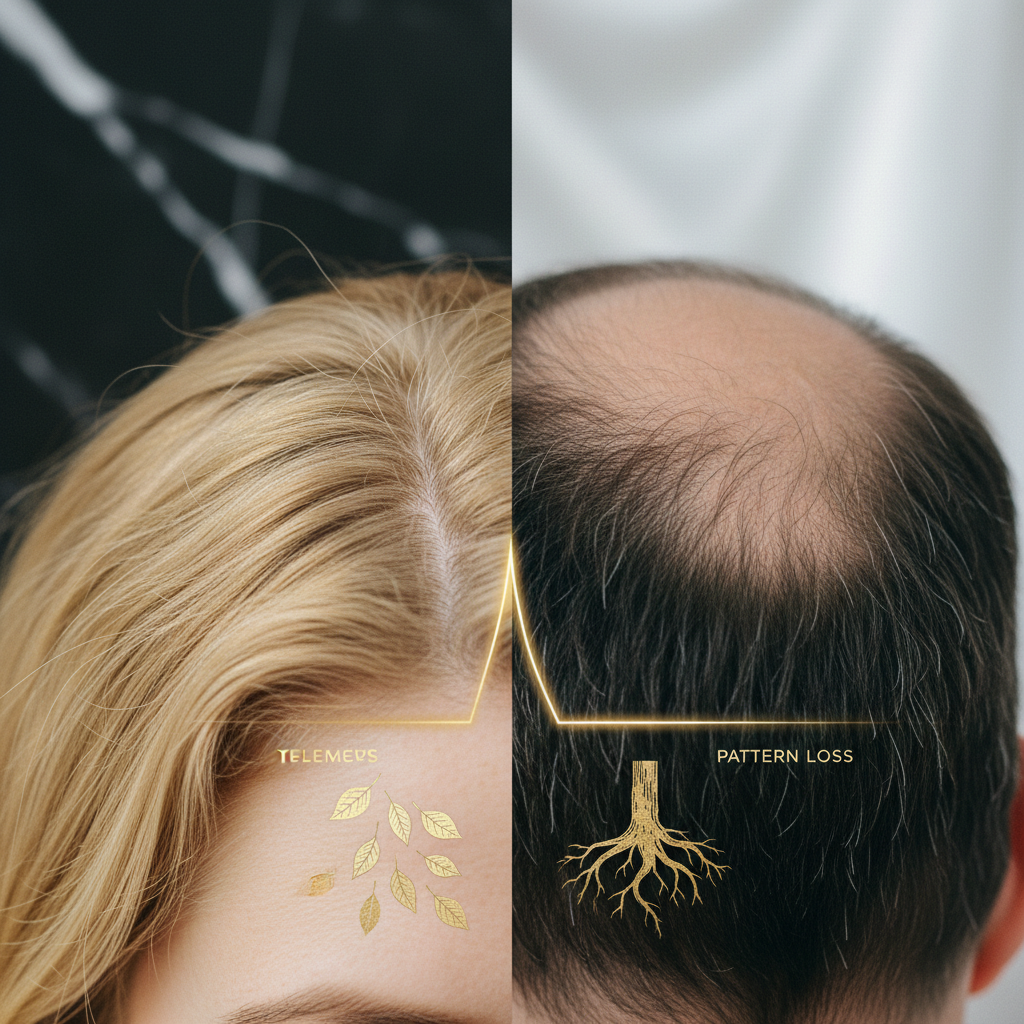
In telogen effluvium, an acute metabolic, hormonal, or psychological shock prematurely jolts up to 30 to 50 percent of anagen hairs into the catagen (transition) and telogen phases. Because the telogen phase naturally spans roughly three months, the resulting deluge of shedding does not appear immediately. Instead, sudden diffuse shedding surfaces two to three months after the triggering event. The hair follicle itself remains entirely healthy, intact, and capable of producing a full-diameter terminal hair once the cycle resets.
Pattern loss, medically termed androgenetic alopecia, operates through a completely different biological mechanism. It is driven by genetic predisposition and the sensitivity of specific hair follicles to androgens, primarily dihydrotestosterone (DHT). 5-alpha reductase enzymes convert testosterone to DHT at the follicular level. In susceptible zones (the frontal hairline, temples, and vertex in men; the central midline parting and crown in women), DHT binds to androgen receptors. This binding shortens the anagen phase and lengthens the telogen phase while progressively shrinking the dermal papilla. With each successive cycle over years, the follicle produces a finer, shorter, more fragile hair shaft (miniaturisation) until it eventually yields only microscopic vellus hair or ceases production altogether.
| Feature | Telogen Effluvium | Pattern Loss (Androgenetic Alopecia) |
|---|---|---|
| Primary Mechanism | Premature shift of follicles into resting phase | Progressive follicular miniaturisation via DHT sensitivity |
| Onset Speed | Sudden and rapid (develops over 2 to 4 weeks) | Insidious and gradual (develops over years) |
| Shedding Volume | High (often 200 to 400+ hairs per day) | Low to moderate (rarely excessive daily shedding) |
| Scalp Pattern | Diffuse thinning across the whole scalp | Localised (receding hairline, crown, widened parting) |
| Hair Fibre Calibre | Uniform thickness (full-calibre club hairs) | Variable diameters (mix of thick and miniaturised fine hairs) |
| Hair Pull Test | Frequently positive across multiple scalp zones | Usually negative (unless concurrent shedding exists) |
| Typical Reversibility | Spontaneous regrowth once trigger resolves | Irreversible without active, ongoing clinical therapy |
What the evidence does not show
Controlled dermatological research does not show that telogen effluvium causes permanent destruction of hair follicles. A common fear during acute shedding is that every lost hair is gone forever. Histological studies show that the underlying follicular machinery remains viable throughout telogen effluvium.
Similarly, clinical evidence does not show that pattern loss is caused by poor scalp circulation, clogged pores, or stress alone. While chronic stress can exacerbate inflammation, pattern hair loss is fundamentally driven by genetics and follicular androgen sensitivity. You cannot wash away pattern loss with clarifying shampoos, nor does wearing hats or using styling products accelerate follicular miniaturisation.
Finally, evidence does not support the idea that cosmetic haircare products can alter systemic hormonal conversions or treat clinical alopecia. Shampoos and topical cosmetics can support scalp hygiene, reduce fibre breakage along the shaft, and improve the visual density of existing hair, but they do not alter genetic androgen sensitivity.
Signs and symptoms: how to tell them apart
Differentiating between these two conditions relies on examining the onset, the distribution of hair loss, and the nature of the shed fibres.

Evaluating the hair shed
When assessing your brush or shower drain, look closely at the hairs themselves:
- In telogen effluvium: You will notice large handfuls of hair shedding consistently throughout the day. These fibres are predominantly full-length, mature terminal hairs with a distinct, tiny white bulb at the root (keratinised club hairs). Because the hair simply completed an accelerated resting phase, its diameter remains uniform.
- In pattern loss: You might not notice dramatic handfuls of hair falling out at all. Instead, you will notice that the overall volume feels lighter. When you examine hairs on your pillow or desk, you will see noticeable variation in hair thickness (anisotrichosis), with many short, wispy, thin strands that have lost their pigmentation and structural body.
Inspecting the scalp zones
The physical pattern on your scalp offers the clearest diagnostic clue:
- Diffuse thinning (Telogen Effluvium): The density reduction occurs globally. The sides and the back of your head (the occipital zone) shed just as aggressively as the top. If your ponytail circumference shrinks rapidly within a matter of six weeks while your hairline stays exactly where it has always been, telogen effluvium is the prime suspect.
- Patterned thinning (Pattern Loss): In men, the frontal temporal peaks recede into an M-shape, accompanied by an expanding thin patch at the vertex or crown. In women (Ludwig pattern), the frontal hairline is typically preserved, but the central parting line widens noticeably, resembling a Christmas tree pattern that exposes more scalp under direct light. The back of the head almost always retains its normal, dense coverage because occipital follicles are genetically resistant to DHT.
What causes telogen effluvium?
Telogen effluvium is essentially an alarm response from your endocrine and immune systems. Common triggers that push follicles into resting mode include:
- High fever and severe infection: Major systemic illnesses, including severe flu or viral infections, are classic triggers that prompt widespread shedding roughly 60 to 90 days post-recovery.
- Rapid hormonal fluctuations: Postpartum shedding (telogen effluvium gravidarum) occurs when estrogen levels plummet following childbirth. Stopping or changing certain oral contraceptives can trigger a similar response.
- Nutritional and metabolic deficiencies: Severe caloric restriction, rapid weight loss, crash dieting, or clinical deficiencies in serum ferritin (stored iron), vitamin D, or zinc starve the follicle of the metabolic energy required to sustain anagen growth.
- Major surgical trauma or psychological shock: Undergoing general anaesthesia, experiencing significant physical injury, or navigating acute psychological bereavement releases elevated cortisol and neuroinflammatory mediators that halt the active growth cycle.
- Thyroid dysfunction: Both hypothyroidism and hyperthyroidism disrupt the metabolic pacing of the hair cycle.
What you can do: actionable management strategies
Because the mechanisms behind these conditions differ, your strategy must align with the true cause.
For telogen effluvium
- Identify and remove the root cause: Look backward on your calendar by eight to twelve weeks. Did you have a high fever? Did you start an extreme diet? Once the underlying trigger is corrected (such as restoring ferritin levels above 50 ug/L or letting post-viral recovery run its course), shedding will typically slow down within three to six months.
- Prioritise nutritional sufficiency: Ensure an adequate daily intake of complete proteins (around 0.8 to 1.0 grams per kilogram of body weight) along with micronutrients that support cellular turnover, particularly iron, B vitamins, and zinc.
- Practice gentle mechanical handling: While follicles are resting, the hair is structurally normal, but you want to avoid adding hair breakage on top of hair shedding. Use wide-tooth combs, avoid high-tension hairstyles like tight buns or braids, and wash with lukewarm water.
For pattern loss
- Seek medical therapies early: Because follicular miniaturisation is progressive, early intervention produces the best outcomes. Regimes backed by clinical guidelines include topical or oral minoxidil (which prolongs anagen and increases blood flow to the papilla) and 5-alpha reductase inhibitors such as finasteride or dutasteride (which lower systemic and scalp DHT levels, prescribed under medical supervision).
- Track with baseline photography: Take clear, consistent photographs of your crown, temples, and parting every six months under identical lighting to monitor whether density is stable or declining.
Cosmetic support and scalp care
Supporting the scalp environment helps optimize the conditions for new growth as follicles cycle back into anagen. Watermans provides targeted cosmetic formulations designed to keep the scalp clean and the hair fibre resilient. Watermans GrowMe Shampoo is formulated with biotin, caffeine, argan oil, rosemary, and niacinamide to nurture the scalp surface, clear away sebum build-up, and fortify fragile strands against mechanical breakage. Using a nourishing daily topical like Watermans Grow More Elixir supplies conditioning botanicals directly to the scalp without weighing down fine, thinning hair. These cosmetic steps ensure that regrowing fibres have an ideal surface foundation, helping your hair look and feel thicker while medical treatments or natural recovery take place.
When the cause may be something else
Not all shedding fits neatly into the categories of telogen effluvium or androgenetic alopecia. Other conditions require consideration:
- Alopecia areata: An autoimmune disorder where lymphocytes attack anagen hair bulbs, producing smooth, circular, coin-sized patches of complete hair loss rather than diffuse or patterned thinning.
- Traction alopecia: Mechanical tension from tight weaves, extensions, or ponytails pulls the follicle physically, causing hair loss primarily along the outer frontal and temporal margins.
- Cicatricial (scarring) alopecias: Inflammatory conditions such as lichen planopilaris or frontal fibrosing alopecia permanently destroy the follicle and replace it with scar tissue. These conditions often present with burning, itching, redness, or scale around the follicle openings.
- Hair breakage: If you notice short, jagged pieces of hair without a white bulb falling when you brush, your hair is snapping along the shaft due to chemical processing, bleaching, or heat damage, rather than shedding from the root.
When to seek professional advice
You should consult a GP, dermatologist, or qualified trichologist if:
- Your hair shedding continues at an extreme rate for more than six months without slowing down (which points to chronic telogen effluvium).
- You experience scalp pain, burning, tenderness, crusting, or noticeable erythema (redness).
- Your hair loss is patchy, uneven, or accompanied by shedding of eyebrows or eyelashes.
- You are uncertain whether miniaturisation is taking place and want a definitive dermoscopic evaluation. A clinician using a trichoscope can instantly spot hair diameter diversity and peripilar signs, confirming the diagnosis within minutes.
Frequently asked questions about Telogen Effluvium vs Pattern Loss
Can telogen effluvium turn into pattern loss?
Telogen effluvium cannot biologically transform into pattern loss because they are driven by entirely different mechanisms. However, an episode of telogen effluvium can unmask underlying pattern loss. If you were already genetically predisposed to androgenetic alopecia, the sudden shedding of telogen effluvium can expose miniaturised follicles that were previously concealed by surrounding dense hair, preventing those specific follicles from growing back at their original thickness.
How do dermatologists diagnose Telogen Effluvium vs Pattern Loss?
Dermatologists distinguish Telogen Effluvium vs Pattern Loss using clinical history, a physical pull test, and trichoscopy. Trichoscopy inspects the scalp under high magnification: pattern loss reveals marked hair diameter diversity greater than 20 percent and yellow dots, whereas acute telogen effluvium displays uniform hair thickness across the scalp alongside short, upright regrowing hairs emerging from empty follicular openings.
Does pattern loss always cause high amounts of daily shedding?
No, pattern loss rarely presents with massive daily shedding. Most individuals with androgenetic alopecia lose hair at a relatively normal daily rate (50 to 100 hairs per day). The thinning occurs because each hair that sheds is replaced by a finer, shorter hair that covers less scalp, rather than an abrupt emptying of follicles.
How long does it take for hair to grow back after telogen effluvium?
Once the physiological or psychological trigger has been resolved, shedding typically normalises within three to six months. Visible regrowth appears as short, fine sprouts across the scalp around three to four months after shedding slows down. Because human scalp hair grows at an average rate of roughly 1 to 1.25 centimetres per month, returning to your original length and ponytail thickness can take 12 to 24 months.
Can you have Telogen Effluvium and Pattern Loss at the same time?
Yes, it is common to experience both conditions simultaneously. A person with mild, slowly progressing pattern loss can encounter a severe viral illness, rapid weight loss, or surgical trauma, triggering acute telogen effluvium on top of their existing genetic thinning. In such cases, the diffuse shedding will eventually subside, but the patterned thinning will remain and continue its gradual course.
Closing thoughts on Telogen Effluvium vs Pattern Loss
Distinguishing between Telogen Effluvium vs Pattern Loss is the critical first step toward choosing the right path forward. Telogen effluvium is a temporary, diffuse reaction to an internal physiological disruption that generally resolves once your body regains its equilibrium. Pattern loss is a lifelong, genetically mediated sensitivity to androgens that requires proactive, targeted management to preserve long-term density. By observing where the hair is thinning, evaluating the calibre of the shed fibres, and seeking a professional assessment when in doubt, you can protect your scalp health and approach your hair journey with confidence.
Sources and references
- British Association of Dermatologists. Telogen Effluvium: An Information Leaflet for Patients. 2021.
- National Institute for Health and Care Excellence (NICE). Alopecia androgenetica: Clinical Knowledge Summary. 2022.
- Asghar, F., et al. "Telogen Effluvium: A Review of the Etiology, Diagnosis, and Management." Cureus, 2020. DOI: 10.7759/cureus.8320.
- Starace, M., et al. "Trichoscopy in the Diagnosis of Hair and Scalp Disorders: A Review." Dermatology Practical & Conceptual, 2019. DOI: 10.5826/dpc.0904a08.
- NHS. Hair loss (alopecia). Reviewed 2023.
Find these ingredients in Watermans products
- Zinc: you will find this ingredient in our Hair Vitamins.
- Niacinamide: you will find this ingredient in our Hair Mask.