Tea Tree Oil: Understanding Its Role in Hair and Scalp Health
8 min read ·
Tea tree oil, derived from the Melaleuca alternifolia plant, is widely studied for its antimicrobial and anti-inflammatory properties, offering potential benefits for scalp health.
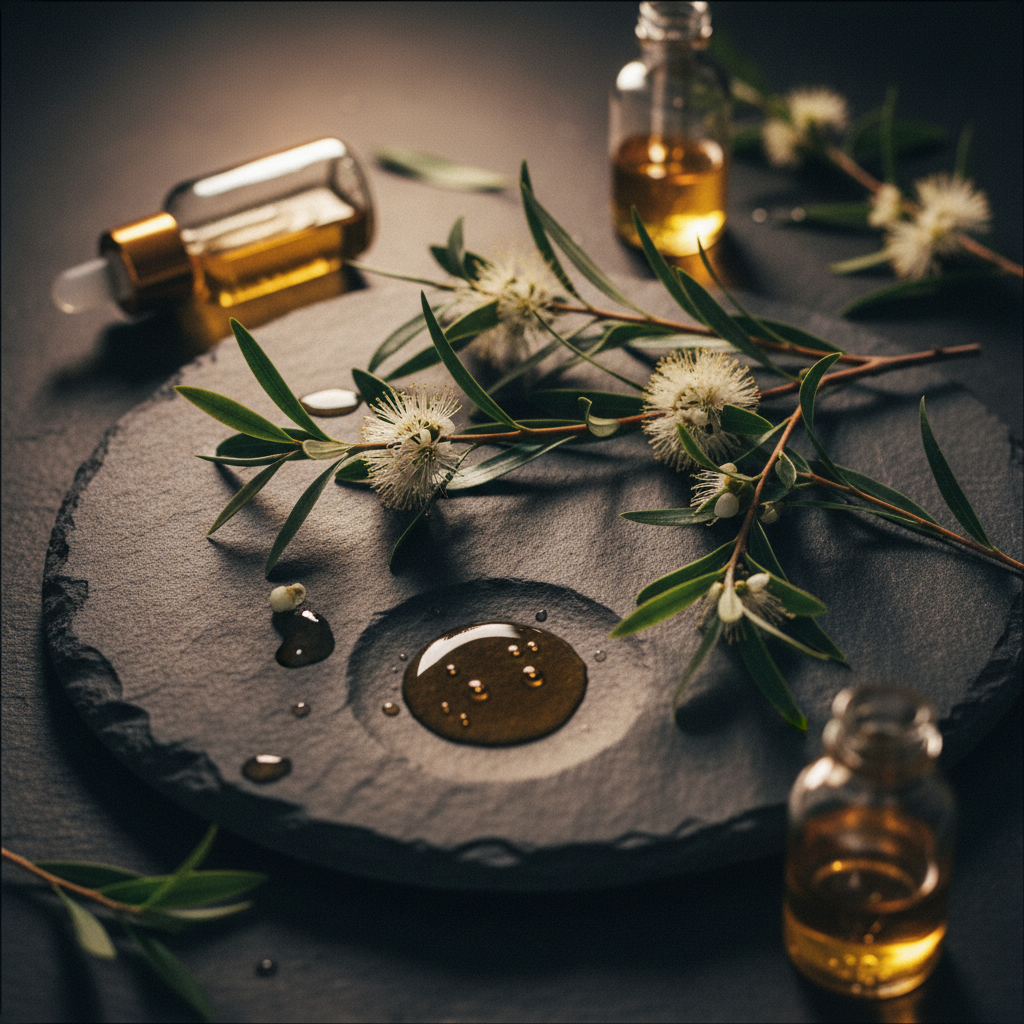
Quick answer: Tea tree oil, also known as melaleuca oil, is an essential oil extracted from the Australian native plant Melaleuca alternifolia. It has been explored for its potential antimicrobial, antifungal, and anti-inflammatory properties, which may offer cosmetic benefits for scalp conditions like dandruff, itchiness, and oiliness. However, evidence supporting its efficacy for hair growth or treating alopecia is limited and largely anecdotal, and it must be used correctly to avoid irritation.
Key takeaways
- Tea tree oil (TTO) comes from the Australian Melaleuca alternifolia plant and contains active compounds like terpinen-4-ol.
- It exhibits antimicrobial and anti-inflammatory properties that can help manage symptoms of dandruff and scalp irritation.
- Studies suggest TTO can be effective against fungi associated with dandruff, such as Malassezia species, and some bacteria.
- Always dilute tea tree oil before applying it to the scalp, typically to a concentration of 0.5% to 10% in haircare products.
- While it may improve scalp health, there's no strong evidence that tea tree oil directly promotes hair growth or prevents hair shedding.
- Patch testing is crucial before widespread use, as TTO can cause skin irritation or allergic reactions in some individuals.
Tea tree oil: what the evidence shows
Tea tree oil, an essential oil obtained from the leaves of Melaleuca alternifolia, has been investigated for its potential cosmetic benefits on the hair and scalp, primarily due to its chemical composition. The most significant active component is terpinen-4-ol, which is responsible for much of its reported antimicrobial and anti-inflammatory activity. Other compounds, such as 1,8-cineole, are also present, though higher concentrations of this particular compound can increase the risk of irritation.
Supporting scalp health
Research indicates that tea tree oil can help manage common scalp concerns. For instance, a randomised, controlled trial published in the Journal of the American Academy of Dermatology found that a 5% tea tree oil shampoo significantly improved symptoms of dandruff, including scaling, itchiness, and greasiness, compared to a placebo shampoo over four weeks. This effect is largely attributed to its antifungal activity against Malassezia yeasts, which are implicated in dandruff (also known as seborrheic dermatitis). See our full guide to Dandruff: Causes and Treatments Explained for more details.
Beyond dandruff, the anti-inflammatory properties of tea tree oil may help soothe an irritated scalp. Some studies suggest it can reduce redness and discomfort, contributing to a healthier-looking scalp environment. This can be particularly beneficial for individuals experiencing mild scalp sensitivity or itchiness not directly related to a microbial overgrowth.
Impact on oiliness
Tea tree oil may also have a role in managing scalp oiliness, though direct evidence specifically for hair is less robust than for its antimicrobial effects. It is thought to help cleanse the scalp and potentially reduce excess sebum, which can contribute to clogged follicles and an oily appearance. This clarifying action might lead to a fresher, less greasy feel for the scalp and hair.
What the evidence does not show
It is important to clarify that while tea tree oil can contribute to a healthy scalp environment, controlled research has not found strong evidence that it directly stimulates hair growth, treats hair loss (alopecia), or prevents hair shedding. Claims suggesting it can 'unclog' follicles to promote new hair growth are largely speculative and not supported by scientific studies. Its benefits are primarily cosmetic, focusing on scalp condition rather than follicular activity or hair fibre strength.
How tea tree oil works on your scalp
The mechanisms by which tea tree oil exerts its effects are primarily through its active compounds, particularly terpinen-4-ol. This compound is believed to disrupt the cell membranes of microorganisms. For example, it can penetrate the cell walls of bacteria and fungi, altering their permeability and leading to leakage of cellular contents, ultimately inhibiting their growth or causing cell death. This makes it effective against a range of microbes that can contribute to scalp issues.
On the scalp, this mechanism helps to reduce the proliferation of Malassezia yeasts, a key factor in dandruff. By controlling these microorganisms, tea tree oil can help alleviate symptoms such as flaking, itching, and inflammation. Its anti-inflammatory properties are thought to be related to its ability to modulate cytokine production, which are signalling molecules involved in inflammatory responses.
Signs your scalp might benefit
You might consider products containing tea tree oil if you experience:
- Dandruff: Persistent white flakes, especially accompanied by an itchy scalp.
- Scalp itchiness: General discomfort or an urge to scratch, even without visible flakes.
- Mild irritation: Redness or sensitivity on the scalp.
- Excessive oiliness: A scalp that feels greasy shortly after washing, leading to dull-looking hair. Our article on Sebum Regulation: Understanding and Managing Scalp Oiliness provides more context.
These signs suggest your scalp's microbiome might be imbalanced or it is experiencing mild inflammation, where the properties of tea tree oil could offer cosmetic relief.
What you can do
If you choose to use tea tree oil, always ensure it is properly diluted before applying it to your scalp. Direct application of undiluted essential oils can cause severe irritation or allergic reactions. Many commercially available haircare products, such as shampoos and conditioners, already contain tea tree oil in safe and effective concentrations, typically between 0.5% and 10%.
When trying a new product, or if diluting pure tea tree oil yourself, perform a patch test first. Apply a small amount to an inconspicuous area of skin (like behind the ear or on your inner arm) and wait 24 hours to check for any adverse reactions like redness, itching, or swelling. If irritation occurs, discontinue use.
When the cause may be something else
While tea tree oil can help with general scalp health, it is not a cure-all. If your scalp issues are severe, persistent, or worsening, or if you experience significant hair shedding or hair loss, the underlying cause may be something more complex. Conditions like severe seborrheic dermatitis, psoriasis, fungal infections (tinea capitis), or even certain autoimmune conditions require professional medical diagnosis and treatment. In these cases, cosmetic products alone are unlikely to be sufficient.
Important Considerations for Using Tea Tree Oil
| Aspect | Description |
|---|---|
| Concentration | For haircare, formulations typically range from 0.5% to 10% tea tree oil. For dandruff, 5% concentrations have shown efficacy. Higher concentrations (above 10%) increase the risk of irritation and are rarely necessary for cosmetic scalp benefits. |
| Application Method | Always use diluted tea tree oil, either in a pre-formulated product or by adding a few drops to a carrier oil (like jojoba or coconut oil) or your regular shampoo. Avoid applying undiluted oil directly to the skin. |
| Safety Precautions | Perform a patch test before use. Avoid contact with eyes and mucous membranes. Tea tree oil is toxic if ingested. Store away from children and pets. Do not use on broken or severely irritated skin. |
| Quality | Look for pure, high-quality tea tree oil, ideally with a terpinen-4-ol content above 30% and 1,8-cineole content below 15% to minimise irritation. Reputable brands will often specify these details. |
| Expected Outcomes | May help reduce dandruff, soothe itchiness, and manage scalp oiliness. Improvement in these areas can support an overall healthier-looking scalp. It does not treat hair loss or significantly boost hair growth. |
Frequently asked questions about Tea tree oil
Can tea tree oil treat hair loss or promote hair growth?
No, there is no strong scientific evidence to suggest that tea tree oil can treat hair loss (alopecia) or directly promote hair growth. Its benefits are focused on improving scalp health by reducing dandruff, itchiness, and excess oil, which can create a more favourable environment for existing hair. However, it does not act on hair follicles to stimulate new growth or prevent genetic hair thinning.
Is it safe to apply tea tree oil directly to the scalp?
It is generally not safe to apply undiluted tea tree oil directly to the scalp. Pure tea tree oil is highly concentrated and can cause skin irritation, redness, dryness, or allergic reactions. Always dilute it with a carrier oil (such as jojoba or almond oil) or use a haircare product that has already incorporated it at a safe concentration, typically 0.5% to 10%.
How long does it take to see results from using tea tree oil for dandruff?
Results can vary between individuals, but studies on tea tree oil shampoos for dandruff have reported significant improvements within four weeks of regular use. Consistency is key. If you don't see any improvement after several weeks, or if your condition worsens, it is advisable to consult a healthcare professional for an alternative diagnosis and treatment plan.
Can tea tree oil cause hair shedding?
Tea tree oil itself is not known to directly cause hair shedding. However, if you experience an allergic reaction or severe irritation from using it, the inflammation could potentially impact the hair cycle, leading to temporary shedding. This is why proper dilution and patch testing are crucial. If you experience unusual shedding, discontinue use and seek professional advice.
Does tea tree oil make your hair oily or dry?
When used correctly and diluted, tea tree oil generally does not make hair oily or dry. Its clarifying properties can help manage excess scalp oiliness. However, if used in too high a concentration, it could potentially dry out the scalp due to its potent nature. Finding the right concentration for your scalp type is important for maintaining balance.
Conclusion
Tea tree oil offers a natural option for cosmetically addressing certain scalp concerns, particularly those related to dandruff, itchiness, and oiliness. Its documented antimicrobial and anti-inflammatory properties, primarily due to terpinen-4-ol, provide a basis for its use in haircare formulations. While it can contribute to a healthier-looking and more comfortable scalp, it is crucial to manage expectations; tea tree oil is not a treatment for hair loss or a direct hair growth stimulant. Always use diluted forms and conduct a patch test to ensure safety and avoid potential irritation, allowing you to harness its benefits effectively.
Sources and references
- American Academy of Dermatology Association, "Dandruff: Diagnosis and treatment", available at aad.org
- Journal of the American Academy of Dermatology, "Treatment of dandruff with 5% tea tree oil shampoo", 2002. DOI: 10.1067/mjd.2002.124503
- Clinical Microbiology Reviews, "Melaleuca alternifolia (Tea Tree) Oil: a Review of Antimicrobial and Other Medicinal Properties", 2006. DOI: 10.1128/CMR.00064-05
- Skin Pharmacology and Physiology, "Anti-inflammatory activity of tea tree oil in human keratinocytes", 2011. DOI: 10.1159/000329943
- International Journal of Toxicology, "Final report on the safety assessment of Melaleuca Alternifolia (Tea Tree) Oil", 2005. DOI: 10.1080/10915810590918731