Sulphate-Free Shampoos for Colour-Treated Hair: The Complete Evidence-Based Guide
9 min read ·
Discover how sulphate-free shampoos for colour-treated hair preserve pigment, reduce cuticle friction, and protect chemically processed strands from premature fade.
Quick answer: Using sulphate-free shampoos for colour-treated hair helps preserve artificial pigment by cleansing with milder surfactants that do not excessively swell the hair cuticle or strip natural lipid layers. Traditional anionic sulphates like sodium lauryl sulphate (SLS) create high charge density that lifts cuticles and accelerates dye molecule leaching. While switching formulas slows colour fade and prevents moisture loss, it cannot stop water-induced oxidation entirely, meaning washing frequency, water temperature, and UV exposure remain critical factors.
Key takeaways
- Permanent and semi-permanent hair dyes rely on an intact cuticle layer to trap synthetic pigments inside the cortex.
- Sulphate-free cleansers use gentle surfactants (such as sodium cocoyl isethionate or coco-glucoside) with a lower critical micelle concentration, reducing cuticle lift during washing.
- The main cause of colour fading is not just the surfactant; water itself causes the hair shaft to swell (hygral fatigue), allowing smaller pigment molecules to escape.
- A balanced formulation buffered to an acidic pH between 4.5 and 5.5 helps keep the hair cuticle flat and reflective.
- Eliminating sulphates preserves hair moisture and prevents snapping along processed strands, but it will not repair internal chemical bond damage without dedicated conditioning treatments.
Sulphate-free shampoos for colour-treated hair: what the evidence shows
Research shows that sulphate-free shampoos for colour-treated hair significantly reduce the rate of surfactant-induced dye washout compared to traditional harsh detergents. When you colour your hair, chemical processing (such as oxidation via hydrogen peroxide and ammonia) removes the natural protective 18-methyleicosanoic acid (18-MEA) lipid layer from the cuticle. This leaves the hair fibre porous, hydrophilic, and vulnerable.
Standard shampoos typically rely on primary surfactants such as sodium lauryl sulphate (SLS) or sodium laureth sulphate (SLES). These molecules carry a strong negative ionic charge and aggressive degreasing capabilities. In laboratory wash tests measuring colourfastness, hair tresses washed with high-foaming SLS formulas consistently exhibit higher delta E values (a measurement of colour change perceptible to the human eye) compared to tresses washed with non-ionic or amphoteric surfactants.
Sulphate-free alternatives rely on gentler cleansing agents such as sodium lauroyl sarcosinate, disodium laureth sulfosuccinate, alkyl polyglucosides, and betaines. These ingredients form larger micelles in solution and have lower detergency, meaning they remove surface sebum and dirt without aggressively penetrating the damaged outer epicuticle. As a result, the artificial dye trapped inside the cortex is less prone to dissolving into the wash water.
What the evidence does not show
Controlled cosmetic chemistry studies make an important distinction: sulphates are not the sole villain behind fading colour. While marketing often implies that a sulphate-free formula will completely halt colour loss, research demonstrates that running tap water alone accounts for the majority of pigment leaching. Water penetrates the porous fibre, temporarily swells the cortex, and rinses out water-soluble dye intermediates regardless of the surfactant used.
Furthermore, evidence does not show that sulphate-free formulas automatically outperform well-formulated, low-concentration sulphate shampoos paired with high-performance conditioning polymers. A poorly formulated sulphate-free shampoo with an alkaline pH (above 6.5) will cause more cuticle swelling and colour leaching than a professionally buffered, slightly acidic sulphate shampoo containing protective silicones or polyquaterniums. The total product architecture, pH level, and conditioning agents matter just as much as the absence of sulphates.
The mechanism: why artificial colour fades
To understand why mild cleansing matters, look at the physical architecture of chemically altered hair:
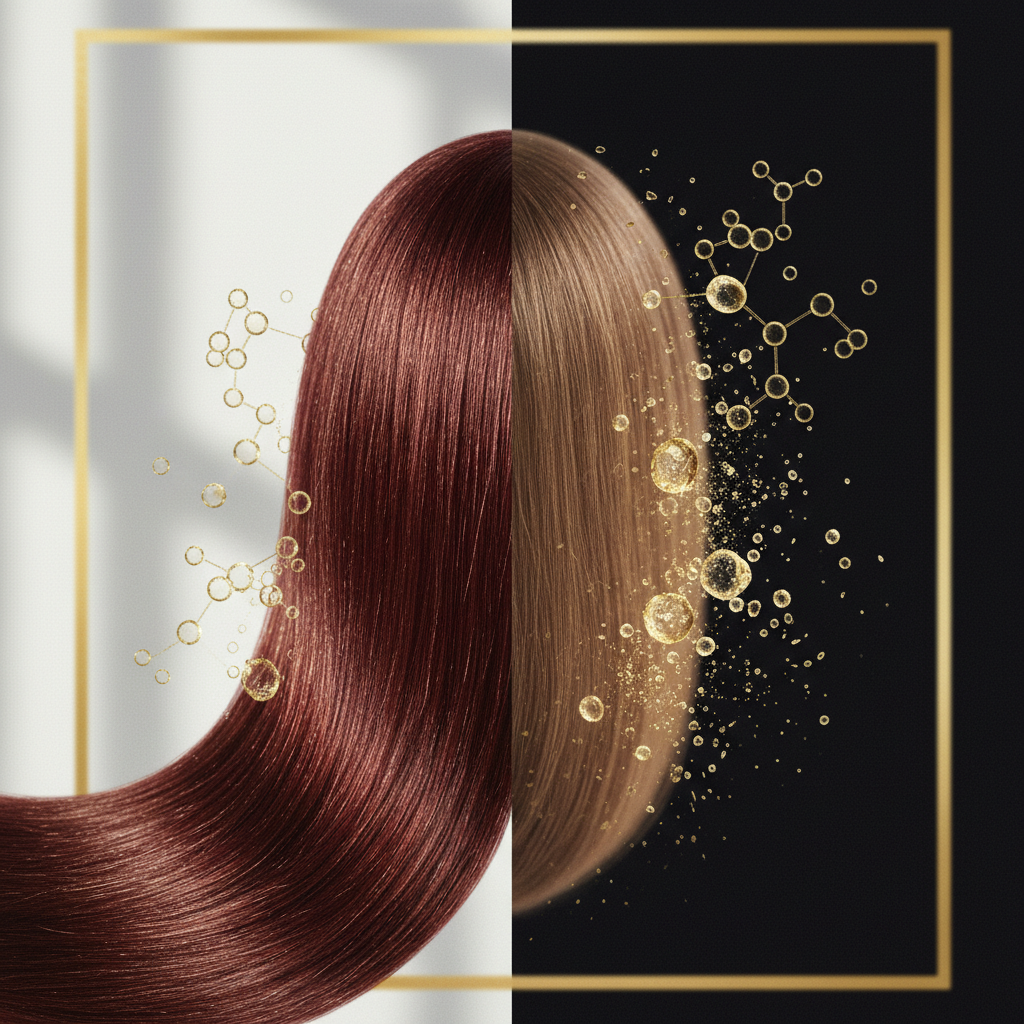
- Cuticle disruption and loss of 18-MEA: Healthy hair is naturally hydrophobic (water-repellent) due to a bound lipid monolayer. Alkaline colour treatments strip this layer, transforming the fibre into a hydrophilic sponge.
- Hygral swelling: When hydrophilic hair meets water, the internal cortex absorbs water molecules and swells radially by roughly 15 to 20 percent. This physical expansion pushes the overlapping cuticle scales outward like open shingles on a roof.
- Surfactant penetration and pigment displacement: Strong anionic surfactants penetrate between the raised cuticle scales into the endocuticle. Sulphates disrupt hydrogen bonds and solubilise any unanchored pigment molecules residing in the outer cortex, washing them down the drain.
- Environmental oxidation: Beyond the shower, UV radiation and ambient oxygen degrade the chromophores of the dye molecules, leading to brassiness and dullness.
| Feature | Sulphate-Based Formulas (e.g. SLS / SLES) | Sulphate-Free Formulas (e.g. Isethionates / Glucosides) |
|---|---|---|
| Primary Surfactant Charge | High anionic charge density | Non-ionic, amphoteric, or mild anionic |
| Cuticle Swelling Impact | Moderate to high lift | Minimal lift |
| 18-MEA & Lipid Stripping | High (can leave hair rough and dry) | Low (retains natural sebum balance) |
| Foam Characteristics | Instant, airy, high-volume lather | Denser, creamier, fine-bubble lather |
| Colour Retention (Delta E) | Faster pigment shift over 10 to 20 washes | Slower pigment shift over 10 to 20 washes |
| Optimal Formulation pH | Often 5.5 to 7.0 | Ideally 4.5 to 5.5 |
Signs your current shampoo is stripping your colour
If your wash routine is breaking down your colour investment too quickly, your hair will display clear physical symptoms:
- Rapid wash-out: Your shower water runs tinted with colour for weeks after the initial application, well past the first post-salon wash.
- Premature brassiness: Cool tones (ash blonds, cool brunettes) turn warm, yellow, or copper within three to four washes as smaller blue and violet dye molecules leach out first.
- Tactile roughness: Hair feels squeaky, stiff, or tangles instantly under running water, signalling that the cuticle scales are raised and catching on one another.
- Snapping along the shaft: Increased hair breakage during wet detangling, caused by lost moisture and structural friction rather than root shedding.
- Accelerated dullness: The hair surface loses light reflectivity within two weeks of colouring, appearing chalky or flat.
What you can do to protect coloured hair
Adopting sulphate-free shampoos for colour-treated hair forms the foundation of colour longevity, but supporting wash habits maximise the results.
- Check the surfactant labels: Look for cleansers formulated with sodium cocoyl isethionate, cocamidopropyl betaine, sodium methyl cocoyl taurate, or decyl glucoside.
- Wash with lukewarm or cool water: Hot water increases cuticle swelling, accelerating the rate at which water sweeps dye out of the cortex. Cool water keeps cuticles tighter.
- Lower your wash frequency: Because water exposure itself triggers colour loss, extending the interval between washes to two or three times per week will preserve dye vibrancy longer than any cosmetic formulation alone.
- Seal with an acidic conditioner: Always follow cleansing with a conditioner formulated between pH 3.5 and 4.5. Acidic environments neutralise residual negative charges, compress the cuticle scales, and lock in moisture.
- Shield against heat and sunlight: Apply a leave-in treatment containing UV filters and heat protectants before blow-drying or styling with hot irons. High heat degrades synthetic pigments instantly.
When fading or damage stems from another cause
If your hair colour is dulling or breaking despite using gentle cleansers, the shampoo may not be the primary culprit:
- Hard water mineral buildup: High concentrations of calcium, magnesium, and copper in domestic water supplies react with hair protein and artificial dyes. Copper in particular catalyses free-radical reactions that oxidise pigments into muddy, greenish, or orange tones.
- High porosity from over-bleaching: When hair has undergone repeated high-lift bleaching, the inner protein structure is extensively damaged with broken disulphide bonds. The fibre simply lacks the internal architecture required to hold dye, causing colour to rinse out rapidly regardless of the shampoo.
- Physical breakage mistaken for hair loss: If you notice hair gathering in the drain or on your brush, check the ends. Hair leaving the scalp via shedding features a white follicular bulb. Short pieces without bulbs represent breakage along weakened, chemically compromised shafts.
When to consult a professional
You should consult an experienced colourist or a qualified trichologist if you encounter severe hair changes. If your scalp becomes persistently itchy, red, flaky, or inflamed after switching products, you may be experiencing contact dermatitis from a preservative or fragrance rather than the surfactant itself.
Additionally, if your hair feels gummy, stretches excessively when wet, or snaps under light tension, the chemical integrity of the cortex has been compromised. A professional salon treatment, such as a targeted protein or bond-repair regime, is necessary to stabilise the fibre before any further colour processing occurs.
The Watermans perspective on colour-treated hair
Watermans designs hair wellness formulas around the principle that scalp vitality and fibre strength go hand in hand. Colour-treated hair requires an environment that safeguards delicate cosmetic pigments while keeping the scalp microbiome balanced. Using gentle, sulphate-free surfactants paired with nutrient-dense ingredients like biotin, rosemary, caffeine, and hydrolysed lupin protein helps protect the hair shaft from premature mechanical breakage and preserves natural moisture balance without relying on aggressive foaming detergents.
Conclusion
Switching to sulphate-free shampoos for colour-treated hair is one of the most effective, accessible choices for extending the life and radiance of your colour investment. By avoiding aggressive detergents that strip essential surface lipids and force cuticles open, you protect both the artificial pigment inside the cortex and the physical integrity of the hair strand. Combine gentle cleansing with cool water, acidic conditioning, and moderated wash frequencies to maintain rich, salon-fresh colour for weeks longer.
Frequently asked questions about sulphate-free shampoos for colour-treated hair
Are sulphate-free shampoos for colour-treated hair genuinely necessary?
Yes, they are highly beneficial. Chemically coloured hair lacks its natural water-repellent lipid barrier, leaving cuticles vulnerable to lifting. Sulphate-free shampoos cleanse using milder surfactants that lift less cuticle surface, reducing colour leaching and fibre roughness compared to traditional sodium lauryl sulphate cleansers.
Will a sulphate-free shampoo clean an oily scalp effectively?
Yes. Modern sulphate-free surfactants like sodium lauroyl sarcosinate and amphoteric betaines effectively bind to sebum and rinse it away. If your scalp is naturally oily or you use heavy styling products, you may simply need to massage the product across your scalp for an extra 60 seconds or perform a double cleanse.
Why does hair colour still fade when using a sulphate-free shampoo?
Surfactants are only part of the equation. Water itself swells the hair shaft and rinses out pigment molecules. Additionally, ultraviolet light exposure, hot styling tools, and hard water minerals continuously degrade artificial colour molecules over time, independently of your shampoo.
Do sulphate-free shampoos lather as well as standard formulas?
They produce a different type of lather. While sulphates create big, loose, airy bubbles almost instantly, sulphate-free surfactants produce a denser, creamier, fine-bubble foam. To get a richer lather, ensure your hair is completely saturated with water before applying the product.
Sources and references
- Robbins, C. R. (2012). Chemical and Physical Behavior of Human Hair (5th ed.). Springer-Verlag.
- Draelos, Z. D. (2010). Essentials of Hair Care often Neglected: Hair Cleansing. International Journal of Trichology, 2(1), 24-29.
- Trueb, R. M. (2007). Shampoos: Ingredients, formulation and efficacy. Journal of the German Society of Dermatology, 5(5), 356-365.
- Evans, T., & Wickett, R. R. (2012). Practical Modern Hair Science. Allured Business Media.
- Cosmetic Ingredient Review (CIR) Expert Panel. (2010). Final Report on the Safety Assessment of Sodium Lauryl Sulfate and Ammonium Lauryl Sulfate. International Journal of Toxicology.
Find these ingredients in Watermans products
- Copper: you will find this ingredient in our Hair Vitamins.