Preventing Hair Breakage After Bleaching: Science and Care
10 min read ·
Discover science-backed strategies for Preventing Hair Breakage After Bleaching. Learn how to protect the hair cortex, restore moisture, and avoid snap.
Quick answer: Preventing Hair Breakage After Bleaching requires immediately restoring lipid barriers, managing chemical porosity, and avoiding mechanical stress while the fibre is fragile. Bleach oxidises melanin by disrupting protective cuticular lipids (18-MEA) and breaking structural disulphide bonds within the cortex. To prevent snapped strands, minimise high-heat styling, handle wet hair with extreme care, apply leave-in conditioning agents with low pH, and space out chemical sessions. However, cosmetic treatments cannot stitch fully severed keratin back together; severely degraded fibres ultimately require trimming.
Key takeaways
- Bleaching permanently alters the hair shaft by dissolving the natural hydrophobic 18-methyleicosanoic acid (18-MEA) layer and oxidising structural disulphide bonds into cysteic acid.
- Hair fibre is weakest when wet. Bleached hair can absorb up to 30 to 45 percent of its dry weight in water, which increases friction and leads to severe stretching and breakage.
- Heat tools should be dialled down below 150 degrees Celsius or avoided entirely during the initial four to six weeks following an intensive lightening service.
- The fundamental rule of physical care is low friction: use wide-tooth combs, detangle only when saturated with slip-enhancing conditioner, and sleep on smooth surfaces.
- Cosmetic products reinforce tensile resilience and smooth the cuticular plates, but split ends and fractured cortices cannot be permanently glued back together.
Preventing Hair Breakage After Bleaching: what the evidence shows
Preventing Hair Breakage After Bleaching requires an understanding of how lighteners strip away the hair's natural defences. During chemical lightening, alkaline agents like ammonium hydroxide raise the cuticle scales, allowing hydrogen peroxide and persulphate salts to penetrate the cortex. While the goal is to dissolve colour pigment, the oxidation process non-selectively attacks the protein matrix.
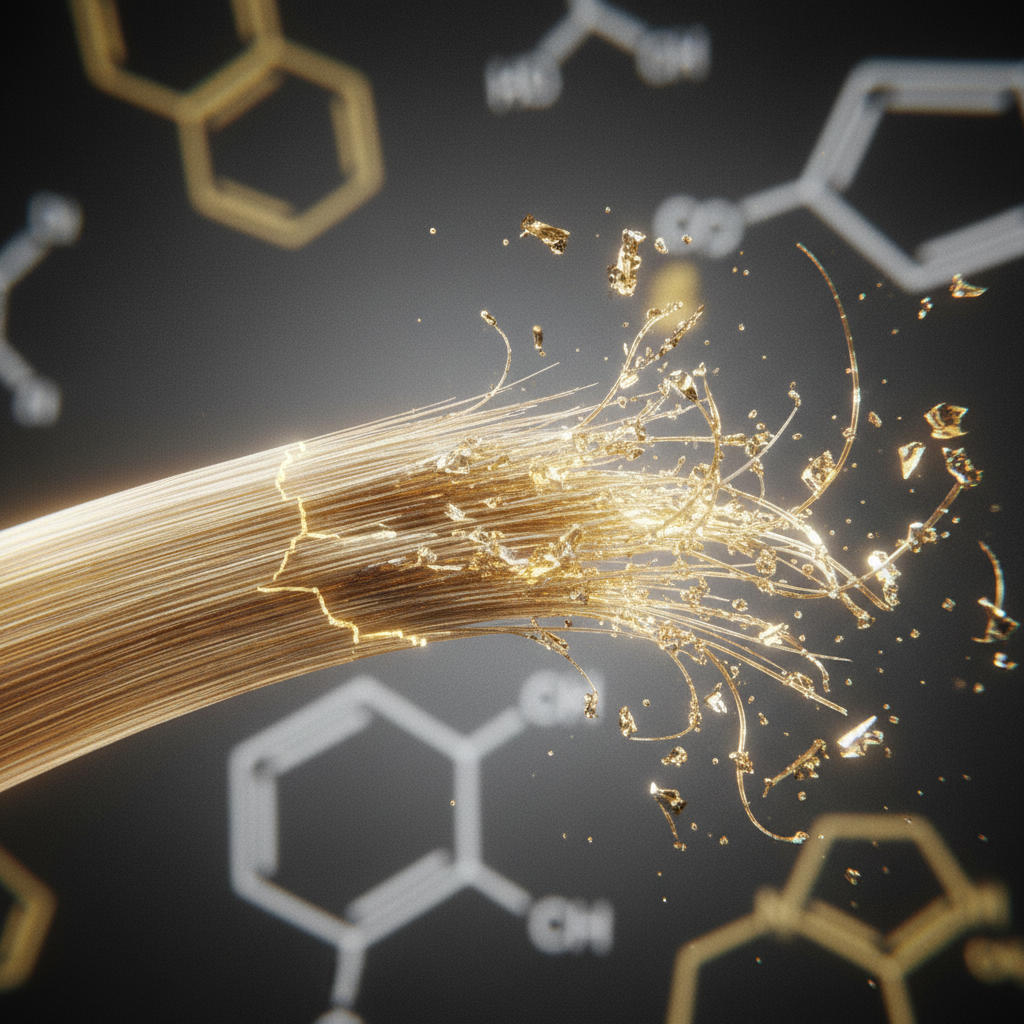
Peer-reviewed studies in cosmetic science confirm that bleaching cleaves the cystine disulphide cross-links that give keratin its natural tensile strength. For every level of lift, a measurable percentage of these bonds oxidize into cysteic acid. Research published in the International Journal of Cosmetic Science shows that severe lightening can decrease the tensile strength of the hair shaft by 20 to 50 percent. Furthermore, the external fatty acid layer known as 18-MEA is practically stripped on contact. Once this protective lipid coating is gone, the hair turns hydrophilic (water-absorbing), dull, and prone to tangling.
Preventing Hair Breakage After Bleaching relies heavily on replacing this missing surface slip and reinforcing the fibre. Conditioning agents such as cationic surfactants (behentrimonium chloride, cetrimonium chloride), hydrolysed proteins, and plant-derived oils form a thin protective film over the exposed cortex. This film lowers inter-fibre friction, which is the primary cause of daily brushing fractures.
What the evidence does not show
There is no credible scientific evidence that topical shampoos, oils, or deep treatments can permanently "repair" hair back to its virgin state. Hair fibre is non-living tissue. Once the internal polypeptide chain is broken, cosmetic chemistry can temporarily patch or reinforce the structure, but it cannot biological regenerate.
Marketing claims that promise complete reversal of chemical damage mischaracterise how bonding treatments work. Bond-building technologies often form ionic or covalent bridges across compromised sections of the cortex, which measurably improves elasticity and wet combability. However, these bonds are not identical to native cystine links and will degrade over time through subsequent washing, environmental exposure, and styling. No treatment can undo extreme chemical over-processing that has liquefied the inner cortical structure.
The biological and chemical mechanism of bleach damage
To successfully protect lightened hair, one must look at the structural degradation across three separate hair layers:
[ Virgin Hair Fibre ]
├── Outer F-Layer: 18-MEA fatty acids (hydrophobic, repels water)
├── Cuticle Scales: tightly shingled, protective barrier
└── Cortex: dense keratin chains linked by strong disulphide bonds

[ Bleached Hair Fibre ]
├── Outer F-Layer: stripped away (hydrophilic, attracts water)
├── Cuticle Scales: lifted, chipped, and permanently raised
└── Cortex: broken disulphide bonds converted to cysteic acid; porous matrix
- The Cuticle and F-Layer: The epicuticle holds a microscopic lipid film called the F-layer (chiefly 18-MEA). Bleach oxidises this lipid layer completely in a single session. Without it, the cuticle scales remain propped open, increasing surface roughness and tangling.
- The Cortex: Inside the hair shaft, keratin filaments are held together by hydrogen, salt, and disulphide bonds. Bleach breaks disulphide bonds to create cysteic acid residues. Cysteic acid carries a negative electrical charge, making the strand attract water rapidly, swell unevenly, and snap under minimal tension.
- Moisture Equilibrium: Porous hair absorbs water quickly but loses it just as rapidly. This continuous swelling and deswelling (hygral fatigue) weakens the cell membrane complex between cortical cells, leading to longitudinal split ends and transverse snapping.
Signs of imminent hair breakage
Hair does not break without warning. Recognizing the signs of tensile failure allows you to intervene before widespread damage occurs:
- Elasticity changes (gumminess): When wet, compromised strands stretch like an elastic band without springing back, feeling soft or mushy before snapping.
- Small white nodules (trichorrhexis nodosa): Tiny white flecks along the hair shaft indicate spots where the cortex has shattered internally and the cuticle has split open.
- Micro-snapping sounds: Hearing snapping sounds while running a brush or fingers through wet or dry hair indicates acute structural failure.
- Short broken fibres: Noticing short lengths of hair on your clothes, pillow, or bathroom sink that lack a white bulb at the root (which separates breakage from natural shedding).
- Severe matting at the nape: Hair that tangles instantly after brushing due to missing cuticular scales locking together like Velcro.
Comparing hair fibre states: Virgin vs Bleached
| Characteristic | Virgin Hair Fibre | Lightened / Bleached Hair Fibre |
|---|---|---|
| Surface property | Hydrophobic (repels excess water) | Hydrophilic (readily absorbs water) |
| Water absorption | Up to 15 to 30% of dry weight | Up to 35 to 45% of dry weight |
| Cuticle state | Smooth, shingled, low friction | Lifted, jagged, high friction |
| Cysteic acid content | Low (approx. 0.5 to 1.5%) | Elevated (often 3 to 7%+) |
| Wet tensile elasticity | Stretches approx. 30% and recovers | Over-stretches, loses recoil, snaps |
| Primary styling hazard | High heat without thermal spray | Wet combing, coarse towels, any heat |
What you can do: an evidence-based care routine
Protecting fragile, lightened strands demands a combination of biochemical replenishment and mechanical reduction.
1. Control wet mechanical stress
Wet bleached hair has significantly lower yield stress than dry hair. Never drag a stiff, fine-tooth comb through wet, lightened locks.
- Apply a conditioning cream with high slip before detangling.
- Work upward in small sections from ends to roots using a wide-toothed comb or flexible wet-detangling brush.
- Replace heavy terry-cloth bath towels with a smooth microfibre wrap or soft cotton shirt. Squeeze gently; never scrub.
2. Acidify your rinse routine
The natural pH of hair and scalp sits between 4.5 and 5.5, while lighteners operate at an alkaline pH of 9.0 to 11.0. To encourage the cuticular plates to lie flat and reduce negative surface charge:
- Use shampoos and conditioners formulated at pH 4.0 to 5.5.
- An acidic environment temporarily contracts the hair shaft, limits unnecessary swelling from tap water, and preserves existing tensile integrity.
3. Lower heat exposure
Keratin begins to denature at roughly 160 degrees Celsius, but chemically oxidised hair shows degradation at even lower thresholds.
- Keep styling irons under 140 to 150 degrees Celsius.
- Always apply a silicone- or polymer-based thermal protectant; these spread heat evenly along the shaft and prevent hot spots that crack the cuticle.
- Air-dry hair partially (around 70 to 80 percent) before using a blow dryer on low to medium heat with a directional nozzle.
4. Rebalance protein and emollients
Bleached hair requires both tensile reinforcement and lubrication:
- Hydrolysed proteins (keratin, wheat, silk, pea): Small enough to enter the porous cortex temporarily, providing structural scaffolding.
- Emollients and lipids (argan oil, squalane, fatty alcohols): Coat the exterior, mimicking the missing 18-MEA layer and locking in vital hydration.
When the cause may be something else
If hair is coming away in large amounts, make sure you are not confusing breakage with follicular hair shedding.
Examine the fallen strands under bright light. If the strand has a tiny, fleshy white bulb at one end, it has shed from the follicle. This is shedding, not breakage. Conditions like telogen effluvium (triggered by stress, illness, nutritional deficits, or hormone shifts) cause whole hairs to fall from the scalp. Alternatively, traction alopecia can pull hairs out at the root due to excessively tight ponytails or extensions.
Breakage, by contrast, presents as irregular, blunt-ended fragments without a root bulb. If you see shedding alongside breakage, an underlying physiological issue may be compounding the fragile state of your lightened hair.
Professional support and salon interventions
When hair exhibits severe damage, home care has limitations. Consult a qualified colourist or trichologist if:
- Hair dissolves or turns jelly-like when wet (indicating extreme cortex destruction).
- Breakage is widespread near the scalp, which often happens when bleach overlaps with previously lightened sections.
- You are planning a touch-up: overlapping bleach onto pre-lightened hair creates a clear line of demarcation where structural failure is almost guaranteed. A professional can apply protective barrier creams to pre-lightened zones.
- You need a corrective trim. The only permanent cure for split ends is sharp shears; unaddressed splits will migrate up the fibre shaft, multiplying breakage.
Supporting bleached hair with Watermans
Alongside a gentle physical care regimen, selecting topical solutions designed to respect fragile hair is essential. The Watermans haircare collection focuses on scalp vitality and strand nourishment without weighing down chemically lightened lengths. Utilizing formulas that maintain an optimal pH and incorporate hair-supporting ingredients like biotin, rosemary, and hydrolysed lupin protein, Watermans products help create an ideal foundation for managing processed, delicate hair textures. By fortifying the surface and nourishing the scalp environment, you reduce unnecessary mechanical friction during washing and detangling.
Frequently asked questions about Preventing Hair Breakage After Bleaching
How soon after bleaching can I wash my hair?
Wait roughly 48 to 72 hours before washing your hair after a bleaching service. Lightening raises the cuticles and strips away natural sebum. Waiting allows the scalp's natural lipids to lightly recoat the base of the hair shaft and gives the fibre time to stabilise its moisture equilibrium before encountering water friction.
Can coconut oil stop bleached hair from breaking?
Coconut oil can help reduce protein loss because its low molecular weight and linear lauric acid chains allow it to penetrate the cortex. Applying it as a pre-shampoo treatment can limit water absorption and hygral fatigue. However, coconut oil does not reform broken disulphide bonds or fully prevent hair breakage on its own.
What is the most effective approach to Preventing Hair Breakage After Bleaching?
The most effective approach to Preventing Hair Breakage After Bleaching combines reducing mechanical friction (using wide-tooth combs and silk pillowcases), eliminating high heat tools, applying acidic leave-in conditioners to smooth raised cuticles, and getting regular micro-trims to remove split ends before they travel up the shaft.
Does purple shampoo cause more breakage on bleached hair?
Purple shampoos do not chemically cause breakage, but they can be drying. Many toning formulas contain higher surfactant concentrations and lack deep conditioning agents to prevent pigment interference. If used too frequently on lightened hair, they can leave strands feeling brittle, making them vulnerable to mechanical snap during brushing.
Why does bleached hair snap more when it is wet?
Bleached hair snaps easily when wet because the broken disulphide bonds and loss of the protective 18-MEA lipid layer allow water to flood the cortex. This weakens the internal hydrogen bonds, causing the strand to lose its natural elasticity and structural resistance.
Summary
Successfully Preventing Hair Breakage After Bleaching requires patience, delicate handling, and chemistry-aligned care. While cosmetic procedures can never truly reconstruct the original virgin fibre once cuticular lipids and disulphide bonds are lost, consistent low-heat styling, acidic pH replenishment, and careful detangling keep lightened hair looking vibrant, supple, and resilient over time.
Sources and references
- Robbins, C. R. (2012). Chemical and Physical Behavior of Human Hair. 5th ed. Springer-Verlag New York.
- Cruz, C. F., et al. (2016). "Human Hair Keratin: A Review on Structure, Properties, and Applications." International Journal of Cosmetic Science, 38(3), 213-223.
- Evans, T., & Wickett, R. R. (2012). Practical Modern Hair Science. Allured Business Media.
- Tate, M. L., et al. (1993). "Quantification and Prevention of Hair Damage." Journal of the Society of Cosmetic Chemists, 44(6), 347-371.
- National Health Service (NHS). "Hair loss." Health A to Z reference guide.
Find these ingredients in Watermans products
- Biotin: you will find this ingredient in our Hair Growth Shampoo.