The Science of Heat Damage on Hair: Protein Breakdown and Protection
9 min read ·
Explore the science of heat damage on hair: understand keratin denaturation, lipid loss, and bubble hair, with evidence-based tips to protect your fibres.
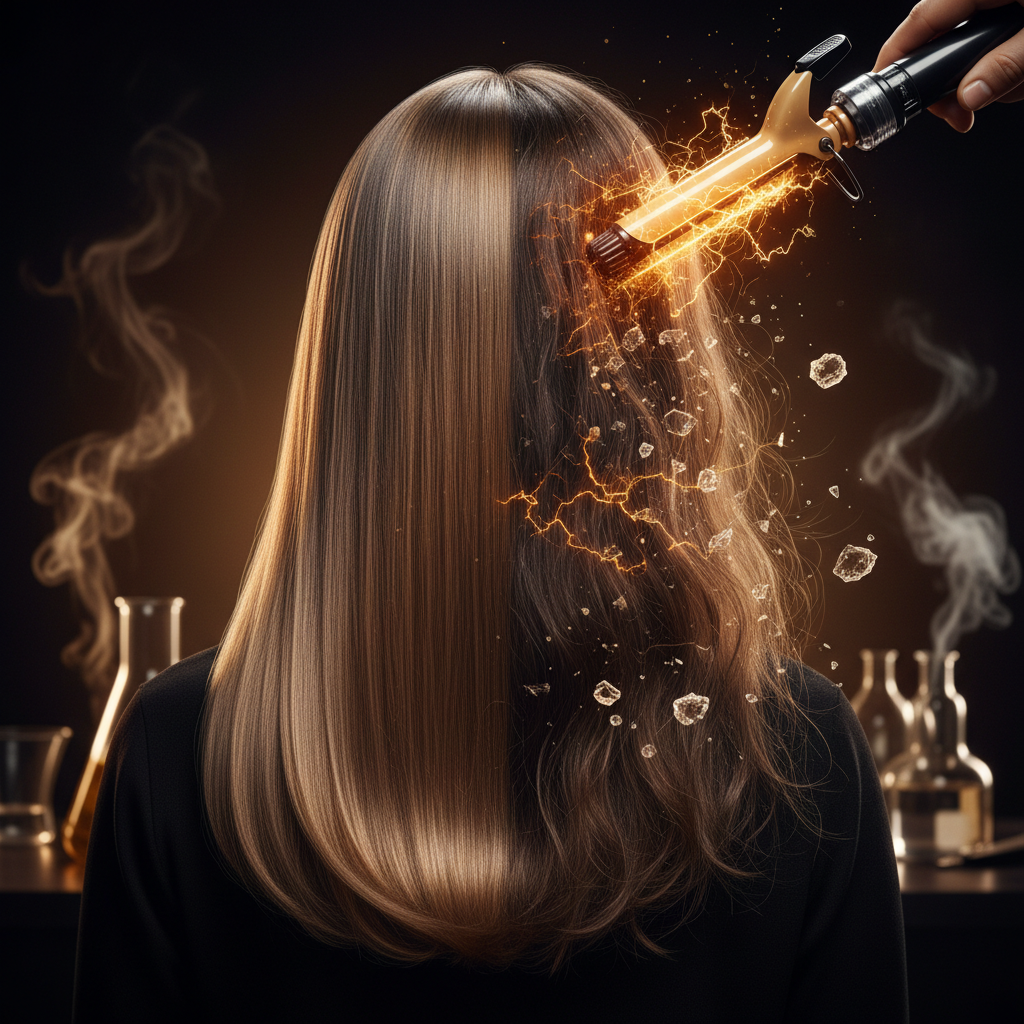
Quick answer: The Science of Heat Damage on Hair reveals that temperatures above 140°C physically alter the fibre's biological architecture. Thermal tools degrade structural alpha-keratin proteins, melt natural protective lipids, and flash-boil internal moisture to produce irreversible structural cavities known as bubble hair. Heat causes mechanical fibre fracture and hair breakage, not direct follicular shedding or alopecia. While modern cosmetic formulations can coat the cuticle and reduce thermal transfer, they cannot regenerate denatured keratin or knit fractured cuticles back together once structural degradation takes place.
Key takeaways
- Thermal degradation begins around 140°C, where soft alpha-keratin converts into unstable beta-sheet structures, leading to fibre weakening.
- Temperatures exceeding 200°C degrade the 18-methyleicosanoic acid (18-MEA) lipid layer, permanently destroying the hair fibre's hydrophobic water-repelling shield.
- Applying flat irons to damp hair causes moisture trapped in the cortex to vaporise instantly, forming microscopic internal gas bubbles that crack the shaft.
- Heat damage leads to fibre breakage along the shaft. It does not cause follicular shedding (telogen effluvium) or pattern hair loss.
- Heat protectants act as heat buffers, dispersing thermal transfer by roughly 30 to 50 percent, but cannot fully prevent damage at extreme temperatures.
The Science of Heat Damage on Hair: what the evidence shows
Research published in the Journal of Cosmetic Science and the International Journal of Cosmetic Science demonstrates that human hair undergoes clear, measurable physical phases when exposed to heat. Human hair consists of roughly 85 to 90 percent keratin protein, 10 to 12 percent water, and a thin protective outer lipid matrix. When you apply thermal styling tools (blow dryers, curlers, or flat irons), this delicate balance is disrupted.
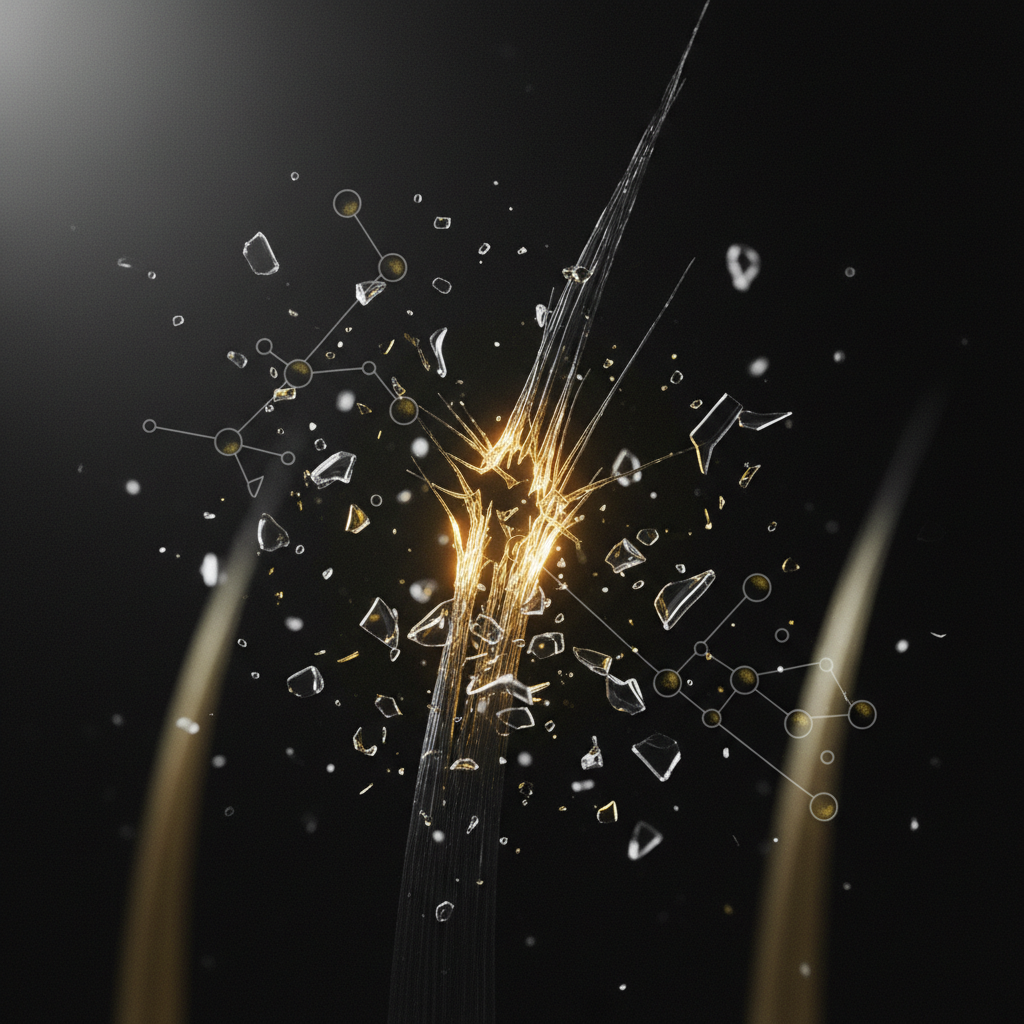
Thermal degradation of hair occurs along a progressive scale:
- At 140°C to 160°C: The alpha-helix protein chains in the cortex begin to unfold and denature. The hair fibre loses its natural elasticity and mechanical tensile strength.
- At 180°C to 200°C: The cuticular cell membrane complex degrades. The naturally protective lipid layer, dominated by 18-methyleicosanoic acid (18-MEA), melts and erodes. Without this layer, the hair fibre turns porous, hydrophilic, and rough.
- At 215°C to 235°C: Keratin undergoes severe pyrolysis (thermal breakdown). Melanin pigment granules oxidise, causing visible colour fading, while disulphide bonds crack, producing brittle split ends and catastrophic breakage.
Hair Heat Thresholds
-------------------------------------------------------------
140°C - 160°C: Keratin denatures (structural elasticity drops)
180°C - 200°C: 18-MEA lipid layer strips (high porosity)
215°C - 235°C: Disulphide bonds snap (severe fibre breakage)
Thermal mechanisms: how heat alters the hair fibre
Understanding the physical breakdown helps explain why damaged hair feels dry and straw-like. When heat touches the shaft, three distinct biological mechanisms take place.
Keratin protein denaturation
Keratin's structural strength comes from polypeptide chains held in an alpha-helix shape by hydrogen bonds and covalent disulphide bonds. When heat exceeds 140°C, hydrogen bonds rupture and the alpha-keratin transforms into beta-keratin. This structural change cannot be undone. The fibre loses its spring-back elasticity, leaving hair unable to hold a curl naturally or withstand ordinary brushing tension without snapping.
Surface lipid destruction and porosity
The hair cuticle is shielded by a monolayer of fatty acids, primarily 18-MEA, linked covalently to cuticular proteins. This layer keeps hair hydrophobic, repelling external moisture and retaining balanced internal hydration. Heat styling quickly strips 18-MEA. Once this lipid barrier is lost, the cuticle scales lift, curl, and chip away. Porosity increases dramatically, meaning hair absorbs humidity from the air, swells, frizzes, and tangles easily.
The "bubble hair" phenomenon
If you apply a flat iron (often running between 180°C and 230°C) to damp or improperly dried hair, water trapped inside the cortex boils rapidly. Water expands over 1,600 times in volume when turning to steam. This violent flash-boiling creates steam blisters inside the cortex. In trichology, this is classified as bubble hair deformity. Under a light or electron microscope, these appear as hollow, gas-filled cavities that create severe weak points along the fibre, snapping under the slightest mechanical tension.
| Temperature Range | Biological Effect on Fibre | Visual and Physical Symptoms | Reversibility |
|---|---|---|---|
| Below 140°C | Temporary hydrogen bond rearrangement | Soft styling hold, minimal structural change | Reversible with water/washing |
| 140°C to 180°C | Denaturation of alpha-keratin to beta-keratin | Loss of natural curl pattern, minor stiffness | Permanent structural change |
| 180°C to 210°C | Loss of 18-MEA lipid layer, cuticular lifting | Rough texture, static, dullness, high porosity | Permanent (cosmetic coating only) |
| Above 215°C | Pyrolysis, disulphide bond rupture, bubble hair | Split ends, severe snapping, discolouration | Irreversible; requires trimming |
What the evidence does not show
It is vital to separate cosmetic fibre damage from medical scalp disorders. Heat styling tools, when used along the hair lengths, do not cause biological hair loss conditions such as androgenetic alopecia (pattern baldness) or alopecia areata.
When hair breaks near the mid-shaft or tips from thermal stress, the root remains intact inside the follicle. You are experiencing mechanical hair breakage, not follicular shedding. Heat cannot alter your hair growth cycle unless hot tools are placed directly onto the scalp tissue, which causes thermal burns and scarring (cicatricial alopecia). Similarly, heat damage does not alter the genetic blueprint of future hair emerging from your follicles.
Observable signs of thermal damage
If you regularly use styling appliances, look for these evidence-backed physical markers of thermal degradation:
- Split ends and trichoptilosis: Longitudinal splitting of the fibre caused by fractured cortical cells.
- White bulb-like flecks (trichorrhexis nodosa): Microscopic nodes where the cuticle has completely worn away, exposing cortical fibres that broom outwards.
- Loss of natural curl pattern: Wavy or curly hair that remains straight or unevenly limp even when soaked with water.
- Chronic tangling: Damaged, lifted cuticle edges latch onto neighbouring fibres like microscopic Velcro.
- Rapid moisture loss: Hair dries unusually fast after washing because it lacks the protective surface lipids needed to regulate water movement.
Evidence-based thermal protection: what actually works
You cannot reverse thermal damage once the protein bonds have broken, but you can minimise structural stress before applying heat.
- Keep temperatures below 180°C: Research shows that keeping styling irons below 175°C to 180°C dramatically cuts down protein degradation and preserves cuticular integrity.
- Apply silicones and heat-shielding polymers: Ingredients like dimethicone, amodimethicone, and hydrolysed wheat protein form a physical film over the cuticle. These ingredients slow heat transfer, smooth down cuticular edges, and reduce friction from styling plates.
- Dry hair completely before heat styling: Ensure hair is 100 percent dry before introducing high-heat curling wands or flat irons. This prevents the explosive vaporization that triggers bubble hair deformity.
- Distance the hair dryer: Keep blow dryers at least 15 cm away from the hair surface and keep the nozzle in constant motion. A 2011 study in the Annals of Dermatology found that using a hair dryer at a 15 cm distance with continuous motion caused less surface cuticle damage than air-drying naturally, because it reduces the time the hair remains swollen with water.
Supporting hair health and fibre resilience
Once structural keratin is damaged, management relies on regular micro-trims to remove split ends and targeted cosmetic conditioning to smooth the fibre.
For supporting overall fibre strength and a healthy scalp environment, Watermans offers targeted cosmetic support. Formulations like Watermans Grow Me Shampoo and Condition Me Conditioner blend gentle cleansers, hydrolysed lupin protein, niacinamide, caffeine, and argan oil. While cosmetic shampoos cannot rebuild snapped disulphide bonds inside thermally degraded hair, these formulas improve surface slip, reduce combing resistance, and support a well-nourished scalp environment where new hair can grow without added mechanical friction.
When the cause may be something else
If your hair is falling out from the root (characterised by a small white bulb at the tip of shed strands), the issue is shedding or hair loss, not thermal breakage. Excessive root-level shedding may indicate telogen effluvium (triggered by stress, illness, or nutritional deficits), iron-deficiency anaemia, thyroid dysfunction, or androgenetic alopecia.
Similarly, chemical treatments like bleaching, permanent dyeing, and chemical straightening break disulphide bonds deliberately. If you combine high heat with chemical processing, the rate of structural failure multiplies.
When to seek professional advice
Consult an accredited trichologist or dermatologist if:
- You notice patchy, coin-shaped bald spots on your scalp.
- Your scalp feels tender, inflamed, itchy, or exhibits burning sensations.
- Shedding exceeds 100 to 150 hairs daily for more than six to eight weeks.
- Hair is snapping directly at the scalp level rather than along the lengths.
Frequently asked questions about The Science of Heat Damage on Hair
Can heat damage to hair be permanently reversed?
No. Hair is non-living biological tissue. Once the internal alpha-keratin proteins denature and disulphide bonds break, the hair shaft cannot biologically heal itself. Conditioners, bonding treatments, and oils can temporarily coat the surface, seal lifted cuticles, and improve cosmetic elasticity, but the only permanent way to eliminate severe structural thermal damage is to trim away the compromised sections.
How does The Science of Heat Damage on Hair explain split ends?
The Science of Heat Damage on Hair demonstrates that high temperatures burn away the protective 18-MEA outer lipid layer. Without this moisture seal, the cortex loses internal hydration and structural proteins weaken. When exposed to subsequent brushing and styling friction, the unprotected cortical fibres split apart longitudinally, forming split ends (trichoptilosis).
Does heat damage cause hair loss at the root?
No. Heat styling appliances break the hair fibre along the shaft, which is classified as breakage rather than hair loss. Your hair follicles sit beneath the scalp skin and are unharmed by styling along the lengths. However, if a heated styling tool touches the scalp directly, it can burn the skin and permanently scar the follicle.
What is bubble hair deformity?
Bubble hair deformity is a structural defect caused by applying high thermal heat to damp or wet hair. The trapped water within the hair shaft flash-boils into steam, expanding and creating hollow, microscopic gas bubbles within the hair cortex. These hollow pockets make the hair fragile, leading to immediate breakage under minimal tension.
Are heat protectant sprays genuinely effective?
Yes, scientific testing confirms that heat protectants reduce thermal damage by roughly 30 to 50 percent. They rely on polymers and silicones to lower thermal conductivity, spreading heat across the fibre rather than letting it concentrate in one spot. They also deposit a protective film that smooths cuticles and reduces mechanical friction during styling.
Summary: managing thermal exposure
Understanding The Science of Heat Damage on Hair gives you the knowledge to protect your hair fibre while achieving your preferred style. The hair shaft is a resilient, finely tuned protein structure, but it has distinct thermal limits. Once temperatures push past 180°C, natural lipids strip away, structural proteins break down, and moisture boils into destructive voids. By maintaining moderate styling temperatures, keeping tools off damp hair, and using high-performing thermal shields, you can preserve the integrity, softness, and natural strength of your hair.
Sources and references
- International Journal of Trichology: "Hair Shaft Damage from Heat Styling: Mechanisms and Prevention" (2011)
- Annals of Dermatology: "Hair Shaft Damage from Heat and Drying Methods" (2011), doi:10.5021/ad.2011.23.4.455
- Journal of Cosmetic Science: "Thermal Degradation of Hair Proteins: Keratin Phase Transitions under Heat" (2004)
- Chemical and Physical Behavior of Human Hair (Clarence R. Robbins, 5th Edition, Springer, 2012)
Find these ingredients in Watermans products
- Caffeine: you will find this ingredient in our Hair Growth Shampoo.
- Niacinamide: you will find this ingredient in our Hair Mask.
- Wheat Amino Acids: you will find this ingredient in our Heat Protection Spray.