Scalp Microcirculation and Hair Density: The Science of Blood Flow and Follicle Growth
8 min read ·
Explore how Scalp Microcirculation and Hair Density connect, why capillaries feed follicles, and what the clinical evidence reveals about blood flow and growth.
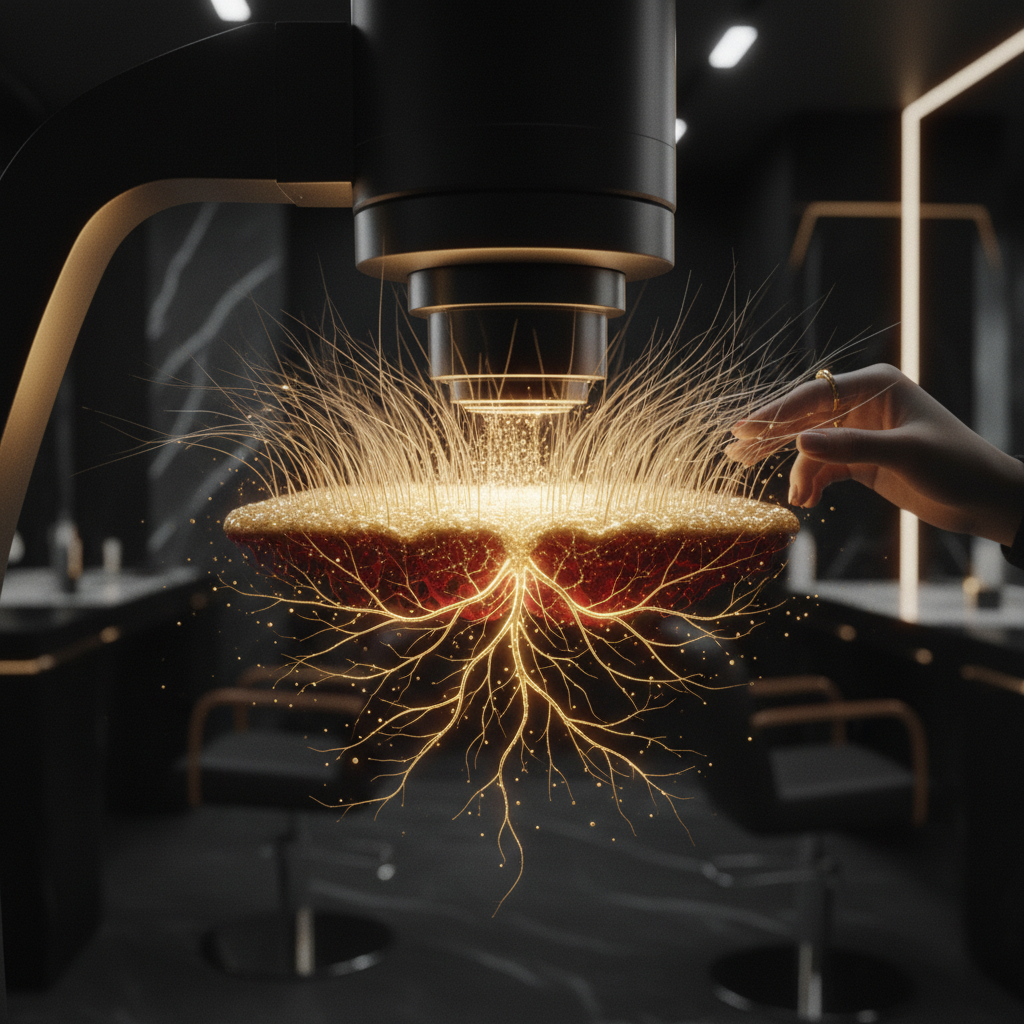
Quick answer: The relationship between Scalp Microcirculation and Hair Density centres on the delivery of oxygen, amino acids, and micronutrients to rapidly dividing matrix cells within active hair follicles. Follicles require robust capillary networks during their anagen (growth) phase to sustain fibre production. However, poor microcirculation alone rarely causes miniaturisation; rather, hormonal and genetic signalling drives follicular decline, which subsequently reduces capillary demand. Improving blood flow supports cellular metabolism, but cannot reverse androgenetic alopecia on its own.
Key takeaways
- Active hair follicles are among the most metabolically demanding structures in the human body, relying on a dense perifollicular capillary network.
- Scalp microcirculation expands significantly during the anagen growth phase through vascular endothelial growth factor (VEGF) signalling.
- Follicle miniaturisation in pattern hair loss leads to secondary capillary regression, meaning decreased blood flow is often a consequence rather than the primary cause of thinning.
- Mechanical stimulation, such as standardised scalp massage, and topical vasodilators can temporarily increase local cutaneous perfusion.
- Differentiating between hair loss (follicular miniaturisation), excessive shedding (telogen effluvium), and fibre breakage is essential before attempting circulation-focused interventions.
Scalp Microcirculation and Hair Density: what the evidence shows
Research into Scalp Microcirculation and Hair Density reveals a direct biological link between cutaneous perfusion and the hair cycle. Human hair follicles are surrounded by microvascular loops located in the dermal papilla and connective tissue sheath. During the anagen (growth) phase of the hair cycle, these vessels proliferate through angiogenesis to supply dividing keratinocytes with glucose, amino acids, and oxygen.

Histological studies demonstrate that anagen follicles possess significantly larger capillary networks than follicles in the catagen (regression) or telogen (resting) phases. When a follicle transitions toward resting, perifollicular blood vessels regress through apoptosis. In conditions such as androgenetic alopecia (pattern hair loss), dihydrotestosterone (DHT) triggers follicular miniaturisation. As the dermal papilla shrinks, the metabolic requirement drops, and local capillary volume diminishes by up to 40 percent in affected scalp zones.
Crucially, modern dermatology views this vascular decline primarily as a downstream effect. Genetic sensitivity to androgens causes follicular shrinkage, which downregulates the secretion of vascular endothelial growth factor (VEGF). The capillary bed scales down to match the smaller follicle size. Therefore, while healthy blood flow is necessary for normal hair production, restricted blood flow does not initiate hereditary baldness.
What the evidence does not show
There is no credible scientific evidence showing that poor circulation by itself initiates male or female pattern hair loss. Historical claims that "tight scalp muscles" or gravity choke off blood vessels to cause baldness have been largely discredited by clinical dermatology.
Furthermore, simply increasing blood flow to the scalp will not reactivate dormant follicles that have fully fibrosed. While topical vasodilators like minoxidil were originally thought to work solely via circulatory expansion, research shows their primary mechanism involves opening potassium channels, prolonging anagen phase duration, and stimulating growth factor release. Vasodilation is a secondary, supportive mechanism, not the entire cure.
Increasing scalp blood flow also does not resolve hair breakage. Breakage occurs along the hair shaft due to mechanical trauma, heat, or chemical processing. Circulatory health impacts the bulb within the dermis, not the non-living keratin structure already protruding past the scalp surface.
| Mechanism | Physiological Role in Hair Health | Impact on Hair Density | Limitations |
|---|---|---|---|
| Angiogenesis (VEGF) | Forms new capillary buds around anagen bulbs | High; sustains active, thick fibre development | Governed by genetics, hormones, and cell signalling |
| Vasodilation | Widens existing arterioles to increase erythrocyte volume | Moderate; ensures efficient nutrient clearance and delivery | Temporary effect; cannot reverse hormonal miniaturisation alone |
| Mechanical Massage | Applies shear stress to dermal fibroblasts | Low to Moderate; increases subcutaneous blood flow acutely | Requires consistent daily commitment; does not block DHT |
| Cold Exposure | Induces vasoconstriction followed by reactive hyperaemia | Negligible; no evidence of long-term density improvement | Can cause vascular spasm or scalp irritation in sensitive individuals |
The biological mechanism: how blood vessels feed the follicle
Hair follicle matrix cells have one of the highest turnover rates in the human body, dividing every 23 to 72 hours during peak growth. This rapid mitosis requires steady cellular respiration.
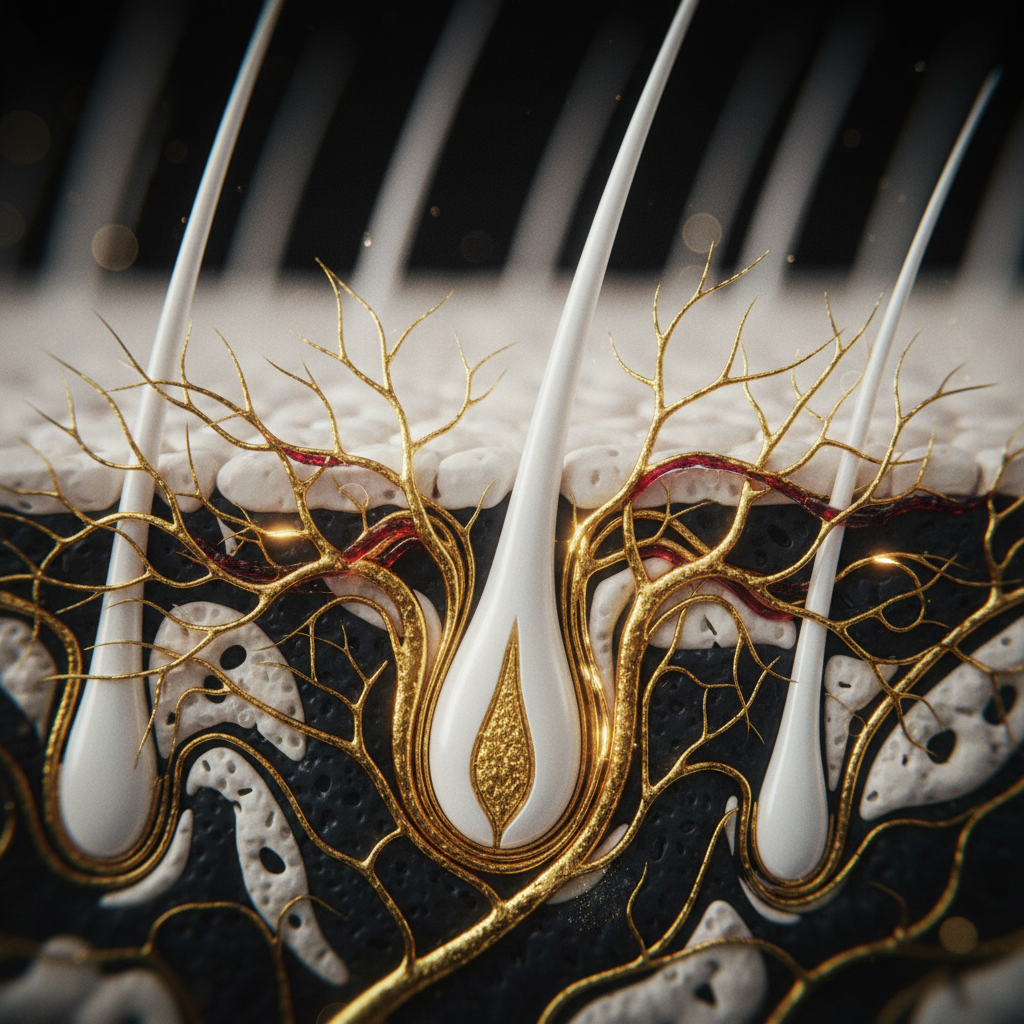
- The Dermal Papilla Microbed: Arterioles enter the subcutaneous fat and branch into the lower dermis, forming a specialized plexus that feeds into the dermal papilla.
- Endothelial Signalling: Perifollicular endothelial cells do not just deliver nutrients; they also secrete paracrine factors, including insulin-like growth factor-1 (IGF-1), which actively signals the follicle to remain in anagen.
- Nutrient Exchange: Erythrocytes exchange oxygen for carbon dioxide, while blood plasma provides cysteine, iron, zinc, and B-vitamins essential for keratin synthesis.
- Waste Clearance: Venules clear metabolic waste products and cellular debris from the dermal sheath, preventing inflammatory buildup in the follicular niche.
When microcirculation is impaired through systemic issues, such as severe peripheral vascular disease or chronic microvascular inflammation, the matrix cells slow their rate of division. This shift can force the follicle into premature catagen, causing diffuse shedding known as telogen effluvium.
What you can do to support scalp microcirculation
Supporting blood flow to the scalp creates an optimal physiological environment for follicular function. Several non-invasive methods show measurable effects on cutaneous circulation:
- Standardised Scalp Massage: Studies using mechanical or manual massage show that 4 to 5 minutes of daily scalp manipulation stretches dermal papilla cells. This mechanical shear stress increases subcutaneous blood flow and upregulates genes associated with hair growth.
- Cardiovascular Exercise: Regular aerobic activity improves systemic endothelial function and resting microvascular perfusion across all peripheral tissues, including the scalp.
- Topical Stimulants: Natural stimulants such as rosemary oil, caffeine, and menthol create mild sensory-nerve stimulation that leads to temporary local vasodilation.
- Scalp Hygiene: Maintaining a clean scalp free from oxidized sebum and heavy product residue prevents perifollicular inflammation, which can otherwise impede microvascular efficiency in the upper dermis.
The role of cosmetic haircare: Watermans
While systemic circulation and genetic factors govern internal follicle nutrition, topical cosmetic products play an important role in keeping the scalp surface balanced and receptive. Watermans formulations, such as the Grow Me Shampoo and Conditioner range, focus on revitalising the scalp environment.
Using ingredients such as caffeine, biotin, and rosemary extract, Watermans products are formulated to energise the feeling of the scalp, cleanse excess sebum from follicular openings, and improve the appearance of hair thickness. These cosmetic formulations work at the surface and follicular orifice to deliver stronger-feeling hair, reduced breakage, and a visibly healthier, fuller-looking scalp without altering the body's internal vascular mechanics.
When the cause may be something else
If you notice a reduction in hair volume or an expanding parting, do not assume poor circulation is the culprit. You must distinguish between three distinct issues:
- Follicular Miniaturisation (Hair Loss): Driven primarily by genetic sensitivity to androgens. The hairs grow back progressively thinner and shorter over successive cycles.
- Excessive Shedding (Telogen Effluvium): Triggered by systemic shocks, including severe stress, high fevers, thyroid dysfunction, rapid weight loss, or nutritional deficiencies (particularly ferritin and vitamin D). Blood vessels are unaffected, but metabolic stress forces follicles into premature resting phases.
- Hair Fibre Breakage: Snapping of the hair shaft caused by bleaching, heat styling, or physical friction. The follicle itself is producing healthy hair, but external damage gives the appearance of reduced density.
When to seek professional advice
You should consult a registered trichologist or dermatologist if you experience sudden, patchy hair loss, rapid shedding exceeding 100 hairs daily for more than six weeks, or scalp symptoms such as itching, burning, scaling, or redness.
These signs often indicate conditions such as alopecia areata, lichen planopilaris, or seborrhoeic dermatitis. Treating these issues requires targeted medical diagnostics, such as trichoscopy or scalp biopsies, which go far beyond general circulatory support.
Frequently asked questions about Scalp Microcirculation and Hair Density
Can poor scalp microcirculation cause permanent baldness?
No. Poor circulation does not cause permanent baldness on its own. While adequate blood flow is vital to feed active follicles, hereditary hair loss is caused by genetic sensitivity to dihydrotestosterone (DHT). Capillary decline around miniaturised follicles happens as a result of the follicle shrinking, not as the original cause of the hair loss.
Does scalp massage improve Scalp Microcirculation and Hair Density?
Standardised scalp massage has been shown to increase local blood flow and exert mechanical tension on dermal papilla cells. While this practice can support follicular metabolism and improve hair shaft thickness, it cannot alter genetic hair loss patterns or fully restore follicles that have already ceased functioning.
Does cold water reduce scalp blood flow and cause shedding?
Rinsing with cold water causes brief vasoconstriction, narrowing scalp capillaries for a few minutes. However, the body quickly compensates with reactive hyperaemia once normal temperature returns. Cold rinses do not cause hair shedding or permanently restrict the nutrient supply to the hair matrix.
How do topical stimulants like caffeine affect microcirculation?
Topical caffeine penetrates the scalp barrier through the hair follicle canals. It has been shown in in vitro and cutaneous models to stimulate microcirculation and counteract some inhibitory mechanisms of DHT at the cellular level, helping maintain a healthy environment for fibre development.
Supporting hair health through balanced circulation
Understanding the connection between Scalp Microcirculation and Hair Density allows you to separate biological reality from marketing exaggerations. Perifollicular capillaries are the delivery pipelines for the nutrients and oxygen that fuel active hair synthesis. Keeping the scalp active through massage, exercise, and targeted cosmetic care supports this natural machinery. However, long-term hair density relies on a comprehensive approach: addressing genetic sensitivities, correcting nutritional shortfalls, maintaining scalp hygiene, and seeking professional clinical evaluation whenever unexpected shedding or thinning occurs.
Sources and references
- British Association of Dermatologists. Guidelines for the management of alopecia areata. British Journal of Dermatology, 2012.
- National Institute for Health and Care Excellence (NICE). Alopecia androgenetica: Scenario: Management. NICE Clinical Knowledge Summaries, 2021.
- Yano, K., Brown, L. F., & Detmar, M. Control of hair growth and follicle size by VEGF-mediated angiogenesis. The Journal of Clinical Investigation, 2001; 107(4): 409-417.
- Koyama, T., et al. Standardized Scalp Massage Results in Increased Hair Thickness by Inducing Stretching Forces to Dermal Papilla Cells in the Subcutaneous Tissue. Eplasty, 2016; 16: ic8.
- Goldman, B. E., Fisher, D. M., & Ringler, S. L. Transcutaneous PO2 of the scalp in male pattern baldness: a new piece to the puzzle. Plastic and Reconstructive Surgery, 1996; 97(6): 1109-1116.
Find these ingredients in Watermans products
- Zinc: you will find this ingredient in our Hair Vitamins.