Understanding Scalp Barrier Function and Sebum Balance
8 min read ·
Discover how scalp barrier function and sebum balance interact to maintain healthy hair, prevent irritation, and protect the skin acid mantle.
Quick answer: The relationship between Scalp Barrier Function and Sebum Balance determines the overall comfort, moisture levels, and defence mechanisms of the scalp skin. The stratum corneum acts as a physical shield while sebaceous lipids lubricate and protect the epidermis. When this equilibrium breaks down through harsh washing, microbial shifts, or genetic factors, the scalp experiences increased transepidermal water loss, irritation, and reactive oiliness. However, topicals can only manage surface dynamics; systemic hormones fundamentally control baseline sebum production.
Key takeaways
- The scalp stratum corneum is thinner and contains more hair follicles than facial skin, making its barrier uniquely vulnerable to external disruption.
- Sebum is not inherently bad; it supplies vital triglycerides, wax esters, and squalene that preserve suppleness and sustain the skin microbiome.
- Stripping natural lipids with aggressive surfactants often leads to compromised moisture retention, provoking stinging, flaking, or perceived rebound greasiness.
- Malassezia yeasts metabolise sebum triglycerides into free fatty acids such as oleic acid, which can trigger inflammatory barrier breakdown in sensitive individuals.
- Balanced care relies on gentle surfactants, physiological pH formulations (around 4.5 to 5.5), and barrier-supportive ingredients rather than constant degreasing.
Scalp Barrier Function and Sebum Balance: what the evidence shows
Dermatological research shows that healthy hair growth depends on an intact epidermis. The interaction between Scalp Barrier Function and Sebum Balance forms a complex acid mantle that keeps external pathogens out and internal moisture in.
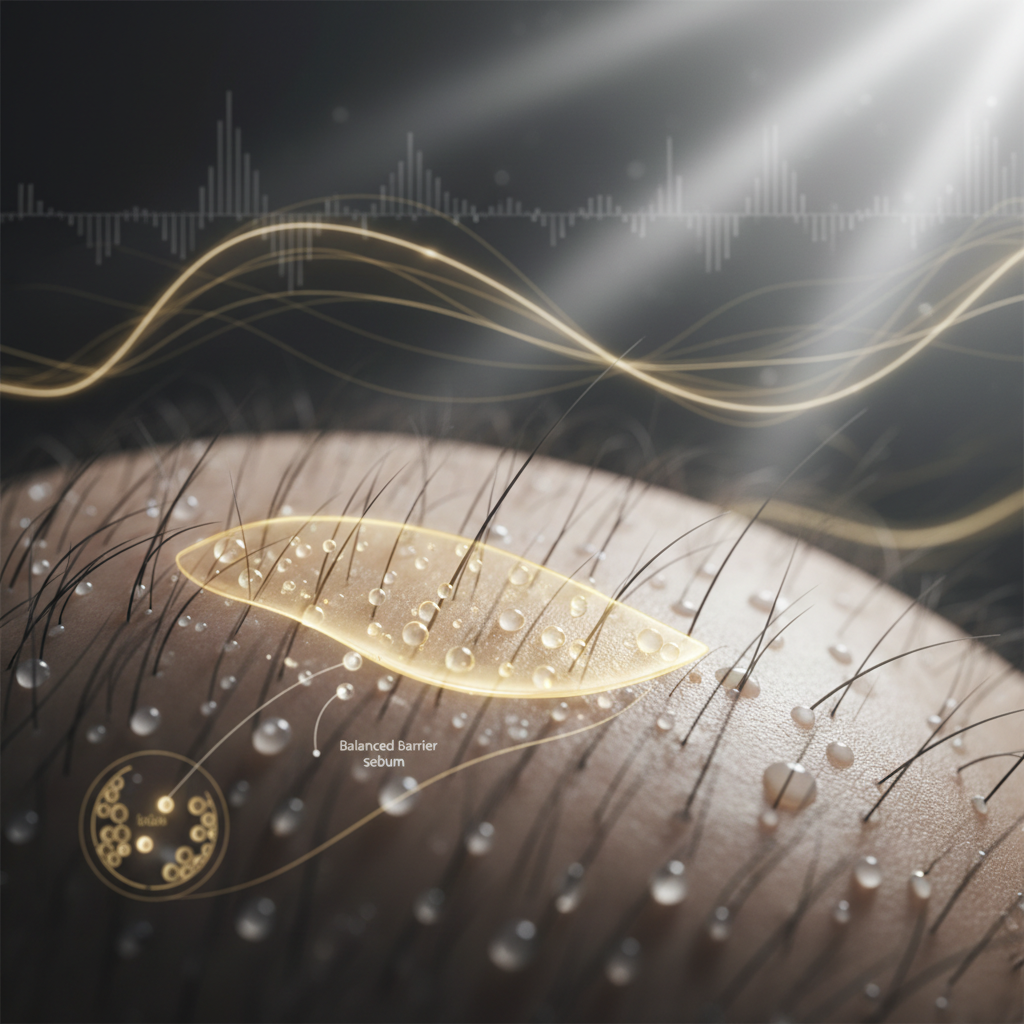
The stratum corneum operates like a brick-and-mortar wall. The corneocytes (dead, keratin-packed skin cells) are the bricks, while intercellular lipids (ceramides, cholesterol, and free fatty acids) make up the mortar. Sebum sits on top of this structure as an emollient film. It is secreted by sebaceous glands attached directly to hair follicles.
When the barrier operates efficiently, transepidermal water loss (TEWL) remains low, typically between 10 and 25 g/m²/h on a healthy scalp. Sebum production remains at a physiological steady state, coating the hair fibre and conditioning the skin without accumulating excessively.
However, clinical measurements reveal that a high sebum level does not automatically mean the scalp is well-hydrated. In conditions like seborrhoeic dermatitis, sebum levels are elevated while the stratum corneum lipid structure is severely disrupted. The scalp can be visibly greasy yet functionally dehydrated, irritated, and leaking moisture.
The mechanism: how sebum and the barrier interact
Understanding this balance requires looking at the biochemistry of surface lipids and microbial activity.
The composition of sebum
Human sebum consists roughly of:
- 57% triglycerides and free fatty acids
- 26% wax esters
- 12% squalene
- 4.5% cholesterol and cholesterol esters
Sebum lacks ceramides. Ceramides are produced independently by epidermal cells during the keratinisation process. While sebum forms a hydrophobic layer on the skin surface, the intercellular lipids inside the stratum corneum provide the actual permeability barrier.
Microbial interactions
The scalp hosts a dense microbiome dominated by Cutibacterium acnes, Staphylococcus epidermidis, and lipophilic Malassezia yeasts. Malassezia cannot manufacture its own lipids. It secretes lipase enzymes to break down sebum triglycerides, consuming the saturated fatty acids and leaving behind unsaturated free fatty acids, particularly oleic acid.
In susceptible individuals, oleic acid penetrates the stratum corneum. It disrupts the neat arrangement of epidermal lipids, provoking irritation, accelerated cell turnover, and visible flaking (dandruff). This triggers subclinical inflammation around the follicle.
| Scalp Condition | Barrier Status (TEWL) | Sebum Excretion Rate | Common Manifestations | Primary Management Goal |
|---|---|---|---|---|
| Healthy Balanced | Normal (low TEWL) | Moderate (steady) | Calm skin, no redness, soft hair roots | Maintenance with mild surfactants |
| Dry / Stripped | Elevated (moisture loss) | Low to depleted | Tightness, fine powdery flakes, itch | Replenish hydration, lower wash frequency |
| Seborrhoeic / Oily | Elevated (compromised) | High | Greasy yellow flakes, redness, inflammation | Regulate microflora, clarify without stripping |
| Reactive Dehydrated | Significantly elevated | Rapid surface re-oil | Oily roots with dry, sensitive, stinging skin | Repair epidermal lipids, restore pH 4.5 to 5.5 |
What the evidence does not show
Controlled research does not support the popular myth of "training" your scalp to stop producing oil indefinitely by refusing to wash it for weeks. Sebaceous gland output is primarily driven by systemic androgens (such as dihydrotestosterone) and genetics, not purely by surface washing frequency.

Similarly, evidence does not show that natural sebum alone is adequate to condition modern, chemically treated or weathered hair lengths. While sebum protects the first few centimetres of the hair fibre, it rarely travels down long hair shafts without manual mechanical distribution (such as brushing).
Finally, an oily scalp does not mean you should apply harsh, high-pH soaps. Alkaline products (pH 7.0 and above) cause the keratin scales to swell, extract structural lipids, and degrade the acid mantle, worsening barrier dysfunction.
Signs of a disrupted scalp barrier
Stylists and individuals should watch for distinct sensory and visual cues indicating that the surface equilibrium has faltered:
- Tightness or stinging: A prickling or burning sensation immediately after washing or when applying light leave-in tonics.
- Micro-flaking: Fine, dry flakes that brush off easily, distinct from the sticky, adherent scales of seborrhoeic dermatitis.
- Paradoxical greasiness: The scalp feels bone-dry and irritated immediately post-wash, only to become intensely greasy within twelve hours as lipids disperse over a broken surface.
- Erythema: Diffuse redness or pink patches visible through the partings.
- Follicular sensitivity: Tenderness at the roots when moving the hair or altering the part.
Practical steps to restore balance
Rebuilding the barrier requires addressing cleansing habits, formulation pH, and topical hydration.
1. Adjust cleansing chemistry
Avoid aggressive anionic detergents if you experience irritation. Look for balanced surfactant blends that incorporate amphoteric or non-ionic cleansers (such as cocamidopropyl betaine or coco-glucoside). These lift excess dirt and oxidised sebum without dissolving the essential intercellular lipids of the stratum corneum.
2. Respect the physiological pH
The scalp surface thrives at an acidic pH between 4.5 and 5.5. This acidity keeps the protective lipid synthesis enzymes active while suppressing the overgrowth of pathogenic microbes. Select shampoos and scalp rinses buffered within this physiological range.
3. Incorporate humectants and barrier lipids
Skin benefits from lightweight hydration. Ingredients like glycerin, panthenol (pro-vitamin B5), and niacinamide help hydrate the stratum corneum, improve barrier integrity, and soothe inflammation without leaving a heavy, pore-clogging film.
4. Moderate water temperature
Washing the hair with very hot water (above 40°C) strips lipid structures and intensifies erythema. Use lukewarm water to dissolve dirt without melting away your natural barrier protection.
When the cause is something else
Persistent scalp disruption is not always simple barrier dehydration or basic sebum excess.
- Contact dermatitis: An allergy to fragrances, preservatives (such as methylisothiazolinone), or paraphenylenediamine (PPD) in hair dyes can mimic barrier damage.
- Psoriasis: Characterised by thick, silvery-white plaques and sharply demarcated red borders, which stems from an autoimmune acceleration of cell turnover rather than standard dryness.
- Folliculitis: Bacterial or fungal infection of the hair follicles presenting as small, pustular bumps.
When to seek professional advice
Consult a GP, dermatologist, or registered trichologist if:
- Flaking and redness persist despite four weeks of targeted, gentle care.
- The scalp develops crusted plaques, open sores, or fluid-filled pustules.
- Intense itching interferes with sleep or daily activities.
- Scalp sensitivity is accompanied by sudden hair shedding or distinct patches of hair loss.
The Watermans approach to balanced scalp care
Supporting the hair follicle requires keeping the surrounding skin calm, clear, and hydrated. Watermans products are formulated to respect the scalp's delicate acid mantle. Rather than stripping the scalp of vital moisture, Watermans prioritises revitalising the micro-environment with targeted botanical extracts, caffeine, biotin, and rosemary. This supports cleaner, stronger-feeling hair while maintaining essential barrier comfort.
Frequently asked questions about Scalp Barrier Function and Sebum Balance
Can poor scalp barrier function cause hair loss?
A disrupted barrier does not directly cause androgenetic alopecia, but it can accelerate hair shedding. Chronic barrier breakdown leads to micro-inflammation around the follicle. This prolonged irritation can prompt premature entry into the telogen (resting) phase, resulting in noticeable shedding until the skin barrier recovers.
How does overwashing affect Scalp Barrier Function and Sebum Balance?
Overwashing with harsh, high-pH shampoos extracts intercellular lipids like ceramides from the stratum corneum. This increases transepidermal water loss and leaves the scalp vulnerable to environmental irritants. While it does not change internal hormone levels, it leaves the skin vulnerable, irritated, and struggling to retain a healthy lipid film.
Is sebum good or bad for the scalp?
Sebum is fundamentally protective. It coats the stratum corneum, reduces friction between hair fibres, delivers antioxidants such as vitamin E, and helps maintain skin flexibility. It only becomes problematic when overproduced or left to oxidise, which feeds inflammatory yeasts and causes scaling.
What ingredients support the scalp barrier?
Effective barrier-supporting ingredients include humectants like glycerin and hyaluronic acid, soothing agents like niacinamide and panthenol, and skin-identical lipids. Formulations maintained at a skin-friendly pH of 4.5 to 5.5 also keep lipid-processing enzymes functioning smoothly.
How long does it take for a damaged scalp barrier to repair?
The epidermal turnover cycle takes approximately 28 days in adults. With gentle, non-stripping products, avoidance of extreme heat, and proper hydration, noticeable improvements in comfort and flaking often appear within two to four weeks.
Maintaining lasting equilibrium
Maintaining healthy hair begins with protecting the skin beneath it. Sustaining a resilient Scalp Barrier Function and Sebum Balance prevents discomfort, discourages microbial overgrowth, and creates the ideal environment for resilient hair growth. By treating the scalp with the same ingredient awareness and pH mindfulness typically reserved for facial skincare, you protect the stratum corneum from daily stress and ensure your hair follicles thrive in a calm, balanced foundation.
Sources and references
- British Association of Dermatologists: Guidelines for the management of seborrhoeic dermatitis.
- Journal of Investigative Dermatology: Epidermal barrier function and stratum corneum lipid composition.
- International Journal of Cosmetic Science: The role of scalp condition and sebum in hair health (2018).
- American Academy of Dermatology: Scalp care and barrier maintenance protocols.
Find these ingredients in Watermans products
- Biotin: you will find this ingredient in our Hair Growth Shampoo.
- Vitamin E: you will find this ingredient in our Hair Vitamins.
- Oleic Acid: you will find this ingredient in our Camellia & Black Castor Hair & Body Oil.
- Niacinamide: you will find this ingredient in our Hair Mask.
- Panthenol (Provitamin B5): you will find this ingredient in our Heat Protection Spray.