Understanding Scalp Acid Mantle Function and Barrier Health
8 min read ·
Understand the biological role of scalp acid mantle function, how pH affects the skin barrier, and practical ways to prevent irritation and fibre breakage.

Quick answer: The primary scalp acid mantle function is to preserve an acidic surface film (typically pH 4.5 to 5.5) that defends the epidermal barrier against opportunistic pathogens, prevents excessive transepidermal water loss, and regulates the resident microbiome. Disruption of this barrier by alkaline soaps, harsh detergents, or oxidative treatments compromises skin cohesion and can aggravate flaking or pruritus. However, normalising acid mantle pH alone cannot cure systemic follicular hair loss conditions such as androgenetic alopecia or alopecia areata.
Key takeaways
- The acid mantle is a delicate, slightly acidic biochemical film composed of sebum, sweat, and metabolic byproducts that sits on the scalp surface.
- A healthy adult scalp maintains a natural pH ranging between 4.5 and 5.5, which restricts pathogenic microbes such as Staphylococcus aureus while favouring beneficial commensals.
- Alkaline cosmetic treatments and high-pH cleansing products strip structural lipids, swelling the hair shaft and causing stratum corneum micro-fissures.
- Topical barrier recovery takes roughly 15 minutes to several hours depending on age, baseline sebum production, and product pH.
- Maintaining scalp barrier health reduces inflammation, erythema, and hair fibre breakage, but cosmetic pH adjustment will not arrest follicular miniaturisation driven by genetics or hormones.
Scalp Acid Mantle Function: what the evidence shows
Understanding scalp acid mantle function begins with dermal biochemistry. The acid mantle was originally described by German physicians Marchionini and Schade in 1928, who observed that healthy human skin maintains an inherent acidity. On the scalp, this hydrolipidic film arises from a mixture of free fatty acids produced by sebaceous gland secretion, lactic acid from eccrine perspiration, and amino acids generated by filaggrin breakdown within the cornified envelope.
Scientific investigation reveals three primary biological duties performed by this acidic micro-environment:
- Microbial equilibrium: The cutaneous microbiome thrives in a narrow acidic window. Beneficial commensal organisms like Cutibacterium acnes flourish at pH 5.0 to 5.5. Conversely, pathogenic organisms such as Staphylococcus aureus or overgrowths of fungal species like Malassezia restricta proliferate when pH shifts toward neutral or alkaline values (pH 6.5 and above).
- Enzyme regulation: Stratum corneum desquamation relies on pH-dependent enzymes. Neutral-to-alkaline shifts activate serine proteases (kallikreins) prematurely, degrading the corneodesmosomes that bind outer skin cells. At the same time, alkaline conditions inhibit beta-glucocerebrosidase and acid sphingomyelinase, the enzymes responsible for generating essential barrier ceramides.
- Moisture retention: When the lipid bilayer remains chemically compact within an acidic matrix, transepidermal water loss (TEWL) remains low. Once the mantle is compromised, water evaporates rapidly, leaving the scalp parched, irritated, and hyper-reactive.
 [ Sebaceous Lipids + Eccrine Sweat + Filaggrin Breakdown ]
 │
 ▼
 Healthy Acid Mantle (pH 4.5 to 5.5)
 ┌──────────────────────┴──────────────────────┐
 ▼ ▼
Suppresses Pathogens & Fungi Optimises Ceramide Enzymes
(Inhibits S. Aureus / Malassezia) (Maintains Compact Barrier & Low TEWL)
What the evidence does not show
It is vital to separate cosmetic scalp biology from follicular pathology. Disrupting the scalp acid mantle function does not trigger permanent genetic hair loss. There is no controlled clinical evidence demonstrating that an alkaline scalp directly causes male or female pattern hair loss (androgenetic alopecia), which is mediated by systemic androgen sensitivity and dihydrotestosterone (DHT) binding at the follicle papilla.
Similarly, an acidic product cannot reverse autoimmune conditions like alopecia areata or scarring cicatricial alopecias. While an elevated pH causes swelling of the hair cuticles, friction, and subsequent hair breakage along the shaft, fibre snapping is not the same as hair shedding from the follicle. Conflating shaft breakage with true follicular loss leads to ineffective management plans.
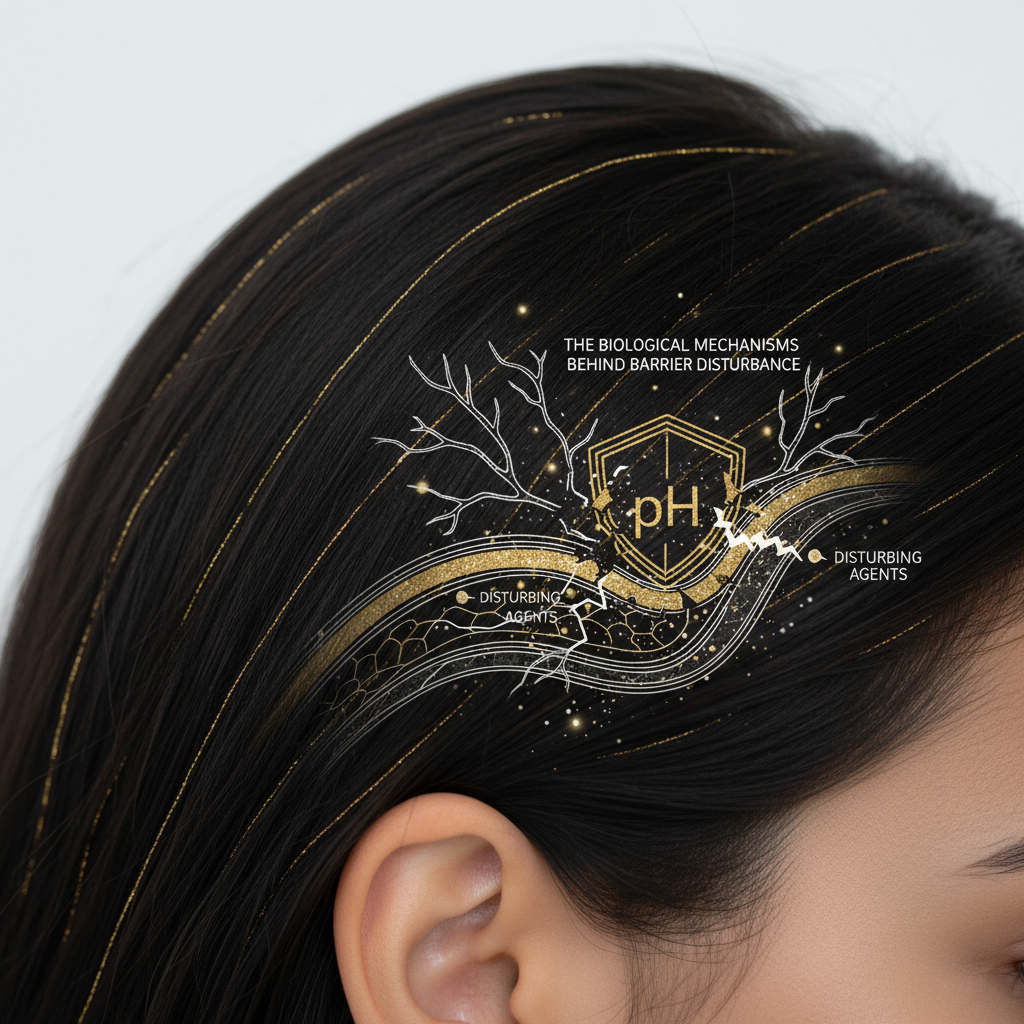
The biological mechanisms behind barrier disturbance
The chemical interaction between water, cleansers, and the stratum corneum dictates barrier stability. Most standard tap water has a pH between 6.5 and 8.5. Traditional alkaline bar soaps often carry a pH of 9.0 to 10.0, while unbuffered high-foaming detergents sit between 6.0 and 7.5.
When an alkaline substance contacts the scalp:
- Corneocyte swelling: Neutral and alkaline solutions cause keratin structures to swell. This increases permeability, allowing irritants, allergens, and surfactants to penetrate deeper into living epidermal tissue.
- Lipid elution: High-pH surfactants dissolve the inter-corneocyte lipid matrix, stripping cholesterol, ceramides, and free fatty acids.
- Delayed recovery: Young, healthy skin can neutralise alkaline residues and restore its baseline pH within 30 to 90 minutes. In dry, aged, or dermatitic skin, barrier recovery can take anywhere from 4 to 24 hours. During this recovery lag, the skin remains susceptible to external irritation and secondary colonisation.
| Metric / Characteristic | Intact Acid Mantle | Disrupted Acid Mantle |
|---|---|---|
| Typical Surface pH | 4.5 to 5.5 | 6.5 to 8.5 |
| Microbial Profile | Balanced commensals (C. Acnes) | Pathogen overgrowth (S. Aureus, Malassezia) |
| Stratum Corneum Integrity | Compact, smooth corneocyte cohesion | Micro-fissuring, premature desquamation |
| Transepidermal Water Loss | Low (8 to 15 g/m²/h) | Elevated (>25 g/m²/h) |
| Hair Shaft State | Closed, flattened cuticles | Swollen cuticles, high friction, vulnerability |
| Common Symptoms | Calm, hydrated, minimal flaking | Pruritus, tightness, redness, dullness |
Recognising the signs of a damaged acid mantle
A disrupted scalp mantle produces tangible physical signals that stylists and clients can readily identify:
- Persistent pruritus and tightness: A sensation of pulling or stinging, particularly immediately after washing.
- Fine, non-greasy flaking: Unlike thick, oily seborrhoeic scales, acid mantle breakdown frequently manifests as small, dry, powdery flakes caused by uneven desquamation.
- Surface erythema: Diffuse redness across the crown or hairline resulting from sub-clinical inflammation.
- Increased hair tangling and dullness: Because product runoff flows down the fibre, an alkaline environment lifts the hair cuticles, increasing inter-fibre friction and scattering light unevenly.
Practical steps to protect the scalp barrier
Restoring equilibrium requires minimising chemical, thermal, and mechanical stressors.
1. Match your cleanser to physiological pH
Select shampoos formulated between pH 4.5 and 5.5. Cleansers buffered with citric acid or lactic acid preserve the lipid bilayers without stripping the skin. Avoid harsh sodium hydroxide-saponified bar soaps on the scalp.
2. Moderate wash water temperature
Excessively hot water (above 40 degrees Celsius) melts cutaneous lipids and accelerates barrier stripping. Use lukewarm water (around 36 to 38 degrees Celsius) to protect the mantle while efficiently emulsifying soil and sebum.
3. Neutralise post-chemical services
Chemical relaxers, permanent dyes, and bleaches routinely operate at alkaline levels (pH 9.0 to 12.0) to swell the hair cuticle and alter structural bonds. Stylists must ensure thorough rinsing followed by a post-service, pH-balancing conditioning treatment to bring the scalp back down into its physiological comfort zone.
4. Provide gentle, targeted nutrition
When selecting restorative care, products formulated to respect physiological acidity give the best foundation. Watermans Grow Me Shampoo and its companion conditioning treatments are developed to cleanse the hair and scalp gently while respecting the natural dermal environment. Formulated with balancing ingredients such as biotin, rosemary, and niacinamide, they support a clean, revitalised scalp foundation without deploying excessive alkaline disruption.
When the cause is something else
Not all scalp irritation stems from cosmetic barrier depletion. If flaking is greasy, yellowish, and accompanied by thick plaques, the underlying issue may be seborrhoeic dermatitis, which involves an inflammatory immune reaction to fungal metabolites rather than simple pH imbalance alone.
Psoriasis presents with sharply demarcated, silvery-white plaques and requires targeted medical therapies such as topical corticosteroids or vitamin D analogues. Contact dermatitis (allergic or irritant) may stem from specific fragrance molecules, preservatives like methylisothiazolinone, or paraphenylenediamine (PPD) in hair dyes. In these cases, restoring pH helps comfort the skin but will not resolve the specific immunological trigger.
When to seek professional medical advice
Cosmetic adjustments have practical limits. You should consult a GP or trichologist if you encounter:
- Weeping lesions, crusting, or yellow discharge indicative of secondary bacterial infection.
- Severe burning sensations that do not subside within 48 hours of product discontinuation.
- Visible patches of hair shedding accompanied by follicular inflammation, scarring, or pustules.
- Persistent scale build-up that resists clarifying or dermatological over-the-counter care.
Frequently asked questions about Scalp Acid Mantle Function
What is the natural pH of the scalp acid mantle?
The healthy adult scalp acid mantle naturally sits at a pH of 4.5 to 5.5. This mild acidity keeps protective lipid-synthesising enzymes operating efficiently, controls unwanted micro-organisms, and maintains a closed, tight cuticle layer along the emerging hair fibre.
Can water alone disrupt the scalp acid mantle function?
Yes. Pure tap water usually carries a neutral or slightly alkaline pH (6.5 to 8.5). Rinsing the scalp with water temporarily raises the surface pH. While an undisturbed, healthy scalp returns to baseline quickly, washing repeatedly with hard, alkaline water can prolong barrier recovery times.
Does an alkaline shampoo cause permanent hair loss?
No. Alkaline shampoos do not cause genetic or autoimmune hair loss. However, they swell the hair fibre and degrade the outer stratum corneum. This can result in scalp irritation, inflammation, and increased hair breakage due to cuticle damage, which is often mistaken for genuine hair loss.
How quickly does the acid mantle recover after washing?
In healthy individuals, the scalp begins buffering its acid mantle immediately, often recovering baseline acidity within 30 to 120 minutes. However, in individuals with compromised barriers, aged skin, or following aggressive alkaline chemical treatments, full replenishment of natural lipids and acidity can take several hours to a full day.
Protecting your scalp foundation
Maintaining optimal scalp acid mantle function is one of the most effective, non-invasive strategies for supporting long-term hair and skin wellness. When the scalp remains within its physiological pH range, the dermal barrier functions smoothly: moisture stays locked in, opportunistic bacteria and fungi are held at bay, and emerging hair fibres are shielded from preventable cuticle distress. Always treat the scalp with the same structural care given to facial skin, selecting gentle, balanced formulations that preserve its natural defensive shield.
Sources and references
- Ali, S. M., & Yosipovitch, G. (2013). Skin pH: From basic science to basic skin care. Acta Dermato-Venereologica, 93(3), 261-267.
- Gavazzoni Dias, M. F., et al. (2014). The shampoo pH can affect the hair: myth or reality? International Journal of Trichology, 6(3), 95-99.
- Lambers, H., et al. (2006). Natural skin surface pH is on average below 5, which is beneficial for its resident flora. International Journal of Cosmetic Science, 28(5), 359-370.
- Schmid-Wendtner, M. H., & Korting, H. C. (2006). The pH of the skin surface and its impact on the barrier function. Skin Pharmacology and Physiology, 19(6), 296-302.
- British Association of Dermatologists (BAD). Seborrhoeic Dermatitis Patient Information Leaflet. Updated 2022.
Find these ingredients in Watermans products
- Vitamin D: you will find this ingredient in our Hair Vitamins.
- Niacinamide: you will find this ingredient in our Hair Mask.