Hair Porosity and pH: The Science of Cuticle Health and Moisture
10 min read ·
Understand how Hair Porosity and pH interact to control hair cuticle behaviour, moisture retention, and shaft strength. Discover evidence-based haircare tips.
Quick answer: Understanding Hair Porosity and pH is essential for maintaining healthy hair fibres, as the electrical charge and chemical environment directly control how cuticles lie against the hair shaft. Hair porosity describes how readily your hair absorbs and holds moisture, while pH dictates whether cuticle scales swell open or contract flat. While balancing product pH helps seal lifted cuticles and smooth high-porosity hair, it cannot physically rebuild permanently degraded or missing protein structures within the hair cortex.
Key takeaways
- Hair porosity measures the hair shaft's capacity to absorb and retain water, oils, and chemical treatments.
- The natural isoelectric point of human hair sits at approximately pH 3.67, while the scalp acid mantle rests between pH 4.5 and 5.5.
- Alkaline solutions above pH 7.0 carry a net negative electrical charge that causes the hair fibre to swell and cuticle scales to flare open, increasing porosity.
- Acidic formulations between pH 3.5 and 5.5 neutralise surface charges, contracting the cuticle layers and reducing friction along the hair shaft.
- Managing pH preserves cuticles and minimises mechanical breakage, but chemical pH adjustments cannot mend broken disulphide bonds or restore blown-away cortex keratin.
Hair Porosity and pH: what the evidence shows
The relationship between Hair Porosity and pH is rooted in electrochemistry and trichological anatomy. The human hair fibre consists of three key components: an inner core called the medulla, a structural cortex made of twisted keratin protein chains, and an outer protective shield known as the cuticle. The cuticle is made of overlapping shingles, roughly 5 to 10 layers deep, glued together by the cell membrane complex (CMC).
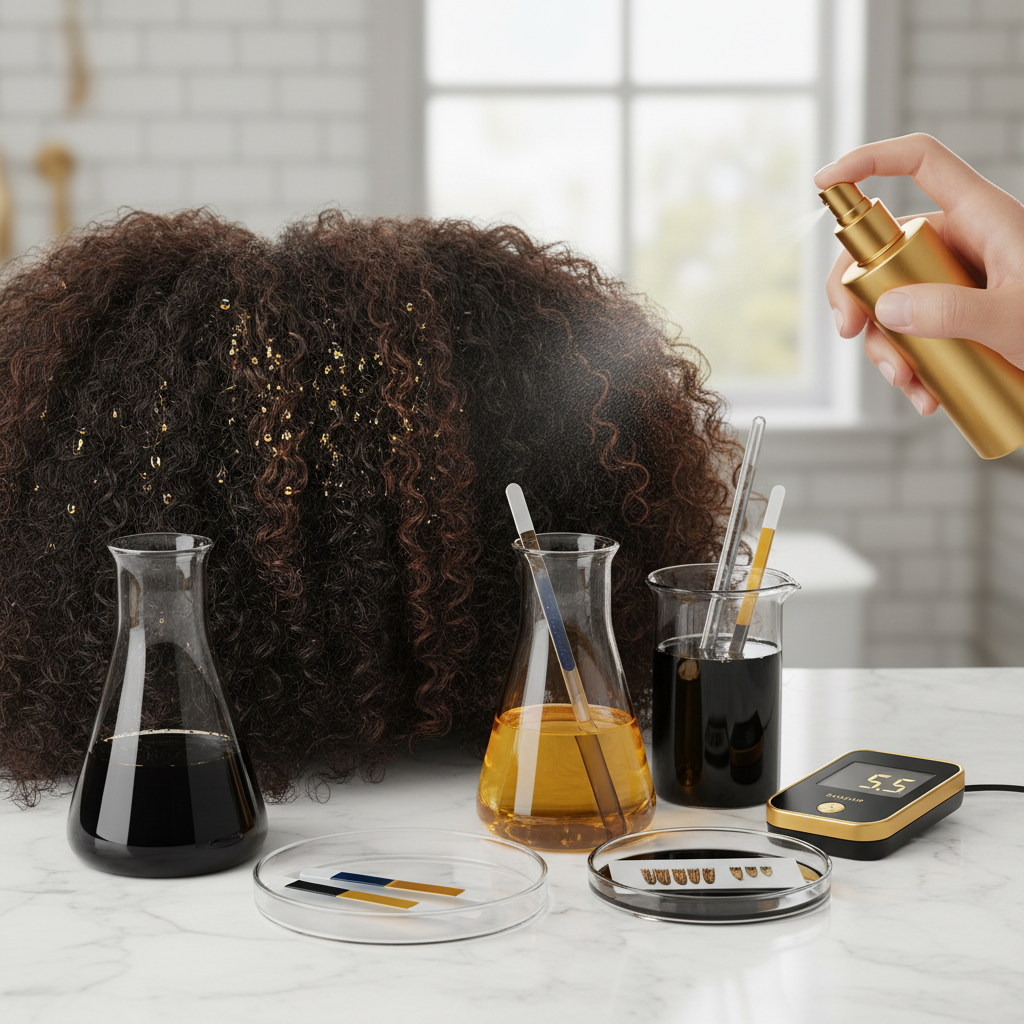
Under normal, healthy conditions, human hair maintains an acidic surface profile. Dermatological studies published in the International Journal of Trichology and the Journal of Cosmetic Science show that the healthy scalp surface holds an average pH of 5.5, while the hair shaft fibre itself reaches electrical neutrality (its isoelectric point) around pH 3.67.
When you apply solutions with a pH higher than this isoelectric threshold, the hair fibre takes on a net negative electrical charge. As the pH climbs into alkaline territory (above pH 7.0), electrostatic repulsion forces individual cuticle scales apart. The water causes the hair cortex to swell radially. This swelling lifts the cuticle shingles away from the shaft, creating gaps that permit moisture, minerals, and chemicals to enter and exit freely. This is the structural state of high porosity.
Conversely, exposing the hair fibre to mild acids between pH 3.5 and 5.5 counteracts negative static charges. At this mildly acidic level, cuticles contract and lie tightly against the cortex. This tight alignment smooths the surface, locks in internal moisture, shields against environmental wear, and creates the low-friction surface typical of low or normal porosity hair.
Acidic (pH 3.5 to 5.5) Isoelectric Point (pH ~3.67) Alkaline (pH >7.0)
[Cuticles Contracted] <---------------------------------> [Cuticles Flared Open]
Low / Balanced Porosity High Porosity / Swelling
How chemical treatments alter porosity via pH
Chemical processing relies deliberately on manipulation of pH to change the hair's architecture. Bleaches, permanent hair dyes, and chemical relaxers typically carry an alkaline pH between 8.5 and 11.0.
Ammonia or ethanolamine within these formulations forces the cuticle open so oxidative agents can penetrate the cortex and break down melanin granules or restructure disulphide bonds. However, repeated exposure to strong alkaline formulas strips the protective 18-methyleicosanoic acid (18-MEA) lipid layer from the cuticle surface. Once this hydrophobic barrier is removed, the cuticles struggle to close fully, even after an acidic rinse. The result is acquired high porosity, where hair absorbs water rapidly like a sponge but dries out almost immediately, leading to chronic brittleness.
| Porosity Level | Cuticle Architecture | Typical Fibre Behaviour | Optimal Product pH Range |
|---|---|---|---|
| Low Porosity | Tightly bound, overlapping scales; intact 18-MEA lipid layer. | Resists moisture absorption; products tend to sit on surface; slow to dry. | pH 5.5 to 6.5 (mild warmth helps initial uptake) |
| Medium Porosity | Uniformly aligned scales; minor routine mechanical wear. | Readily absorbs and retains moisture; styles predictably. | pH 4.5 to 5.5 (physiologically balanced) |
| High Porosity | Lifted, chipped, or missing scales; depleted cell membrane complex. | Absorbs water instantly; loses hydration rapidly; tangles easily; prone to snapping. | pH 3.5 to 4.5 (acidic cuticular compaction) |
What the evidence does not show
There are several persistent myths regarding hair porosity and pH that scientific testing refutes:
- The float test is not reliable: Placing shed hairs in a glass of water to gauge porosity by whether they float or sink is scientifically flawed. Surface tension, natural sebum coatings, and air bubbles adhere to the hair shaft, producing false readings regardless of cuticular integrity.
- Low pH cannot mend structural breakage: Acidic rinses flatten cuticle scales through charge neutralisation, but they do not re-knit cleaved keratin polypeptide chains. A split end remains structurally broken regardless of how acidic your rinse is.
- Apple cider vinegar is not a cure-all: Undiluted vinegar typically sits between pH 2.0 and 3.0. Applying solutions this acidic can cause acid erosion of the hair fibre, irritate the scalp, and strip natural oils, making dry hair brittle rather than shiny.
- High porosity does not mean alopecia: Porosity describes cuticular integrity along the dead hair shaft. Hair loss originates inside the living follicle below the scalp surface. Swollen cuticles cause mechanical breakage, not genetic thinning or telogen effluvium shedding.
The mechanism: why cuticle charge controls moisture
Keratin contains high concentrations of amino acids, particularly cystine, glutamic acid, and aspartic acid. These molecules feature ionisable functional groups (carboxyl and amino groups) that react directly to hydrogen ion concentrations in the surrounding water.
When hair sits in an alkaline medium (pH above 7.0), acidic carboxyl groups lose their protons and become negatively charged (-COO⁻). Because like charges repel, these neighbouring negative charges push away from one another. This repelling force breaks internal salt linkages (ionic bonds) within the hair fibre. As water rushes into the expanded space, the fibre swells up to 20% in diameter, forcing the cuticle edges upward.
In an acidic medium (pH 3.5 to 5.5), basic amino groups accept protons (-NH3⁺), balancing the electrical environment. Electrostatic repulsion drops to near zero near the isoelectric point. Cuticle scales fall back flat against the shaft, compacting the outer sheath and reducing surface friction.
Signs of cuticle and pH imbalance
You can often identify porosity imbalances through physical texture and styling behaviour:
- Lifted, high-porosity cuticles: The hair feels rough, coarse, or raspy when you run fingers upward from tip to root. It tangles instantly upon washing, expands into frizz in humid air, and snaps easily under low tensile tension due to friction between lifted cuticles.
- Closed, low-porosity cuticles: Hair takes a remarkably long time to become thoroughly wet under running water. Conditioners tend to bead on the surface rather than absorb, and drying time can stretch for several hours.
- Acid erosion: Over-acidified hair (from continuous exposure to solutions below pH 3.0) can feel gummy when wet and hard or brittle when dry, as the structural integrity of the cuticle layer weakens.
Practical steps to balance hair porosity and pH
You can manage porosity and cuticular friction by tailoring the pH and weight of your routine:
- Test the pH of your cleansers: Choose shampoos formulated between pH 5.0 and 6.0. Shampoos with alkaline formulas above pH 7.0 increase wet friction, making high-porosity hair vulnerable to cuticle chipping during lathering.
- Use acid-balanced post-wash steps: Apply conditioners, masks, and leave-ins sitting between pH 3.5 and 4.5. This helps flatten the cuticle layer after cleansing, reducing combing resistance and sealing in conditioning agents.
- Incorporate penetrating lipids for high porosity: Hair with high porosity benefits from small-chain fatty acids (such as those found in argan or coconut oils) and hydrolysed proteins that temporarily seat themselves inside cortical voids beneath the open cuticle.
- Use gentle heat for low porosity: If low-porosity hair struggles to take up conditioning agents, mild warmth (from a warm towel or steamer) temporarily loosens the tight cuticular seal, allowing ingredients to slip between the overlapping scales before an acidic cool-down seals them in place.
Watermans: supporting fibre resilience and scalp balance
Maintaining an ideal chemical environment across the hair shaft requires a dual approach: looking after the living follicle and safeguarding the dead hair fibre.
Watermans products are formulated to respect the natural physiology of the hair and scalp. Watermans GrowMe Shampoo is formulated within a balanced pH range that cleanses without excessively swelling the hair shaft. Packed with hydrolysed lupin protein, biotin, rosemary extract, and niacinamide, it nurtures a balanced scalp microbiome while minimising cuticular disruption.
Following cleansing, Watermans ConditionMe Conditioner works to seal lifted cuticles, delivering moisturising cholesterol, hydrolysed keratin, and natural seed oils at an optimal acidic pH. This compacts the cuticles, preserves moisture within porous fibres, and curbs mechanical snapping during brushing.
When the cause may be something else
If your hair appears dull, dry, or damaged, poor cuticle maintenance is not always the culprit:
- Hard water buildup: High concentrations of dissolved calcium and magnesium (above 180 mg/L) react with cleansers to leave sticky mineral curd on the hair shaft. This mimics the rough feel of high porosity, even on virgin hair.
- Nutritional deficiencies: Hair shafts produced during periods of severe iron deficiency (ferritin below 30 ug/L) or low protein intake may emerge with structural weaknesses inside the cortex, leaving fibres prone to snapping even when cuticles are flat.
- Heat styling degradation: Direct heat above 185 degrees Celsius from flat irons melts the cortex's alpha-keratin into amorphous beta-keratin, permanently blunting the cuticle edges regardless of topical pH.
When to seek professional advice
Consult a qualified trichologist or dermatologist if you notice:
- Sudden, excessive hair shedding (more than 100 to 150 hairs daily) accumulating on brushes or shower drains.
- Patchy hair loss, visible scalp widening, or persistent pain, redness, burning, and scaling on the scalp.
- Hair breaking off rapidly in whole clumps near the roots following home bleaching, chemical straightening, or perming. A professional can run trichoscopy or hair shaft microscopy to determine whether the issue stems from cuticle lifting, chemical bubble hair deformity, or true follicular hair loss.
Frequently asked questions about Hair Porosity and pH
How does water pH affect Hair Porosity and pH balance?
Municipal tap water typically sits between pH 6.5 and 8.5 to prevent pipe corrosion. Because this range is higher than the hair's isoelectric point (pH 3.67), plain water naturally lifts the cuticles slightly each time you wash. If you have high porosity, finishing with an acidic conditioner (pH 3.5 to 4.5) is vital to lower surface charge and flatten cuticles before drying.
Can you change your hair's natural porosity permanently?
You cannot make naturally low-porosity hair permanently high-porosity without damaging it, nor can you permanently turn high-porosity hair low. High porosity caused by chemical treatments or heat involves physical loss of cuticle scales. While acidic products and hydrolysed proteins temporarily mimic a smooth, low-porosity cuticle, newly emerging hair from the follicle will always grow in with your genetically determined baseline porosity.
What is the ideal pH for shampoo and conditioner?
The ideal pH for shampoo falls between 5.0 and 6.0, which effectively dissolves scalp sebum and dirt without excessively swelling the hair fibre. Conditioners should be more acidic, ideally sitting between pH 3.5 and 4.5. This lower pH neutralises the negative static charge left after washing, compacts cuticles, and boosts natural shine.
Does apple cider vinegar lower hair porosity?
Apple cider vinegar temporarily flattens cuticles because its low pH (roughly 2.5 to 3.0) neutralises the hair's negative electrical charge. However, it does not permanently change porosity. To avoid acid burn or over-drying the fibre, vinegar must always be diluted significantly with water (typically 1 part vinegar to 8 parts water) to bring its working pH safely to around 4.0.
Cuticle health and pH maintenance
Mastering the connection between Hair Porosity and pH allows you to tailor your hair routine based on structural chemistry rather than marketing guesswork. Understanding that low pH tightens cuticle scales while high pH lifts them gives you direct control over moisture balance, shine, and mechanical strength. While balancing product pH cannot repair shattered internal bonds or restore stripped-away protein, using acid-balanced cleansers and conditioning seals preserves the cuticle barrier and helps stop everyday friction turning into permanent fibre breakage.
Sources and references
- Gavazzoni Dias, M. F. Et al. (2014). The Shampoo pH can Affect the Hair: Myth or Reality? International Journal of Trichology, 6(3), 88 to 99.
- Robbins, C. R. (2012). Chemical and Physical Behavior of Human Hair (5th ed.). Springer-Verlag Berlin Heidelberg.
- Cruz, C. F. Et al. (2016). Human Hair Characteristics Investigated by Atomic Force Microscopy and Tribological Measurements. Skin Research and Technology, 22(4), 438 to 445.
- Dawber, R. (1996). Hair: Its Structure and Response to Cosmetic Preparations. Clinics in Dermatology, 14(1), 105 to 112.
- British Association of Dermatologists. (2022). Hair and Scalp Care Guidelines. BAD Clinical Standards.
Find these ingredients in Watermans products
- Niacinamide: you will find this ingredient in our Hair Mask.