Seborrhoeic Dermatitis Mechanisms: Science, Scalp Biology, and Care
9 min read ·
Explore the biological Seborrhoeic Dermatitis Mechanisms, including Malassezia metabolism, barrier disruption, parakeratosis, and clinical management.

Quick answer: Understanding Seborrhoeic Dermatitis Mechanisms requires looking at a three-part biological interaction: sebaceous gland activity, lipid-dependent Malassezia yeasts, and individual host immune vulnerability. Yeasts hydrolyse sebum triglycerides into free fatty acids such as oleic acid, disrupting the epidermal barrier and triggering an inflammatory cascade that causes rapid, disordered keratinocyte turnover. While topical treatments manage symptoms by suppressing yeast density and calming inflammation, these mechanisms cannot permanently cure the condition because individual genetic and immunological predispositions persist indefinitely.
Key takeaways
- Seborrhoeic dermatitis is an inflammatory scalp and skin condition driven by the interaction between sebum, commensal Malassezia yeasts, and the host immune system.
- Yeasts consume specific saturated fatty acids in sebum and release irritating unsaturated free fatty acids, notably oleic and arachidonic acids.
- These free fatty acids degrade stratum corneum lipid bilayers, impairing barrier function and triggering cytokine production (interleukins 1-alpha, 6, and 8).
- Accelerated epidermal proliferation cuts skin cell transit time from roughly 28 days down to 7 to 14 days, resulting in nucleated, greasy flakes (parakeratosis).
- Management relies on reducing yeast populations, curbing inflammation, and restoring barrier integrity, rather than trying to sterilise the scalp completely.
Seborrhoeic Dermatitis Mechanisms: what the evidence shows
Seborrhoeic dermatitis is not an infectious disease, nor is it caused by poor hygiene. Decades of dermatological research show that Seborrhoeic Dermatitis Mechanisms centre on a disordered physiological relationship with a normal microbe.
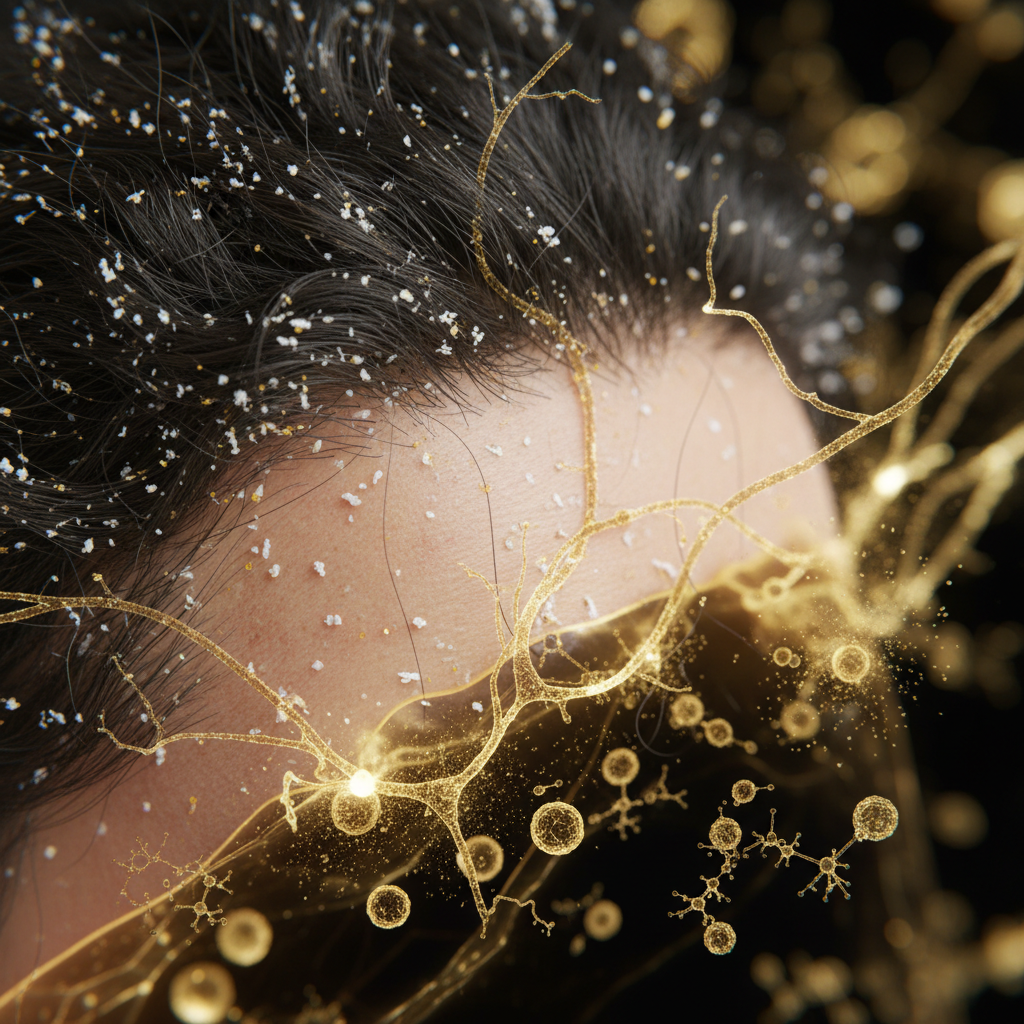
The microflora of human skin naturally contains lipophilic yeasts belonging to the genus Malassezia, primarily M. Restricta and M. Globosa on the scalp. These yeasts lack the genes needed to synthesise their own fatty acids. Consequently, they depend entirely on host sebum for survival. Sebaceous glands, which are dense across the scalp, face, and chest, secrete sebum rich in squalene, wax esters, triglycerides, and cholesterol.
Malassezia produces extracellular lipase enzymes that split sebum triglycerides. The yeasts ingest the saturated fatty acids they require for their cell walls, leaving behind unsaturated fatty acids, primarily oleic acid and arachidonic acid. In susceptible individuals, these leftover unsaturated fatty acids directly penetrate the stratum corneum.
Once inside the outer skin layer, these free fatty acids disrupt the organised lamellar lipid structure. This disruption increases trans-epidermal water loss (TEWL) and prompts keratinocytes to release inflammatory cytokines, including interleukin-1 alpha (IL-1a), interleukin-8 (IL-8), and tumour necrosis factor-alpha (TNF-a). This chemical signal attracts neutrophils and lymphocytes, manifesting clinically as erythema (redness) and burning pruritus (itching).
Host Sebum Secretion (Triglycerides)
 │
 ▼
Malassezia Extracellular Lipases
 │
 ├─► Saturated fatty acids (consumed by yeast)
 │
 └─► Unsaturated free fatty acids (Oleic acid left behind)
 │
 ▼
 Barrier Disruption
 (Increased lipid fluidity & TEWL)
 │
 ▼
 Immune / Cytokine Cascade
 (IL-1a, IL-8, TNF-a release)
 │
 ▼
 Hyperproliferation & Parakeratosis
 (Erythema, greasy scaling, itching)
What the evidence does not show
The biological pathway of seborrhoeic dermatitis is frequently misunderstood. Rigorous research dispels several common misconceptions:
- It is not an absolute overgrowth of yeast: Multiple clinical studies show that people with active seborrhoeic dermatitis do not always have higher absolute counts of Malassezia than people without it. The key difference is host sensitivity to metabolic by-products, not yeast quantity alone.
- It is not an allergic IgE reaction: Seborrhoeic dermatitis is an irritant and non-specific inflammatory immune response, not a classical type I hypersensitivity allergy. Skin prick tests and allergy panels do not diagnose or explain it.
- It does not permanently destroy hair follicles: Seborrhoeic dermatitis does not cause scarring alopecia. Severe inflammation and relentless scratching can induce temporary telogen effluvium (shedding) or hair breakage along the shaft, but the follicle itself remains alive.
- Dietary oil does not directly become sebum: Consuming oily foods does not translate directly into higher skin lipid levels, although metabolic factors, systemic stress, and neuroendocrine changes can modulate sebaceous activity over time.
Keratinocyte turnover and parakeratosis
In healthy scalp tissue, basal keratinocytes divide, mature, lose their nuclei, and migrate upward to the stratum corneum over roughly 28 days. By the time they desquamate (shed), they separate as invisible, microscopic individual cells.
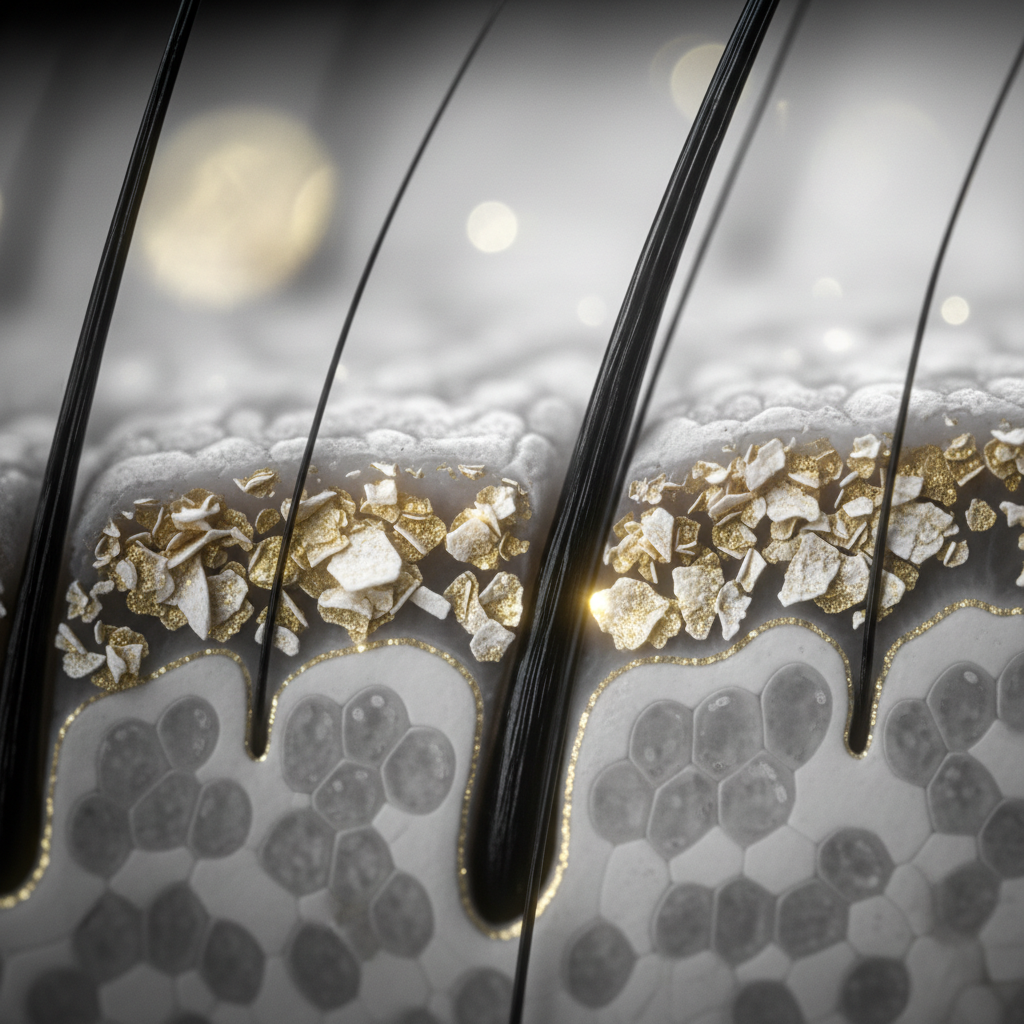
Under the inflammatory pressure of seborrhoeic dermatitis, this epidermal transit time drops dramatically to between 7 and 14 days. Keratinocytes multiply and mature too quickly to complete normal cornification. They reach the surface still retaining their cellular nuclei, an abnormality known as parakeratosis.
Simultaneously, the intercellular cement (composed of ceramides, cholesterol, and free fatty acids) fails to form proper lamellar sheets. Instead of detaching individually, the parakeratotic cells stick together in large clumps, held fast by unhydrolysed sebum. Clinically, this appears as large, yellowish, greasy scales that adhere tightly to the scalp and hair roots.
Clinical signs to look for
Identifying seborrhoeic dermatitis involves checking for specific clinical markers that separate it from simple dryness:
- Scale quality: Greasy, moist, yellowish or cream-coloured flakes adhering to the scalp and base of the hair fibres, rather than dry, white, fine dust.
- Erythema: Background pink or red plaques on fair skin; violet, hyperpigmented, or hypopigmented patches on brown and darker skin tones.
- Distribution: Primarily affects areas rich in sebaceous glands, including the frontal hairline, vertex, eyebrows, nasolabial folds, and behind the ears.
- Sensory symptoms: Pruritus ranging from mild irritation to intense itching, often worsening with sweat, heat, or emotional stress.
Comparing scalp conditions
Because scaling and redness are common across multiple skin problems, misidentification is frequent. The table below outlines how seborrhoeic dermatitis differs from other scalp presentations.
| Feature | Seborrhoeic Dermatitis | Pityriasis Capitis (Dandruff) | Scalp Psoriasis | Atopic Scalp Dermatitis |
|---|---|---|---|---|
| Primary Mechanism | Lipid cleavage, immune response to free fatty acids | Mild non-inflammatory response to Malassezia metabolites | Autoimmune hyperproliferation driven by IL-17/IL-23 | Barrier protein deficiency (e.g. filaggrin), allergic diathesis |
| Inflammation Level | Moderate to high erythema | None to minimal erythema | High; sharply demarcated red or violaceous plaques | Moderate; diffuse, often with eczematous excoriation |
| Scale Appearance | Greasy, yellowish, adherent clumps | Fine, dry, powdery white flakes | Thick, silvery-white, mica-like, dry scales | Variable, dry, fine scaling with crusting if weeping |
| Follicular Impact | Occasional shedding via telogen effluvium | None | Can cause temporary telogen effluvium; follicular plugging | None, though severe scratching causes hair breakage |
| Typical pH Range | Scalp surface elevated (pH 5.5 to 6.5) | Mildly altered (pH 5.0 to 5.8) | Altered, elevated (pH 6.0+) | Elevated surface pH (pH 6.0 to 7.0) |
What you can do: evidence-based scalp care
Managing the condition means disrupting the yeast-lipid-inflammation loop. Cosmetics and therapeutic cleansers target different parts of the cascade:
- Reduce fungal density: Antifungal active ingredients lower the metabolic load of Malassezia. Ketoconazole (1% to 2%), ciclopirox olamine (1%), selenium sulfide (1% to 2.5%), and zinc pyrithione work by altering yeast membrane permeability or cellular metabolism.
- Remove adherent scale (keratolysis): Salicylic acid (2% to 3%) dissolves the intercellular lipid bonds holding parakeratotic scales together, clearing the build-up so topical treatments can reach the scalp surface directly.
- Calm surface inflammation: Mild topical corticosteroids or calcineurin inhibitors can be prescribed by a doctor for acute flare-ups to switch off cytokine production. For everyday maintenance, calming cosmetic ingredients like niacinamide or panthenol soothe the scalp.
- Cleanse frequently enough: Allowing sebum to accumulate provides more substrate for lipases, raising oleic acid concentrations. Washing every 1 to 3 days with a balanced, non-stripping cleanser helps keep sebum levels under control.
When the cause may be something else
If an inflamed, scaling scalp fails to respond to standard anti-dandruff or antifungal protocols, examine alternative possibilities:
- Contact Dermatitis: An allergic reaction to hair dye (such as paraphenylenediamine / PPD), fragrances, or preservatives mimics seborrhoeic redness. It typically flares acutely after product use.
- Tinea Capitis: A true dermatophyte fungal infection that invades the hair shaft itself, leading to localized hair loss, broken "black dot" hairs, and occasionally swollen cervical lymph nodes. It requires oral antifungal medication.
- Discoid Lupus Erythematosus: An autoimmune condition causing scarring follicular loss, atrophy, and hypopigmentation. It requires urgent dermatological biopsy and intervention.
Supporting the scalp with Watermans
When managing a sensitive scalp prone to flaking and irritation, supporting the skin barrier is just as important as washing away excess sebum. Watermans formulations are built to maintain an optimal environment for both the scalp microbiome and the hair fibre.
Watermans Grow Me Shampoo combines gentle cleansing agents with strengthening botanical extracts, including rosemary, biotin, and allantoin. By effectively clearing excess sebum without stripping the skin of its essential moisture, it helps keep the scalp surface clean and fresh. For hair fibres stressed by frequent cleansing regimens, Watermans Condition Me Conditioner supplies lightweight hydration and cholesterol-supporting lipids to reinforce the cuticle, minimising the mechanical hair breakage that often accompanies a reactive, itchy scalp.
When to get professional advice
Seek guidance from a GP, dermatologist, or trichologist if:
- Scaling and erythema do not improve after 4 weeks of consistent over-the-counter therapeutic shampoos.
- The scalp develops weeping, crusting, or painful pustules, which can point to secondary bacterial infection (such as Staphylococcus aureus).
- Redness and scaling spread extensively beyond the hairline across the face, neck, or body.
- Noticeable hair shedding begins, or you see distinct bald patches forming on the scalp.
Frequently asked questions about Seborrhoeic Dermatitis Mechanisms
How do Seborrhoeic Dermatitis Mechanisms cause hair shedding?
The mechanisms do not attack hair follicles directly. However, intense cytokine-driven inflammation around the infundibulum (the upper follicle), combined with continuous physical scratching, can prematurely push growing anagen hairs into the resting telogen phase. This triggers temporary telogen effluvium. Once the underlying inflammation settles, standard follicular cycling resumes and hair regrows.
Why does cold or dry weather trigger seborrhoeic dermatitis?
Winter weather lowers ambient humidity, drying out the skin and degrading stratum corneum barrier integrity. At the same time, changes in indoor heating alter sebum viscosity and composition. These shifts make the epidermis more permeable to irritating free fatty acids produced by Malassezia, accelerating the inflammatory cascade and triggering seasonal flare-ups.
Can changing your diet cure seborrhoeic dermatitis?
Dietary adjustments cannot cure seborrhoeic dermatitis because the condition stems from individual immune sensitivity to yeast metabolites rather than food intake. While a balanced diet rich in micronutrients supports overall skin health, it does not alter the genetic or immunological factors that drive the inflammatory response.
Does seborrhoeic dermatitis spread to other people?
No. The yeast involved, Malassezia, is a natural commensal organism already present on virtually all human skin. Seborrhoeic dermatitis reflects an individual's unique biological and immunological reaction to normal yeast metabolites. It cannot be caught, transferred, or spread through contact, combs, or shared pillows.
A balanced view of scalp biological health
Managing a scalp affected by Seborrhoeic Dermatitis Mechanisms requires realistic expectations and consistent care. Because the condition is an inherent feature of how your immune system responds to normal skin flora, the goal is long-term management rather than a permanent cure. By using targeted active ingredients to keep yeast populations balanced, clearing scale gently, and supporting the epidermal barrier, you can control flares and keep your scalp comfortable and clear.
Sources and references
- British Association of Dermatologists (BAD). Seborrhoeic Dermatitis Guidelines and Patient Information. 2021.
- Dawson, T. L. Malassezia globosa and restricta: Breakthrough Comprehension of the Etiology and Treatment of Dandruff and Seborrheic Dermatitis through Whole-Genome Analysis. Journal of Investigative Dermatology Symposium Proceedings, 2007.
- Borda, L. J., & Wikramanayake, T. C. Seborrheic Dermatitis and Dandruff: A Comprehensive Review. Journal of Clinical and Investigative Dermatology, 2015.
- National Institute for Health and Care Excellence (NICE). Seborrhoeic Dermatitis: Management. Clinical Knowledge Summaries (CKS), 2022.
- Gaitanis, G., et al. The Malassezia Genus in Skin and Systemic Diseases. Clinical Microbiology Reviews, 2012.
Find these ingredients in Watermans products
- Zinc: you will find this ingredient in our Hair Vitamins.
- Oleic Acid: you will find this ingredient in our Camellia & Black Castor Hair & Body Oil.
- Niacinamide: you will find this ingredient in our Hair Mask.
- Panthenol (Provitamin B5): you will find this ingredient in our Heat Protection Spray.