The Role of Keratin in Hair Strength: Structure, Science, and Protection
9 min read ·
Discover the role of keratin in hair strength, exploring how disulphide bonds reinforce the cortex, why damage causes breakage, and how to protect fibre integrity.
Quick answer: The role of keratin in hair strength centres on its function as the primary structural protein of the hair shaft, accounting for roughly 85% to 90% of its total weight. Organised into alpha-helical intermediate filaments and cross-linked by covalent disulphide bonds, keratin gives hair its tensile strength, elasticity, and resistance to environmental wear. However, topical keratin treatments cannot biologically regenerate living cells or permanently fuse broken fibres, meaning their benefits remain cosmetic and surface-level rather than curative.
Key takeaways
- Keratin makes up 85% to 90% of the hair fibre, forming the cortex and protective outer cuticle.
- The tensile strength of hair relies on disulphide bonds formed between cysteine amino acid residues within the keratin matrix.
- Chemical processing (bleaching, perming, relaxing) and heat styling degrade these protein bonds, leading to brittleness and mechanical breakage.
- Topical cosmetic keratin adheres to the shaft to temporarily patch porosity, but it cannot biologically restore fractured disulphide bridges deep inside the cortex.
- True hair shedding from the follicle is biologically distinct from fibre breakage along the shaft; protein treatments only address the latter.
The Role of Keratin in Hair Strength: what the evidence shows
Scientific research reveals that the role of keratin in hair strength is largely defined by its unique molecular architecture. Human hair is composed of hard alpha-keratins, which are fibrous, insoluble proteins rich in sulphur. Within the hair follicle, living keratinocytes synthesise these proteins. As the cells migrate upward, they undergo terminal cornification, lose their nuclei, and pack tightly together to form the non-living hair shaft.
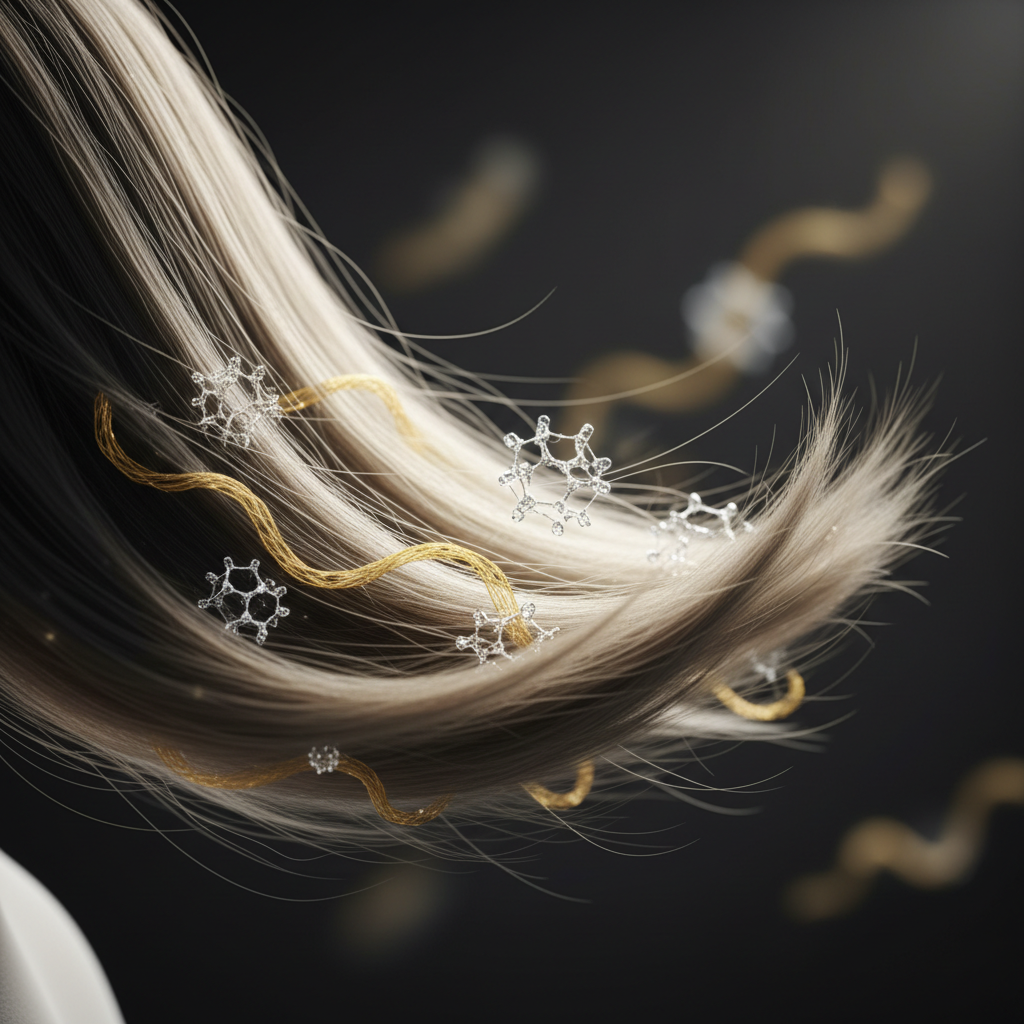
Inside the hair shaft, keratin chains coil into alpha-helices. Pairs of these helices twist around each other to form protofibrils, which assemble into microfibrils and macrofibrils inside cortical cells. This hierarchical organisation provides enormous mechanical resilience. A healthy, intact hair fibre can withstand a load of 100 to 150 grams before snapping, and it can stretch by roughly 20% to 30% of its original length when dry (and up to 50% when wet) before reaching its breaking point.
The true cornerstone of this mechanical strength is the amino acid cysteine, which forms roughly 16% to 18% of hair protein. The sulphur atoms in adjacent cysteine residues form covalent disulphide bonds. Unlike weaker hydrogen bonds that break and reform in the presence of water, disulphide bonds remain intact under normal wet conditions, preserving the structural core of the hair fibre.
Chemical bonds that dictate hair strength
Hair fibre integrity depends on three primary types of chemical interactions within the keratin protein matrix. Each type responds differently to daily handling, water, and styling chemicals.
| Bond Type | Abundance / Relative Strength | How It Breaks | How It Restores | Impact on Fibre Strength |
|---|---|---|---|---|
| Disulphide Bonds | Covalent (High strength) | Chemical reducers, alkaline perms, chemical relaxers, high-lift bleaching | Cannot naturally reform once oxidised; requires specific bond-building chemistry or is permanently lost | Dictates permanent shape and baseline tensile strength |
| Hydrogen Bonds | Non-covalent (Weak, but highly abundant) | Water exposure, high humidity, steam | Re-forms automatically as the hair dries | Controls temporary styling (e.g. blow-outs, heat setting) |
| Salt (Ionic) Bonds | Non-covalent (Moderate strength) | Extreme pH shifts (below pH 3.5 or above pH 5.5) | Re-normalises when hair returns to its natural isoelectric point (pH 4.5 to 5.5) | Maintains cohesion of the protein matrix against daily stress |
What the evidence does not show about topical keratin
While laboratory analyses confirm that native keratin provides internal tensile strength, cosmetic claims often blur the line between biology and topical conditioning.
Topical products cannot regenerate the cortex from within. Once hair emerges from the scalp, it is biologically non-living tissue. Hydrolysed keratin peptides added to shampoos, conditioners, and masks have molecular weights typically ranging from 500 to 3,000 Daltons. While smaller peptides can penetrate into the outer cuticle and superficial cortex layers to improve hydration and surface smoothness, they do not cross-link to become native, intact intermediate filaments.
Furthermore, topical protein treatments cannot resolve hair loss at the follicle. If an individual experiences excessive shedding due to hormonal imbalances, telogen effluvium, or nutritional deficiencies, applying keratin directly to the hair shaft will not stop hairs from exiting the anagen (growth) phase. Protein treatments reduce snapping along the length of the shaft; they do not alter follicular signalling.
How damage disrupts the keratin structure
When hair encounters chemical or physical trauma, the keratin matrix degrades progressively from the outside in.
- Cuticle stripping: The outer layer of the hair consists of overlapping keratin scales coated in a lipid layer known as 18-methyleicosanoic acid (18-MEA). Alkaline chemicals (such as ammonia in colour formulations) lift and strip this protective lipid layer, exposing the underlying protein scales to friction and moisture loss.
- Cortex oxidation: Bleaching agents use hydrogen peroxide to oxidise natural melanin. Concurrently, they oxidise cysteine into cystic acid. This permanent cleavage of disulphide bonds leaves the cortex spongy, porous, and prone to structural collapse.
- Thermal denaturing: Applying flat irons or curling wands above 185°C denatures the alpha-keratin helices, converting them into disordered beta-sheet structures. At temperatures exceeding 215°C to 230°C, the protein literally melts, creating internal voids and micro-fractures.
Signs of keratin depletion and mechanical weakness
Recognising the difference between protein-depleted hair and simple moisture loss prevents styling missteps. Hair with compromised keratin typically exhibits:
- Gummy or mushy texture when wet: Because the disulphide network is fractured, the hair absorbs excessive water (hygral stress) and feels elastic like a rubber band, failing to bounce back to its original length.
- Mid-shaft snapping: Small fragments of hair fall onto your shoulders or sink during gentle brushing, without a white follicular bulb at the end.
- Extreme porosity: The hair absorbs water instantly upon contact but dries out almost immediately, remaining rough and frizzy.
- Loss of natural curl pattern: Wavy and curly hair patterns loosen or become uneven because the internal structural scaffolding can no longer support the hair's shape.
Evidence-based strategies to protect and support keratin
To preserve the role of keratin in hair strength, daily routines should focus on structural prevention and surface reinforcement.
- Maintain the isoelectric point: Human hair has an isoelectric point around pH 3.67, while the scalp sits near pH 5.5. Cleansers and conditioners formulated between pH 4.0 and 5.5 keep the cuticle flat and minimise excess swelling of the keratin matrix in water.
- Use hydrolysed proteins strategically: Hydrolysed keratin, wheat protein, and amino acids temporarily fill gaps in a weathered cuticle. This reduces friction between strands and prevents split ends from migrating upward.
- Control heat exposure: Always keep styling tools below 185°C. Heat protectants containing silicones or conditioning polymers distribute heat evenly and form a thermal barrier that reduces direct protein denaturing.
- Support endogenous keratin via nutrition: Your body builds keratin from dietary amino acids, notably cysteine and methionine, alongside micronutrients like zinc and biotin. While eating keratin does nothing (it simply digests like any dietary protein), consuming adequate total protein provides the biochemical building blocks necessary for healthy keratinisation within the hair bulb.
Watermans approaches to fibre resilience
When external stressors leave the hair cuticle weathered and brittle, targeted topical conditioning helps shield remaining protein structures from further friction. Watermans formulations, such as the Grow Me Shampoo and Condition Me Conditioner, are engineered to support a balanced scalp environment while coating the shaft with fortifying ingredients. Hydrolysed lupin protein and botanical extracts help smooth the cuticle surface and improve wet combability, which substantially lowers mechanical breakage during daily grooming without leaving brittle protein overload on fine strands.
When weakness indicates an underlying medical issue
If your hair breaks despite minimal heat or chemical use, or if you notice diffuse thinning across the scalp, the issue may not be simple mechanical damage. Structural defects like trichorrhexis nodosa (node-like swellings along the shaft) or trichothiodystrophy (hereditary sulphur-deficient brittle hair) require dermatological evaluation.
Likewise, do not mistake hair shedding for breakage. If hairs shedding onto your pillow have a small, rounded white bulb at one end, they have released from the follicle. Conditions like iron-deficiency anaemia, thyroid disorders, and telogen effluvium demand blood tests and consultation with a GP or trichologist rather than cosmetic protein therapies.
Frequently asked questions about The Role of Keratin in Hair Strength
Can salon keratin smoothing treatments actually improve hair strength?
Most salon "keratin smoothing treatments" do not strengthen hair. In fact, many rely on heat and chemical cross-linkers (such as formaldehyde or glyoxylic acid) to break and reset the hair's bonds into a straight alignment at very high temperatures. While they coat the hair in a sleek finish, the intense heat can degrade natural keratin over time, potentially increasing long-term fibre fragility.
How does the role of keratin in hair strength differ between wet and dry hair?
When hair is dry, its strength is supported by both disulphide bonds and millions of rigid hydrogen bonds. When hair gets wet, water molecules infiltrate the cortex and disrupt the hydrogen bonds. This causes the keratin matrix to soften, increasing elasticity but temporarily halving the fibre's resistance to mechanical stretching and snapping.
Can you overuse keratin treatments at home?
Yes. Overusing high-concentration protein treatments without adequate emollients can lead to "protein overload." The excessive surface buildup makes the outer cuticle stiff and rigid. When the hair lacks flexibility, ordinary brushing or styling can cause it to snap under tension.
Does taking keratin supplements make hair grow stronger?
There is limited evidence showing that oral keratin supplements improve hair strength over a standard balanced diet. Dietary keratin is broken down into basic amino acids in the digestive tract. Eating sufficient dietary protein (providing cysteine and methionine) gives your follicles everything they need to produce native keratin naturally.
Conclusion
Understanding the role of keratin in hair strength underscores why the hair shaft requires deliberate protection against chemical and thermal trauma. As an insoluble, sulphur-dense fibrous matrix, native keratin gives your hair its structural backbone, elasticity, and resistance to everyday physical stress. Because the hair shaft cannot biologically repair itself once broken, preserving these vital disulphide bonds through low-heat styling, pH-balanced care, and friction reduction is the single most effective way to keep your hair strong and resilient over its entire lifespan.
Sources and references
- Robbins, C. R. (2012). Chemical and Physical Behavior of Human Hair. 5th ed. Springer Science & Business Media.
- Cruz, C. F., et al. (2016). "Human Hair Keratin After Chemical and Physical Treatments: An Overview." Journal of Applied Cosmetology, 34, 15-27.
- Dawber, R. (1996). "Hair: Its structure and response to cosmetic preparations." Clinics in Dermatology, 14(1), 105-112.
- Society of Cosmetic Chemists (SCC). "Keratin Protein Chemistry and Hair Fibre Mechanics." Monograph series.
- British Association of Dermatologists (BAD). "Hair Shaft Disorders and Breakage: Clinical Guidelines."
Find these ingredients in Watermans products
- Biotin: you will find this ingredient in our Hair Growth Shampoo.