The Role of 18-MEA in Hair Health: Science of the Cuticle F-Layer
9 min read ·
Explore the role of 18-MEA in hair health, how this vital lipid forms the protective F-layer, and how to protect hair when chemical damage occurs.
Quick answer: The role of 18-MEA in hair health centres on its function as the primary lipid boundary covering the outer cuticle. Known scientifically as 18-methyleicosanoic acid, this branched fatty acid forms the hydrophobic F-layer, repelling water, reducing friction, and preventing excessive moisture absorption. The role of 18-MEA in hair health is critical for smoothness and manageability, but the main limitation is that chemical processing, such as bleaching or permanent dyeing, permanently strips it, and the dead hair fibre cannot biologically regenerate it.
Key takeaways
- 18-MEA (18-methyleicosanoic acid) constitutes roughly 40% to 50% of the total lipid content on the outer cuticle surface.
- It is covalently bonded via thioester linkages to sub-surface cysteine-rich proteins, creating the protective, hydrophobic F-layer.
- Bleaching, permanent colouring, chemical relaxing, and prolonged ultraviolet exposure cleave these covalent bonds, turning the hair surface hydrophilic.
- Once chemically stripped, 18-MEA cannot regrow or regenerate along the hair shaft; biological renewal happens only at the follicle as new hair emerges.
- Cosmetic conditioning agents can temporarily mimic the hydrophobic properties of 18-MEA, but they wash out and require continuous replenishment.
The Role of 18-MEA in Hair Health: what the evidence shows
The role of 18-MEA in hair health is foundational to surface physics and fibre protection. Published cosmetic and dermatological literature demonstrates that healthy, virgin hair possesses an outermost lipid monolayer termed the F-layer (epicuticle). The primary component of this monolayer is 18-methyleicosanoic acid, an unusual branched-chain fatty acid.
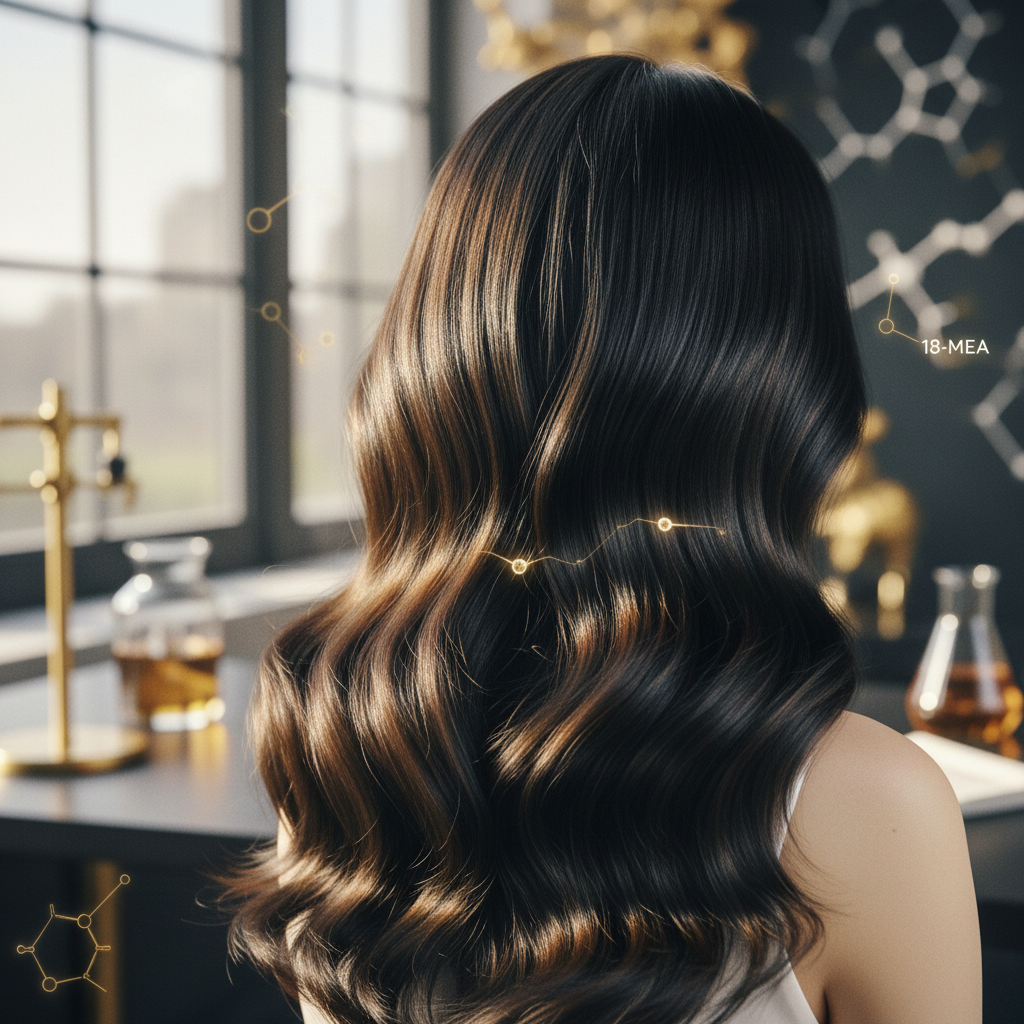
Because the lipid tails orient outward away from the fibre, 18-MEA gives virgin hair a low surface energy. This creates high hydrophobicity, meaning water droplets bead on the surface rather than soaking straight into the cortex. Contact angle measurements on virgin hair fibres typically register above 100 degrees, reflecting strong water repellence.
By keeping the surface hydrophobic, 18-MEA plays several vital roles:
- Friction reduction: It acts as a built-in molecular lubricant, minimising cuticle-on-cuticle friction during combing and styling.
- Porosity control: It stops the hair shaft from swelling excessively when exposed to water or humidity, reducing hygral fatigue.
- Surface integrity: It protects the delicate keratin scales of the cuticle from lifting, chipping, and abrading.
Research confirms that alkaline oxidative treatments, particularly bleaching and permanent hair dyes at pH levels between 9.0 and 10.5, rapidly hydrolyse the thioester bonds anchoring 18-MEA to the cuticle. A single session of alkaline bleaching can remove over 80% of the surface-bound 18-MEA. This shifts the water contact angle down below 60 degrees, transforming the fibre from water-repelling to water-attracting (hydrophilic).
Understanding the structure: how the F-layer functions
To appreciate the role of 18-MEA in hair health, you need to look at how it attaches to the hair shaft. Hair is not a homogeneous rod; it is protected by overlapping cuticle scales, structured like tiles on a roof. Each cuticle cell contains multiple sub-layers, including the epicuticle, the A-layer, the exocuticle, and the endocuticle.
The outermost surface of the epicuticle is where 18-MEA resides. Unlike free lipids such as squalene or sebum, which coat the hair loosely from the sebaceous glands, 18-MEA is chemically bonded. Its carboxyl end forms a covalent thioester bond with cysteine residues in the underlying protein matrix.
Because it is branched at the 18th carbon atom, 18-MEA packs into a slightly disordered, fluid-like monolayer. This molecular arrangement gives virgin hair its distinctively silky, slippery tactile feel. Free sebum produced by the scalp travels down this hydrophobic surface easily, distributing natural oils evenly across the fibre length.
What the evidence does not show
While 18-MEA is essential for surface performance, there are misconceptions regarding its biological and physical scope:
- It does not prevent follicular hair loss: The loss of 18-MEA affects the structural condition of the dead hair fibre. It has no biological connection to androgenetic alopecia, telogen effluvium, or autoimmune hair loss at the follicle level.
- It does not repair internal cortex bonds: 18-MEA is purely a surface phenomenon. Disulphide bond breakage inside the cortex, caused by extreme heat or chemical reduction, cannot be solved by surface lipid restoration.
- Cosmetic products cannot permanently re-graft 18-MEA: While some cosmetic formulations contain synthetic or quat-modified 18-MEA derivatives, these ingredients bind electrostatically, not via permanent covalent thioester bonds. They rinse away over time.
- It does not make hair waterproof: Hair remains a permeable, hygroscopic structure. 18-MEA regulates the rate and balance of moisture exchange, but it does not create an impenetrable seal.
| Feature | Virgin hair (Intact 18-MEA) | Chemically processed hair (Depleted 18-MEA) |
|---|---|---|
| Surface energy | Low (water-repellent) | High (water-attracting) |
| Water contact angle | > 100 degrees | < 60 degrees |
| Surface charge | Low negative charge | High negative charge (cysteic acid exposed) |
| Combability wet | High slip, low mechanical friction | High drag, prone to tangling and wet snapping |
| Moisture uptake | Controlled, gradual | Rapid, excessive swelling (hygral fatigue) |
| Shine and light reflection | Flat, aligned cuticles yield high shine | Disordered cuticles scatter light, looks dull |
Signs of 18-MEA depletion in your hair
When the F-layer is compromised, the signs appear rapidly along the hair shaft. Because the fibre is dead tissue, it cannot self-heal. Look for these distinct mechanical and cosmetic symptoms:
- Instant wetting: When you step into the shower, damaged hair absorbs water instantaneously like a sponge, rather than allowing water to bead and run off.
- Prolonged drying times: Because hydrophilic hair takes in significantly more internal water, blow-drying takes noticeably longer.
- Severe wet friction: Wet hair feels gummy, sticky, or rough to the touch, catching violently against combs or brush bristles.
- Matting and static: Once dry, hair flies away easily due to uneven electrical charges and tangles constantly throughout the day.
- Loss of natural lustre: Without the uniform lipid layer, cuticle margins lift, scattering light unevenly and producing a matte, faded look.
What you can do: protecting and mimicking the lipid layer
Because your follicles cannot send fresh lipids down an already formed hair shaft, preserving your natural 18-MEA is always your best strategy. If it is already damaged, cosmetic mimicry is the next best path.
Minimise irreversible chemical lifting
Oxidative processes are the primary enemy of 18-MEA. High-lift bleaches, regular permanent tinting, and strong perm lotions strip the lipid layer in minutes. If you colour your hair, ask your colourist about lower-pH demi-permanent options or bond-protecting systems that lower the degree of surface lipid stripping.
Shield against ultraviolet (UV) radiation
Solar UV radiation produces free radicals that oxidise the thioester linkages of 18-MEA, even on hair that has never been dyed. Wearing hats or applying leave-in conditioning formulas containing UV filters helps conserve your natural lipid shield during extended sun exposure.
Use biomimetic conditioning agents
Cosmetic chemists formulate specific ingredients to replicate the role of 18-MEA in hair health. Cationic surfactants, quaternary ammonium compounds (such as behentrimonium chloride or cetrimonium methosulfate), and quat-modified 18-MEA (quaternium-33) bind strongly to the negatively charged cysteic acid sites exposed when natural 18-MEA is stripped. While temporary, regular application restores hydrophobicity, brings back slip, and shields against mechanical breakage.
Mind the water temperature and mechanical habits
Washing in lukewarm water rather than scalding hot water limits swelling of the cuticles. Always apply a slippery leave-in detangler before brushing wet hair to compensate for missing lipid lubrication, preventing fibre breakage along the mid-lengths.
When the cause of damage may be something else
If your hair snaps easily, feels brittle, or looks thin, do not assume 18-MEA loss is the only culprit. Other structural and systemic issues mimic or worsen surface lipid loss:
- Cortex degradation: Intense heat styling (above 185°C) denatures fibrous keratin and destroys internal disulphide bonds. Hair with full 18-MEA can still snap if the internal cortex is scorched.
- Hard water minerals: High concentrations of calcium, magnesium, and copper create rough, insoluble mineral deposits on the cuticle. This produces friction and stiffness that mimics lipid loss, but requires chelating treatments rather than simple conditioning.
- True hair shedding vs breakage: If you notice hair collecting on your brush with small white bulbs on the end, that is hair shedding from the follicle (such as telogen effluvium), not mechanical breakage from lipid depletion.
When to seek professional advice
Consult a qualified trichologist or dermatologist if you experience sudden, diffuse hair thinning, patchy bald spots, or persistent scalp irritation, redness, or burning. These symptoms point toward scalp or follicular health disorders rather than cuticle-level lipid depletion. For fibre damage, an experienced salon stylist can perform an elasticity and porosity test to design a structural conditioning routine.
Supporting hair condition: the Watermans approach
Maintaining visibly resilient, strong-feeling hair involves caring for both the growing scalp environment and the exposed fibre. While no topical cosmetic can regrow the natural 18-MEA lipid layer on damaged hair shafts, healthy hair growth begins at the follicle.
Watermans products, including the GrowMe shampoo range, focus on delivering a balanced, premium wash that leaves the scalp refreshed and the hair fibre moisturised, soft, and visibly fuller. Integrating targeted cleansing with gentle conditioning helps keep the hair shaft manageable, reducing the friction and mechanical stress that lead to snapping.
Frequently asked questions about The Role of 18-MEA in Hair Health
What is the exact role of 18-MEA in hair health?
The role of 18-MEA in hair health is to serve as the hair's natural waterproof sealant. As the key component of the cuticle's F-layer, it repels excess moisture, reduces combing friction, and creates a smooth, hydrophobic shield across every virgin hair strand.
Can 18-MEA be permanently restored once it is bleached off?
No, 18-MEA cannot be permanently reattached. The thioester bond connecting it to the cuticle is destroyed by chemical oxidation. Products containing quaternium-33 or conditioning lipids can temporarily stick to damaged spots to mimic its slip, but they wash away and require regular reapplication.
How does loss of 18-MEA cause hair breakage?
When 18-MEA is lost, the cuticle becomes rough, negatively charged, and hydrophilic. This spikes surface friction during brushing and washing. The cuticles snag against neighbouring fibres, leading to tangles, raised scales, and eventual mechanical breakage along the shaft.
Does sebum replace missing 18-MEA?
Sebum does not replace 18-MEA. Sebum is a blend of free fatty acids, triglycerides, and squalene produced by sebaceous glands, while 18-MEA is a covalently bound structural lipid. While sebum lubricates the hair, it cannot recreate the covalently locked F-layer.
Can heat tools strip the 18-MEA layer?
Excessive heat does degrade surface lipids. Temperatures above 180°C can melt and oxidise surface fatty acids over time. While alkaline chemicals remove 18-MEA much faster, repeated high-heat styling gradually erodes the lipid layer and compromises the underlying cuticle proteins.
Rebuilding protection for damaged hair
Understanding the role of 18-MEA in hair health transforms how you approach daily washing, styling, and chemical treatments. This microscopic fatty acid layer represents nature's engineering at its finest: an ultra-thin, durable, water-repelling coat that protects your hair fibre from the elements. While modern salon processes easily strip this delicate F-layer, consistent care, heat restraint, and lipid-mimicking conditioning ingredients ensure your hair stays smooth, glossy, and resistant to mechanical breakage.
Sources and references
- Journal of Cosmetic Science: "The chemical and physical properties of the hair surface: the role of 18-MEA."
- International Journal of Cosmetic Science: "Surface characterization of human hair: the epicuticle and the F-layer."
- Robbins, C. R., Chemical and Physical Behavior of Human Hair, Springer-Verlag, 5th Edition.
- Society of Cosmetic Chemists (SCC): Monograph series on lipid composition of human hair.
Find these ingredients in Watermans products
- Copper: you will find this ingredient in our Hair Vitamins.