Restoring the Scalp Skin Barrier: A Dermatological Guide
8 min read ·
Learn how to repair a dry, tight, or irritated scalp. Our expert guide explains the science of restoring the scalp skin barrier with proven lipids, pH, and care.

Quick answer: Restoring the Scalp Skin Barrier involves repairing the outermost epidermal layer (the stratum corneum) by replenishing intercellular lipids, balancing scalp hydration, and returning surface acidity to its physiological level of pH 4.5 to 5.5. A compromised barrier presents as flaking, redness, tightness, and itching. While cosmetic adjustments resolve routine disruption within two to four weeks, restoring the scalp skin barrier cannot cure chronic inflammatory dermatoses like psoriasis or seborrhoeic dermatitis without targeted medical care.
Key takeaways
- The scalp barrier relies on an acid mantle (pH 4.5 to 5.5) and a lipid matrix composed of ceramides, cholesterol, and free fatty acids.
- Frequent washing with alkaline surfactants or hot water strips essential lipids, increasing transepidermal water loss (TEWL).
- Distinguishing between dry flaking caused by barrier disruption and greasy scaling caused by fungal overgrowth is vital for choosing the right treatment.
- Topically applied humectants, physiological lipids, and mild, pH-balanced cleansers accelerate epidermal recovery.
- Complete stratum corneum turnover takes approximately 28 days, meaning barrier restoration requires consistent care over several weeks.
Restoring the Scalp Skin Barrier: what the evidence shows
Restoring the scalp skin barrier requires re-establishing the structural integrity of the stratum corneum, which acts as the body's primary shield against environmental pathogens and moisture loss. Dermatological research shows that the scalp skin barrier functions identically to facial skin in its cellular architecture, yet it possesses a higher density of sebaceous glands and hair follicles. This unique microenvironment makes it prone to rapid microbial shifts when its defences falter.

When dermatologists measure barrier health, they look at transepidermal water loss (TEWL). Elevated TEWL indicates that moisture is escaping uncontrollably from the viable epidermis. Controlled clinical trials demonstrate that applying physiological lipid ratios (ceramides, cholesterol, and free fatty acids) significantly accelerates barrier recovery compared to non-physiological oils. Restoring the scalp skin barrier also requires maintaining an acidic surface pH between 4.5 and 5.5. Studies confirm that alkaline exposures, such as bar soaps or high-pH shampoos (pH 7.0 and above), activate kallikreins (serine proteases) that degrade corneodesmosomes prematurely, leading to flaking, micro-inflammation, and irritation.
Biological mechanisms of scalp barrier disruption
The brick-and-mortar model describes the stratum corneum: corneocytes form the bricks, and intercellular lamellar lipids form the mortar. The mortar consists of roughly 50% ceramides, 25% cholesterol, and 15% free fatty acids. In a healthy scalp, these lipids form dense sheets that seal water inside and prevent irritants from penetrating into the dermis.
Barrier breakdown occurs when external or internal insults disturb this matrix:
- Surfactant extraction: Strong anionic surfactants, such as poorly buffered sodium lauryl sulphate, insert themselves into lipid bilayers, solubilising essential ceramides and denaturing protective keratin proteins.
- pH elevation: Raising scalp pH above 5.5 disrupts the acid mantle. This neutralises the enzymatic synthesis of ceramides, which requires an acidic environment (specifically for beta-glucocerebrosidase and acid sphingomyelinase activity).
- Microbiome imbalance: Elevated pH and lipid depletion alter the scalp microbiome. Commensal organisms like Cutibacterium acnes decline, allowing opportunistic fungal proliferation (such as Malassezia restricta and Malassezia globosa), which release irritating free fatty acids through sebum digestion.
- Neurogenic inflammation: As the barrier thins, irritants contact unmyelinated C-nerve fibres in the dermis, releasing substance P and calcitonin gene-related peptide. This cascade triggers itching, burning sensations, and capillary dilation (erythema).
Recognising the signs: barrier damage versus fungal conditions
A damaged skin barrier is frequently misdiagnosed as simple dandruff or poor hygiene, leading people to use harsh anti-dandruff washes that strip the barrier further. Identifying the exact symptoms ensures you do not aggravate an already delicate epidermis.
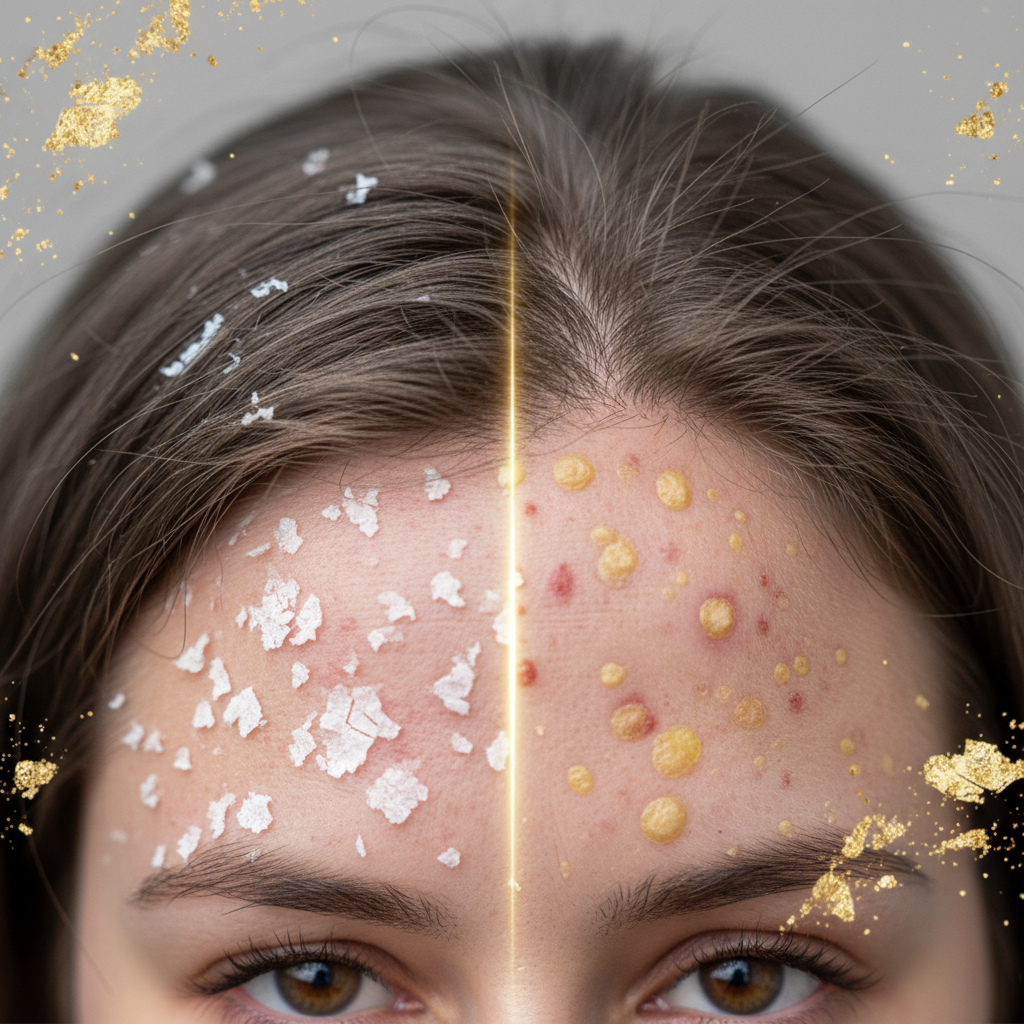
| Clinical Feature | Compromised Scalp Barrier | Seborrhoeic Dermatitis | Scalp Psoriasis |
|---|---|---|---|
| Flake Texture | Fine, white, powdery, dry | Greasy, yellowish, clumped | Thick, silvery, adherent plaques |
| Scalp Sensation | Tightness, stinging on product application | Pruritus (intense itching) | Soreness, itching, burning |
| Erythema (Redness) | Diffuse, mild pinkness | Well-demarcated pink-to-yellow patches | Well-defined red plaques with clear borders |
| Primary Driver | Lipid depletion, mechanical/chemical damage | Malassezia yeast overgrowth, sebum reaction | Autoimmune keratinocyte hyperproliferation |
| First-line Action | Gentle, low-pH moisturising care | Antifungal agents (e.g., ketoconazole) | Medical evaluation, topical corticosteroids |
Practical steps for restoring the scalp skin barrier
Restoring the scalp skin barrier involves removing aggressive external irritants while actively delivering structural lipids and humectants to the stratum corneum.
1. Adjust washing habits and water temperature
Wash hair using lukewarm water, never hot. Water temperatures above 40 degrees Celsius melt cutaneous surface lipids and accelerate dehydration. Wash frequency should balance hygiene without over-cleansing: washing every 2 to 3 days works well for most disrupted scalps.
2. Switch to acidic, low-foaming cleansers
Look for shampoos formulated at a physiological pH of 4.5 to 5.5. Avoid harsh sulphate-based detergents if your scalp feels tight or stings after washing. Look for gentle amphoteric or non-ionic surfactants, such as cocamidopropyl betaine, decyl glucoside, or sodium cocoyl isethionate.
3. Deliver biomimetic lipids and humectants
Apply leave-on or pre-wash scalp serums that feature bio-identical barrier components:
- Glycerin and Hyaluronic Acid: Humectants that draw atmospheric water into dehydrated corneocytes.
- Ceramides (NP, AP, EOP): Rebuild the lamellar sheet structure in intercellular spaces.
- Niacinamide (Vitamin B3): Proven in dermatological studies to stimulate endogenous ceramide synthesis and reduce micro-inflammation.
- Panthenol (Pro-Vitamin B5): Enhances stratum corneum hydration and soothes trans-epidermal irritation.
4. Limit chemical and thermal stressors
Cease scalp bleaching, chemical relaxing, oxidative hair dyes, and direct heat application from hairdryers until the barrier recovers. Heat and high-pH chemical processes dissolve the protective outer lipid layers of both hair fibre and scalp skin.
What the evidence does not show
There is no scientific proof that smothering a compromised scalp in heavy kitchen oils like raw coconut oil or olive oil restores the barrier efficiently. Olive oil is rich in oleic acid, which peer-reviewed studies show actually disrupts stratum corneum lamellar lipids and can induce irritant contact dermatitis. Furthermore, oleic acid fuels Malassezia species, worsening flaking.
Additionally, barrier repair topical products cannot cure male or female pattern hair loss (androgenetic alopecia). While a healthy scalp environment provides an optimal foundation for follicular performance and reduces reactive shedding (telogen effluvium), barrier repair treatments do not block dihydrotestosterone (DHT) or reverse genetic miniaturisation.
Supporting scalp wellness with Watermans
When working on everyday scalp comfort and hair resilience, gentle cosmetic formulas can support a balanced environment. Watermans Grow Me Shampoo is designed with revitalising botanicals, biotin, and rosemary, formulated to clean hair thoroughly without relying on stripping, aggressive systems that compromise the scalp. Pairing purposeful cleansing with an energising leave-in treatment, such as Watermans Grow More Elixir, delivers hydration and scalp-nourishing vitamins directly to the roots. While cosmetic formulations cannot replace dermatological medicine, a thoughtful scalp-first regimen helps maintain an optimal environment for hair to flourish.
When the cause may be an underlying medical condition
If your scalp shows signs of cracking, crusting, yellow oozing, or persistent bleeding, the root issue extends beyond simple barrier wear. Conditions that mimic barrier breakdown include:
- Atopic Dermatitis: Systemic allergic diathesis causing chronic eczema.
- Contact Dermatitis: An allergic reaction to a specific ingredient, such as paraphenylenediamine (PPD) in hair dyes or methylisothiazolinone (MI) in rinse-off cosmetics.
- Tinea Capitis: A fungal dermatophyte infection common in school-age children, requiring oral antifungals.
- Cicatricial (Scarring) Alopecia: Inflammatory conditions such as lichen planopilaris or frontal fibrosing alopecia that destroy follicles permanently.
If symptoms fail to improve after three weeks of gentle barrier care, consult a dermatologist or an accredited trichologist for a physical examination and dermoscopy.
Frequently asked questions about Restoring the Scalp Skin Barrier
How long does Restoring the Scalp Skin Barrier usually take?
Restoring the scalp skin barrier generally takes between two and four weeks. This timeframe aligns with the epidermal renewal cycle, where basal keratinocytes differentiate, migrate upward to form the stratum corneum, and naturally shed over roughly 28 days. Minor surface irritation may calm down within a few days of stopping harsh products, but rebuilding a robust lipid matrix requires consistent gentle care across the full cycle.
Can a damaged scalp barrier cause hair loss?
A damaged scalp barrier does not cause follicular hair loss like androgenetic alopecia, but it can trigger temporary hair shedding or hair breakage. Barrier breakdown induces itching and micro-inflammation. Vigorous scratching causes mechanical trauma to the root and breaks fragile hair fibres. Severe inflammatory distress around the infundibulum can also push vulnerable follicles prematurely into the telogen (resting) shedding phase.
Should I exfoliate my scalp if my barrier is compromised?
No, you should not physically scrub or chemically peel a compromised scalp barrier. Exfoliation with physical scrubs, salicylic acid, or glycolic acid strips the remaining fragile corneocytes that are desperately trying to seal the epidermis. When your barrier is actively inflamed or dry, pause all chemical and mechanical exfoliants until the scalp feels comfortable, moisturised, and flake-free.
Will applying pure natural oils fix my scalp barrier?
Not necessarily. While mineral oils and certain lightweight plant oils can create an occlusive film that slows water evaporation, pure oils lack the balanced 3:1:1:1 physiological ratio of ceramides, cholesterol, and fatty acids needed to repair the deeper cellular mortar. Some oils, such as olive oil, contain high levels of oleic acid, which degrades barrier cohesion and can worsen redness and fungal flaking.
Conclusion
Restoring the scalp skin barrier is fundamentally an exercise in cellular preservation and patience. The skin on your scalp requires the same thoughtful care as the skin on your face: a stable acidic pH, balanced intercellular lipids, and protection from mechanical and thermal trauma. By eliminating harsh alkaline cleansers, avoiding scalding wash water, and introducing biomimetic moisturising agents, you create the conditions needed for the epidermis to rebuild itself. Listen to early warning signs of tightness, stinging, and dry flaking, and remember that long-term scalp comfort always starts with protecting the integrity of your skin barrier.
Sources and references
- British Association of Dermatologists. Scalp Care and Common Scalp Conditions Clinical Guidelines, 2022.
- Elias, P. M. "Skin barrier function: basic concepts and clinical applications." Journal of Investigative Dermatology, 2005.
- Rawlings, A. V., and Harding, C. R. "Moisturization and skin barrier function." Dermatologic Therapy, 2004.
- Trüeb, R. M. "The impact of oxidative stress on hair." International Journal of Cosmetic Science, 2015.
- Cork, M. J., et al. "Epidermal barrier dysfunction in atopic dermatitis." Journal of Allergy and Clinical Immunology, 2006.
Find these ingredients in Watermans products
- Oleic Acid: you will find this ingredient in our Camellia & Black Castor Hair & Body Oil.
- Niacinamide: you will find this ingredient in our Hair Mask.
- Panthenol (Provitamin B5): you will find this ingredient in our Heat Protection Spray.