Dandruff vs Dry Scalp Differences: Clinical Guide and Solutions
10 min read ·
Learn the real Dandruff vs Dry Scalp Differences. Understand causes, flake types, yeast activity, barrier hydration, and how to treat your scalp correctly.

Quick answer: Understanding Dandruff vs Dry Scalp Differences comes down to moisture versus oil and microbial activity. Dry scalp occurs when the skin barrier loses hydration, producing tiny, white, dry flakes and tight skin. Dandruff is an inflammatory response to excess sebum and an overgrowth of Malassezia yeast, producing larger, greasy, yellowish flakes accompanied by redness and itching. The main limitation is that visual inspection alone can miss overlapping dermatological conditions such as seborrhoeic dermatitis, scalp psoriasis, or contact eczema, which require tailored clinical care.
Key takeaways
- Root causes differ entirely: Dry scalp stems from a compromised epidermal lipid barrier and dehydration, whereas dandruff stems from an inflammatory response driven by Malassezia yeast metabolising sebum.
- Flake characteristics provide clues: Dry scalp sheds small, powdery, non-adherent white specks. Dandruff produces larger, clumped, oily flakes that often look yellow or greyish.
- Washing frequency plays opposite roles: Infrequent washing worsens dandruff by allowing natural sebum to accumulate, while excessive washing with harsh detergents strips moisture and worsens a dry scalp.
- Targeted treatments are required: Hydrating humectants and barrier-repairing lipids soothe dry scalp, whereas dandruff requires anti-fungal or cytostatic active ingredients to regulate yeast and cell turnover.
- Rule out mimickers: Chronic redness, thick silvery scales, or inflammation spreading beyond the hairline point towards scalp psoriasis, seborrhoeic dermatitis, or allergic contact dermatitis rather than simple dryness.
Dandruff vs Dry Scalp Differences: what the evidence shows
When assessing Dandruff vs Dry Scalp Differences, clinical dermatology looks at the integrity of the stratum corneum, sebum excretion rates, and the scalp microbiome. Although both conditions cause flakes to fall onto your shoulders, their underlying biological mechanisms are fundamentally opposed.
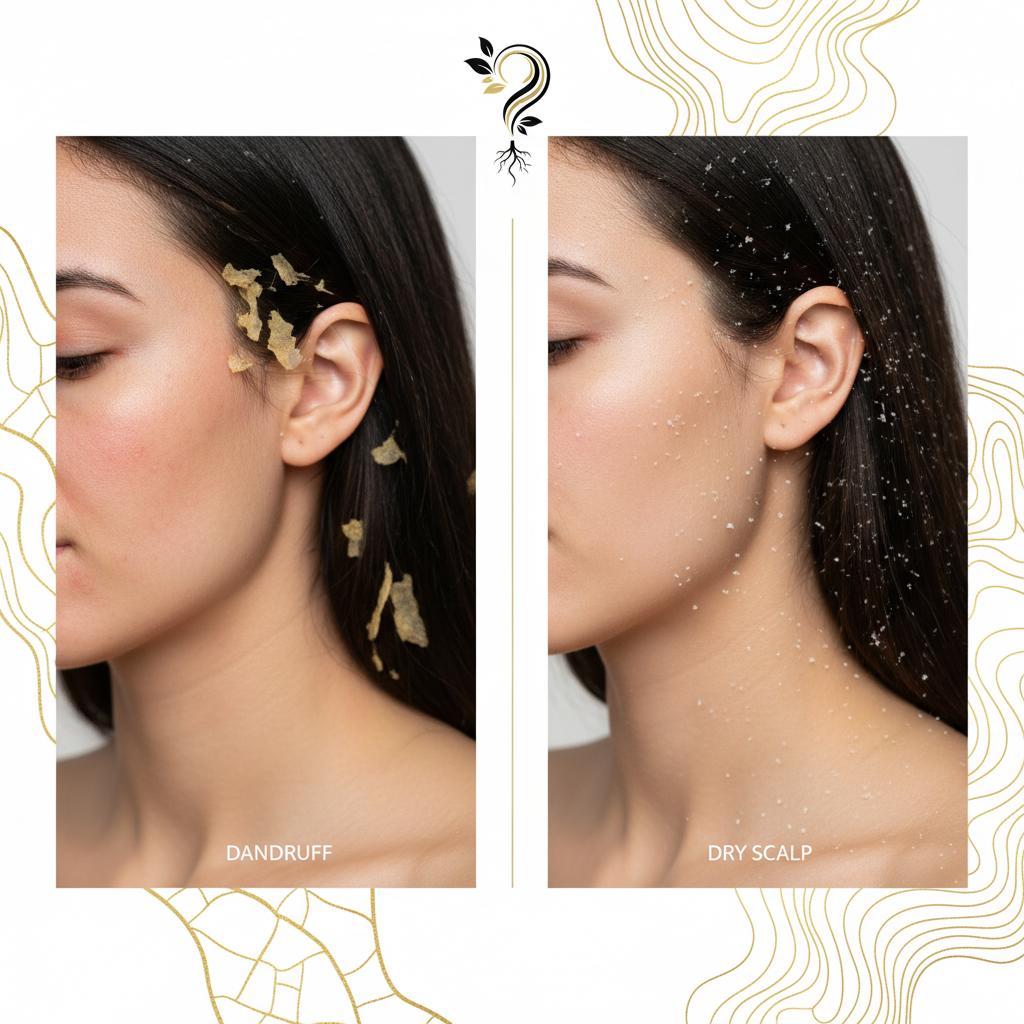
Dry scalp (xerosis capitis) occurs when the stratum corneum lacks adequate water content. Normal scalp skin maintains an optimal water balance through natural moisturising factors (NMF) and intercellular lipids (ceramides, cholesterol, and free fatty acids). When these lipids become depleted due to environmental factors, harsh surfactants, or low humidity, transepidermal water loss (TEWL) increases. The surface corneocytes shrink, lose cohesion, and detach prematurely in tiny, visible clusters.
Dandruff (pityriasis capitis) is considered a mild, non-curative, non-contagious form of seborrhoeic dermatitis. Research shows that three key factors must align for dandruff to manifest: high sebum production, the presence of lipophilic yeasts from the genus Malassezia (predominantly Malassezia restricta and Malassezia globosa), and individual scalp barrier susceptibility. Malassezia species feed on triglycerides within sebum, breaking them down into free fatty acids. They consume saturated fatty acids and leave behind unsaturated fatty acids, such as oleic acid. In susceptible individuals, oleic acid penetrates the compromised skin barrier, inducing subclinical inflammation and accelerating epithelial turnover from the typical 28-day cycle down to 7 to 14 days. This rapid epidermal turnover forces immature, nucleated corneocytes to clump together with sebum, forming visible, greasy flakes.
Comparison: Dandruff vs Dry Scalp Differences
The following table breaks down the clinical and cosmetic distinctions between the two conditions:
| Diagnostic Feature | Dry Scalp | Dandruff |
|---|---|---|
| Primary Driver | Lack of moisture; high transepidermal water loss | Sebum excess and Malassezia yeast metabolites |
| Flake Appearance | Tiny, dry, white, fine dust-like particles | Larger, oily, yellow or off-white clumps |
| Scalp Texture | Dry, tight, rough to the touch | Oily, greasy, sometimes slightly moist |
| Itch Severity | Mild to moderate, often accompanied by tightness | Moderate to intense, pruritogenic inflammation |
| Shedding Pattern | Drops freely from the hair when brushed | Often adheres to the hair shaft and scalp |
| Impact of Washing | Worsened by frequent shampooing or strong surfactants | Improved by frequent, regular scalp cleansing |
| Associated Symptoms | Dry skin elsewhere on the body (e.g. limbs, face) | Oily patches on eyebrows, nasolabial folds, or chest |
What the evidence does not show
Dermatological literature clearly refutes several common myths about these two scalp states:

- Dandruff is not caused by poor hygiene: While infrequent washing allows sebum and yeast metabolites to accumulate, poor hygiene does not initiate dandruff. The fundamental trigger is an individual inflammatory susceptibility to Malassezia by-products.
- Dandruff is not contagious: You cannot catch dandruff from sharing hairbrushes, hats, or pillows with someone experiencing active flaking. Malassezia is a normal commensal organism found on almost all human scalps after puberty.
- Oil treatments do not cure dandruff: Applying vegetable oils such as olive oil or coconut oil to a dandruff-prone scalp often worsens the issue. Malassezia thrives on lipid sources and uses them to fuel further replication and fatty acid production.
- Dry scalp does not cause follicular hair loss: Simple epidermal dehydration does not destroy the hair follicle. However, severe scratching induced by intense pruritus can cause mechanical damage, leading to hair breakage or temporary shedding (telogen effluvium).
Signs and symptoms: how to tell them apart
Determining whether you have a dry scalp or dandruff relies on evaluating your daily hair cycle and scalp feel.
Signs of a dry scalp
- The scalp feels tight, taut, or slightly stinging after hot showers or exposure to dry winter winds.
- Flakes are small, translucent or bright white, and float away easily when you run your fingers through your hair.
- You tend to experience dry skin on other areas of your body, including your legs, arms, and hands.
- Brushing your hair produces a light dusting across your collar rather than oily patches stuck to your roots.
Signs of dandruff
- The scalp feels greasy within 24 to 48 hours of washing, often accompanied by a distinct musky scalp odour.
- Flakes are noticeably thick, yellowish, or dull white, often clumping around the base of hair shafts.
- Redness or patchy erythema may be visible around the follicular ostia or along the hairline.
- The itch feels deep, persistent, and inflammatory rather than a surface prickle.
Management strategies for dry scalp
Managing a dry scalp involves restoring lipid barriers and reducing moisture evaporation:
- Lower water temperature: Wash your hair with lukewarm water rather than steaming hot water, which dissolves protective intercellular lipids and raises TEWL.
- Use gentle, sulphate-free cleansers: Switch to mild, amphoteric or non-ionic surfactant formulations that clean the hair without stripping the skin's acidic mantle (pH 4.5 to 5.5).
- Incorporate scalp hydrators: Look for leave-on scalp serums containing humectants such as hyaluronic acid, glycerin, or panthenol, balanced with light barrier lipids like squalane.
- Adjust wash frequency: If your hair and scalp do not produce excessive sebum, spacing washes out to two or three times a week can prevent barrier disruption.
Management strategies for dandruff
Targeting dandruff requires suppressing yeast populations, removing scale buildup, and calming local inflammation:
- Anti-fungal actives: Over-the-counter shampoos containing ketoconazole (1% to 2%), piroctone olamine, or zinc pyrithione work by disrupting the cellular membranes of Malassezia yeasts.
- Keratolytic agents: Ingredients such as salicylic acid break down the protein bonds between corneocytes, loosening thick scales so they rinse away cleanly.
- Cytostatic agents: Selenium sulfide and coal tar slow down the accelerated rate of epidermal cell division, reducing the formation of large clusters.
- Regular scalp cleansing: Wash frequently, daily or every other day, to remove accumulating sebum before Malassezia can break it down into irritating oleic acid.
- Contact time matters: Always allow medicinal or active clarifying shampoos to sit on the scalp for 3 to 5 minutes before rinsing to let the ingredients penetrate the upper follicular funnel.
When the cause is something else
If your scalp flaking fails to respond to either moisturising regimens or anti-dandruff washes within three to four weeks, the cause may be another dermatological condition:
- Scalp psoriasis: Characterised by sharply demarcated, raised, erythematous plaques covered with thick, silvery-white micaceous scales. Psoriasis often extends slightly beyond the hairline and can affect the elbows, knees, or nails.
- Seborrhoeic dermatitis: A more extensive inflammatory state of dandruff that spreads beyond the scalp into the eyebrows, behind the ears, the nasolabial folds, and the sternum, presenting with greasy yellow scales and intense erythema.
- Allergic contact dermatitis: A reaction to fragrances, preservatives (such as methylisothiazolinone), or hair dye compounds (such as paraphenylenediamine/PPD), resulting in sudden burning, weeping, intense itch, and peeling.
- Tinea capitis: A fungal dermatophyte infection, more common in children, which presents with circular scaly patches, brittle broken hairs ("black dots"), and sometimes swollen lymph nodes.
Supporting the scalp with Watermans
Maintaining a balanced, healthy-looking scalp environment benefits both root health and hair appearance. The Watermans range focuses on cosmetic scalp care and hair vitality through thoughtfully balanced formulations:
- Watermans Grow Me Shampoo: Formulated without harsh, stripping agents, this daily cleanser contains biotin, rosemary extract, niacinamide, caffeine, and allantoin to gently cleanse the scalp surface, lift debris, and leave the hair looking thicker and fuller.
- Watermans Condition Me Conditioner: Provides lightweight moisture with cholesterol, shea butter, and natural oils, hydrating the hair fibre and conditioning dry-feeling scalps without creating heavy grease or suffocating buildup.
These cosmetic products are designed to support a clean, invigorated scalp environment and promote stronger-feeling hair. They are not medicinal treatments for clinical fungal infections or chronic psoriasis.
Frequently asked questions about Dandruff vs Dry Scalp Differences
Can you have both dandruff and a dry scalp at the same time?
Yes, it is possible. You can possess a naturally dehydrated scalp barrier that also experiences localised Malassezia overgrowth and excess sebum production. When evaluating Dandruff vs Dry Scalp Differences, addressing this combination requires alternating a targeted anti-fungal shampoo with a soothing, hydrating scalp serum to avoid further moisture loss.
Does washing your hair every day cause dandruff?
No. Daily washing does not cause dandruff. In fact, people prone to dandruff often benefit from daily cleansing because it removes the excess sebum that feeds Malassezia yeast. However, daily washing with harsh, highly alkaline shampoos can cause a dry scalp by stripping natural skin barrier lipids.
How long does it take to see improvements after switching routines?
Most people see changes within two to four weeks. Epidermal turnover takes roughly 28 days under normal conditions. If you are treating a dry scalp with barrier hydrators or treating dandruff with active anti-fungal agents, allow at least three weeks of consistent application before assessing whether the flaking has subsided.
Does drinking more water cure a dry scalp?
While systematic hydration supports overall organ function, drinking water alone will not resolve an externally damaged scalp barrier. Topical moisture loss is driven primarily by external factors, hot water, and surfactant exposure. Topical humectants and barrier-repairing lipids are far more effective at restoring stratum corneum hydration than water intake alone.
Can oiling my scalp get rid of dandruff?
No, oiling your scalp usually makes dandruff worse. The yeasts responsible for dandruff feed directly on lipids and fatty acids. Applying heavy natural oils provides additional nutrients for Malassezia to proliferate, worsening inflammation and scaling. Oil treatments should only be used carefully on genuinely dry, non-inflamed scalps.
Summing up Dandruff vs Dry Scalp Differences
Recognising Dandruff vs Dry Scalp Differences is the critical first step in restoring comfort, balance, and shine to your hair. Dry scalp requires moisture preservation, milder cleansers, and barrier support to prevent fine, white flakes from peeling away. Dandruff requires targeted anti-fungal agents, regular cleansing, and sebum control to neutralise yeast activity and break down thick, oily scales. If your symptoms persist despite targeted care, or if you develop marked redness, swelling, or pain, consult a registered trichologist or dermatologist for an accurate clinical diagnosis.
Sources and references
- British Association of Dermatologists. Seborrhoeic Dermatitis Guidelines and Patient Information, 2021.
- National Institute for Health and Care Excellence (NICE). Seborrhoeic Dermatitis: Management, Clinical Knowledge Summaries, 2022.
- PubMed Central. Dandruff: The most commercially exploited skin disease, Indian Journal of Dermatology, 2011.
- National Health Service (NHS). Dandruff Causes, Treatments and Overview, 2023.
- Journal of Investigative Dermatology. The Role of Malassezia in Seborrhoeic Dermatitis and Dandruff, 2015.
Find these ingredients in Watermans products
- Zinc: you will find this ingredient in our Hair Vitamins.
- Oleic Acid: you will find this ingredient in our Camellia & Black Castor Hair & Body Oil.
- Niacinamide: you will find this ingredient in our Hair Mask.
- Panthenol (Provitamin B5): you will find this ingredient in our Heat Protection Spray.
- Shea Butter: you will find this ingredient in our Curly Hair Conditioner.