Healthy Scalp Microbiome Basics: The Complete Evidence-Based Guide
8 min read ·
Explore healthy scalp microbiome basics, covering the balance of bacteria and fungi, pH levels, dysbiosis signs, and practical evidence-based care routines.
Quick answer: Understanding Healthy Scalp Microbiome Basics begins with recognising that millions of bacteria and fungi naturally colonise your skin to defend against pathogens, regulate sebum breakdown, and maintain the skin barrier. A balanced ecosystem prevents irritation, flaking, and inflammation. However, cosmetic products cannot permanently cure chronic medical dermatoses, and an individual's microflora varies dramatically based on genetics, climate, age, and personal hygiene practices.
Key takeaways
- The scalp microbiome is a complex ecosystem dominated primarily by bacteria (Cutibacterium acnes, Staphylococcus epidermidis) and fungi (Malassezia species).
- The natural scalp environment is slightly acidic, typically resting at a pH between 4.5 and 5.5, which discourages opportunistic microbial overgrowth.
- Dysbiosis, or microbial imbalance, correlates strongly with common scalp disorders such as dandruff and seborrhoeic dermatitis.
- Harsh cleansing agents, excessive heat, and heavy product build-up disrupt the delicate moisture barrier and microflora balance.
- Cosmetic care supports barrier health and comfort, but persistent inflammation, severe scaling, or follicular hair loss requires clinical evaluation by a GP or dermatologist.
Healthy Scalp Microbiome Basics: what the evidence shows
Learning Healthy Scalp Microbiome Basics means looking closely at skin biology and microbiology. The human scalp possesses a high density of sebaceous glands and terminal hair follicles. This anatomy creates a unique ecological niche rich in lipids, proteins, and moisture. Rather than being sterile, a normal scalp hosts trillions of micro-organisms that live in mutualistic harmony with human cells.
Microbiological studies consistently show that two bacterial phyla dominate the scalp: Actinomycetota (formerly Actinobacteria) and Bacillota (formerly Firmicutes). At the species level, Cutibacterium acnes and Staphylococcus epidermidis make up over 85% to 90% of the bacterial population on a balanced scalp. C. Acnes thrives in the lipid-dense environment deeper within the hair follicle, while S. Epidermidis colonises the superficial stratum corneum.
The fungal community, or mycobiome, is overwhelmingly dominated by the genus Malassezia, particularly Malassezia restricta and Malassezia globosa. These yeasts are lipophilic, meaning they cannot synthesise their own fatty acids. They rely on host sebum, breaking down triglycerides into free fatty acids using lipase enzymes.
When this ecosystem is balanced, these organisms protect the host. They produce antimicrobial peptides, outcompete harmful external pathogens, and help sustain an acid mantle with a pH of 4.5 to 5.5. The bacteria and fungi also keep each other in check. Research demonstrates that S. Epidermidis and C. Acnes produce metabolites that restrict the over-proliferation of one another, maintaining a stable microbial equilibrium.
What the evidence does not show
There are widespread misconceptions about the scalp flora that research does not support:
- Sterilisation is not the goal: Clinical evidence does not support using aggressive antibacterial or harsh antiseptic cleansers on an otherwise healthy scalp. Eradicating native bacteria removes your first line of defence, clearing space for resistant pathogens or yeast overgrowth.
- Microbes do not directly cause pattern hair loss: An imbalanced microbiome does not directly cause androgenetic alopecia. While severe, prolonged surface inflammation can exacerbate shedding or impair hair fibre anchorage, it is fundamentally driven by genetics and dihydrotestosterone (DHT), not fungal infection.
- Topical probiotics have limited lasting colonization: Skincare and haircare formulas advertising live probiotic cultures rarely introduce permanent colonies to your scalp. The resident flora fiercely resists foreign strains. Most benefits from topical cosmetic ferments stem from postbiotics (metabolites like lactic acid) supporting barrier hydration, rather than live bacteria colonising the tissue.
The mechanism: how dysbiosis creates scalp problems
To maintain comfort, your scalp relies on three intertwined factors: the host skin barrier, sebum production, and the microflora. When external or internal conditions shift, dysbiosis occurs.
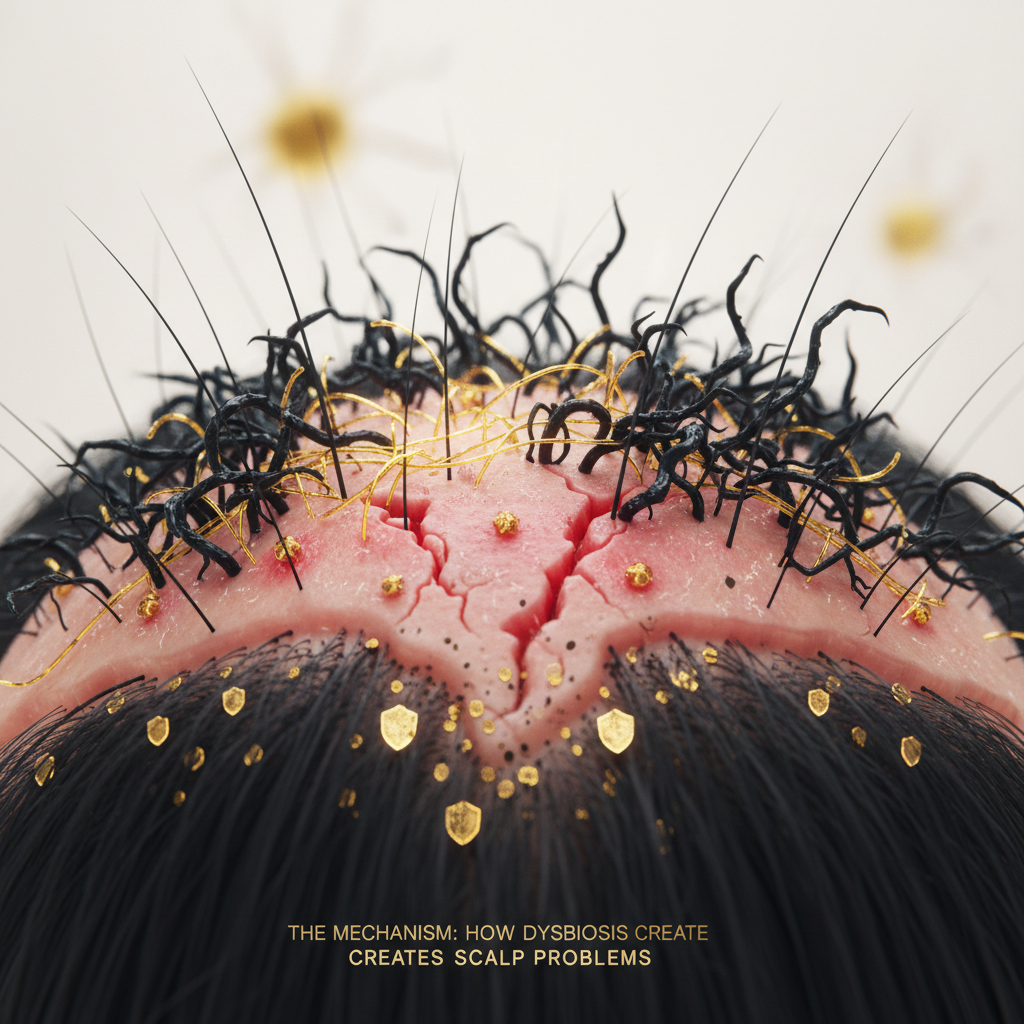
The clearest example of dysbiosis occurs in dandruff and seborrhoeic dermatitis. Malassezia yeasts secrete lipases that consume saturated fatty acids from sebum, leaving behind unsaturated fatty acids, primarily oleic acid and arachidonic acid. In susceptible individuals, oleic acid penetrates the stratum corneum, disrupting barrier lipid organisation.
This penetration triggers an inflammatory cascade. The skin responds by accelerating epidermal turnover from the normal 28-day cycle down to as few as 7 to 14 days. Keratinocytes fail to mature and detach cleanly, clumping together with lipids to form visible white or yellowish flakes.
Concurrently, the bacterial ratio shifts. Studies analysing dandruff sufferers show a marked increase in the ratio of Staphylococcus species relative to Cutibacterium, alongside elevated Malassezia activity. This shift increases transepidermal water loss (TEWL), leaving the scalp tight, dehydrated, and intensely itchy.
Sebum Secretion + Microbial Lipases
 │
 ▼
Release of Irritating Free Fatty Acids (Oleic Acid)
 │
 ▼
Stratum Corneum Disruption & TEWL Increase
 │
 ▼
Sub-clinical Inflammation & Rapid Keratinocyte Shedding (Flaking)
Signs of a balanced vs. disrupted scalp ecosystem
Understanding physical symptoms helps distinguish between normal microbial fluctuation and acute barrier breakdown.
| Parameter | Balanced Scalp Ecosystem | Disrupted Scalp Ecosystem (Dysbiosis) |
|---|---|---|
| Surface pH | Slightly acidic (4.5 to 5.5) | Often elevated above 6.0 |
| Flaking | Negligible; microscopic cellular shed | Visible white, grey, or yellow adherent flakes |
| Sensory Feel | Calm, comfortable, no tightness | Itching, burning, stinging, or tenderness |
| Sebum Balance | Supple skin, regulated oil production | Rebound oiliness, greasy roots, or dry scaling |
| Dominant Bacterial Ratio | Balanced C. Acnes to S. Epidermidis | Elevated Staphylococcus, depressed C. Acnes |
| Skin Barrier Integrity | Low transepidermal water loss | Compromised barrier, high moisture evaporation |
What you can do to support your scalp microbiome
You cannot sterilise your way to a healthy scalp, but daily habits significantly influence microbial balance:
1. Maintain physiological pH
Cleansers with an alkaline pH (above 6.5) swell the hair cuticle and alter the scalp acid mantle. Choose shampoos formulated around pH 5.0 to 5.5. A weakly acidic environment inhibits the growth of unwanted pathogens while supporting normal enzymatic barrier functions.
2. Cleanse regularly without stripping
Under-washing allows sebum to oxidise and accumulate, feeding Malassezia proliferation. Over-washing with harsh sulfates removes essential barrier lipids, triggering reactive sebum production. Wash frequently enough to prevent heavy oil pooling, adjusting based on your sweat levels, sebum output, and styling product usage.
3. Minimize product build-up
Heavy silicones, waxes, and synthetic styling polymers applied directly to the roots create an occlusive film. This micro-environment alters oxygen levels around the follicle, favoring anaerobic overgrowth and trapping irritants against the stratum corneum. Direct conditioners and leave-ins primarily to the mid-lengths and ends.
4. Support barrier hydration
A dehydrated scalp cannot support balanced microflora. Formulations incorporating humectants (such as glycerin, hyaluronic acid, or panthenol) and soothing botanical extracts help maintain moisture levels, reducing the need for the skin to over-produce sebum.
Thoughtful cosmetic support: Watermans
When formulating cosmetic scalp solutions, respecting the skin's natural balance is paramount. Products that support vitality without relying on harsh, stripping detergents help foster a comfortable environment where hair can thrive. Watermans designs formulations such as Grow Me Shampoo with gentle, balanced cleansing agents and scalp-supportive ingredients, including rosemary extract, biotin, and allantoin, to refresh the scalp surface, clear debris, and support a revitalised, balanced feel for everyday styling.
When the cause may be something else
Not all scalp discomfort stems from simple microbial dysbiosis. Several systemic and dermatological conditions mimic microbial imbalances:
- Scalp Psoriasis: An autoimmune condition characterised by well-demarcated, thick, silvery-white plaques and intense scaling. It is driven by T-cell-mediated hyperproliferation, not microbial yeast overgrowth.
- Contact Dermatitis: An allergic reaction or chemical irritation caused by hair dyes (e.g., paraphenylenediamine), fragrances, or preservatives, presenting with acute redness, vesicular weeping, and swelling.
- Cicatricial (Scarring) Alopecia: Conditions like lichen planopilaris or frontal fibrosing alopecia destroy follicles and cause permanent loss. Early signs often include perifollicular redness, scaling around hair bases, and burning sensations.
- Sebaceous Gland Hyperactivity: Endocrine fluctuations, including androgen spikes or thyroid dysfunction, can accelerate sebum output independently of topical hygiene.
When to get professional advice
Consult a GP, dermatologist, or qualified trichologist if you experience:
- Severe redness, swelling, or warm-to-the-touch scalp inflammation.
- Crusts that ooze pus, bleed when disturbed, or produce a foul odour.
- Localised or patchy hair shedding accompanied by scalp pain or burning.
- Flaking and itching that fail to improve after four weeks of targeted over-the-counter anti-dandruff care.
- Hair shedding that exceeds normal daily levels (typically 50 to 100 hairs daily) alongside physical scalp irritation.
Frequently asked questions about Healthy Scalp Microbiome Basics
What are Healthy Scalp Microbiome Basics everyone should know?
Healthy Scalp Microbiome Basics centre on recognizing that your scalp is naturally inhabited by bacteria and fungi that safeguard skin health. The ecosystem depends on a slightly acidic pH (4.5 to 5.5), managed sebum levels, and an intact stratum corneum. Disrupting this environment causes inflammation and flaking.
How often should I wash my hair to maintain a healthy microbiome?
Washing frequency depends on your individual sebum production, hair texture, and physical activity. Most people benefit from washing every one to three days. Leaving sebum to accumulate for weeks feeds Malassezia yeasts, while washing multiple times daily with aggressive cleansers strips protective lipids.
Can diet affect the scalp microbiome?
Yes, diet influences your microbiome indirectly. High glycemic diets and saturated fats can alter systemic hormone levels, potentially increasing sebum production. Sebum composition directly dictates the food supply for resident yeasts and bacteria. A varied diet rich in micronutrients, omega-3 fatty acids, and antioxidants supports overall barrier function.
Does an unbalanced scalp microbiome cause hair loss?
Microbial dysbiosis primarily causes cosmetic flaking, itchiness, and surface inflammation. It does not cause follicular androgenetic alopecia. However, severe scratching and long-term, unmanaged scalp dermatitis can weaken the follicle anchor, contributing to transient telogen shedding or mechanical hair breakage along the shaft.
Summary on Healthy Scalp Microbiome Basics
Mastering Healthy Scalp Microbiome Basics allows you to make informed decisions about your haircare routine. By respecting your skin's natural biology, keeping its pH mildly acidic, avoiding harsh build-up, and cleansing thoughtfully, you provide the optimal foundation for comfortable skin and resilient hair. When symptoms persist beyond cosmetic flaking, consult a healthcare professional to identify underlying dermatological conditions.
Sources and references
- British Association of Dermatologists. Seborrhoeic Dermatitis Guidelines. 2019.
- Journal of Investigative Dermatology. The Scalp Microbiome: Composition and Role in Scalp Health and Disorders. 2018.
- American Society for Microbiology: mBio. Bacterial and Fungal Dysbiosis Associated with Dandruff and Scalp Disorders. 2020.
- International Journal of Cosmetic Science. The Role of the Skin Barrier and pH in Scalp Health. 2021.
Find these ingredients in Watermans products
- Oleic Acid: you will find this ingredient in our Camellia & Black Castor Hair & Body Oil.
- Panthenol (Provitamin B5): you will find this ingredient in our Heat Protection Spray.