Protein Moisture Balance Guide: Understanding Hair Elasticity
9 min read ·
Master your hair's elasticity and strength with our science-backed Protein Moisture Balance Guide, detailing fixes for brittle strands and hygral fatigue.
Quick answer: This Protein Moisture Balance Guide explains the dynamic equilibrium between structural keratin proteins and water-retaining lipids within the hair cortex. Healthy hair requires internal tensile strength from protein and elasticity from bound water. When this balance shifts, hair presents as either stiff, brittle, and snapping under minimal tension (protein overload) or limp, gummy, and failing to return when stretched (hygral fatigue). The main limitation is that hair is non-living tissue; treatments cannot permanently repair fractured disulphide bonds.
Key takeaways
- Hair fibre strength depends on an intricate balance between structural alpha-keratin filaments and lipid-bound water in the cortex.
- Protein overload causes hair to feel rough, brittle, and straw-like, snapping immediately when stretched without rebounding.
- Moisture overload (often manifesting as hygral fatigue) leaves strands limp, mushy, overly stretchy, and unable to hold their natural shape.
- Hair porosity dictates how quickly your hair absorbs and sheds both moisture and hydrolysed proteins.
- Cosmetic protein conditioners reinforce hair temporarily by adhering to the cuticle, but they cannot biologically regenerate damaged hair.
Protein Moisture Balance Guide: what the evidence shows
The human hair shaft consists of roughly 65 to 95 percent proteins (primarily keratin), 15 to 32 percent water depending on ambient relative humidity, and 1 to 9 percent lipids. Cosmetic science demonstrates that tensile strength and elastic recovery rely on the structural integrity of the cortex and cuticle.
When people search for a Protein Moisture Balance Guide, they are usually navigating changes in how their hair bends, stretches, and recovers. Peer-reviewed textile and cosmetic chemistry shows that hair behaves as a viscoelastic material. Keratin provides rigidity and elastic modulus, while water acts as an internal plasticiser. Water molecules insert themselves between keratin polypeptide chains, temporarily breaking weak hydrogen bonds and allowing the fibre to extend under tension.
However, neither water nor protein functions properly in isolation. Without adequate hydration, keratin filaments remain rigid and snap when pulled. Conversely, without structural protein reinforcement, an over-hydrated cortex swells excessively, weakening the fibre and leading to mechanical failure.
The biological mechanism of hair elasticity and hydration
To understand the balance, you have to look inside the hair fibre:
- The Cuticle: The outermost protective layer of overlapping cells, bound together by the cell membrane complex (CMC) rich in 18-methyleicosanoic acid (18-MEA). When intact, it prevents excessive water penetration and protects the internal cortex.
- The Cortex: The thickest layer, containing microfibrils of alpha-keratin embedded in an amorphous, sulphur-rich protein matrix. This layer dictates hair strength, curl pattern, and colour.
- Hydrogen and Disulphide Bonds: Disulphide bonds are permanent covalent bonds formed between cysteine residues, giving hair permanent structural strength. Hydrogen bonds are physical bonds formed between polar side chains of keratin molecules, which break easily when wet and reform when dry.
When you wet your hair, water penetrates through the cuticle scales into the cortex. Bound water plasticises the keratin network, enabling normal hair to stretch by roughly 30 percent of its dry length without snapping. If the cuticle is damaged from bleaching, heat, or weathering, water enters and exits too quickly. Topical hydrolysed proteins (such as hydrolysed wheat, silk, or soy protein) work by temporarily filling gaps in the compromised cuticle, creating a sacrificial protective film that slows down moisture loss.
Protein overload versus moisture overload
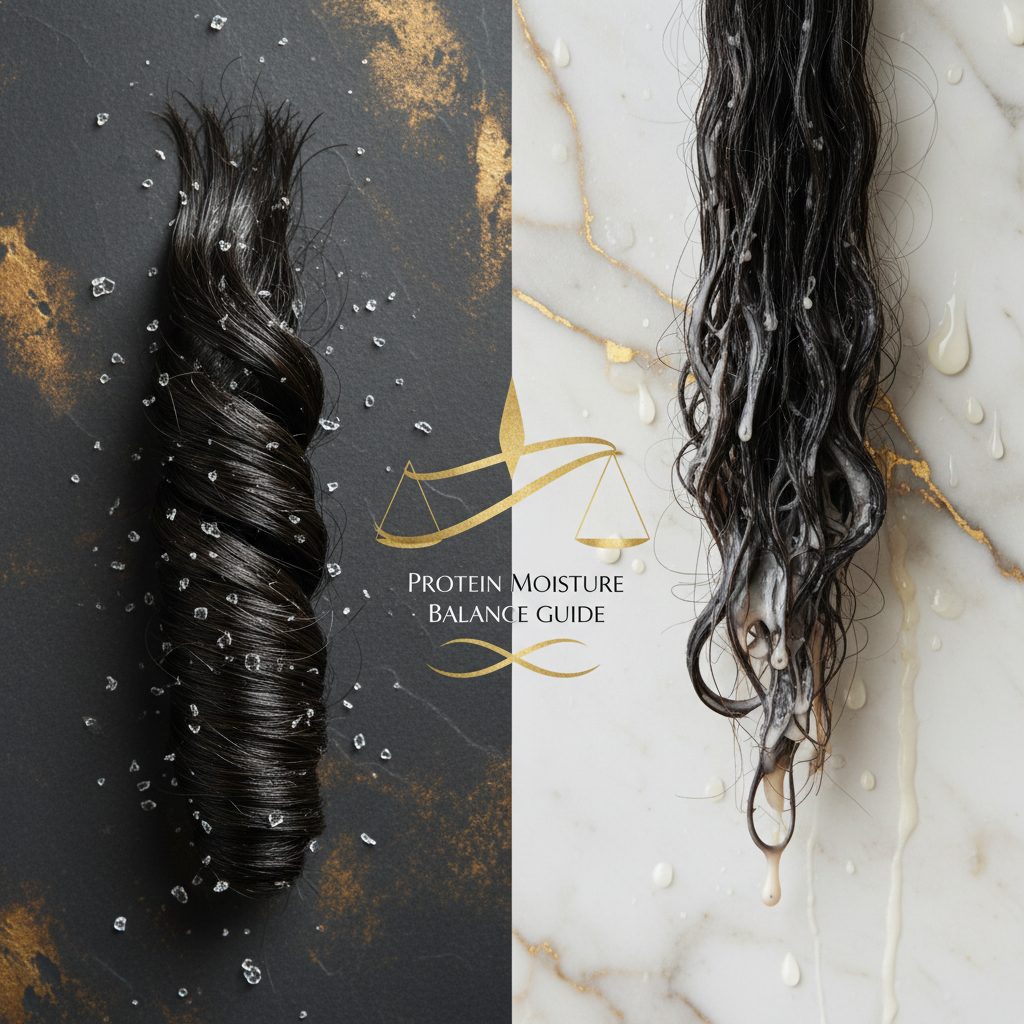
The table below outlines how to distinguish between the two primary imbalances using physical diagnostic signs:
| Characteristic | Protein Overload (Brittleness) | Moisture Overload (Hygral Fatigue) |
|---|---|---|
| Tactile Feel | Stiff, coarse, straw-like, dry | Limp, mushy, overly soft, gummy |
| Stretch Test | Snaps almost immediately with zero stretch | Stretches excessively without bouncing back; snaps eventually |
| Curl Definition | Frizzy, stringy, resists clumping | Droopy curls, stretched-out coils, lacks volume |
| Porosity Association | Often low porosity, or over-treated high porosity | Often highly porous, frequently wet or deep-conditioned |
| Primary Need | Emollient moisture, humectants, clarifying wash | Hydrolysed protein, structure, reduced soaking time |
What the evidence does not show
There are several persistent myths in the haircare community regarding protein and moisture:
- Hair does not digest protein: Food-grade proteins (such as raw eggs, mayonnaise, or yoghurt) have molecular weights far too high (often above 50,000 Daltons) to penetrate the cuticle. Only hydrolysed proteins broken down to low molecular weights (typically 500 to 3,000 Daltons) can effectively bind to or enter the hair shaft.
- Water alone does not moisturise: Pure water evaporates rapidly. True cosmetic moisture involves water plus humectants (like glycerin or panthenol) sealed with occlusive emollients (such as cetyl alcohol, shea butter, or plant oils) to retain equilibrium.
- Treatments do not repair hair permanently: Because the visible hair fibre is non-living tissue, no conditioner or protein treatment can permanently mend cracked cuticles or fractured disulphide bonds. The benefits wash away over 1 to 6 shampoos.
Practical steps to restore balance
If your hair is exhibiting signs of imbalance, systematic adjustments can restore tensile strength and flexibility.
What to do for protein overload
- Clarify your hair: Use a gentle, sulphate-based or chelating clarifying shampoo to strip away excess conditioning polymers and surface-bound proteins.
- Eliminate protein temporarily: Check your product labels for terms like "hydrolysed keratin", "amino acids", "hydrolysed wheat protein", or "collagen". Avoid them for 2 to 4 weeks.
- Apply penetrating emollients and humectants: Use conditioners containing ingredients like panthenol, aloe vera, and fatty alcohols. Apply low indirect heat (such as a warm towel) for 15 to 20 minutes to lift low-porosity cuticle scales and encourage humectant absorption.
What to do for moisture overload
- Reduce prolonged water exposure: Stop leaving wet conditioners or hair masks on your head overnight. The constant expansion and contraction of the cortex as it soaks up water is known as hygral fatigue, which weakens the cell membrane complex.
- Introduce hydrolysed proteins: Apply a dedicated protein reconstructor or treatment containing hydrolysed vegetable or silk proteins. Leave it on according to manufacturer instructions (usually 5 to 15 minutes).
- Use gentle styling habits: Blow-dry hair on a low-to-medium heat setting rather than leaving it damp for hours, as hair is in its most vulnerable state when swollen with water.
Supporting the hair with Watermans
When managing hair condition, selecting well-balanced formulas prevents you from swinging from one extreme to the other. Watermans designs formulations such as GrowMe Shampoo and ConditionMe Conditioner to respect the hair fibre's mechanical needs while supporting a healthy-looking scalp environment.
ConditionMe incorporates balanced conditioning agents alongside hydrolysed lupine protein and natural oils, delivering lightweight structural reinforcement without overloading the cuticle. This helps smooth the cuticle layer, cut down on mechanical breakage from brushing, and maintain proper moisture retention for fuller-looking, stronger-feeling hair.
When the cause may be something else
Before assuming your hair troubles stem purely from a protein-moisture imbalance, rule out other underlying causes:
- Hard water mineral buildup: Calcium and magnesium ions bind to hair keratin, creating a brittle, waxy coating that mimics protein overload. A chelating shampoo is required to remove these deposits.
- Disulphide bond damage: Severe chemical services (bleaching, perm, relaxers) physically sever covalent disulphide bonds. Protein treatments provide temporary structural scaffolding, but bond-building technology (like bis-aminopropyl diglycol dimaleate) is needed to address the covalent network.
- Follicular shedding: If you are noticing hair leaving the scalp from the root (with a small white bulb attached), this is telogen effluvium or another form of follicular shedding, not fibre breakage. Protein and moisture adjustments only affect the shaft, not the hair cycle.
When to seek professional advice
Consult a qualified trichologist or dermatologist if you experience sudden, diffuse hair shedding, patchy hair loss, or scalp symptoms such as itching, scaling, pain, or redness. A professional hair stylist should be consulted if your hair is severely chemically compromised (for instance, showing melting or gummy breakdown after bleach) before applying high-concentration professional protein reconstructors, as improper application can accelerate fibre breakage.
Frequently asked questions about Protein Moisture Balance Guide
How often should I use protein treatments according to this guide?
Frequency depends on your hair's chemical state. Low-porosity, untreated hair rarely needs concentrated protein, often benefiting from a treatment once every 6 to 8 weeks. Highly porous, bleached, or heat-styled hair benefits from gentle hydrolysed proteins every 2 to 3 weeks to reinforce cuticles and minimise breakage.
What does this Protein Moisture Balance Guide recommend for low-porosity hair?
Low-porosity hair has tightly overlapping cuticle scales that resist water and product penetration. This guide recommends using lightweight, protein-free humectants with warm water or gentle heat to open the cuticles. Avoid heavy protein treatments unless you regularly use thermal tools, as proteins accumulate easily on low-porosity cuticles, leading to rapid stiffness.
Can coconut oil cause protein overload?
Coconut oil does not contain protein, but it is rich in lauric acid, a medium-chain fatty acid with a high affinity for hair keratin. It penetrates the cortex and reduces protein loss. For some hair types, this reduction in internal porosity causes the fibre to feel stiff and brittle, producing symptoms that feel identical to protein overload.
How do I perform an elasticity test on my hair?
Take a clean, wet strand of hair shed from your head. Hold it firmly between your thumb and index finger on each end and stretch gently. If it stretches roughly 20 to 30 percent and bounces back to its original length, balance is optimal. If it snaps immediately, it lacks moisture. If it stretches continuously and breaks without rebounding, it lacks protein.
Summary
Achieving long-term hair resilience requires listening to your hair's physical cues rather than adhering to rigid schedules. This Protein Moisture Balance Guide highlights that hair strength relies on structural proteins, while flexibility depends on regulated internal moisture. By identifying whether your strands are suffering from protein rigidity or hygral fatigue, clarifying away product residue, and applying appropriate targeted treatments, you can keep your hair fibre strong, supple, and resistant to daily breakage.
Sources and references
- Robbins, C. R. Chemical and Physical Behavior of Human Hair. 5th ed., Springer-Verlag, 2012.
- Dawber, R. "Hair: Its structure and response to cosmetic preparations." Clinics in Dermatology, vol. 14, no. 1, 1996, pp. 105-112.
- Evans, A. O., & Wickett, R. R. "A review of the role of water in the properties of human hair." Journal of Cosmetic Science, vol. 63, no. 6, 2012, pp. 387-393.
- Kamath, Y. K., et al. "Mechanical and surface properties of human hair." Journal of Cosmetic Science, vol. 35, 1984, pp. 241-256.
- Cruz, C. F., et al. "Human hair characteristics and methods to evaluate hair damage: A review." International Journal of Cosmetic Science, vol. 38, no. 5, 2016, pp. 443-459.
Find these ingredients in Watermans products
- Hydrolysed Lupine Protein: you will find this ingredient in our Hair Mask.
- Panthenol (Provitamin B5): you will find this ingredient in our Heat Protection Spray.
- Aloe Vera: you will find this ingredient in our Curly Hair Conditioner.