Protein Moisture Balance in Haircare: The Definitive Guide
8 min read ·
Learn how protein moisture balance affects hair elasticity, strength, and texture. Discover how to identify structural imbalances and restore brittle or limp hair.
Quick answer: The concept of protein moisture balance refers to the functional equilibrium between structural keratin integrity and water retention within the hair cortex. When hair maintains a healthy protein moisture balance, it demonstrates optimal elasticity, resisting breakage while remaining soft and pliable. Too much hydrolysed protein without adequate conditioning agents can leave strands brittle, stiff, and prone to snapping. Conversely, excessive water absorption without structural support leads to hygral fatigue, limpness, and weak, stretchy fibres that fail to spring back.
Key takeaways
- Hair fibres consist of roughly 85% to 90% keratin protein, 10% to 15% water under ambient conditions, and small amounts of lipids and melanin.
- Protein treatments use hydrolysed proteins that temporarily adsorb to the cuticle and outer cortex, reinforcing weak spots along damaged strands.
- Moisture in cosmetic terms refers to water retained in the fibre by humectants and sealed by emollient lipids, preventing rapid evaporation.
- Over-treating with structural proteins leads to brittle fibre breakage, while chronically over-saturating porous hair causes hygral fatigue.
- Neither extreme alters the living follicle; balance issues affect the non-living hair shaft, meaning breakage must never be confused with follicular hair loss.
Protein Moisture Balance: what the cosmetic science shows
The idea of protein moisture balance dominates salon consultations, yet cosmetic scientists approach it through the lens of polymer chemistry and fibre mechanics. Hair is primarily a cross-linked polymer of alpha-keratin. These polypeptide chains provide tensile strength, which dictates how much physical stress a strand can withstand before snapping. Water acts as a natural plasticiser inside this matrix. When water molecules bind to keratin's hydrophilic sites, they increase fibre flexibility and reduce stiffness.
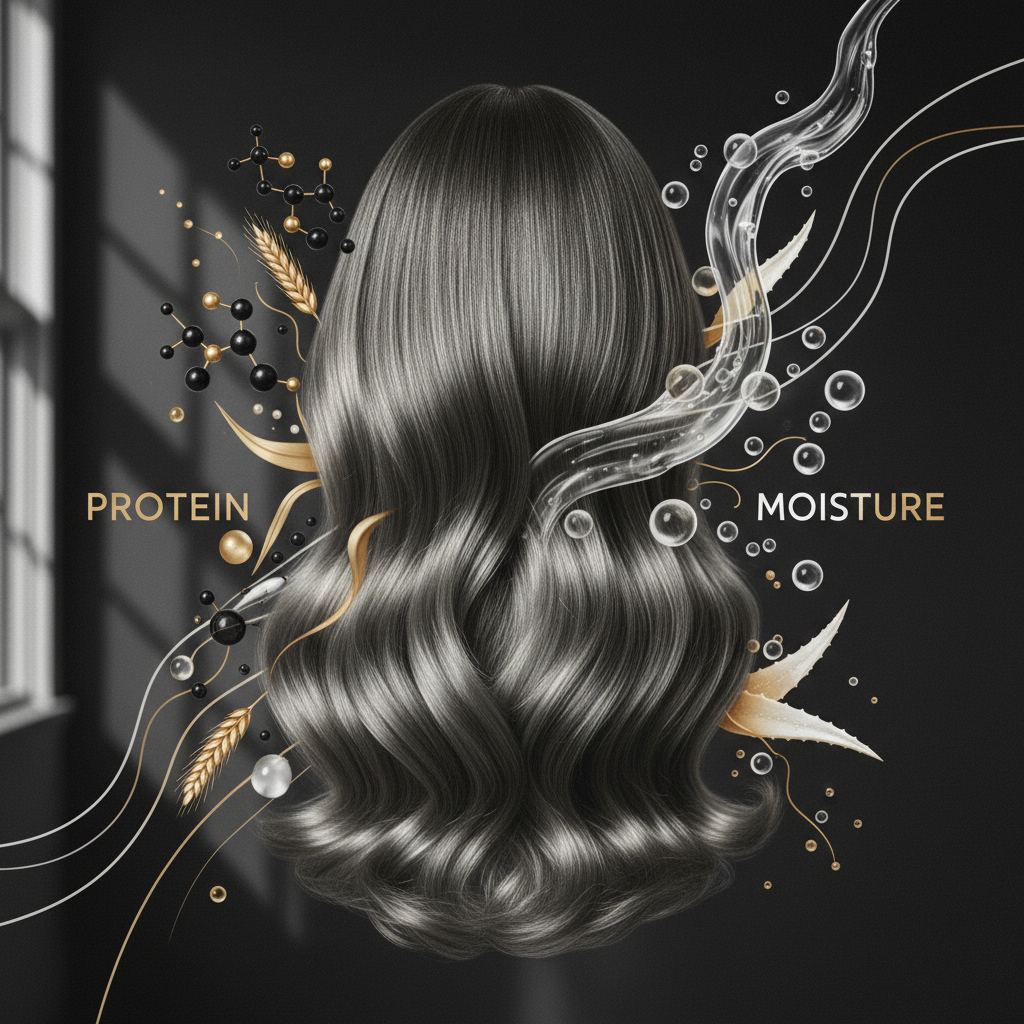
A healthy hair strand requires both tensile strength (from intact keratin chains and disulphide bonds) and plasticisation (from bound water). If hair loses structural protein through bleaching, chemical straightening, UV exposure, or repeated heat styling, the internal matrix weakens. Porosity increases, allowing water to rush in and out uncontrollably. Restoring a functional protein moisture balance requires introducing film-forming, hydrolysed proteins to patch the gaps, coupled with conditioning lipids to regulate moisture flux.
What the evidence does not show
The hair care community frequently circulates misconceptions regarding how proteins and water interact within human hair:
- Water alone does not permanently moisturise hair. Soaking brittle hair in plain water does not fix dryness. In fact, repeated swelling and deswelling weakens the cell membrane complex, exacerbating structural porosity.
- Cosmetic proteins cannot rebuild living tissue. Hydrolysed wheat, soy, silk, or keratin proteins deposit onto the hair surface and penetrate only the outer cortex layers. They do not permanently repair split ends or biologically regenerate the original disulphide architecture.
- Protein overload is not a permanent chemical alteration. Stiff, crunchy hair caused by protein-heavy formulas can be reversed by washing with a clarifying shampoo and following with intensive conditioning emollients.
- Imbalance does not cause alopecia. When people notice short, broken hairs shedding onto their shoulders, they often mistake mechanical fibre snapping for follicle-level shedding. Breakage along the shaft is completely separate from telogen effluvium or pattern hair loss.
The mechanical signs of imbalance
Evaluating whether hair requires structural reinforcement or conditioning emollients relies on physical diagnostic signs. You can test elasticity by gently stretching a small, wet strand between your fingers.
| Physical Characteristic | Protein Overload / Deficit of Moisture | Moisture Overload / Deficit of Protein | Balanced Hair Fibre |
|---|---|---|---|
| Feel and Texture | Rough, rigid, straw-like, stiff | Mushy, gummy when wet, overly soft | Smooth, pliable, soft with natural body |
| Elasticity Behaviour | Snaps immediately with minimal stretch | Stretches excessively without bouncing back | Stretches roughly 20% to 30% wet, then returns |
| Common Causes | Heavy leave-in proteins, keratin treatments | Frequent soaking, zero protein, high porosity | Alternating conditioning masks and proteins |
| Primary Risk | High-tension brittle breakage | Hygral fatigue, cuticle degradation | Minimal mechanical damage |
| Target Treatment | Clarifying wash, deep fatty emollients | Hydrolysed protein treatments, light humectants | Gentle cleansing, balanced conditioning |
The underlying mechanism: proteins, lipids, and hygral fatigue
Understanding hair behaviour requires looking at its three microscopic components: the cuticle, the cortex, and the cell membrane complex.
The outer cuticle is coated with an ultra-thin lipid layer called the 18-methyleicosanoic acid (18-MEA) layer. This lipid coat gives healthy hair a hydrophobic, water-repellent surface. Chemical processing strips 18-MEA, making the fibre hydrophilic (water-loving). When water enters a porous cortex unopposed, the hair shaft swells up to 15% to 20% in diameter.
Repeated cycles of swelling from water absorption followed by rapid drying cause a mechanical wear-and-tear process known as hygral fatigue. The internal keratin structures stretch beyond their elastic limit, leading to longitudinal fractures along the shaft.
Hydrolysed proteins, which have been enzymatically chopped into smaller molecular weights (typically between 500 and 10,000 Daltons), work by electrostatically binding to the negative charges on damaged keratin. They form a supportive colloidal film around the fibre, reducing the excessive water absorption that drives hygral fatigue. However, if too many high-molecular-weight proteins settle without adequate plasticising lipids (such as fatty alcohols, ceramides, or plant oils), the fibre loses all bending compliance. The resulting stiffness causes the hair to snap under everyday detangling tension.
How to restore equilibrium in your routine
Balancing your routine does not require complicated science experiments at home. It comes down to monitoring how your hair behaves after washing and adjusting your product categories accordingly.
Dealing with protein overload
If your hair feels crunchy, dry, and snaps when brushed:
- Pause all leave-in conditioners, styling creams, and masks containing terms like "hydrolysed keratin", "wheat protein", "amino acids", or "collagen".
- Use a gentle clarifying shampoo with an anionic surfactant to lift superficial protein deposits from the cuticle.
- Apply a deep conditioning treatment formulated with fatty alcohols (cetyl alcohol, stearyl alcohol) and natural conditioning oils.
- Allow the conditioning agents to sit for 15 to 20 minutes to restore suppleness.
Dealing with moisture overload (hygral fatigue)
If your hair feels limp, gummy when wet, and loses its curl definition or style hold:
- Incorporate a dedicated treatment containing hydrolysed vegetable or keratin protein. Look for molecularly small amino acids that can enter the outer cortex.
- Reduce the time your hair stays wet. Avoid sleeping in wet hair or leaving deep conditioners on overnight, which weakens the cortex.
- Use a diffuse heat source or warm blow-dryer with heat protection to reduce the duration of internal swelling.
- Follow protein applications with a light, non-occlusive rinse-out conditioner to maintain surface slip.
When the cause may be something else
Not all structural hair issues stem from cosmetic ingredient formulation:
- Hard water buildup: High concentrations of calcium and magnesium ions cross-link with fatty acids, creating an insoluble film on the hair shaft. This mineral coating mimics the rough, brittle texture of protein overload. A chelating shampoo containing disodium EDTA or citric acid resolves this issue where regular conditioners fail.
- Severe chemical damage: If hair has been bleached repeatedly beyond its structural threshold, cysteic acid forms from destroyed disulphide bonds. Cosmetic proteins can provide temporary scaffolding, but severe chemical dissolution eventually necessitates trimming the damaged ends.
- Internal health factors: If you observe thinning patches, a widening parting, or clumps of hair coming out with intact white roots, this is telogen effluvium or an inflammatory scalp condition, not a mechanical surface imbalance.
When to seek professional advice
Consult a qualified trichologist or dermatologist if you experience sudden scalp shedding exceeding 100 to 150 hairs daily, scalp redness, itching, scaling, or burning. A cosmetic chemist or experienced professional stylist can help determine mechanical porosity, but medical professionals must evaluate genuine follicular hair loss, nutritional deficiencies, and hormonal shifts.
A holistic approach with Watermans
Maintaining the cosmetic condition of the hair fibre works hand-in-hand with creating an optimal scalp environment. While topical conditioning steps handle fibre mechanics, hair density depends on follicle vitality. Watermans Grow Me Shampoo and Condition Me Conditioner are designed to support this complete approach. The formulas blend strengthening hydrolysed proteins, biotin, and restorative ingredients that fortify the hair shaft against daily styling stress, while nurturing the scalp surface to help you maintain thicker-looking, resilient hair from root to tip.
Frequently asked questions about Protein Moisture Balance
What is the simplest test for protein moisture balance at home?
Take a clean, wet strand of shed hair between your thumb and index fingers. Gently pull it. If it stretches by about a third and bounces back when released, your protein moisture balance is sound. If it snaps immediately, you likely have protein overload or low moisture. If it stretches endlessly like wet gum without returning, the strand lacks protein reinforcement.
How often should you use protein treatments on healthy hair?
For hair with minimal processing, a light hydrolysed protein mask once every four to six weeks is generally sufficient. If your hair is bleached, heat-styled regularly, or chemically relaxed, you may benefit from protein-containing conditioners once every one to two weeks, followed by a moisturising conditioner to prevent rigidity.
Can low-porosity hair experience protein overload faster?
Yes. Low-porosity hair has tightly overlapping cuticle scales that resist water and large molecules. High-molecular-weight proteins struggle to penetrate the cortex, settling heavily on the outside of the hair shaft instead. This surface buildup rapidly leads to stiffness, dullness, and mechanical snapping.
Does drinking more water fix a moisture deficit in hair?
Drinking water is vital for biological health, but systemic hydration does not translate directly into hydrated hair lengths. The non-living hair shaft absorbs moisture from ambient air humidity and cosmetic emollients. Maintaining internal hydration cannot counteract environmental weathering or chemical lipid loss on the hair shaft.
Summary
Achieving an ideal protein moisture balance is an ongoing management strategy for the cosmetic integrity of your hair. Keratin proteins supply the physical scaffolding that prevents snapping under tension, while water and conditioning lipids grant the pliability needed for effortless styling. By learning to recognise whether your strands feel brittle and rigid or overly stretchy and limp, you can alternate between hydrolysed proteins and rich emollients to keep your hair resilient, shiny, and strong.
Sources and references
- Robbins, C. R. (2012). Chemical and Physical Behavior of Human Hair. 5th Edition, Springer-Verlag.
- Cruz, C. F., et al. (2016). "Human Hair Keratin and Protein Interactions." International Journal of Cosmetic Science, 38(4), 327 to 335.
- Evans, T. A. (2017). "Measuring Hair Strength and Elastic Properties." Practical Aspects of Cosmetic Testing, Springer.
- Barba, C., et al. (2010). "Water content evaluation in human hair by thermal analysis." Thermochimica Acta, 506(1-2), 102 to 106.
- Society of Cosmetic Scientists (SCS). "The Science of Hair Structure and Cleansing Mechanisms." Educational resources, cosmeticscience.com.