Proper Towel Drying Techniques: The Science of Safe Hair Drying
8 min read ·
Learn how Proper Towel Drying Techniques prevent cuticle damage, friction, and breakage. Discover the science of drying wet hair safely and effectively.
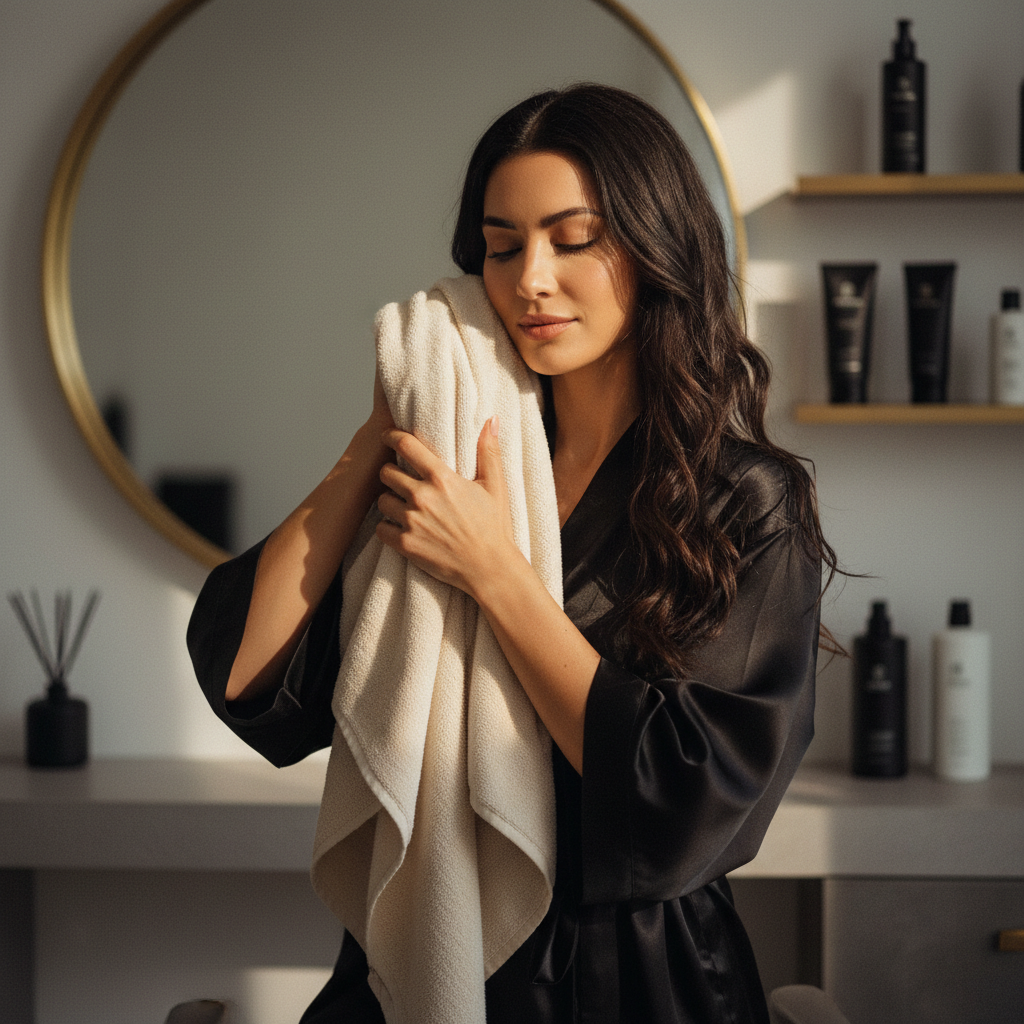
Quick answer: Proper Towel Drying Techniques protect the hair fibre when it is at its most vulnerable, wet state. Instead of rubbing vigorously with standard terrycloth, correct methods involve gently pressing, blotting, or wrapping the hair using microfibre fabrics or smooth cotton. Practising Proper Towel Drying Techniques minimises cuticle abrasion, controls hygral fatigue, and drastically cuts down mechanical hair breakage. However, gentle towel drying cannot repair pre-existing structural cortex fractures, nor can it stop biological shedding originating inside the hair follicle.
Key takeaways
- Wet hair can stretch by up to 30% of its dry length before breaking, but its elasticity makes it prone to permanent structural deformation and cuticle lifting.
- Vigorous rubbing with coarse terrycloth shears the outer cuticle scales, causing surface roughness, frizz, and mid-shaft snapping.
- Microfibre towels and smooth cotton fabrics absorb water rapidly through capillary action without requiring frictional movement.
- Proper drying methods reduce heat styling time, lowering cumulative thermal damage to the hair shaft.
- Towel-induced mechanical snapping is breakage, not follicular shedding or hair loss.
Proper Towel Drying Techniques: what the evidence shows
Textile science and cosmetic trichology agree that wet keratin behaves very differently from dry keratin. Applying Proper Towel Drying Techniques respects the physical alterations that occur when hair absorbs water. When hair is submerged or washed, water penetrates past the protective cuticle layer and into the cortex. The influx of water breaks temporary hydrogen bonds between keratin chains, allowing the cortex to swell.
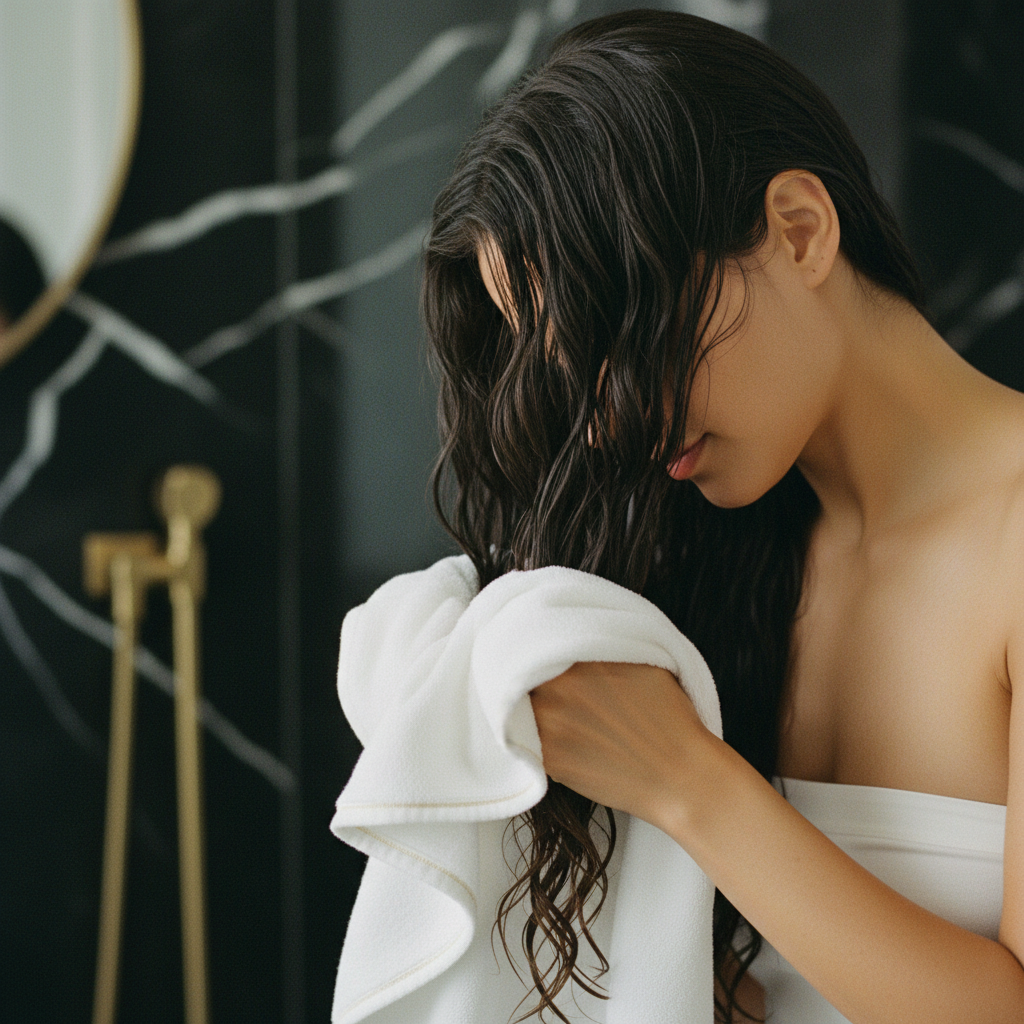
In this swollen state, the hair fibre requires significantly less mechanical force to deform. Standard cotton terrycloth towels feature thousands of tiny, uncut yarn loops. When you rub these coarse loops back and forth against wet hair, they catch on the edges of softened cuticle cells. Research published in the International Journal of Trichology and the Journal of Cosmetic Science shows that repeated wet friction physically lifts, chips, and strips away the cuticular layers.
Adopting Proper Towel Drying Techniques replaces harmful friction with passive absorption. By pressing, blotting, or loosely wrapping hair, the fabric wicks water away via capillary action while keeping the cuticular scales flattened against the hair shaft.
The mechanism: why wet hair breaks so easily
To understand why towel choice and movement matter, look at the architecture of the hair shaft. The outer layer, the cuticle, consists of 6 to 10 overlapping layers of flat cells, similar to tiles on a roof. These cells are glued together by the cell membrane complex, rich in structural lipids like 18-methyleicosanoic acid (18-MEA).
When hair gets wet, several distinct physical shifts take place:
- Hydrogen bond disruption: Water molecules insert themselves between keratin polypeptide chains, temporarily disengaging hydrogen bonds. This causes the fibre's tensile strength to fall by roughly 30% compared to its dry state.
- Radial swelling: The cortex absorbs up to 30% or more of its own weight in water, expanding outwards. This swelling forces the protective cuticle shingles to lift slightly at their free margins.
- Frictional vulnerability: The friction coefficient of wet hair is naturally higher than that of dry hair. When an uneven, looped fabric surface rubs against lifted cuticles, the shear stress rips cells off the shaft. Once the cuticle is compromised, the inner cortex is exposed to moisture loss, split ends, and immediate breakage.
Wet Hair Swelling & Friction Cycle:
Water Enters Cortex -> Hair Swells -> Cuticle Scales Lift -> Terrycloth Rubbing Catches Cuticles -> Cuticle Stripping -> Cortex Snapping (Breakage)
Signs of towel-induced mechanical damage
Towel damage is often misidentified as thermal damage, product buildup, or natural shedding. Here is how to recognise mechanical damage caused by aggressive towel drying:
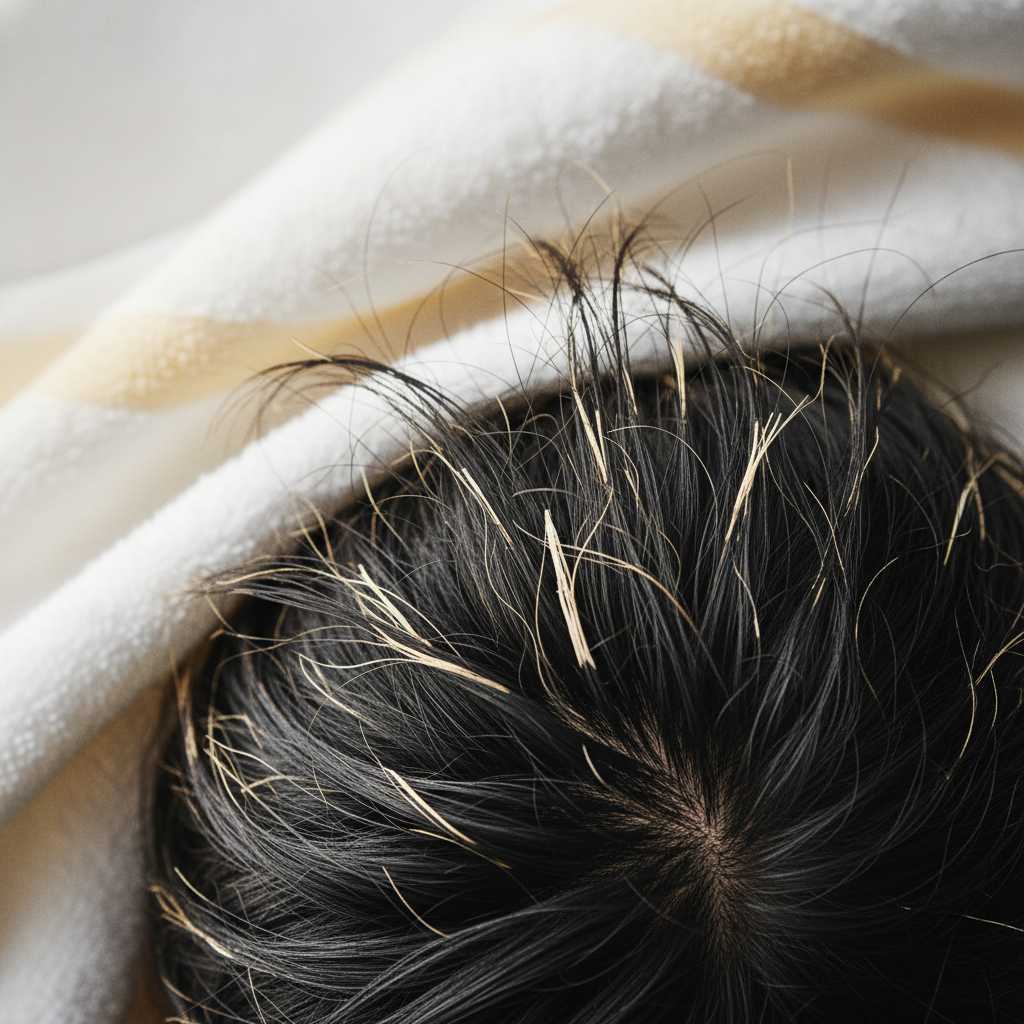
- Short, fragmented broken hairs: You notice tiny, jagged pieces of hair on your shoulders, bathroom counters, or clothing without a white follicular bulb at the tip.
- Surface frizz along the canopy: The uppermost layer of your hair appears rough and frizzy, while the under-layers feel noticeably smoother. The outer canopy bears the brunt of towel rubbing.
- Tangled, velcro-like ends: Hair catches on itself immediately after washing because raised, abraded cuticles snag on neighbouring fibres.
- Dull appearance after drying: Intact cuticles reflect light evenly; chipped, rough cuticles scatter light, making hair look matte and lifeless.
How to execute Proper Towel Drying Techniques step by step
Achieving healthy results requires the right fabric and an intentional, low-friction routine.
1. The initial squeeze (hands only)
Before picking up any fabric, gently squeeze excess water from your hair while still in the shower. Use an open-palm pressing motion, starting near the roots and working down to the ends. Never twist or wring your hair like a washcloth.
2. Choose the right fabric
Replace standard looped cotton bath towels with high-surface-area microfibre or a clean, smooth 100% cotton T-shirt. Microfibre split-weave fabrics have fibres thinner than a single strand of silk. They absorb over five times their weight in water via capillary action, pulling liquid off the hair without requiring you to move the cloth back and forth.
3. The blot-and-press method
Drape the microfibre towel around a section of hair. Press your hands together firmly over the fabric for 3 to 5 seconds to let the material draw out the water. Release, move down the section, and repeat. Continue across the entire head.
4. Plunking or loose wrapping
For curly, wavy, or fragile hair, consider "plunking" or loose turban wrapping. Lay your smooth towel or T-shirt flat on a surface, bend forward so your hair accordions down onto the fabric, and fold the fabric securely around your head. Leave it in place for 10 to 15 minutes. Avoid tightly twisting the fabric, as rotational torque pulls at fragile wet roots and stretches the wet hairline.
| Drying Method | Friction Level | Water Absorption Speed | Risk of Fibre Breakage | Best Suited For |
|---|---|---|---|---|
| Vigorous Terrycloth Rubbing | Very High | Moderate | Severe | Not recommended for any hair type |
| Microfibre Blot & Press | Very Low | Fast | Minimal | All hair types, especially fine or chemically processed |
| Cotton T-shirt Plunking | Very Low | Moderate | Minimal | Wavy, curly, and coily textures |
| Tightly Twisted Towel Turban | Moderate to High | Moderate | Moderate (tension at hairline) | Resilient, short to medium straight hair |
What the evidence does not show
While gentle drying is essential for hair health, it is important to separate scientific facts from common myths:
- Gentle towel drying does not stop hair shedding: True hair shedding (such as telogen effluvium or androgenetic alopecia) happens deep within the dermal papilla inside the scalp. Gentle towel techniques prevent the hair shaft from snapping; they do not alter biological hair growth cycles.
- Leaving hair soaking wet for hours is not better: Allowing hair to air dry for prolonged periods keeps the cortex in a swollen state for longer, a process known as hygral fatigue. A balance of careful microfibre blotting followed by low-heat, controlled diffusing or drying is physically safer for the cell membrane complex than letting heavy, wet hair sit damp all day.
- Towel techniques cannot mend split ends: Once the cuticle is stripped and the cortex splits, no fabric choice or pressing technique can fuse the keratin back together. Damaged ends must be trimmed.
When the cause may be something else
If you adopt gentle drying habits but still notice widespread thinning or hair loss, the issue likely extends beyond mechanical friction. Consider these alternative causes:
- Telogen effluvium: If you are losing hundreds of full-length hairs bearing tiny white bulbs at the root, your follicles may have entered a premature resting phase due to stress, illness, dietary shifts, or hormonal imbalances.
- Nutritional deficiencies: Inadequate intake of iron, zinc, or protein impairs the body's synthesis of keratin, leaving the emerging shaft physically weak from the moment it leaves the follicle.
- Chemical processing: Bleaching, relaxers, and permanent dyes chemically strip the protective lipid layer (18-MEA) and break internal disulphide bonds, leaving hair prone to snapping even under gentle handling.
If you observe scalp inflammation, sudden patchy hair loss, or diffuse thinning that reduces your ponytail circumference, consult a trichologist or dermatologist for a full clinical evaluation.
Supporting hair resilience with Watermans
Proper physical handling works best when paired with targeted topical care that supports your scalp and strands. Watermans focuses on scalp and hair vitality through carefully balanced formulas. Watermans GrowMe Shampoo delivers natural nutrients, including biotin, rosemary, caffeine, and argan oil, directly to the scalp environment to help hair look thicker and feel fuller. Following your wash with Watermans ConditionMe Conditioner provides the slip and conditioning needed to replenish the surface moisture barrier, softening wet friction before you ever reach for your towel.
Frequently asked questions about Proper Towel Drying Techniques
How long should I leave hair wrapped in a microfibre towel?
Ten to twenty minutes is the ideal timeframe. Leaving a towel wrapped around wet hair for longer creates a damp, humid microclimate that can encourage scalp microflora imbalances while keeping the hair fibre swollen and delicate. Once excess dripping moisture is absorbed, remove the towel and let hair dry or diffuse.
Can Proper Towel Drying Techniques prevent hair loss?
Proper Towel Drying Techniques prevent hair breakage, not biological hair loss. Hair loss occurs at the follicular level under the scalp, leading to shedding with the root intact. Towel drying techniques prevent the hair fibre from snapping along the shaft due to surface friction and tension.
Is an old cotton T-shirt really as good as a microfibre towel?
Yes, a clean cotton T-shirt is an excellent alternative. Unlike traditional bath towels, T-shirt cotton is woven into a flat, smooth jersey knit without abrasive loops. It absorbs water effectively while allowing hair cuticles to lie flat, preventing mechanical wear and tear.
Does rubbing hair with a towel cause split ends?
Yes. Rubbing hair aggressively with a standard bath towel forces the outer cuticle scales to lift and peel away. Once this protective outer layer is worn down, the cortex fibres unravel, leading directly to mid-shaft snapping and split ends.
Final thoughts on drying hair safely
Understanding how wet hair reacts to physical stress is the foundation of long-term hair health. Using Proper Towel Drying Techniques by swapping abrasive terrycloth for smooth microfibre and swapping vigorous rubbing for gentle pressing prevents unnecessary mechanical damage. This simple daily habit preserves your cuticles, maintains hair elasticity, and keeps your hair looking smooth, resilient, and full of natural shine.
Sources and references
- International Journal of Trichology: "Hair Cosmetics: An Overview" (2015).
- Journal of Cosmetic Science: "The effect of water absorption on the mechanical properties of human hair" (2004).
- British Journal of Dermatology: "Frictional properties of human hair and the effect of grooming" (2007).
- NHS: "Hair loss" clinical guidance (2020).
Find these ingredients in Watermans products
- Biotin: you will find this ingredient in our Hair Growth Shampoo.
- Zinc: you will find this ingredient in our Hair Vitamins.