PH Balance in Haircare: The Definitive Scientific Guide
9 min read ·
Discover the science of PH Balance in Haircare. Learn how acidic formulas protect the cuticle and scalp, prevent breakage, and improve hair shine and manageability.
Quick answer: Understanding PH Balance in Haircare is essential because human hair and scalp thrive in a mildly acidic environment, typically between pH 4.5 and 5.5. When hair products are too alkaline, they force the hair cuticle to swell and lift, causing friction, frizz, and structural fibre breakage while disrupting the scalp acid mantle. However, maintaining the right pH cannot repair severed disulfide bonds or reverse follicular hair loss; it is purely a physiological and cosmetic mechanism for preserving cuticle integrity and surface barrier health.
Key takeaways
- Human scalp skin has a natural acidic pH of approximately 4.5 to 5.5, while the hair shaft itself rests around pH 3.67 to 5.5.
- Alkaline formulas (pH above 7.0) increase the negative electrical charge of the hair fibre, causing cuticle lifting, tangling, and mechanical breakage.
- Maintaining an acidic pH seals the cuticle scale layer flat against the hair cortex, reducing friction and preserving internal moisture.
- Scalp microbiome stability depends on the acidic barrier to suppress opportunistic fungi such as Malassezia.
- PH balance influences hair shaft integrity and scalp comfort, but it does not treat follicular conditions such as androgenetic alopecia.
PH Balance in Haircare: what the evidence shows
The role of PH Balance in Haircare is well-documented in cosmetic dermatology and trichology. A milestone study published in the International Journal of Trichology (Gavazzoni Dias et al., 2014) analysed 123 commercial shampoos and discovered that 61.8% had a pH higher than 5.5, with some popular cleansing formulations exceeding pH 7.0. The researchers demonstrated that alkaline shampoos generate an increased negative electrical charge on the hair surface, which creates repulsive forces between adjacent cuticles. This forces the protective outer scales to flare outward, dramatically increasing combing friction and accelerating fibre breakage.
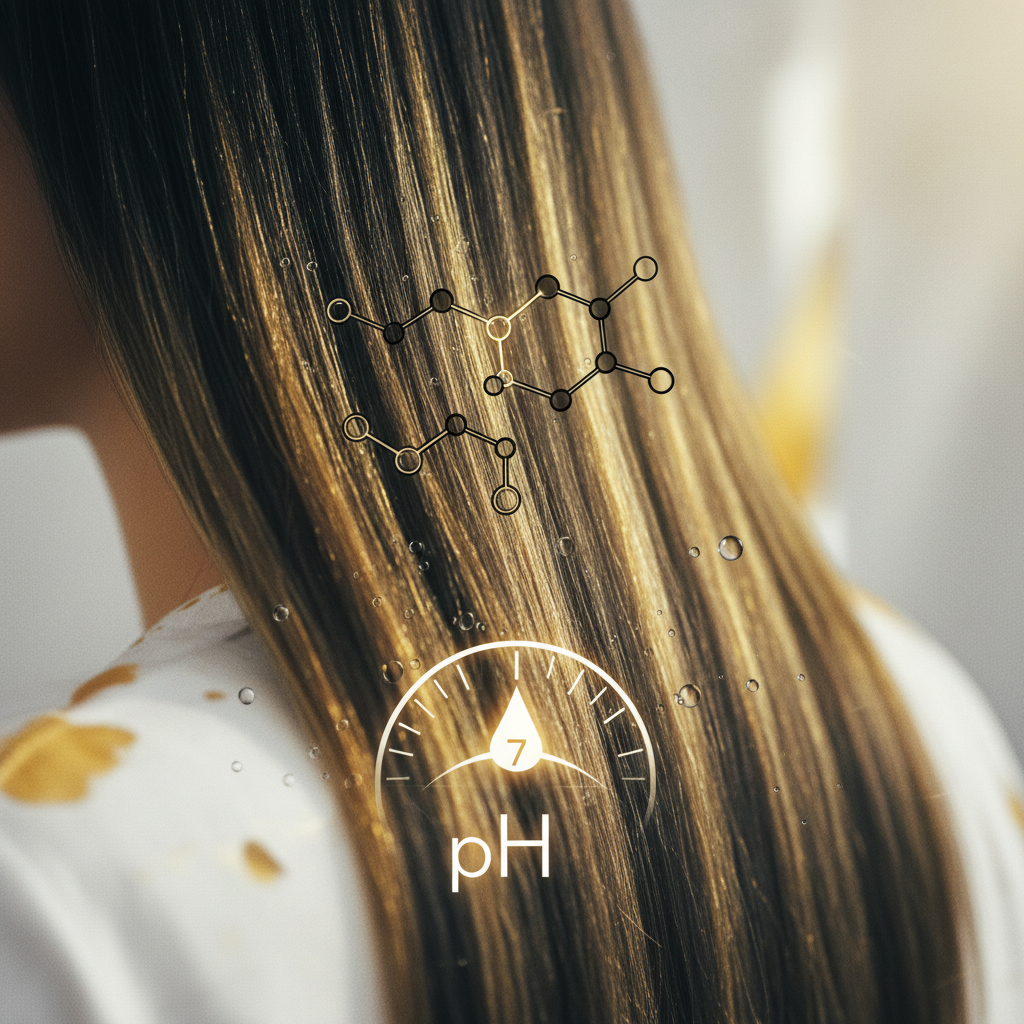
The hair fibre itself has an isoelectric point of approximately pH 3.67. At this precise point, the positive and negative electrical charges on the keratin protein are perfectly balanced, resulting in minimal swelling and optimal structural stability. In real-world cosmetic formulations, matching product pH to the scalp mantle range of 4.5 to 5.5 provides the ideal compromise. It maintains skin barrier function while keeping the cuticle layer compacted and flat against the cortex.
 Acidic (Cuticle Compacted) Alkaline (Cuticle Swollen)
 pH 4.0 - 5.5 pH 7.5 - 9.0+
 ------------------------- -------------------------
 | | | | | | | | | / / / / / / / / /
 ------------------------- -------------------------
 Low friction, high shine High friction, dull, prone to snap
How pH alters the hair shaft and scalp
The physical mechanisms behind pH changes operate on two distinct biological structures: the dead keratinised hair fibre and the living tissue of the scalp epidermis.
The hair cuticle response
Hair cuticles consist of six to ten overlapping layers of flattened, keratin-rich cells that point downward from root to tip. These scales are bonded together by the cell membrane complex, a lipid-rich intercellular cement.
When exposed to water or solutions with an alkaline pH (greater than 7.0), water molecules penetrate the cuticle and enter the cortex. The keratin chains accept hydroxyl ions, which disrupts ionic bonds and salt linkages between adjacent polypeptide chains. This causes the hair fibre to swell radially by up to 15 to 20 percent. The cuticle edges curl upward and outward. When cuticles flare:
- Inter-fibre friction increases significantly during washing, drying, and brushing.
- Light reflects diffusely rather than specularly, making the hair look matte and dull.
- The internal cortex loses structural moisture and becomes susceptible to longitudinal splitting.
Conversely, applying a mildly acidic formula (pH 4.0 to 5.5) contracts the keratin network. The cuticles lie flush against the shaft, which restores smooth surface geometry, locks in moisture, and minimises surface friction.
The scalp acid mantle
The scalp surface is coated in an emulsion of sweat, sebum, and cellular lipids known as the acid mantle. Its normal pH hovers between 4.5 and 5.5. This mild acidity serves as a biological defense system:
- It maintains optimal activity for enzymes responsible for synthesis of stratum corneum ceramides.
- It deters excessive colonisation by pathogenic bacteria and keeps yeast populations (Malassezia restricta and Malassezia globosa) in check.
- It regulates natural shedding of dead corneocytes, preventing large visible flakes.
Alkaline soaps or harsh detergents strip this lipid barrier and raise the scalp surface pH for hours after rinsing, leaving the tissue vulnerable to dehydration, tightness, and micro-inflammation.
Comparing pH levels across haircare formulations
| Product Category | Typical pH Range | Cuticle Impact | Scalp Impact |
|---|---|---|---|
| Healthy Scalp & Hair Baseline | 4.5 to 5.5 | Flat, closed, low friction | Balanced microbiome, intact barrier |
| Tap Water (UK average) | 6.5 to 8.5 | Slight swelling over baseline | Neutralises acid mantle temporarily |
| Acid-Balanced Shampoo | 4.5 to 5.5 | Preserves cuticle alignment | Protects lipid barrier |
| Standard Clarifying / Baby Shampoo | 6.5 to 7.5 | Moderate cuticle lifting | Can cause mild dryness |
| Conditioner & Hair Masks | 3.5 to 5.0 | Tightens and flattens cuticle | Restores acidic surface buffer |
| Permanent Hair Dye & Bleach | 9.0 to 11.0 | Forces cuticles open wide | Disrupts barrier, potential irritation |
| Chemical Relaxers | 12.0 to 14.0 | Extreme swelling to break bonds | High burn and irritation risk |
What the evidence does not show
It is critical to separate physiological cosmetic chemistry from clinical dermatology. The evidence does not show that:
- pH imbalances cause genetic hair loss: Androgenetic alopecia is mediated by dihydrotestosterone (DHT) binding to androgen receptors inside genetically susceptible follicles. Alkaline shampoo will not trigger pattern baldness, nor will an acidic shampoo reverse it.
- Acidic products repair severed internal bonds: While an acidic pH contracts the outer cuticle, it cannot rebuild broken covalent disulfide cross-links inside the cortex caused by bleaching or over-processing.
- Low pH stimulates follicular hair growth: Hair follicles are situated deep in the dermis where tissue fluid maintains a neutral physiological pH (around 7.4). Topical cosmetic pH affects the outer stratum corneum and the emerging hair fibre, not follicular cell division.
Signs your haircare routine is out of balance
When hair and scalp products consistently skew outside the healthy acidic zone, characteristic symptoms emerge:
Signs of alkaline disruption (pH too high)
- Chronic tangling and wet friction: Hair feels rough, "squeaky", or Velcro-like while rinsing in the shower.
- Persistent frizz and lack of gloss: Cuticles remain partially raised, creating a diffuse, lifeless appearance regardless of oil applications.
- Mid-shaft snapping: Elevated combing resistance leads directly to mechanical snapping during detangling.
- Scalp tightness and dry flaking: The alkaline environment impairs barrier function, accelerating transepidermal water loss.
Signs of excessive acidity (pH below 3.0)
- Brittle, stiff fibres: Extreme acidity can over-contract keratin structures, leaving dry hair feeling unnaturally rigid.
- Chemical irritation: Formulations with a pH below 3.0 can cause stinging, chemical irritation, or erythema on sensitive scalp tissue.
How to restore and protect your hair's pH balance
Achieving optimal hair behaviour requires simple, evidence-based adjustments to your routine:
- Prioritise pH-optimised shampoos: Choose daily and weekly cleansers explicitly formulated between pH 4.5 and 5.5. Look for mild surfactants that cleanse effectively without requiring alkaline builders.
- Never skip conditioner after washing: Conditioners are naturally formulated at an acidic pH (typically 3.5 to 5.0) specifically to neutralise the alkaline buffering capacity of tap water and surfactant cleansers, smoothing the cuticle before styling.
- Be cautious with kitchen chemistry: Homemade rinses using pure apple cider vinegar or lemon juice often carry a pH of 2.0 to 3.0. If applied undiluted, they can irritate scalp skin and cause cuticle brittleness. Always dilute mild vinegar solutions heavily (for example, one tablespoon in 250ml of water) to keep the rinse safely between pH 4.0 and 5.0.
- Counterbalance chemical services: If you highlight, dye, or perm your hair, the cuticle has been chemically forced open with alkaline agents. Follow chemical appointments with acidic sealers, restructuring masks, and leave-in conditioners to return the hair fibre closer to its isoelectric zone.
Supporting the scalp environment with Watermans
When managing hair density and vitality alongside cuticle maintenance, a balanced formulation approach is vital. Watermans products are developed to respect natural skin physiology. Rather than relying on aggressive, stripping detergents, Watermans cleansers and leave-in scalp elixirs are crafted to maintain the scalp's healthy microenvironment. By pairing scalp-friendly pH parameters with targeted botanical extracts, caffeine, and nourishing ingredients, they help preserve the scalp acid mantle while strengthening individual hair strands against daily mechanical breakage.
When the cause may be something else
If your hair is shedding excessively from the root or snapping despite using carefully pH-balanced formulas, the root cause lies beyond topical chemistry:
- Telogen effluvium: Sudden shedding across the entire scalp is usually triggered by physiological shock, illness, high fever, nutritional deficiencies (such as ferritin or vitamin D), or hormonal shifts.
- Pattern hair thinning: Gradual reduction in hair diameter at the temples, crown, or parting is driven by hormonal and genetic factors.
- Severe structural damage: If hair has been repeatedly bleached or relaxed, the internal polypeptide structure is degraded. PH adjustment alone will not restore tensile strength; physical trimming and protein-lipid complexes are necessary.
When to seek professional advice
Seek guidance from a GP, dermatologist, or registered trichologist if you notice:
- Inflamed, weeping, or crusting lesions on the scalp.
- Hair coming out in distinct circular bald patches (alopecia areata).
- Severe scalp itching accompanied by redness that does not respond to gentle, acid-balanced cleansers.
- Shedding exceeding 100 hairs a day that persists for more than two months.
Frequently asked questions about PH Balance in Haircare
Why does PH Balance in Haircare matter so much for curly hair?
Curly and afro-textured hair fibres have elliptical cross-sections and natural bends where cuticle scales naturally lift. Maintaining PH Balance in Haircare between 4.5 and 5.5 keeps these cuticles as smooth and compact as possible, reducing inter-strand friction and preventing severe mechanical tangling.
What is the natural pH level of healthy hair?
The hair fibre itself has an acidic isoelectric point near pH 3.67, while the scalp's acid mantle sits between pH 4.5 and 5.5. Together, these natural parameters mean that cosmetic formulas perform best when balanced to a mildly acidic range between 4.0 and 5.5.
Can water alone disrupt the pH of my hair?
Yes. Most municipal tap water has a neutral to slightly alkaline pH, typically between 6.5 and 8.5. Even without shampoo, washing hair in alkaline tap water causes mild cuticle swelling, which is why following every wash with an acidic conditioner is beneficial.
Does a low pH shampoo encourage hair growth?
No. While a low pH shampoo protects the hair fibre from breakage and keeps the scalp surface barrier comfortable, it does not stimulate the dermal papilla or reverse follicular miniaturisation. It supports hair retention purely by reducing shaft breakage.
Is apple cider vinegar a reliable way to balance hair pH?
Pure apple cider vinegar is strongly acidic, usually between pH 2.0 and 3.0. While it can smooth cuticles, applying it undiluted risks scalp chemical irritation and dry, brittle fibres. It should always be diluted with water until it reaches a safe range of 4.0 to 5.0.
Maintaining lasting structural integrity
Achieving and sustaining proper PH Balance in Haircare is one of the simplest, most effective steps you can take to preserve the cosmetic appearance, softness, and resilience of your hair. By matching your wash routine to the natural acidic profile of your hair fibres and scalp, you minimise friction, protect the vital lipid barrier, and protect delicate cuticles from unnecessary daily damage. Respect the biology of the hair shaft, and your strands will reward you with long-term gloss, smoothness, and strength.
Sources and references
- International Journal of Trichology: Gavazzoni Dias, M. F., et al. (2014). The Shampoo PH Can Affect the Hair: Myth or Reality? PMC4158629.
- Journal of the Society of Cosmetic Chemists: Robbins, C. R. (2012). Chemical and Physical Behavior of Human Hair (5th Edition). Springer.
- British Journal of Dermatology: Ali, S. M., & Yosipovitch, G. (2013). Skin pH: From Basic Science to Basic Skin Care. DOI: 10.1111/bjd.12522.
- International Journal of Cosmetic Science: Marsh, J. M., et al. (2015). Role of internal lipids in hair health and cuticle integrity. DOI: 10.1111/ics.12260.
Find these ingredients in Watermans products
- Caffeine: you will find this ingredient in our Hair Growth Shampoo.
- Vitamin D: you will find this ingredient in our Hair Vitamins.