Understanding Hair Cuticle Damage: Biology, Causes, and Care
9 min read ·
Learn the science of cuticle erosion. Discover the true causes of shaft breakage, porosity changes, and evidence-based ways to smooth and protect hair fibres.
Quick answer: Understanding Hair Cuticle Damage begins with recognising that the cuticle is your hair's protective outer shield, made of overlapping, shingle-like keratin scales. When chemical processing, excessive heat, or rough friction lift, crack, or strip these scales away, the inner cortex becomes exposed, leading to dullness, tangling, and fibre breakage. Because hair is non-living biological tissue, damaged cuticles cannot biologically regenerate; cosmetic management relies on protective habits, conditioning agents, and film-forming lipids to smooth the fibre and prevent structural failure.
Key takeaways
- The cuticle consists of 5 to 10 layers of flattened, overlapping cells that seal moisture in and protect the inner cortex.
- Chemical treatments (like bleaching and perming) break disulphide bonds and strip 18-methyleicosanoic acid (18-MEA), the hair's natural hydrophobic barrier.
- Heat tools above 160 degrees Celsius melt surface lipids and degrade structural proteins, causing micro-cracking and cuticle lifting.
- Cuticle damage is not hair loss; it causes fibre breakage, split ends, and high porosity along the shaft, leaving the living follicle completely unaffected.
- True biological repair is impossible once the cuticle sheds, but acidic rinses, conditioning agents, and lipid-replacing formulas can temporarily coat and smooth the surface.
Understanding Hair Cuticle Damage: what the evidence shows
Scientific research reveals that the hair shaft's outermost layer dictates virtually all surface properties: shine, friction, moisture retention, and tactile softness. In a healthy hair fibre, the cuticle scales lie flat against one another, pointing toward the hair tip. They are glued together by the cell membrane complex (CMC) and coated with a thin lipid layer known as 18-methyleicosanoic acid (18-MEA). This fatty layer makes healthy hair naturally water-repellent (hydrophobic).
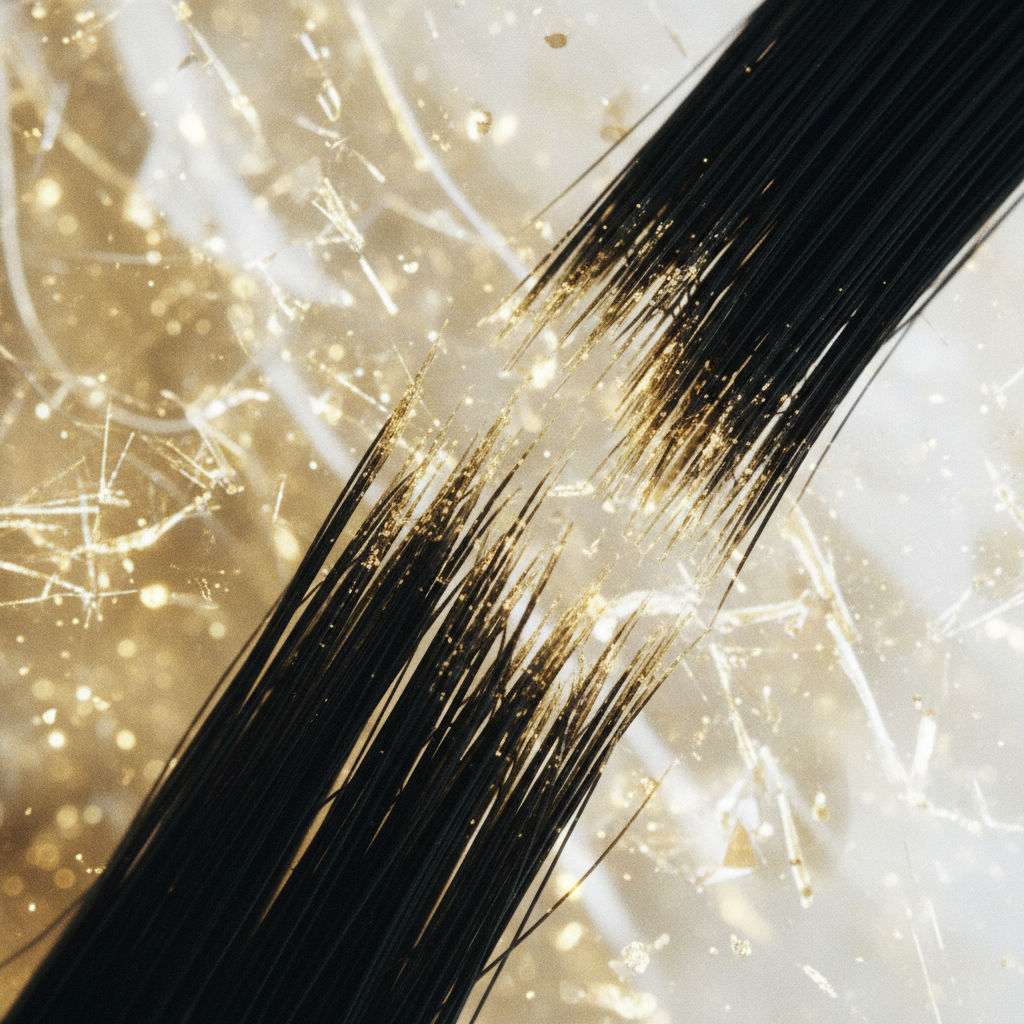
When you examine cuticle erosion under a scanning electron microscope (SEM), you see a clear progression. Healthy fibres look smooth, like neatly stacked roof tiles. Early damage presents as chipped edges and lifted scale margins. Advanced damage shows total loss of the cuticle cells, exposing the fibrillar structure of the underlying cortex.
Research in cosmetic dermatology shows that once 18-MEA is removed (typically by a single alkaline chemical process such as bleaching or oxidative permanent colouring), the surface becomes hydrophilic. The hair now absorbs ambient water rapidly, swells unevenly, and loses its natural slip. This friction creates severe mechanical stress during brushing, accelerating further cuticle chipping and ultimately causing fibre breakage.
+-----------------------------------------------------------+
| EPICUTICLE (18-MEA) | <- Hydrophobic protective lipid layer
+-----------------------------------------------------------+
| EXOCUTICLE (High sulphur) | <- Rigid, highly cross-linked protein
+-----------------------------------------------------------+
| ENDOCUTICLE (Low sulphur) | <- Soft protein matrix, vulnerable to water
+-----------------------------------------------------------+
| CELL MEMBRANE COMPLEX (Lipid & Protein) | <- "Glue" holding cuticle scales together
+-----------------------------------------------------------+
| CORTEX FIBRE | <- Structural core of the hair
+-----------------------------------------------------------+
The biological mechanisms behind cuticle breakdown
To grasp what happens beneath the surface, you need to understand the layered architecture of an individual cuticle cell:
- The Epicuticle: A thin membrane covered with 18-MEA lipids that repels moisture and lubricates the fibre.
- The Exocuticle: A rigid layer rich in cystine (roughly 30% of its amino acid content), providing high physical resilience.
- The Endocuticle: A softer, low-sulphur layer that swells dramatically when exposed to water or alkaline solutions.
Damage occurs when these distinct layers are subjected to three primary stressors:
Alkaline pH and chemical breakdown
Healthy hair and scalp thrive at an acidic pH between 4.5 and 5.5. Most chemical bleaches, permanent dyes, and relaxers have an alkaline pH ranging from 9.0 to 11.0. Alkaline solutions force the cuticle scales to swell and flare open, allowing processing agents to reach the cortex. However, this process permanently strips the 18-MEA lipid layer, breaks disulphide bonds, and weakens the cell membrane complex. Even after washing, the scales often fail to return to their original flattened alignment.
Thermal degradation
Styling tools heated to between 180 and 230 degrees Celsius instantly vaporise internal moisture. If your hair is damp, this causes "bubble hair" deformity, where expanding steam creates microscopic cavities within the cortex and bursts through the cuticle. Even on dry hair, temperatures above 160 degrees Celsius degrade keratin proteins and melt the protective lipid surface, causing edges to curl upward and snap off.
Mechanical abrasion
Brushing hair when it is soaking wet causes tremendous physical strain. Wet hair can stretch by up to 30 percent before breaking, but the swollen endocuticle makes the outer scales soft and fragile. Dragging fine-toothed combs or rough bristles through tangled, swollen hair peels the cuticle scales away from the cortex, a process known as delamination.
| Factor | Healthy cuticle state | Damaged cuticle state |
|---|---|---|
| Surface charge | Low negative charge | High negative charge (cysteic acid formation) |
| Hydration behaviour | Hydrophobic (repels excess water) | Hydrophilic (swells rapidly, absorbs excess water) |
| Light reflection | High specular reflection (glossy, shiny) | Diffuse reflection (dull, matte appearance) |
| Inter-fibre friction | Low friction (slides easily, resists knots) | High friction (tangling, rough texture) |
| Tensile response | Smooth elongation under tension | Fraying, splitting, premature mid-shaft breakage |
Signs of cuticle erosion to watch for
Cuticle damage shows specific, measurable physical signs along the length of your hair:
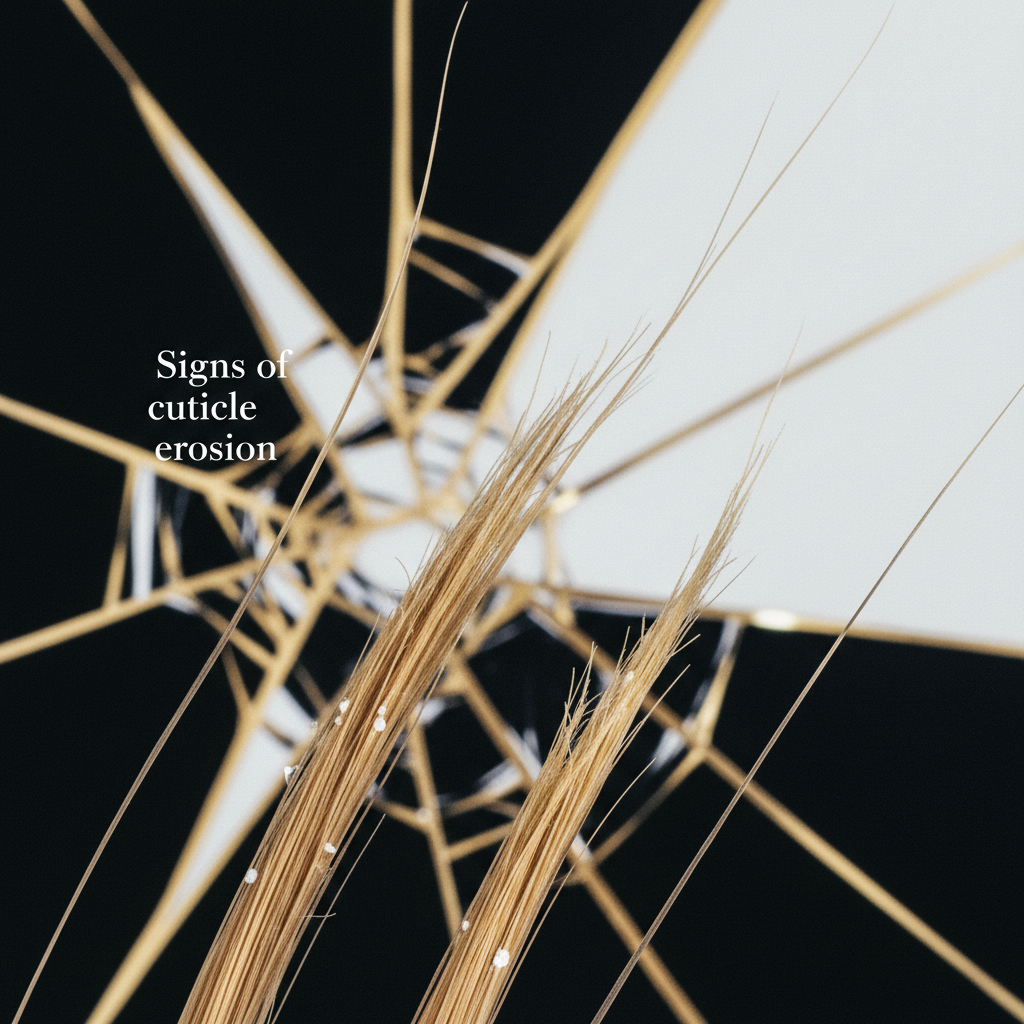
- Persistent dullness: When scales lift or break away, light scatters in all directions rather than bouncing straight back off a smooth surface.
- Micro-tangling and "velcro" ends: Fibres catch on one another because raised scale edges act like tiny hooks.
- High porosity: Your hair absorbs water the second you step under the shower, but dries out just as rapidly into a brittle, frizzy state.
- Split ends (trichoptilosis): Once the cuticle is completely stripped from the ends, the cortex splits into separate microfibrils.
- White dots along the shaft (trichorrhexis nodosa): These tiny white specks mark points where the cuticle has vanished, leaving an exposed cortical bundle ready to snap under minimal tension.
What the evidence does not show
There are several persistent myths regarding hair repair that contradict basic fibre science:
- The cuticle cannot heal biologically: Hair is non-living keratinised tissue. It contains no living cells, blood supply, or metabolic machinery. No product, oil, or supplement can "regenerate" a dead protein scale once it has chipped away or split.
- Conditioners do not permanently rebuild cuticles: Cationic surfactants, silicones, and hydrolysed proteins temporarily patch damaged sites by clinging to the hair's negative electrical charge. These ingredients wash out over time and must be reapplied regularly.
- Cuticle damage does not cause alopecia: A shredded cuticle leads to hair breakage along the shaft. It does not damage the hair follicle beneath the scalp, nor does it trigger follicular shedding (telogen effluvium) or pattern hair loss.
What you can do: protective and restorative strategies
While you cannot regrow broken cuticles, you can protect your remaining cuticle layers and chemically smooth the outer surface using proven methods.
Optimise your wash pH
Always use shampoos and conditioners formulated around pH 4.5 to 5.5. An acidic environment neutralises static charges, prevents excessive swelling of the endocuticle, and helps the scale margins lie flat against the shaft.
Use cationic conditioning agents
Damaged hair carries a strong negative electrostatic charge due to the oxidation of cystine into cysteic acid. Conditioners containing positively charged cationic surfactants (such as cetrimonium chloride or behentrimonium methosulfate) bind firmly to these negative sites, reducing inter-fibre friction and flattening rough cuticle edges.
Shield against mechanical stress
Detangle starting at the ends and work your way up to the roots, using wide-tooth combs or flexible detangling brushes. Never vigorously rub your hair with standard cotton loop towels; instead, gently press excess water out using a smooth microfibre towel or cotton shirt to prevent scale friction.
Reduce heat exposure
Keep heated styling tools below 150 to 160 degrees Celsius, and never apply direct heat to damp hair. Always use thermal protectants containing film-forming polymers that distribute heat evenly across the shaft rather than letting it scorch local cuticle edges.
When the cause may be something else
If your hair appears dull, brittle, or limp, the problem is not always external cuticle erosion:
- Hard water mineral buildup: High levels of calcium and magnesium carbonate (over 180 mg/L) can leave a chalky film on the hair shaft that mimics the coarse feel of cuticle damage without structural loss.
- Underlying nutritional deficits: Severe protein deficiencies or iron deficiency anaemia can cause hair to emerge from the follicle with weaker cortical structures from the start.
- Scalp inflammation: Conditions like seborrhoeic dermatitis alter sebum composition and natural acid mantle balance, indirectly affecting the tactile quality of the hair roots.
When to seek professional advice
Consult a certified trichologist or consultant dermatologist if you notice:
- Hair shedding from the root (characterised by a small white bulb at the tip of shed strands) rather than snapped fragments without bulbs.
- Sudden, patchy thinning across your scalp.
- Scalp burning, persistent flaking, redness, or pain. A qualified professional can use trichoscopy (magnified scalp and hair analysis) to distinguish structural cuticle weathering from medical follicular conditions.
Supporting your hair routine with Watermans
If you want to protect your hair against daily mechanical wear, Watermans offers targeted, cosmetic haircare solutions. Products such as Watermans GrowMe Shampoo and ConditionMe Conditioner are carefully balanced to cleanse the scalp while coating the hair fibre with moisturising, strengthening ingredients.
ConditionMe incorporates moisturising lipids, hydrolysed proteins, and cholesterol that temporarily fill in surface irregularities, helping to smooth lifted cuticle scales, soften coarse hair, and reduce future breakage during styling.
The bottom line on Understanding Hair Cuticle Damage
Mastering the principles of Understanding Hair Cuticle Damage is essential for maintaining resilient, vibrant hair over months and years of styling. Because your hair shaft cannot heal itself, every chemical service, rough brushing session, and hot iron pass permanently chips away at the cuticle's finite protective layers. By maintaining an acidic pH, replacing lost surface lipids with cationic conditioners, and handling damp hair with care, you preserve the structural integrity of the cuticle and keep your hair smooth, manageable, and resistant to breakage.
Frequently asked questions about Understanding Hair Cuticle Damage
Can split ends and lifted cuticles ever be permanently repaired?
No. Because hair is non-living biological tissue, damaged cuticles cannot biologically heal. Cosmetic treatments and serums use film-forming polymers, proteins, and conditioning agents to temporarily seal splits and smooth down lifted edges, but these effects wash away over time and require consistent reapplication.
How does Understanding Hair Cuticle Damage help differentiate breakage from hair loss?
Understanding Hair Cuticle Damage clarifies that surface weathering snaps the fibre along the shaft, producing short, broken hairs without roots. True hair loss originates below the scalp inside living follicles, causing entire hairs with root bulbs to shed or stop growing altogether.
What is the single biggest cause of cuticle erosion?
Chemical lifting via alkaline treatments like bleach, permanent colour, and relaxers causes the fastest, most severe cuticle loss. These treatments strip the protective 18-MEA lipid layer and break disulphide bonds, leaving the cuticle permanently porous, fragile, and prone to rapid mechanical chipping.
How do hot tools damage the cuticle layer?
Heat tools above 160 degrees Celsius dry out internal moisture and degrade structural keratin proteins. If used on damp hair, the trapped water turns to steam, creating internal micro-bubbles that rupture through the cuticle scales, causing severe surface chipping and cracking.
Sources and references
- Robbins, C. R. (2012). Chemical and Physical Behavior of Human Hair (5th ed.). Springer-Verlag.
- Gavazzoni Dias, M. F. (2015). Hair cosmetics: An overview. International Journal of Trichology, 7(1), 2-15.
- Swift, J. A. (1999). Human hair cuticle: Biologically conspired to the owner's advantage. International Journal of Cosmetic Science, 21(4), 227-239.
- Sinclair, R. D. (2007). Healthy hair: What is it? Journal of Investigative Dermatology Symposium Proceedings, 12(2), 2-5.