Evidence-Based Minoxidil Alternatives for Hair Thinning
9 min read ·
Explore clinically evaluated minoxidil alternatives for hair thinning, comparing natural botanicals, laser therapy, and prescription treatments for healthier hair.

Quick answer: Clinically validated Minoxidil Alternatives for Hair Thinning include prescription options like finasteride, low-level laser therapy (LLLT), microneedling, and botanical compounds such as rosemary oil, caffeine, and saw palmetto. While these choices offer viable options for individuals seeking to avoid minoxidil side effects such as scalp irritation, hypertrichosis, or dread shed, their primary limitation is variability in efficacy. Cosmetic and botanical substitutes support scalp health and follicle vitality, but prescription alternatives remain the benchmark for arresting severe genetic miniaturisation.
Key takeaways
- Prescription anti-androgens address the hormonal root of androgenetic alopecia by lowering scalp dihydrotestosterone (DHT), whereas minoxidil functions primarily as a vasodilator and potassium channel opener.
- Botanical extracts like rosemary oil and caffeine stimulate peripheral microcirculation and possess mild 5-alpha reductase inhibiting properties, but they require consistent, long-term application.
- Low-level laser therapy (LLLT) and microneedling physically stimulate cellular ATP production and local growth factors, serving as strong device-based non-pharmacological substitutes.
- Cosmetic interventions improve fibre density, reduce physical breakage along the hair shaft, and cultivate an optimal scalp environment, but they cannot alter irreversible genetic follicle death.
- Any alternative regimen demands a minimum commitment of 3 to 6 months before measurable clinical changes in follicle calibre and hair density become apparent.
Minoxidil Alternatives for Hair Thinning: what the evidence shows
Evaluating Minoxidil Alternatives for Hair Thinning requires examining how different non-minoxidil interventions perform in peer-reviewed trials. The primary reason people seek substitutes is the side-effect profile of topical minoxidil, which frequently includes contact dermatitis, propylene glycol intolerance, temporary shedding, and facial hair growth.

Prescription systemic alternatives represent the most robust medical category. Finasteride, an oral type II 5-alpha reductase inhibitor, reduces systemic DHT levels by roughly 70%. In long-term clinical trials published in dermatology literature, oral finasteride halted hair loss progression in over 80% of treated men and stimulated noticeable regrowth in roughly 60%. Dutasteride, which inhibits both type I and type II 5-alpha reductase isoenzymes, demonstrates even higher binding affinity, reducing serum DHT by over 90%. However, these prescription options alter systemic hormone pathways and carry risks of sexual dysfunction or mood changes, making them unsuitable for certain demographics, especially women of childbearing potential.
Physical modalities have earned regulatory clearances as standalone substitutes. Low-level laser therapy (LLLT) utilises red light within the 650 to 655 nm wavelength range. Photobiomodulation increases cytochrome c oxidase activity inside follicular mitochondria, which ramps up adenosine triphosphate (ATP) synthesis, shifting resting telogen follicles into active anagen growth. Sham-controlled trials show measurable gains in hair count, averaging 15 to 20 additional hairs per square centimetre after 16 to 26 weeks.
Microneedling creates micro-perforations in the stratum corneum, activating platelet-derived growth factor (PDGF), epidermal growth factor (EGF), and Wnt/beta-catenin signalling pathways. Used once weekly at depths of 0.5 to 1.5 mm, microneedling stimulates follicle repair mechanisms even when applied without topical medications.
Among botanicals, rosemary oil (Rosmarinus officinalis) garnered widespread clinical interest following a 2015 randomised comparative trial published in Skinmed. The study compared 1 ml of rosemary oil applied twice daily against 2% minoxidil over six months. Both cohorts showed a statistically significant increase in hair count at the six-month mark with comparable efficacy, while the rosemary group reported significantly less scalp itching. Similarly, caffeine applied topically penetrates follicular pathways rapidly, where in vitro research demonstrates it counteracts testosterone-mediated growth suppression and lengthens the anagen phase.
| Alternative Option | Mechanism of Action | Clinical Evidence Level | Primary Drawback or Limitation |
|---|---|---|---|
| Oral Finasteride | Inhibits 5-alpha reductase (DHT reduction) | Strong (Multiple phase III RCTs) | Systemic hormonal side effects; contraindicated in pregnancy |
| Low-Level Laser (LLLT) | Cellular photobiomodulation; elevates ATP | Moderate to Strong (Sham-controlled trials) | High equipment cost; demands strict protocol adherence |
| Microneedling | Induces wound repair and growth factor release | Moderate (Controlled human studies) | Risk of local infection or mechanical follicle trauma |
| Rosemary Oil | Enhances microcirculation, mild anti-androgen | Moderate (Single major comparative trial) | Slower visible onset; potential essential oil irritation |
| Topical Caffeine | Phosphodiesterase inhibition; barrier penetration | Moderate (In vitro and clinical observational) | Mild effect size; best used alongside broader scalp care |
| Saw Palmetto (Serenoa repens) | Phytosterol-mediated block of DHT binding | Low to Moderate (Small clinical cohorts) | Inconsistent phytosterol extraction concentrations |
What the evidence does not show for natural alternatives
While commercial marketing frequently frames plant extracts as instant cures, the clinical record tells a more measured story. Controlled research has not found that any over-the-counter herbal tincture can fully mirror the potent vasodilatory and potassium-channel-opening action of pharmaceutical compounds.
Crucially, natural and botanical solutions cannot revive a follicle that has completely fibrosed. When severe miniaturisation culminates in slick, scarred baldness, no topical oil, laser device, or nutritional supplement can generate a new follicle. Furthermore, isolated internet claims suggesting that dietary biotin repairs male or female pattern hair loss are unsupported by medical literature; biotin supplementation only demonstrates clinical utility in the rare context of a diagnosed systemic biotin deficiency.
Biological mechanisms: distinguishing shedding, breakage, and loss
To choose an effective alternative, you must identify whether your thinning stems from follicle miniaturisation, diffuse shedding, or structural breakage.
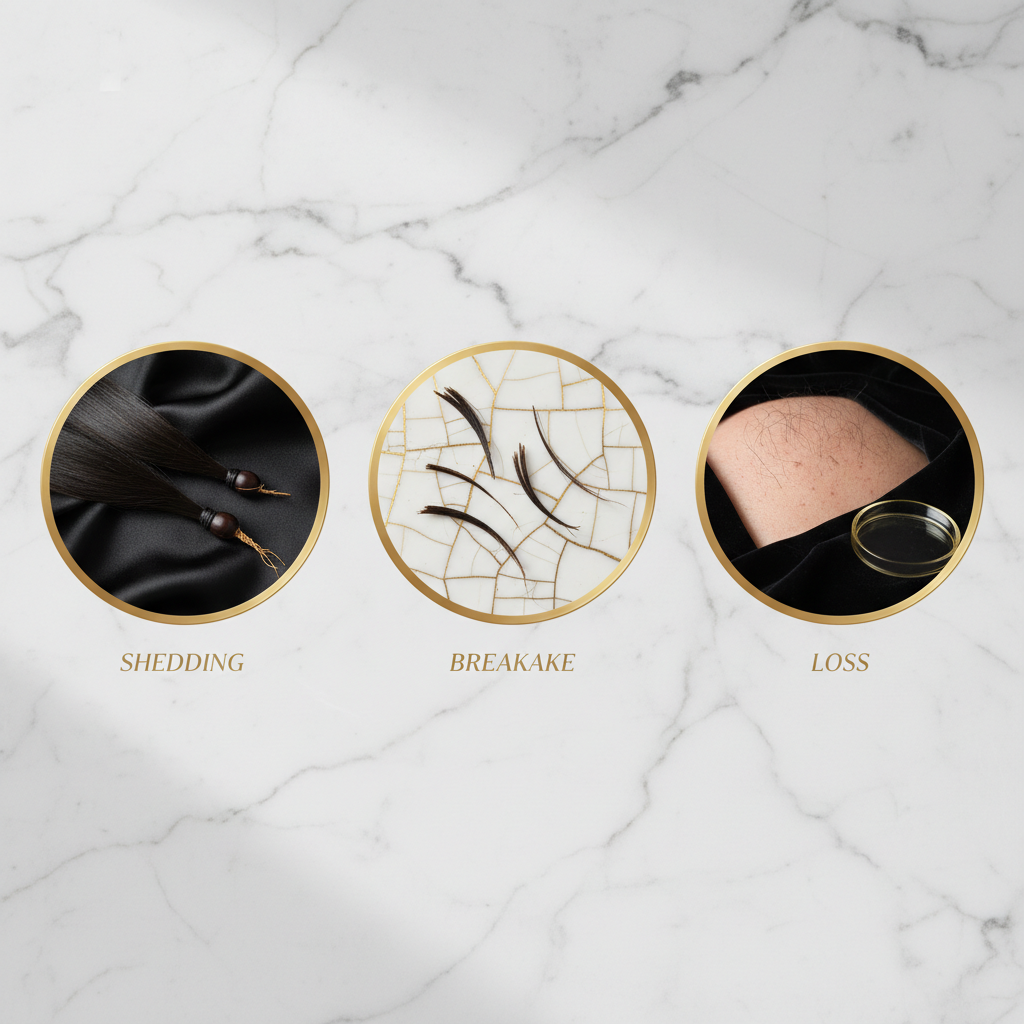
Follicular hair loss, such as androgenetic alopecia, involves follicular miniaturisation. Dihydrotestosterone attaches to androgen receptors in genetically susceptible follicles, shortening the anagen growth cycle and elongating the telogen rest cycle. Over successive turns of the cycle, the follicle shrinks, producing thinner, shorter, unpigmented vellus fibres until production halts entirely.
Hair shedding (telogen effluvium) occurs when a physiological stressor, high fever, post-pregnancy hormonal crash, or rapid weight loss pushes up to 30% of active follicles into the shedding phase prematurely. The hair bulb leaves the scalp intact, with a distinct white keratin bulb at the root. Telogen effluvium usually resolves spontaneously over 3 to 9 months once the trigger is corrected; it does not require anti-androgens.
Hair breakage is purely cosmetic and mechanical. The fibre fractures along the hair shaft due to chemical processing, heat styling, or mechanical friction. The follicle itself remains healthy in the dermis. Treating hair breakage requires fortifying the keratin protein matrix and smoothing the protective cuticle, not pharmaceutical intervention.
Signs that your hair thinning requires intervention
Recognising the early presentation of follicular thinning ensures you select an appropriate regimen before extensive miniaturisation takes place:
- A widening natural parting line that exposes more scalp skin under direct overhead lighting.
- Gradual recession of the frontotemporal hairline, creating an 'M' shape across the forehead.
- Bitemporal thinning or diffuse reduction across the crown and vertex, leaving the occipital back untouched.
- A shrinking ponytail diameter over a 6 to 12 month window, with no sudden shedding event.
- A high ratio of thin, wispy hairs relative to thick, terminal fibres during regular brushing.
Complementary cosmetic support: scalp health and density
Nourishing the scalp environment provides the biological baseline required for any alternative hair-density regimen to succeed. Cosmetic topical care cannot alter your genetics, but it directly protects newly emerging hair fibres from environmental oxidative stress, cleanses follicle openings of sebum and cellular debris, and reinforces the hair shaft against premature breakage.
When designing a restorative routine, look for evidence-backed cosmetic actives that support follicle vitality and fibre resilience:
- Topical Caffeine: Easily absorbed across the follicular infundibulum to energise the skin surface and stimulate local vitality.
- Hydrolysed Lupine Protein and Biotin: Coat the exterior cuticle, imparting temporary structural volume, bolstering moisture retention, and decreasing mechanical snap.
- Niacinamide (Vitamin B3): Enhances the skin's natural barrier function, reduces micro-inflammation, and supports optimal cutaneous microcirculation.
- Rosemary and Botanical Extracts: Condition the scalp skin, reduce flaky buildup, and provide antioxidant defence against free radicals that compromise cellular integrity.
In this context, targeted formulations like Watermans Grow Me Shampoo and Condition Me Conditioner blend caffeine, biotin, rosemary extract, niacinamide, and hydrolysed lupine protein. While remaining entirely cosmetic rather than medicinal, these formulas are crafted to revitalise the scalp surface, clear follicular blockages, and fortify hair fibres to maximise the appearance of natural density without the application challenges associated with pharmaceutical lotions.
When the cause may be something else
Thinning is not always hereditary. If your scalp displays rapid, patchy hair loss (alopecia areata), scaling, redness, or painful pustules, you may be experiencing a dermatological condition such as lichen planopilaris or seborrhoeic dermatitis.
Similarly, systemic metabolic imbalances frequently mimic pattern thinning. Ferritin levels below 30 ng/mL, thyroid dysregulation (hypothyroidism or hyperthyroidism), and polycystic ovary syndrome (PCOS) can disrupt anagen cycling. In these circumstances, topical substitutes cannot correct the underlying internal pathology.
When to seek professional advice
Consult a GP, dermatologist, or registered trichologist under the following circumstances:
- You experience sudden, dramatic hair fall where hundreds of strands shed daily during washing or brushing.
- The hair loss occurs in circular, coin-shaped bare patches across the scalp or beard.
- You experience persistent burning, scalp tenderness, severe erythema, or scarring around follicle openings.
- Your thinning fails to stabilise after six months of disciplined lifestyle and supportive cosmetic care.
Frequently asked questions about Minoxidil Alternatives for Hair Thinning
What is the most effective natural option among Minoxidil Alternatives for Hair Thinning?
Rosemary oil has the strongest comparative clinical evidence among natural options. Applied consistently over six months at adequate dilutions, it showed hair count improvements comparable to 2% minoxidil in a peer-reviewed human trial, while causing less scalp irritation.
Can low-level laser therapy replace minoxidil entirely?
Yes, LLLT can serve as a non-pharmacological substitute for mild to moderate pattern thinning. Laser devices use photobiomodulation to boost cellular ATP production and prolong anagen growth without triggering the chemical contact dermatitis or initial dread shedding linked to topical drugs.
How long does it take for non-minoxidil alternatives to show results?
All hair density regimens require 3 to 6 months to demonstrate visible changes. Hair fibres grow at approximately 1 to 1.25 cm per month, meaning structural improvements in calibre and folicle density require multiple anagen cycles before becoming noticeable.
Will stopping minoxidil to switch to an alternative cause hair loss?
Switching abruptly from minoxidil often causes shedding. Any hair follicles maintained strictly through minoxidil-induced vasodilation may shed once the drug is withdrawn. Introduce your chosen alternative several weeks before tapering off minoxidil slowly under medical supervision.
Choosing the right path for your hair
Navigating the landscape of Minoxidil Alternatives for Hair Thinning means balancing realistic clinical expectations against your personal tolerance for pharmaceutical side effects. While systemic prescription anti-androgens deliver the most powerful clinical defence against hormonal miniaturisation, non-pharmacological options such as low-level laser therapy, microneedling, and botanical compounds like rosemary oil and caffeine provide viable avenues for individuals seeking gentler protocols.
Coupling these targeted approaches with proactive scalp hygiene, balanced nutrition, and structural cosmetic care gives your follicles the resilient foundation they need to thrive over the long term.
Sources and references
- British Association of Dermatologists. Guidelines for the management of alopecia areata and androgenetic alopecia. 2021.
- Panahi, Y., et al. Rosemary oil vs minoxidil 2% for the treatment of androgenetic alopecia: a randomized comparative trial. Skinmed, 2015.
- Adil, A., & Godwin, M. The effectiveness of treatments for androgenetic alopecia: A systematic review and meta-analysis. Journal of the American Academy of Dermatology, 2017.
- Fischer, T. W., et al. Differential effects of caffeine on hair shaft elongation, matrix and outer root sheath keratinocyte proliferation, and transforming growth factor-beta2/insulin-like growth factor-1-mediated regulation of the hair cycle in male and female human hair follicles in vitro. British Journal of Dermatology, 2014.
- National Institute for Health and Care Excellence (NICE). Alopecia androgenetica: Clinical Knowledge Summaries. 2023.
Find these ingredients in Watermans products
- Niacinamide: you will find this ingredient in our Hair Mask.