Rosemary Oil versus Commercial Hair Treatments: Evidence and Scalp Science
9 min read ·
Compare Rosemary Oil versus Commercial Hair Treatments: discover clinical evidence, mechanisms, scalp safety risks, and which approach works best for hair density.
Quick answer: When evaluating Rosemary Oil versus Commercial Hair Treatments, clinical evidence shows that rosemary oil can support follicle health and hair count similarly to standard mild topical remedies over a six-month period. However, commercial formulas often deliver more consistent concentrations, enhanced delivery systems, and broader multi-ingredient support. The main limitation of rosemary oil is its variability: undiluted essential oils risk acute contact dermatitis, and botanical oils cannot cure advanced genetic hair loss or rapidly reverse acute shedding on their own.
Key takeaways
- A landmark 2015 comparative trial demonstrated that rosemary essential oil performed similarly to 2% topical minoxidil for androgenetic alopecia after six months of daily use.
- Commercial treatments provide standardised active concentrations, controlled pH levels, and specialised penetration enhancers that raw botanical oils lack.
- Rosemary oil works primarily by improving microcirculation, down-regulating inflammatory pathways, and offering mild antioxidant protection at the scalp level.
- Applying neat essential oil causes severe scalp irritation and barrier breakdown; it must always be diluted in a suitable carrier oil or formulated into a wash-off cosmetic.
- Sudden, patchy, or rapid shedding requires professional dermatological assessment rather than prolonged self-treatment with home remedies.
Rosemary Oil versus Commercial Hair Treatments: what the evidence shows
The clinical debate surrounding Rosemary Oil versus Commercial Hair Treatments largely stems from a randomised comparative trial published in 2015 by Panahi et al. In this study, 100 individuals with androgenetic alopecia received either rosemary oil or 2% topical minoxidil twice daily for six months. At the three-month evaluation, neither group showed significant changes in hair count. By month six, however, both cohorts demonstrated a statistically significant increase in hair count compared to baseline, with no significant difference between the two groups. Notably, the rosemary oil group reported significantly less scalp itching than the commercial 2% minoxidil cohort, which frequently experienced irritation from carrier solvents like propylene glycol.
Beyond this trial, smaller animal studies (such as Murata et al., 2013) demonstrated that topical rosemary leaf extract (Rosmarinus officinalis) inhibited 5-alpha reductase activity in mice experiencing testosterone-induced hair regrowth interruption. This suggests a potential biological mechanism for reducing dihydrotestosterone (DHT) binding at the follicular receptor.
However, commercial hair treatments hold a distinct pharmacological advantage: standardisation. Over-the-counter clinical lotions, medicinal serums, and professionally formulated leave-on scalp treatments undergo strict batch testing. Their active percentages (such as 2% or 5% minoxidil, peptide complexes, or caffeine) remain uniform. By contrast, pure botanical essential oils vary dramatically in their chemical profile (chemotypes) based on soil quality, harvest timing, and extraction methods.
What the evidence does not show
It is critical to distinguish between modest improvements in hair density and complete reversal of follicle miniaturisation. Research does not show that rosemary oil can reverse long-standing, advanced baldness where follicles have already become fibrotic.
Furthermore, evidence does not show that rosemary oil halts rapid hair shedding triggered by physiological shock (telogen effluvium), nutritional deficiencies, or thyroid disorders. Social media trends frequently present botanical oils as overnight cures, but clinical changes in hair diameter and anagen-to-telogen ratios take a minimum of three to six months to become measurable. Expecting immediate reduction in daily shedding from botanical applications is not supported by dermatology literature.
Mechanisms of action: how they work on the scalp
Understanding how these options operate helps you choose the right path for your scalp condition. Both approaches target the biological environment of the follicle, but they use different pathways:
Microvascular circulation
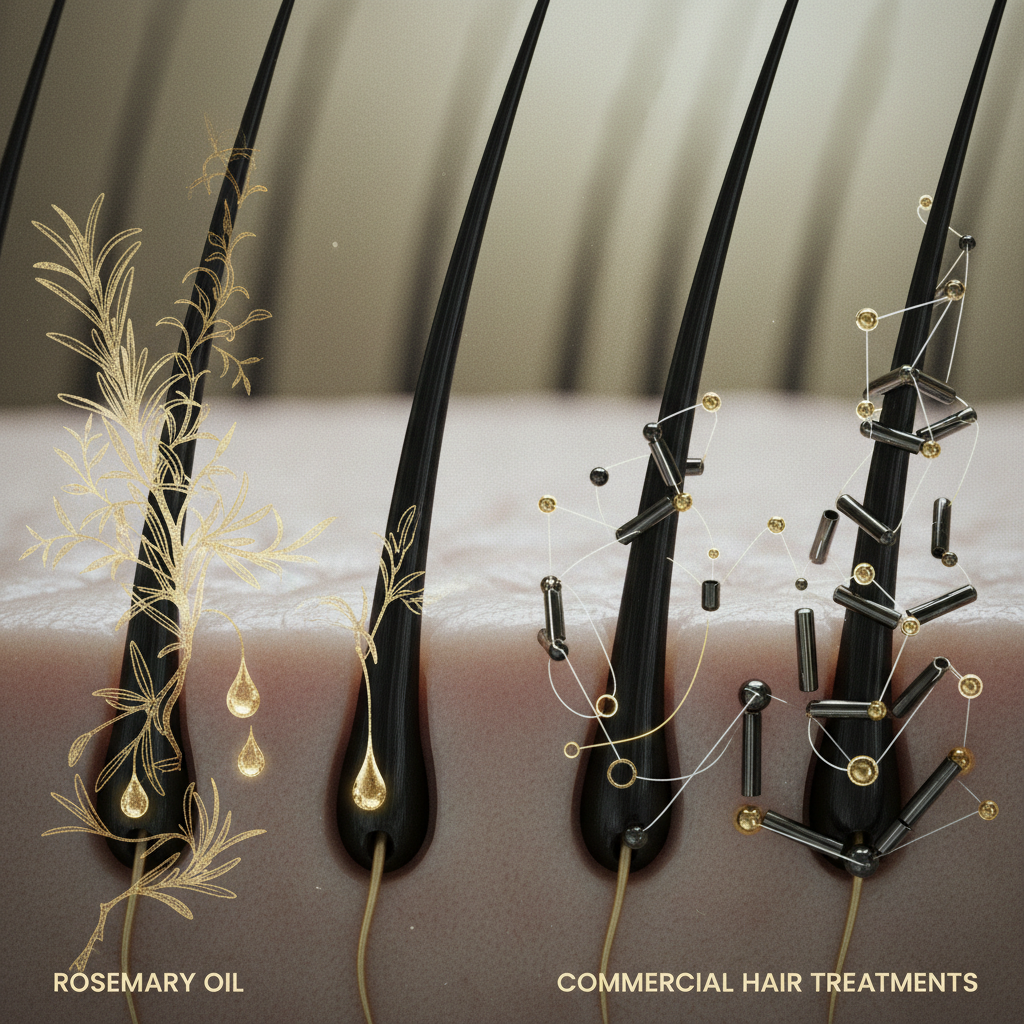
Rosemary oil contains carnosic acid and rosmarinic acid, polyphenols that help counteract tissue inflammation and stimulate local vascular perfusion. Enhanced blood flow to the dermal papilla ensures that oxygen and micronutrients reach actively dividing matrix cells. Commercial vasodilator solutions achieve a similar vascular effect by opening adenosine triphosphate-sensitive potassium channels in vascular smooth muscle cells.
Inflammatory regulation and microbial balance
Scalp inflammation caused by Malassezia yeast overgrowth can accelerate follicular miniaturisation. Rosemary oil exhibits broad-spectrum antimicrobial and antifungal characteristics, which help calm the scalp microbiome. Well-engineered commercial anti-shedding shampoos and scalp serums complement this by using balanced surfactants, piroctone olamine, or salicylic acid to clarify sebum plugs without stripping the acid mantle.
Formulation mechanics and skin penetration
The skin barrier (the stratum corneum) is designed to keep external substances out. Pure essential oils sit largely on the surface unless suspended in light carriers with appropriate molecular weights. Commercial hair treatments use specific penetration enhancers, liposomal encapsulation, or adjusted pH levels (typically 4.5 to 5.5) to transport active peptides, vitamins, and plant extracts directly to the follicle bulb.
| Feature | Rosemary Oil (Diluted) | Commercial Formulations |
|---|---|---|
| Active Concentration | Variable depending on plant source | Standardised and measured (e.g., 2% to 5%) |
| Scalp Irritation Risk | High if improperly diluted; low if balanced | Low to moderate (depends on alcohol/glycol content) |
| Primary Mechanism | Microcirculation, antioxidant, mild 5-AR inhibition | Vasodilation, targeted cellular signaling, peptide delivery |
| Convenience & Texture | Greasy; requires pre-wash masking or carriers | Often lightweight, water-based, or integrated into washes |
| Timeframe for Results | 6 months of consistent daily application | 3 to 6 months of consistent daily application |
| Scalp Barrier Support | Variable; carrier oils can feed yeast if heavy | Formulated at physiological pH (4.5 to 5.5) |
Dangers of DIY application: dilution and dermatitis
One of the largest risks in the Rosemary Oil versus Commercial Hair Treatments debate is the mishandling of raw essential oil. Pure essential oils are volatile, highly concentrated phytochemicals. Applying neat rosemary oil directly to the scalp can cause contact dermatitis, chemical burns, erythema, and secondary hair shedding caused by severe inflammation.
If using pure essential oil, it must be diluted to a safe concentration:
- Maintain an active concentration of no more than 1% to 2% (roughly 3 to 6 drops of pure rosemary essential oil per 30 ml of carrier oil).
- Use lightweight, non-comedogenic carrier oils such as jojoba or squalane. Heavy kitchen oils (like olive or unrefined coconut oil) can trap heat, clog follicles, and exacerbate seborrhoeic dermatitis.
- Conduct a 24-hour patch test on the inner forearm before applying any home mixture to the scalp.
When the cause may be something else
Hair loss is biologically complex. Neither rosemary oil nor cosmetic commercial treatments will resolve shedding caused by systemic or internal medical conditions. Follicles are metabolic barometers; they respond quickly to internal imbalances:
- Ferritin and Iron Deficiency: Low iron stores restrict oxygen delivery to matrix cells, shifting follicles prematurely into the telogen (resting) phase.
- Thyroid Dysfunction: Both hypothyroidism and hyperthyroidism cause diffuse thinning across the entire scalp.
- Autoimmune Conditions: Conditions like alopecia areata require targeted immunomodulatory treatments, not cosmetic oils.
- Traction and Mechanical Tension: Tight hairstyles snap hair fibres and cause traction alopecia, which requires physical tension relief rather than topical remedies.
What you can do: building a safe regimen
If you wish to explore botanical benefits without the mess and variability of raw essential oils, combine gentle botanical elements with structured commercial formulations.
- Clarify and Cleanse Regularly: Wash your scalp regularly to remove oxidised sebum, environmental pollutants, and dead skin cells. Allowing botanical oils to accumulate on the scalp encourages Malassezia proliferation.
- Prioritise Fibre Integrity: Remember that hair shedding (from the root) is different from hair breakage (along the shaft). While scalp treatments address the follicle, fragile hair shafts need hydrolysed proteins, moisture, and gentle detangling to prevent snapping.
- Patience and Consistency: Hair grows at an average rate of 1 centimetre per month. Commit to any chosen regimen for at least 16 to 24 weeks before evaluating changes in hair density.
The Watermans approach to botanical and clinical balance
For those who want the biological advantages of natural extracts alongside scientific formulation stability, commercial blends offer an ideal middle ground. Watermans approaches hair wellness by bridging this gap. Rather than relying on messy, unstandardised raw oils that risk contact allergies, Watermans integrates premium botanical extracts with proven cosmetic actives.
Formulas like Watermans Grow More Elixir and Grow Me Shampoo incorporate rosemary extract alongside complementary ingredients such as caffeine, biotin, argan oil, allantoin, and hydrolysed lupin protein. This targeted combination supports a healthy, invigorated scalp environment, helps improve hair density, and strengthens hair fibres against everyday breakage without greasy residue or barrier disruption.
When to seek professional advice
Consult a GP, dermatologist, or qualified trichologist if you notice any of the following signs:
- Sudden, excessive clumps of hair falling out during washing or brushing.
- Patchy, coin-sized areas of complete baldness.
- Burning, intense itching, tenderness, or visible scaling on the scalp.
- Thinning accompanied by unexplained weight changes, fatigue, or menstrual irregularities.
Frequently asked questions about Rosemary Oil versus Commercial Hair Treatments
Is rosemary oil as effective as 2% minoxidil?
In a controlled 2015 study by Panahi et al., rosemary oil demonstrated comparable increases in hair count to 2% minoxidil after six months of daily application. However, commercial treatments provide standardised active doses, whereas raw rosemary oil varies in potency and requires careful dilution.
How often should I apply rosemary oil compared to commercial hair treatments?
Rosemary oil mixtures are typically massaged into the scalp two to three times per week as a pre-wash treatment for 30 minutes. Commercial hair serums are usually formulated as lightweight leave-in liquids designed for daily or twice-daily use without leaving the hair greasy.
Can rosemary oil make hair shedding worse?
Yes, if applied incorrectly. Undiluted rosemary oil or heavy carrier oils can cause severe allergic contact dermatitis, follicle inflammation, or exacerbate seborrhoeic dermatitis. This scalp stress can trigger temporary telogen effluvium, worsening the very shedding you intended to treat.
Do I need to wash out rosemary oil?
Yes, pure botanical oils suspended in carrier oils should generally be washed out after 30 to 60 minutes. Leaving heavy oils on the scalp for multiple days traps dead skin cells, clogs follicular openings, and can feed surface yeast. Water-based commercial leave-on treatments do not require washing out.
Why choose commercial hair treatments over pure rosemary oil?
Commercial treatments offer consistent, laboratory-tested active concentrations, balanced pH levels (4.5 to 5.5), and cosmetic elegance. They absorb cleanly without greasy build-up, contain penetration enhancers to reach the follicle, and often include multiple synergistic ingredients like peptides and caffeine.
Summary
Weighing up Rosemary Oil versus Commercial Hair Treatments comes down to your personal priorities: do-it-yourself natural remedies versus calibrated, stable science. Rosemary oil provides valid, research-backed benefits for scalp circulation and mild hair density support over long periods. However, commercial hair treatments deliver consistency, safer skin penetration, and broader ingredient profiles without the risk of formulation errors at home. Whichever path you choose, monitor your scalp health closely, practice patience over several months, and consult a medical professional if rapid shedding persists.
Sources and references
- Panahi, Y. Et al. (2015) 'Rosemary oil vs minoxidil 2% for the treatment of androgenetic alopecia: a randomized comparative trial', Skinmed, 13(1), pp. 15-21.
- Murata, K. Et al. (2013) 'Promotion of hair growth by Rosmarinus officinalis leaf extract', Phytotherapy Research, 27(2), pp. 212-217.
- British Association of Dermatologists (2020) 'Telogen Effluvium: An Information Leaflet'.
- National Institute for Health and Care Excellence (NICE) (2022) 'Alopecia androgenetica: Clinical knowledge summary'.