Mechanical Damage from Brushing: Causes, Fibre Physics, and Safe Detangling
9 min read ·
Understand the mechanics of mechanical damage from brushing, how friction degrades hair cuticles, and practical steps to detangle safely without breakage.
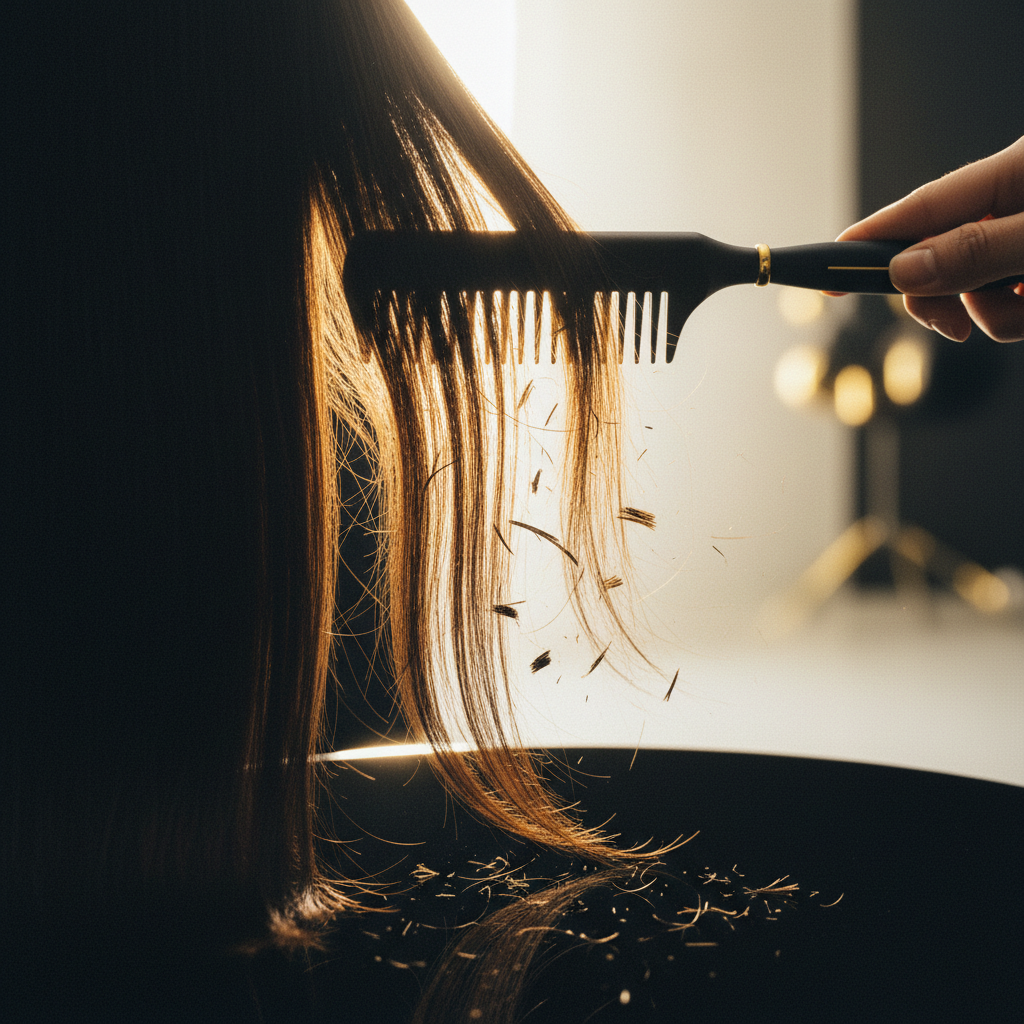
Quick answer: Mechanical damage from brushing occurs when physical friction, tension, and shear forces chip away at the protective hair cuticle, eventually exposing and fracturing the internal cortex. While brushing removes shed strands and distributes natural sebum, aggressive or improper detangling snaps fibres along the shaft rather than dislodging them from the root. Mechanical damage from brushing cannot be reversed once the fibre splits, meaning prevention through proper tool choice, gentle technique, and adequate slip remains your only effective defence.
Key takeaways
- Brushing exerts physical tension and friction that can lift, chip, and erode the protective cuticle scales of the hair fibre.
- Hair is significantly weaker when wet, stretching up to 30% to 50% before breaking at much lower tensile forces than dry hair.
- Mechanical damage causes hair breakage along the shaft; it does not cause follicular hair shedding or telogen effluvium.
- High-friction tools like fine-toothed combs or stiff, tightly spaced synthetic bristles accelerate wear compared to flexible, wide-spaced alternatives.
- Pre-treating strands with conditioning slip dramatically reduces detangling friction and shields vulnerable cuticles.
Mechanical Damage from Brushing: what the evidence shows
Research in cosmetic dermatology and fibre physics shows that hair fibres possess remarkable tensile strength, yet remain vulnerable to cumulative abrasive wear. Mechanical damage from brushing occurs through repeated frictional contact between tool surfaces and hair shafts, as well as fibre-on-fibre contact. Every brush stroke creates frictional drag. Over time, this shear stress lifts the outer shingle-like layers of the cuticle, eventually peeling them away entirely.
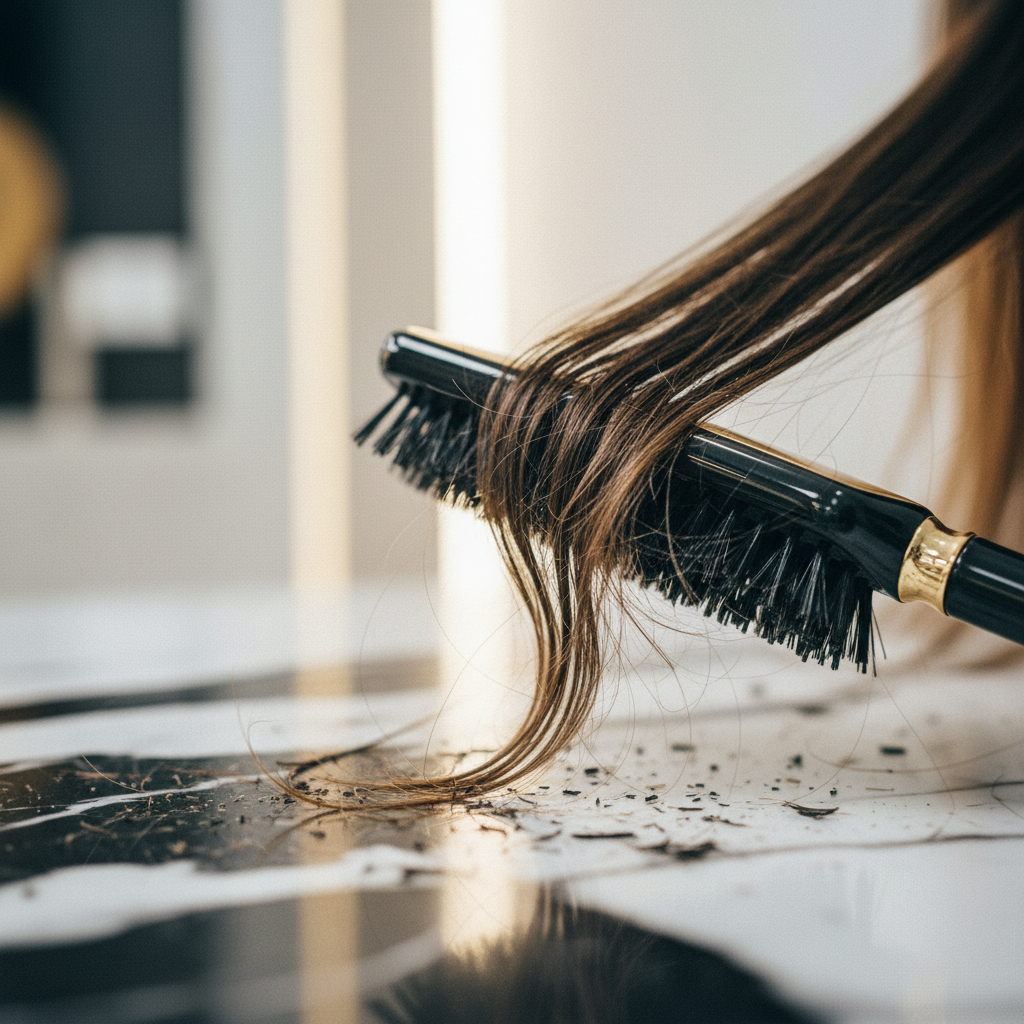
Once the cuticle strips away, the hair loses its hydrophobic protective barrier. The inner cortex becomes exposed to atmospheric humidity, ultraviolet light, and friction. Studies examining hair topography via scanning electron microscopy show that mechanically damaged hair exhibits jagged, chipped cuticle margins, longitudinal fissuring (splits running up the length of the shaft), and brush-induced trichorrhexis nodosa (node-like swelling where the fibre has buckled under stress).
The severity of this wear depends on velocity, applied pressure, moisture levels, and the surface topography of the tool. Fast, forceful strokes amplify friction exponentially. When bristles encounter an obstruction, such as a knot, sudden tensile loading occurs. If that localized force exceeds the tensile yield point of the hair shaft (typically between 1.5 to 2.5 Newtons for healthy single fibres), the hair snaps.
The mechanism: wet versus dry hair mechanics
Understanding how moisture alters hair mechanics explains why improper brushing causes so much harm. A dry hair fibre is composed of rigid keratin proteins cross-linked by strong disulphide bonds alongside temporary hydrogen bonds. When hair is submerged in water, the fibre absorbs up to 30% of its dry weight in moisture. This hydration breaks the internal hydrogen bonds, softening the cortex.
As a result, wet hair becomes far more elastic. It can stretch between 30% and 50% beyond its original resting length. However, this elasticity comes at a steep price: wet hair has a significantly lower breaking threshold under dynamic tension. When you drag a brush through wet hair, knots catch and pull the softened fibre beyond its elastic recovery limit. The strand stretches, deforms plastically, and breaks.
Conversely, dry hair generates far higher surface friction. When dry fibres rub against each other and synthetic bristles, electrostatic charges build. This static causes fibres to repel one another, tangle more easily, and catch against bristles with greater abrasive impact. Therefore, dry brushing requires slow, controlled movement, while wet detangling demands substantial conditioning lubrication to offset structural vulnerability.
What the evidence does not show
It is critical to separate the physical breakdown of the fibre from physiological hair loss. Mechanical damage from brushing does not cause:
- Follicular miniaturisation or androgenetic alopecia: Brushing does not alter hormonal sensitivity or shrink the hair follicle.
- Telogen effluvium: Aggressive brushing does not prompt follicles to prematurely exit the anagen (growth) phase into the telogen (resting) phase.
- Permanent cessation of growth: Snapping a fibre along the mid-shaft leaves the living dermal papilla intact under the scalp.
While severe, chronic pulling can theoretically provoke traction alopecia, standard brushing rarely creates the continuous, prolonged isometric tension required for that condition. Brushing breakage leaves short, jagged fragments without the white keratinised bulb seen on naturally shed telogen hairs.
Signs of brush-induced breakage
Identifying mechanical wear early allows you to correct your technique before damage travels upward toward the scalp. Look for these hallmark signs:
- Short, uneven hair fragments: Finding broken bits of hair across your sink, shoulders, or floor that lack a white bulb at either end.
- Split ends and mid-shaft splits: The presence of classic fork-like splits (trichoptilosis) or small white dots along the shaft where the fibre has partially fractured.
- Rough, velcro-like texture: Strands snagging against one another even after thorough detangling, caused by lifted, ragged cuticle scales.
- Dullness and frizz: Loss of natural shine caused by light scattering off uneven, pitted cuticle surfaces rather than reflecting off a smooth plane.
- Thinning ends with intact root density: Hair that feels thick near the scalp but tapers dramatically toward the perimeter without any change in overall scalp coverage.
Comparing detangling tools and techniques
Choosing the right tool and moisture environment significantly alters friction levels during styling.
| Tool / Technique | Friction Level | Risk of Fibre Breakage | Best Suited For |
|---|---|---|---|
| Wide-tooth seamless comb | Low | Low | Wet detangling with conditioner |
| Flexible-bristle detangling brush | Low to Moderate | Low to Moderate | Removing knots gently on damp, prepped hair |
| Boar bristle brush | High | Moderate to High (if tangled) | Dry hair; smoothing and sebum distribution only |
| Fine-tooth plastic comb | High | High | Precision parting; never for detangling |
| Unbuffered wet brushing | Severe | Extremely High | Not recommended for any hair type |
What you can do to prevent mechanical damage
Once a hair fibre fractures, cosmetic products cannot rebuild the original biological structure. Prevention remains the primary strategy.
1. Master the bottom-up detangling method
Never drag a brush from roots to ends in a single, continuous sweep. Doing so pushes small, manageable tangles downward, compressing them into a tight, impenetrable knot near the ends. Instead, begin detangling the bottom 5 centimetres of your hair. Once clear, move 5 centimetres higher and work down. Continue incrementally until the brush passes smoothly from scalp to perimeter.
2. Introduce adequate slip
Friction drops substantially when you apply a lubricant before detangling. When working on wet hair, saturate the strands with a rich conditioner or detangling spray containing cationic surfactants or light plant oils. These agents coat the cuticle, lower the coefficient of friction, and allow bristles to glide through snags without catching.
3. Inspect your tools for manufacturing defects
Many cheap plastic combs and brushes have rough moulding seams running down the centre of each bristle or tooth. Under microscopic examination, these microscopic ridges act like miniature saws, slicing into hair cuticles with every pass. Invest in seamless, saw-cut combs or high-grade brushes with rounded, snag-free tips. Throw away any brush whose protective ball tips have fallen off, as exposed wire bristles will gouge the shaft.
4. Adjust your technique to your hair type
Straight and loosely wavy textures (Types 1 and 2) generally tolerate dry detangling better than wet detangling, provided it is done gently. Highly textured, curly, and coily hair (Types 3 and 4) should rarely, if ever, be detangled completely dry. For these patterns, dry manipulation risks snapping fragile bend points along the elliptical fibre. Detangle curls wet, saturated with conditioner, using fingers or a wide-tooth comb.
Supporting hair resilience with Watermans
While no topical cosmetic can physically reconnect broken hair shafts, improving the overall health of the scalp environment and supporting fibre strength can help hair tolerate daily styling stress.
Watermans Grow Me Shampoo combines biotin, rosemary extract, caffeine, niacinamide, and argan oil in a gentle, pH-balanced formulation designed to cleanse the scalp without stripping protective natural lipids. Pairing it with Watermans Condition Me Conditioner provides hydrolysed lupin protein, cholesterol, and natural oils that coat the fibre shaft. This conditioning barrier improves cuticle slip, cuts mechanical friction during detangling, and leaves strands feeling noticeably stronger and more manageable.
When the cause may be something else
If you are noticing hair accumulation and cannot determine whether it stems from mechanical wear or another issue, examine the discarded strands under good lighting.
If the hair measures full length and features a tiny white bulb at one end, you are observing natural physiological shedding or potentially telogen effluvium. The average person sheds between 50 and 100 telogen hairs per day. Conversely, if the fallen hairs vary in length, exhibit blunt or jagged ends, and lack a root bulb, the culprit is mechanical or chemical breakage.
Keep in mind that prior chemical processing (such as bleaching, permanent dyeing, or relaxing) fundamentally weakens the hair's structural integrity. Bleach oxidises disulphide bonds, leaving the fibre far more porous and susceptible to snapping under standard brushing forces that healthy hair would easily withstand.
When to get professional advice
If you observe widening part lines, patchy bald spots, or diffuse thinning across the scalp, consult a registered trichologist or dermatologist. Mechanical damage from brushing will not thin the scalp at the root level. A medical professional can carry out a pull test, perform trichoscopy (dermoscopy of the hair and scalp), or request blood tests to investigate ferritin levels, thyroid markers, and hormonal profiles.
Frequently asked questions about Mechanical Damage from Brushing
Can mechanical damage from brushing cause permanent hair thinning?
No, it cannot cause permanent follicular thinning. Mechanical damage from brushing snaps hair along the shaft, leaving the living follicle beneath the scalp intact and capable of growing new hair. It can, however, make the ends and mid-lengths look noticeably thin and wispy over time, giving the cosmetic illusion of thinning hair.
Should I brush my hair wet or dry to avoid breakage?
It depends on your hair pattern. Naturally straight or wavy hair has greater tensile strength when dry, making gentle dry detangling safer. Curly, coily, and afro-textured hair should almost always be detangled while damp and saturated with a slippery conditioner, as dry manipulation fractures vulnerable curl bends.
How often should I brush my hair each day?
Brush only as much as necessary to detangle and style your hair. The old myth that brushing 100 strokes a day improves hair health is incorrect; dermatological evidence shows that excessive brushing simply accelerates cuticle abrasion. Detangling once or twice daily with a gentle, wide-spaced tool is plenty.
Can split ends caused by brushing be repaired with leave-in products?
No cosmetic product can permanently mend split ends. Certain conditioners, serums, and bonding treatments can temporarily glue the split fibres together until your next wash, smoothing the appearance of the hair. The only permanent fix for split ends is trimming the damaged sections away.
Conclusion
Guarding against mechanical damage from brushing requires an understanding of hair fibre physics and a patient, gentle routine. Hair cuticles are fragile biological shingles that wear down under friction, dry static, and unbuffered tension. By choosing high-quality, seamless tools, detangling strictly from bottom to top, and providing adequate conditioning slip, you can maintain your hair's structural integrity and avoid preventable breakage.
Sources and references
- British Association of Dermatologists. Hair breakage and cosmetic damage, 2022.
- Robbins, C. R. Chemical and Physical Behavior of Human Hair. 5th ed., Springer-Verlag, 2012.
- Dawber, R. Hair: Its structure and response to cosmetic preparations. Clinics in Dermatology, 1996.
- Swift, J. A. The mechanics of fracture of human hair. International Journal of Cosmetic Science, 1999.
- Evans, A. O., & Wickett, R. R. An examination of the effects of combing and brushing on hair breakage. Journal of Cosmetic Science, 2009.
Find these ingredients in Watermans products
- Biotin: you will find this ingredient in our Hair Growth Shampoo.
- Niacinamide: you will find this ingredient in our Hair Mask.