Mechanical Damage and Detangling: Causes, Physics, and Solutions
9 min read ·
Learn the science behind Mechanical Damage and Detangling, including friction mechanics, wet versus dry combing risks, and proven techniques to halt fibre breakage.
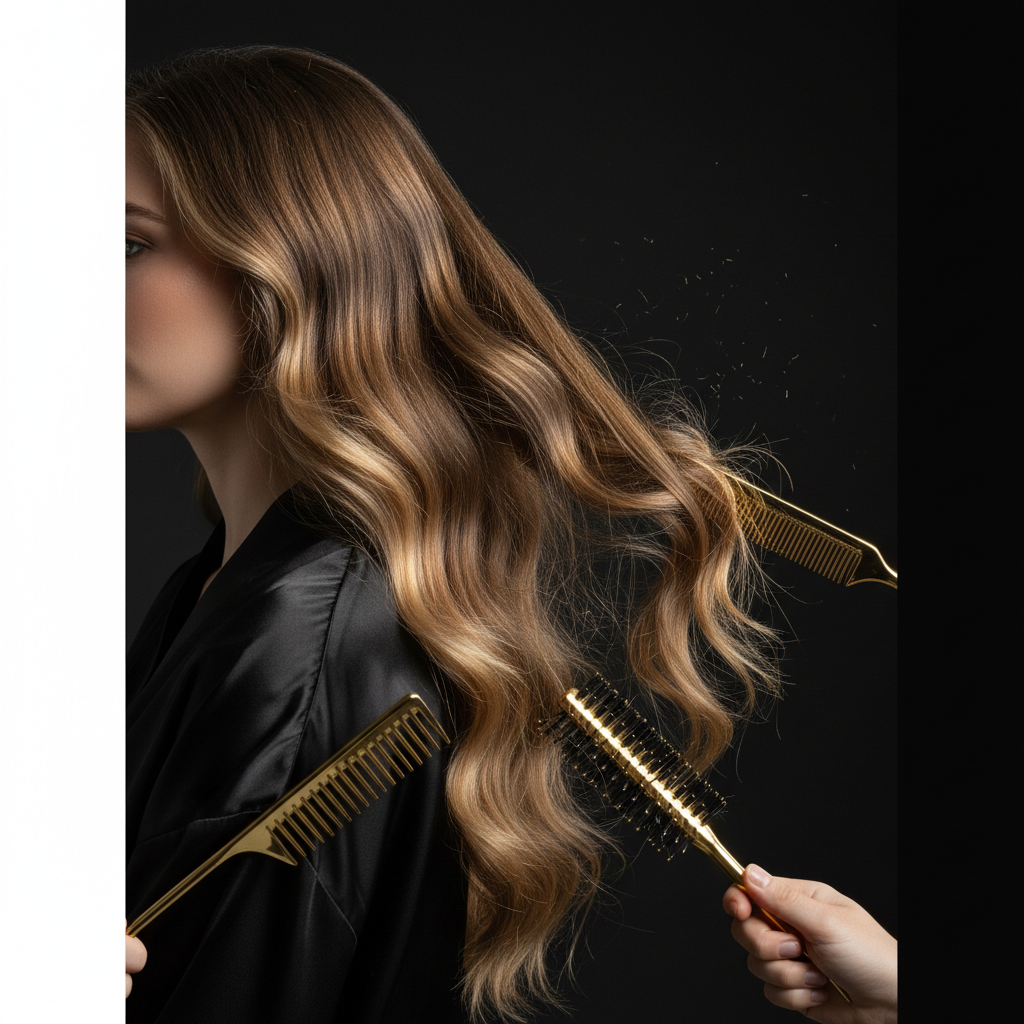
Quick answer: Understanding Mechanical Damage and Detangling is essential for preserving the hair fibre, because physical manipulation causes more cumulative breakage than many people realise. Combing, brushing, and friction strip away the protective cuticle layer and can stretch the inner cortex beyond its elastic limit. The main limitation is that hair is non-living tissue; once mechanical force snaps or splits a strand, you cannot biologically heal it. Preventing friction and tension during detangling remains the only reliable defence against progressive mechanical wear.
Key takeaways
- Mechanical damage refers to physical wear, friction, and tension that strip cuticle scales and fracture the cortex.
- Detangling dry, straight hair is generally safer than wet detangling, whereas tightly curled or coiled hair requires water and slip to prevent catastrophic shear stress.
- Wet hair can stretch by 30 to 50 percent before snapping, but its hydrogen bonds are weakened, lowering its elastic recovery threshold.
- Mechanical breakage is not follicular hair loss; breakage snaps the shaft, while shedding sheds the entire strand with its root intact.
- Using wide-tooth combs, starting at the tips, and applying lubricating conditioning agents significantly cuts inter-fibre friction.
Mechanical Damage and Detangling: what the evidence shows
Research in cosmetic dermatology reveals that Mechanical Damage and Detangling practices directly govern the integrity of the hair shaft. Hair fibres endure repeated cycles of tension, shear, bending, and friction throughout daily grooming. Under scanning electron microscopy (SEM), hair subjected to aggressive detangling displays worn, chipped, or completely abraded cuticle scales.
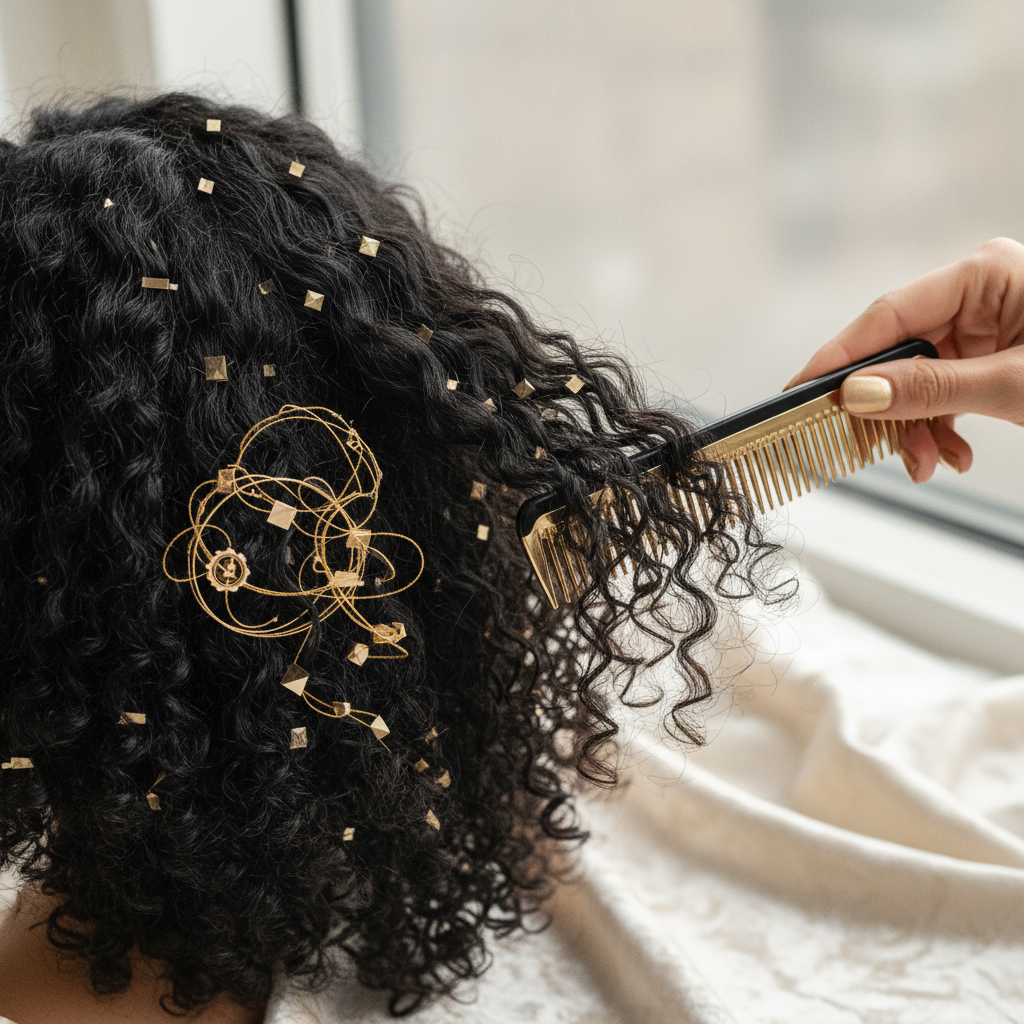
The outer cuticle consists of flattened, overlapping scales pointing toward the tip. When you drag a comb or brush through knots from root to tip, you pull directly against the natural grain of opposing knots. This action forces cuticle cells to lift, crack, and tear off.
Once the cuticle strips away, the underlying cortex becomes exposed. The cortex provides tensile strength through parallel keratin protofibrils. Without its protective sheath, the cortex unravels, creating trichorrhexis nodosa (node-like swellings where fibres shred) or common longitudinal split ends (trichoptilosis).
Controlled biomechanical studies show that combing force peaks dramatically when approaching knots. If the pulling force exceeds the fibre's tensile strength (roughly 50 to 100 grams of force per single healthy strand, depending on diameter), the fibre suffers plastic deformation. It stretches irreversibly and snaps.
What the evidence does not show
Controlled research does not show that mechanical grooming stimulates hair growth from the scalp. The persistent cultural myth that brushing your hair 100 strokes a day invigorates follicles is unsupported by dermatological science; in reality, frequent aggressive brushing accelerates fibre weathering and cuticle loss.
Furthermore, evidence does not show that any cosmetic product can permanently mend mechanically severed hair bonds. While leave-in conditioners, silicones, and hydrolysed proteins temporarily fill micro-fissures and glue split ends together, these effects wash away with your next shampoo. Hair cannot cellularly regenerate.
Finally, mechanical damage does not cause systemic alopecia. Excessive tension from styles like tight braids can cause traction alopecia at the follicle, but routine friction and detangling break the dead shaft without altering your body's intrinsic shedding cycles or hair follicle health.
The physical mechanisms of fibre friction and stretching
To understand why detangling causes damage, you have to look at the physics of the hair fibre in both dry and wet states.
Wet versus dry tensile properties
Dry hair is held rigid by strong hydrogen bonds, salt linkages, and covalent disulphide bonds. When dry hair stretches past roughly 2 percent of its length, it enters an elastic region where it returns to normal. Beyond approximately 25 to 30 percent elongation, permanent structural yield occurs.
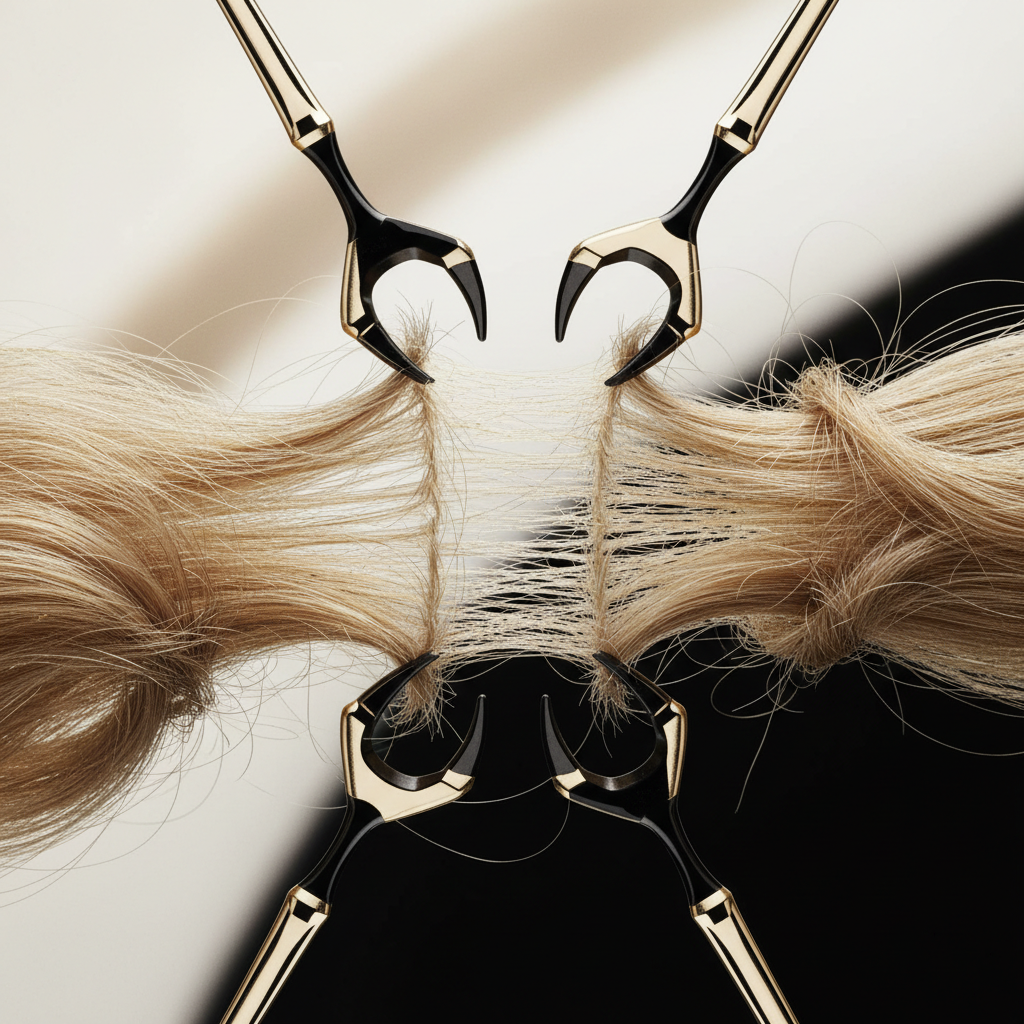
When hair absorbs water, water molecules disrupt temporary hydrogen bonds within the keratin matrix. This swelling increases fibre diameter by roughly 14 to 16 percent. Wet hair stretches much more easily, sometimes elongating up to 50 percent before breaking. However, its force-to-break threshold drops. It requires significantly less pull to cause plastic deformation in wet hair than in dry hair.
The friction coefficient
Dry hair has a naturally low friction coefficient thanks to the 18-methyleicosanoic acid (18-MEA) lipid layer bound to the outer cuticle. This lipid layer repels water and lets strands glide smoothly past each other. Chemical processing (bleaching, permanent dyeing, relaxers) strips 18-MEA, raising inter-fibre friction substantially. High friction causes strands to catch, tangle, and knot, dramatically amplifying the mechanical force required to pull a tool through them.
| Factor | Dry Detangling | Wet Detangling (Without Conditioner) | Wet Detangling (With Slip / Conditioner) |
|---|---|---|---|
| Keratin Structure | Rigid, hydrogen bonds intact | Softened, hydrogen bonds broken | Softened, hydrogen bonds broken |
| Elastic Yield Point | High resistance to stretch | Low resistance, deforms easily | Low resistance, deforms easily |
| Friction Level | Moderate to low | Very high (water creates drag) | Extremely low (lubricated) |
| Best Suited For | Straight to loose wavy hair | Never recommended | Coiled, curly, and afro textures |
| Risk of Snap/Break | Low if gentle and knot-free | Extremely high | Low when worked slowly |
Visible signs of mechanical damage
Recognising the signs of physical stress lets you alter your technique before hair suffers widespread breakage:
- Short, fragmented strands on your clothes or counter: Unlike shed hairs, which feature a white, bulbous root sheath at one end, broken hairs have blunt or frayed edges on both ends.
- White dots near the ends (Trichorrhexis Nodosa): These tiny white specks indicate spots where the cortical fibres have burst under mechanical tension, forming an impending snap point.
- Frayed, uneven ends: Hair thins out noticeably toward the perimeter, even without recent chemical processing or heat exposure.
- Matting and rapid re-tangling: Hair that has lost its outer cuticle exposes high-friction cortical surfaces, causing fibres to snag onto neighbouring strands almost immediately after combing.
- Dull, rough texture: Light bounces evenly off flat, intact cuticles. Chipped, raised cuticles scatter light, leaving the hair looking lacklustre.
Best practices for low-friction detangling
Minimising mechanical wear requires reducing both friction and pulling force. Stylists and dermatologists recommend several key adjustments.
1. Work from tip to root
Never force a comb downwards from the scalp. This compacts multiple loose knots into a single dense, impassable tangle, spiking tension to destructive levels. Instead, section hair into manageable quadrants. Start detangling at the bottom 2 inches, clear those knots gently, and work upward incrementally.
2. Choose the right tool
Flesh out your toolkit with wide-toothed combs crafted from seamless, moulded materials or hand-carved wood. Inexpensive plastic combs produced via injection moulding feature sharp seams along the teeth that act like microscopic blades against your cuticle. For brush detangling, flexible bristles that yield under pressure prevent the tool from yanking fibres past their breaking point.
3. Maximise slip based on your hair type
Straight and slightly wavy hair (Types 1 and 2) retains natural sebum well and should typically be gently detangled when dry or mostly dry, using a drop of lightweight oil to lower surface drag.
Curly and coiled patterns (Types 3 and 4) possess structural points of variation and natural curvature that interlock tightly. Detangling these textures dry produces severe shear stress. They should always be detangled damp or wet, coated thoroughly in a high-slip conditioner containing cationic surfactants, fatty alcohols, or silicones that dramatically cut friction.
When the issue is not mechanical
If you notice excessive shedding rather than short, snapped fibres, mechanical stress is rarely the root cause. A full-length hair strand showing a rounded root bulb represents a hair that has exited the follicle naturally via the telogen phase.
Diffused, high-volume shedding over 100 strands per day typically points to telogen effluvium triggered by illness, emotional stress, hormonal fluctuations, nutritional deficits (such as iron or vitamin D deficiencies), or thyroid disorders. Similarly, patchy or localised hair loss reflects conditions like alopecia areata or androgenetic alopecia, which occur deep inside the follicle and cannot be remedied or caused by standard detangling techniques.
When to seek professional advice
Consult a qualified trichologist or dermatologist if you experience sudden, unexplained hair shedding from the root, distinct bald spots, scalp burning, redness, or tenderness.
If your hair breaks constantly despite using ultra-gentle detangling routines, a professional stylist or trichologist can perform an elasticity and porosity assessment to check for severe chemical over-processing, protein-moisture imbalances, or environmental degradation.
Supporting fibre strength with Watermans
When addressing fragile hair prone to mechanical stress, improving the physical handle and conditioning of the strand makes a noticeable difference. The Watermans haircare collection focuses on optimising the scalp environment while reinforcing the feel and resilience of delicate strands.
Using Watermans Condition Me conditioner provides the emollience and slip necessary to lower inter-fibre friction during combing. Formulated with ingredients such as cholesterol, niacinamide, caffeine, and rosemary, it smooths the cuticle layer, helping tools glide through tangles with far less mechanical pull. This cosmetic reinforcement supports healthier-looking, stronger-feeling hair that resists daily grooming breakage.
Frequently asked questions about Mechanical Damage and Detangling
Is wet or dry detangling better for preventing breakage?
The answer depends entirely on your hair pattern. Straight and loosely wavy hair types are strongest when dry, making gentle dry combing safer because wet hair stretches and yields quickly. Conversely, curly, coily, and afro-textured hair suffers severe friction if detangled dry. These textures require water and conditioning slip to minimise friction, making wet detangling the safer approach for them.
What is the biggest mistake regarding Mechanical Damage and Detangling?
The most damaging mistake is pulling a comb down from root to tip. This drives separate tangles into an impenetrable knot. As pulling force spikes, strands stretch beyond their elastic limit and snap. Always work in sections, untangling the lowest few inches first before moving higher up the hair shaft.
Can split ends caused by mechanical damage be repaired?
No. Because hair consists of non-living keratin fibres, broken bonds and fractured cuticles cannot biologically heal. Leave-in serums and conditioners temporarily coat the strand, smoothing split ends together so they appear intact, but the split reopens once the coating washes away. The only permanent fix for mechanical splits is trimming.
How do I tell the difference between mechanical breakage and hair shedding?
Inspect the hairs you find. Broken hairs are noticeably shorter than your total hair length and feature blunt, jagged edges without a white bulb. Shed hairs represent full-length strands that have left the follicle naturally, carrying a small, rounded white keratin bulb at the root end.
Protecting your hair fibre long term
Understanding the balance between Mechanical Damage and Detangling lets you preserve your hair's structural integrity. Hair is an incredible biopolymer, but its tensile strength is finite. Every rough brush stroke, unlubricated comb pass, and forced knot permanently chips away at the protective cuticle. By prioritising slip, choosing seamless tools, respecting your hair's unique wet and dry properties, and working with patience, you can eliminate avoidable breakage and keep your hair looking smooth, full, and resilient.
Sources and references
- British Association of Dermatologists: Hair Loss and Breakage Overview (2022)
- Journal of Cosmetic Science: Biomechanical properties and friction of human hair (2018)
- International Journal of Trichology: Hair Cosmetics: An Overview (2015)
- Robbins, C. R.: Chemical and Physical Behavior of Human Hair, 5th Edition, Springer (2012)
- Society of Cosmetic Scientists: Principles of Hair Conditioning and Cleansing (2020)
Find these ingredients in Watermans products
- Caffeine: you will find this ingredient in our Hair Growth Shampoo.
- Vitamin D: you will find this ingredient in our Hair Vitamins.
- Niacinamide: you will find this ingredient in our Hair Mask.