Safe Wet Hair Styling Practices: An Evidence-Based Guide to Preventing Fibre Damage
10 min read ·
Learn safe wet hair styling practices to prevent mechanical breakage, protect vulnerable keratin bonds, and maintain resilient hair from wash to dry.
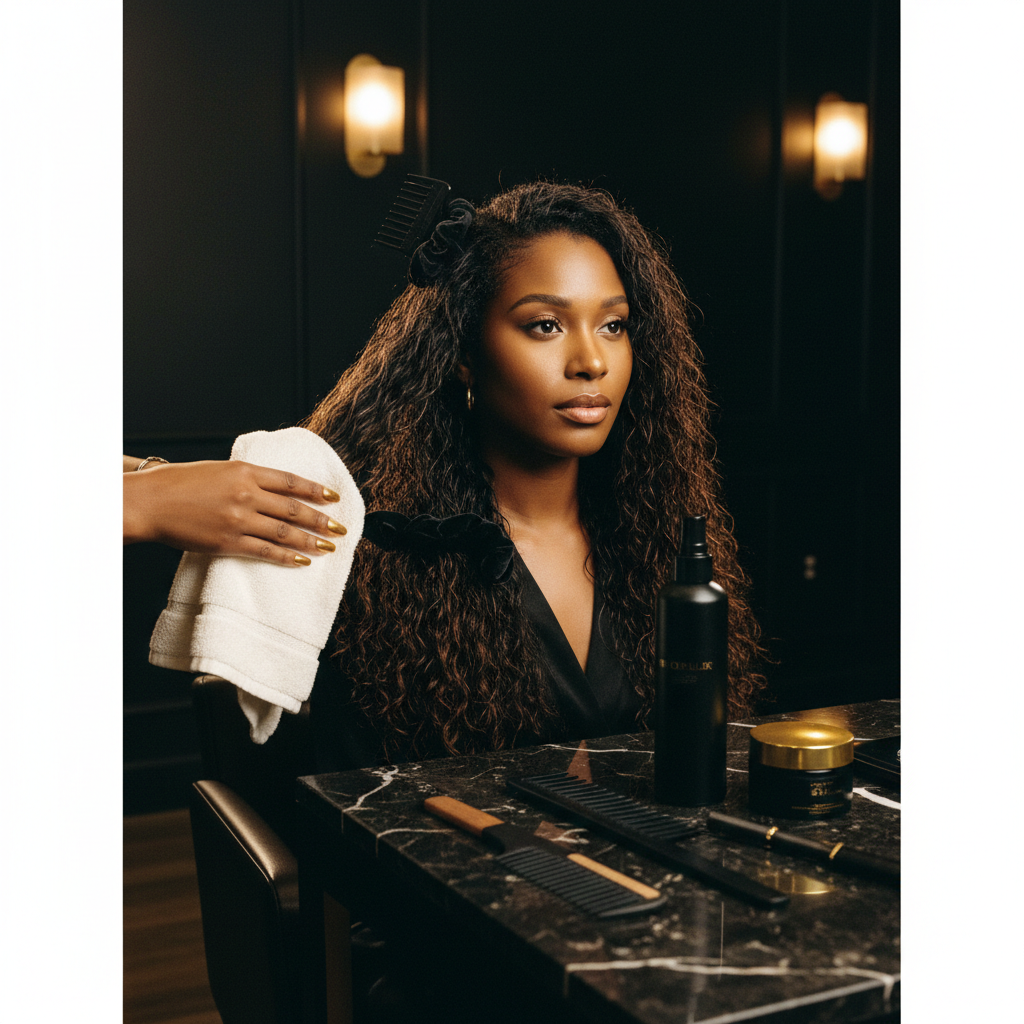
Quick answer: Establishing Safe Wet Hair Styling Practices protects the hair shaft when it is at its most structurally vulnerable. Water temporarily breaks weak hydrogen bonds within the cortex and causes the hair fibre to swell by up to 16 percent in diameter, lowering its tensile strength. Safe handling requires wide-tooth detangling tools, gentle slip agents, microfibre drying, and avoiding direct heat or high-tension styles while damp. The main limitation is that these techniques prevent mechanical fibre breakage, but cannot repair already fractured cuticles or alter natural follicular growth rates.
Key takeaways
- Wet hair can stretch by 30 to 50 percent before snapping, compared to roughly 15 to 20 percent when dry, but its load-bearing capacity is significantly reduced.
- Water breaks temporary hydrogen bonds within keratin, leaving the fibre reliant only on permanent disulphide bonds to resist mechanical strain.
- High tension while wet leads to plastic deformation, cuticle lifting, and mid-shaft fractures often mistaken for shedding.
- Heat styling wet hair above 100 degrees Celsius boils trapped moisture within the cortex, causing permanent bubble hair deformities.
- Safe practices focus on low-friction drying, gradual sectioned detangling with conditioning lubricants, and deferring tension styling until hair is predominantly dry.
Safe Wet Hair Styling Practices: what the evidence shows
Adopting Safe Wet Hair Styling Practices is essential because wet hair behaves like an entirely different material to dry hair. Research published in the Journal of Cosmetic Science confirms that when water penetrates the hair shaft, it swells the cortex and cuticle layer. A fully hydrated hair shaft absorbs roughly 30 percent of its dry weight in water. This hydration increases the cross-sectional area of the fibre by approximately 15 to 16 percent while lengthening it by 1 to 2 percent.
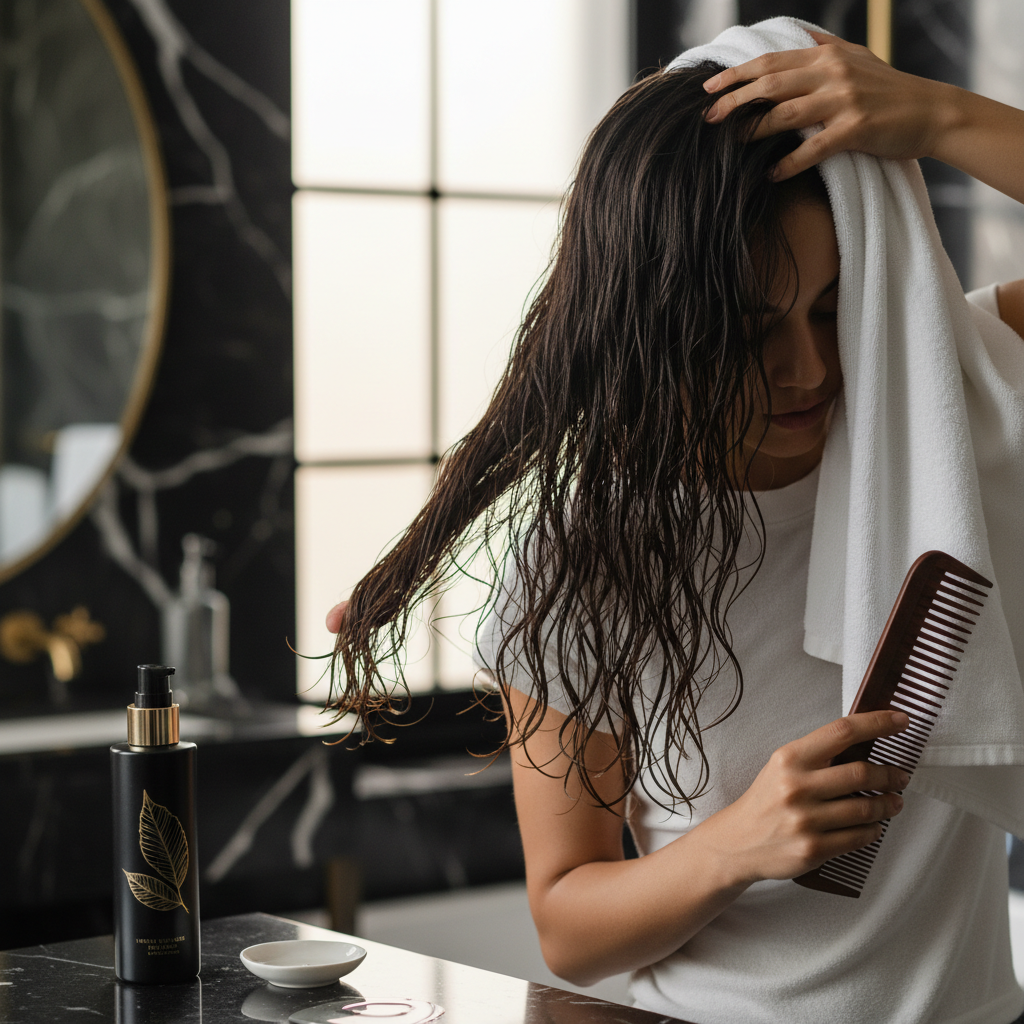
The critical issue is bond disruption. Dry hair maintains structural rigidity through millions of weak hydrogen bonds alongside robust covalent disulphide bonds. Water molecules flood the matrix, displacing these hydrogen bonds. As a consequence, the force required to stretch wet hair is far lower than the force required to stretch dry hair.
When you apply mechanical forces such as fine-tooth combing, tight elastic bands, or heavy brushing to damp hair, you pull the fibre beyond its elastic recovery limit. While dry hair snaps under extreme tension, wet hair enters a state of plastic deformation: it stretches, fails to return to its original length, thins out, and tears the outer cuticle scales away from the cortex. Implementing safe styling routines directly minimises this friction and overextension.
The mechanical biological mechanism: why wet hair breaks
Hair keratin consists of an organised crystalline phase (alpha-helical intermediate filaments) embedded in an amorphous, high-sulphur protein matrix. The structural integrity relies heavily on:
- Disulphide bonds: Covalent links between cysteine residues that provide chemical and heat resistance.
- Hydrogen and salt bonds: Weaker, abundant electrostatic links that give hair its everyday elasticity and shape.
When hair absorbs water, water molecules insert themselves between the polypeptide chains in the amorphous matrix. This softens the protein network, lowering the glass transition temperature of hair keratin. At the same time, the outer protective cuticles, which normally lie flat like overlapping roof tiles, swell and lift outwards.
Because the cuticle scales are raised, the coefficient of friction along the hair surface doubles. Running a fine comb through wet hair requires significantly more force to overcome friction than combing dry hair, precisely when the inner cortex has less tensile resistance. If that mechanical force exceeds approximately 50 to 100 grams of load per single fibre, the cuticle chips, longitudinal splits form, and the shaft snaps.
Dry Hair:
[Flat Cuticle] -> [Tightly Bound Matrix] -> [High Tensile Strength, Low Stretch]

Wet Hair:
[Swollen, Raised Cuticle] -> [Hydrated Matrix (Broken H-Bonds)] -> [Low Tensile Strength, High Stretch / Prone to Snapping]
Comparing wet styling methods: high-risk vs safe approaches
The table below contrasts standard high-friction habits with evidence-backed alternatives that safeguard the hair fibre.
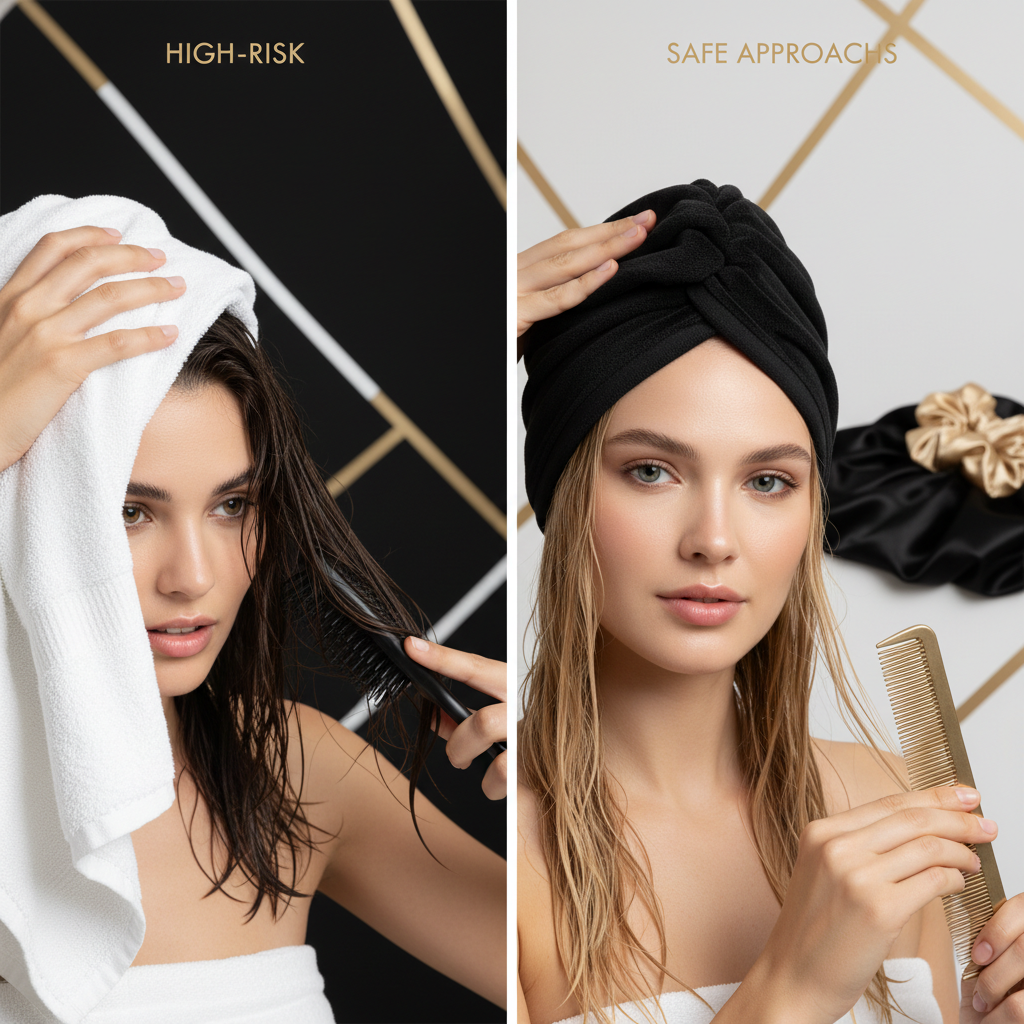
| Styling Technique | High-Risk Practice | Safe Alternative (Low Breakage) | Fibre Impact |
|---|---|---|---|
| Drying | Vigorous towel rubbing with terry cloth cotton | Blotting or turban-wrapping with smooth microfibre or cotton t-shirt | Eliminates surface friction; prevents cuticle scale abrasion. |
| Detangling | Brushing from roots down with a fine-bristle brush | Finger detangling, followed by a wide-tooth comb starting at ends | Distributes mechanical load; reduces tensile stress spikes. |
| Styling Slip | Combing unconditioned, freshly rinsed damp hair | Applying a leave-in conditioner or botanical serum with good lubricity | Lowers comb force by up to 50 percent; coats lifted cuticles. |
| Updos / Tension | Tight buns, ponytails, or braids secured while wet | Loose, low-tension protective styles secured with silk or satin ties | Prevents plastic elongation and traction breakage at the root. |
| Heat Tool Use | Blow-drying soaking wet hair or using flat irons on damp strands | Rough air-drying to 70-80% dry before low-heat directional blow-drying | Prevents the rapid vaporisation of water ("bubble hair"). |
Signs of wet styling damage to look for
Damage caused by unsafe wet handling presents distinct physical signs that differ from chemical over-processing or metabolic shedding:
- Short, fragmented strands without a white bulb: Snapped hairs left in your comb, towel, or sink indicate mechanical breakage rather than follicular shedding.
- Tapered, frayed ends (trichoptilosis): Longitudinal splitting along the fibre, occurring when lifted wet cuticles expose the vulnerable inner cortical cells.
- Loss of natural curl or wave recoil: When hair is stretched wet beyond its yield point, it suffers permanent plastic deformation, resulting in stringy, limp sections that refuse to bounce back.
- White nodules along the shaft (trichorrhexis nodosa): Swollen, fractured points where cortical fibres have burst through stripped cuticles due to repeated high-tension wet combing.
- Excessive tangling upon washing: A rough, lifted cuticle catches on adjacent strands, creating dense matting each time the hair is submerged in water.
What you can do: evidence-based protocols for wet hair
Protecting fragile damp hair requires reducing friction, supporting the protein structure, and managing tension.
1. Controlled detangling with sufficient slip
Never detangle freshly washed hair without a slip agent. Water alone is a poor lubricant; it actually increases inter-fibre friction. Use a rinse-out conditioner with cationic surfactants or a silicone-free leave-in conditioning spray before running any tool through your hair. Work in four to six distinct quadrants. Always use a wide-tooth seamless comb or a flexible wet detangler, working upward from the ends to the roots in short, gentle strokes.
2. Moisture management without mechanical abrasion
Traditional cotton terry-cloth towels have large, looped fibres that snag raised cuticle scales like tiny hooks. Vigorous rubbing chips the protective F-layer (the natural lipid barrier). Instead, gently squeeze excess water from your hair using a smooth microfibre towel or cotton jersey fabric. Allow hair to air-dry naturally until it feels cool and faintly damp (roughly 70 to 80 percent dry) before introducing any round brushes or styling heat.
3. Avoiding wet tension styling
Never tie hair into tight ponytails, buns, or sleek styles while wet. Wet hair contracts as it dries. When bound tightly, the drying fibre attempts to shrink against the unyielding elastic band or braid, generating extreme radial and axial tension. This causes severe mid-shaft breakage and can aggravate traction stress on the hair follicle. If you must secure damp hair, opt for loose, soft scrunchies made of silk or satin.
4. Thermal protection and evaporation rates
Applying hot flat irons or curling tongs to wet hair causes a severe cosmetic defect known as "bubble hair". The trapped moisture inside the cortex instantly boils, turning to steam that expands and blows microscopic cavities through the hair shaft. Ensure hair is completely dry before using direct-contact thermal styling tools. For blow-drying, keep the nozzle at least 15 centimetres away from the hair, use the medium heat setting, and direct the airflow downwards from root to tip to seal the cuticle.
When the cause may be something else
It is vital to distinguish mechanical wet-styling breakage from systemic hair loss or chemical damage:
- True shedding (Telogen Effluvium): If full-length hairs featuring a tiny white keratin bulb at the root are falling out in large quantities across the scalp, the trigger is metabolic, hormonal, or nutritional, not mechanical styling.
- Chemical weathering: Hair that turns mushy, gummy, or stretches endlessly like elastic when submerged in water has suffered significant disulphide bond destruction from bleaching, perming, or relaxers. Mechanical precautions help, but bond reconstruction is required.
- Scalp conditions: Itching, flaking, or inflammation may tempt you to scrub damp hair aggressively, exacerbating breakage. Conditions like seborrhoeic dermatitis or psoriasis require targeted medicated scalp interventions, not changes in brush design.
When to seek professional advice
Consult a qualified trichologist or dermatologist if you notice:
- Noticeable thinning patches on your scalp, widening parting lines, or receding temples.
- Sudden, diffuse shedding that exceeds 100 to 150 hairs daily for more than six weeks.
- Severe shaft brittleness where hair snaps effortlessly within 2 to 3 centimetres of the scalp without obvious mechanical or heat triggers.
- Scalp pain, redness, pustules, or burning sensations during or after hair washing.
A certified salon professional or trichologist can perform a mechanical elasticity pull test and examine your fibres under dermoscopy to verify whether your routine requires better detangling tools, lipid restoration, or follicular clinical care.
Targeted support: Watermans haircare
While mechanical technique is the first line of defence against wet fibre damage, providing the hair and scalp with high-calibre nourishment supports overall hair vitality. Watermans products are formulated to foster an optimal scalp environment and improve the feel and manageable condition of delicate hair.
Using Watermans GrowMe Shampoo delivers nutrient-rich botanical extracts, rosemary, biotin, and hydrolysed lupin protein directly to the hair and scalp during washing, strengthening the tactile feel of the strands. Following with Watermans ConditionMe Conditioner infuses the fibre with restorative moisture, offering exceptional slip that substantially cuts down on combing friction when navigating wet hair. For targeted scalp care, Watermans Grow More Elixir provides a leave-in blend designed to nourish the hair surface and support thicker, fuller-looking hair without weighing down damp strands.
Frequently asked questions about Safe Wet Hair Styling Practices
Is it safe to brush hair while wet if I use a soft bristle brush?
No, pure natural bristle brushes (such as boar bristle) are unsuitable for wet hair. Their dense, fine bristles cause excessive drag and snagging against raised, wet cuticle scales. For Safe Wet Hair Styling Practices, choose a wide-tooth comb or a brush specifically engineered with widely spaced, highly flexible synthetic bristles designed to bend rather than pull when meeting a knot.
Can I sleep with wet hair tied in a loose bun?
Sleeping with wet hair is not recommended, even when loosely secured. Damp keratin is vulnerable to prolonged friction against pillows, leading to cuticle abrasion and tangling. Furthermore, keeping the scalp damp against a warm pillow for seven to eight hours creates a humid microclimate that can encourage the overgrowth of Malassezia yeast, potentially triggering scalp irritation and flaking.
Why does wet hair break more easily than dry hair?
Wet hair breaks because water temporarily breaks the internal hydrogen bonds that give keratin its strength and structure. Although wet hair stretches further than dry hair before failing, the amount of force needed to tear the fibre is significantly lower. Its natural cuticle scales also swell and lift, making strands more prone to snagging during styling.
What is bubble hair, and how does wet styling cause it?
Bubble hair is a permanent structural deformity of the hair shaft. It occurs when heated styling tools (such as flat irons, curling wands, or high-heat dryers held too close) are applied to damp or wet hair. Water trapped inside the cortex boils rapidly into steam, expanding and creating microscopic, bubble-like voids that make the hair brittle and prone to snapping.
Conclusion
Understanding Safe Wet Hair Styling Practices ensures that you do not inadvertently sabotage your hair length through avoidable mechanical breakage. Because wet hair operates with disrupted hydrogen bonds, raised cuticles, and reduced tensile strength, rough towel drying, forceful combing, and premature heat styling inevitably produce fractured ends and thinning lengths. By approaching wet styling with patience, gentle detangling tools, ample conditioning slip, and zero high-tension styling, you safeguard the physical integrity of every fibre from wash to dry.
Sources and references
- Journal of Cosmetic Science, "The mechanical properties of hair and their relationship to hair condition", 2009.
- International Journal of Trichology, "Hair cosmetics: An overview", 2015.
- British Association of Dermatologists, "Hair breakage and cosmetic hair damage guidelines", 2021.
- Journal of the American Academy of Dermatology, "Bubble hair: A unique acquired hair shaft deformity", 1992.
- Skin Appendage Disorders, "Physiological and mechanical properties of human hair fibres", 2017.