Thermal Heat Protection Mechanisms: Evidence, Function, and Hair Fibre Science
9 min read ·
Explore the science behind Thermal Heat Protection Mechanisms, how protectants buffer high styling temperatures, and their actual biological limits.

Quick answer: Understanding Thermal Heat Protection Mechanisms reveals how cosmetic formulations shield hair fibres from extreme styling temperatures. Heat protectants work primarily by lowering thermal conductivity, distributing heat evenly across the shaft, sealing cuticle scales, and creating a sacrificial barrier that slows moisture evaporation. However, these mechanisms have clear limitations: no cosmetic product provides total immunity against heat. High temperatures exceeding 200°C will degrade internal keratin and strip structural lipids, meaning protectants merely reduce the rate and severity of thermal trauma rather than preventing it completely.
Key takeaways
- Thermal protectants function by slowing heat transfer, sealing cuticular scales, and buffering internal moisture against rapid vaporisation.
- Silicones, polyquaternium conditioning polymers, and hydrolysed proteins form sacrificial films that absorb thermal shock before heat reaches the cortex.
- High styling heat (above 160°C) denatures hair keratin, oxidises structural 18-methyleicosanoic acid (18-MEA), and can cause "bubble hair" if water flashes into steam inside the cortex.
- No product provides 100 percent heat shielding; typical formulations reduce surface thermal damage by roughly 30 to 50 percent compared to unprotected hair.
- Applying heat tools to damp or wet hair bypasses cosmetic protection mechanisms and causes severe, irreversible structural fracture.
Thermal Heat Protection Mechanisms: what the evidence shows
Research published in cosmetic science literature, notably the Journal of Cosmetic Science, demonstrates that topical heat protectants work through physical and chemical pathways rather than biological intervention. Hair is a non-living biological filament made of roughly 85 to 90 percent keratin protein, water, melanin, and structural lipids. When you apply hot tools such as flat irons, curling wands, or blow dryers, temperatures range from 120°C to over 230°C.
Cosmetic scientists analyse Thermal Heat Protection Mechanisms across four distinct operational pathways:
- Thermal conductivity buffering: Ingredients with low thermal conductivity, such as specific dimethicones, silicones, and synthetic polymers, form an insulating film over the hair cuticle. This barrier slows down the rate of heat conduction into the hair cortex, preventing instantaneous thermal shock to internal keratin chains.
- Even heat dispersion: Hot spots on styling tool plates can reach blistering localised temperatures. Polymers and conditioning agents smooth surface imperfections, helping the hot iron glide seamlessly across the hair fibre. This movement spreads thermal energy uniformly instead of concentrating heat on a single section of the cuticle.
- Moisture moderation and evaporation control: Keratin requires a basal level of bound water (typically 10 to 15 percent at ambient humidity) to maintain flexibility. Sudden heat drives rapid dehydration. A protective film slows this trans-epidermal-style water loss, avoiding the violent flash-evaporation that tears fibre architecture.
- Sacrificial barrier action: Heat degrades organic compounds. When exposed to temperatures above 180°C, the polymers, conditioning agents, and hydrolysed wheat or vegetable proteins in the spray decompose or absorb heat first, preserving the underlying cuticular proteins beneath them.
What the evidence does not show
The science does not support claims that heat protectants completely neutralise thermal damage. No cosmetic film can fully insulate a fibre against a 230°C flat iron held in direct contact for multiple seconds.
Controlled laboratory studies consistently demonstrate that while treated hair exhibits significantly less cuticle cracking, surface pitting, and protein loss than bare hair, it still incurs progressive degradation over repeated heat cycles. Protectants mitigate damage; they do not render hair indestructible. Furthermore, heat protectants cannot repair split ends or reverse structural keratin denaturation once it has occurred.
The biophysical mechanism of thermal damage
To understand why protective mechanisms are necessary, consider how intense heat alters the hair fibre.
At temperatures around 140°C to 160°C, the hair's protective F-layer, a lipid layer made primarily of 18-methyleicosanoic acid (18-MEA) bonded to the cuticle surface, begins to oxidise and degrade. Once this lipid sheath vanishes, hair becomes hydrophilic, porous, and prone to friction and static.
Between 160°C and 190°C, internal changes accelerate. The alpha-helical keratin proteins in the cortex begin to denature, shifting irreversibly into weaker beta-sheet formations. Hair loses its natural tensile strength and elasticity, meaning it snaps under normal brushing.
Above 200°C, severe structural destruction occurs. Tryptophan and cystine amino acids oxidise, disulphide bonds break down, and moisture within the fibre vaporises explosively. If hair contains free water when flat-ironed, this liquid rapidly converts to steam, expanding violently inside the cortex and blowing microscopic cavities into the shaft. This condition, medically termed "bubble hair", causes acute, irreversible fibre snapping.
| Protective Ingredient Class | Primary Mechanism | Heat Resistance Range | Common Examples |
|---|---|---|---|
| Volatile and Non-Volatile Silicones | Thermal insulation, surface lubrication, friction reduction | Effective up to ~220°C | Dimethicone, Cyclopentasiloxane, Amodimethicone |
| Conditioning Polymers | Film-forming, moisture retention, surface uniformisation | Effective up to ~180°C to 200°C | Polyquaternium-55, Polyquaternium-4, PVP/DMAPA acrylates copolymer |
| Hydrolysed Proteins | Sacrificial thermal absorption, cuticular micro-filling | Effective up to ~160°C to 190°C | Hydrolysed wheat protein, Hydrolysed vegetable protein, Keratin peptides |
| Plant and Seed Oils (Refined) | Lubrication, lipid replenishment (variable thermal stability) | Highly variable (typically 150°C to 200°C before smoking) | Argan oil, Jojoba oil, Crambe abyssinica seed oil |
The visible signs of thermal damage
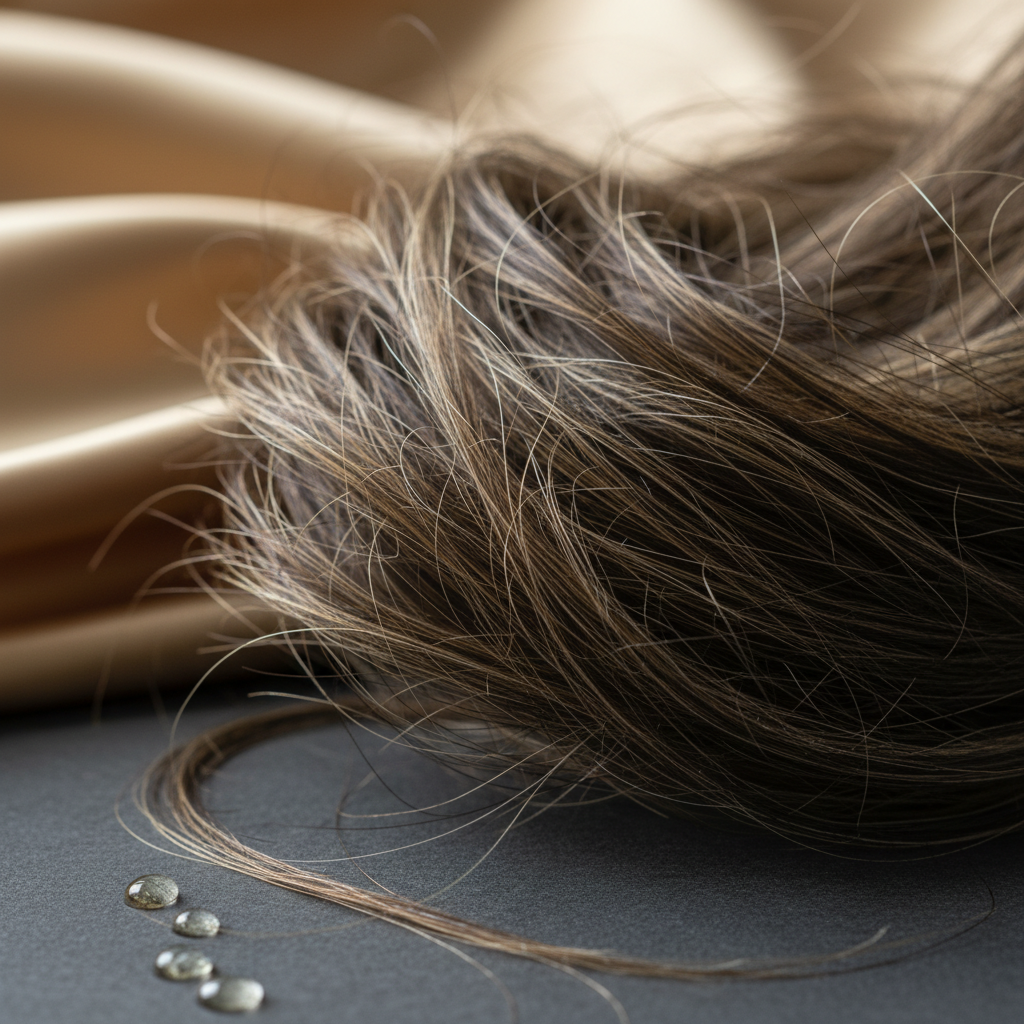
Thermal trauma leaves clear physical markers along the hair shaft. Because hair cannot regenerate, these indicators reflect cumulative stress:
- Altered hair texture: Hair feels rough, brittle, and dry, resembling straw even after conditioning.
- Loss of natural curl pattern: Thermal denaturation of cortical keratin disrupts the disulphide geometry that dictates curl shape, causing wavy or coily hair to hang limp, stringy, or unevenly loose.
- Increased split ends and mid-shaft snapping: Because the cortex loses tensile strength, individual strands snap cleanly midway down the shaft during styling or detangling. This is mechanical breakage, not follicular shedding.
- Surface dullness and colour fade: Degraded, cracked cuticle scales cannot reflect light uniformly, muting natural shine and causing artificial dyes to leach out prematurely.
- Persistent tangling and friction: Stripped of the 18-MEA lipid layer, cuticles flare outward and catch on neighbouring fibres.
Practical steps to maximise heat protection
Applying a spray is only one half of the equation; proper styling habits dictate how effectively the product performs.
- Dry your hair thoroughly first: Never apply direct hot-plate tools (flat irons or curling tongs) to wet or damp hair. The protectant film cannot prevent boiling water from tearing the cortex from within. Hair should be 100 percent dry before irons touch it.
- Distribute product systematically: Mist or apply your heat protectant section by section rather than relying on a casual top-layer spritz. Use a wide-tooth comb to distribute the emulsion evenly across every strand.
- Regulate styling tool temperatures: Keep styling irons below 185°C whenever possible. Fine, chemically treated, or bleached hair should stay between 150°C and 165°C. Coarse or highly textured hair rarely requires temperatures over 200°C if high tension and steady passes are used.
- Limit dwell time and passes: Move tools smoothly down the shaft in a single, controlled pass. Lingering on a single section for multiple seconds overwhelms cosmetic polymer films and incinerates cuticular lipids.
When the cause may be something else
If your hair is breaking, snapping, or shedding excessively, heat may not be the sole culprit. It is essential to differentiate between fibre fracture and hair shedding.
Fibre breakage occurs along the strand, leaving short, fragmented pieces without a root attached. This stems from mechanical friction, chemical bleaching, perming, or thermal degradation.
By contrast, telogen effluvium or androgenetic alopecia involve true follicular disruption, where full-length hairs shed directly from the scalp, often showing the tiny white keratin bulb at the tip. Deficiencies in ferritin, vitamin D, zinc, or thyroid hormones frequently manifest as diffused shedding or thinned hair density. Applying a heat protectant will not resolve biological scalp conditions or internal physiological imbalances.
If you experience sudden scalp shedding, scalp tenderness, scaling, or patchy baldness, consult a dermatologist, GP, or qualified trichologist rather than relying on thermal styling adjustments.
Supporting hair resilience with Watermans
Cosmetically shielded hair still demands comprehensive conditioning and a nourished scalp environment to withstand daily styling. Watermans focuses on evidence-based cosmetic care designed to support healthy-looking hair density and fibre resilience.
Watermans Grow Me Shampoo and Condition Me Conditioner supply targeted hydrolysed lupin proteins, caffeine, rosemary extract, niacinamide, and essential fatty acids. While they do not replace dedicated high-temperature thermal barrier sprays during flat-ironing, they reinforce the cuticle surface with moisture and surface-smoothing conditioning agents. This extra resilience helps reduce friction, improve tensile feel, and keep heat-styled hair feeling soft, supple, and substantially less prone to mechanical breakage.
Frequently asked questions about Thermal Heat Protection Mechanisms
How do Thermal Heat Protection Mechanisms physically shield the hair?
Thermal Heat Protection Mechanisms work primarily by forming a microscopic polymeric or silicone barrier over the cuticle. This sacrificial film lowers the rate of thermal conductivity into the hair shaft, distributes heat evenly across the surface, seals moisture inside to prevent rapid flashing into steam, and absorbs initial thermal shock before heat can destabilise cortical keratin.
Can a heat protectant prevent 100 percent of heat damage?
No. Independent laboratory testing shows that while heat protectants significantly reduce surface cracking, colour degradation, and protein loss, they only offer partial shielding. Even the most advanced formulations typically buffer 30 to 50 percent of thermal trauma. Temperatures above 200°C will eventually degrade hair proteins regardless of product use.
Are natural oils as effective as silicone-based thermal protectants?
Generally, no. While some plant oils provide mild lubrication and surface moisture, their smoke points and thermal stability vary considerably. Silicones and synthetic conditioning polymers such as polyquaternium-55 are specifically engineered to remain stable at high styling temperatures without smoking, breaking down, or burning into the cuticle layer.
What happens if I use a flat iron on wet hair with heat protectant?
The protectant will fail. When water trapped inside the hair reaches 100°C, it violently converts to steam. The rapid expansion causes cortical cavitations known as "bubble hair", snapping the strand from the inside out. Always ensure hair is 100 percent dry before using flat irons, regardless of the heat protectant applied.
At what temperature does hair sustain permanent structural damage?
Permanent structural damage begins between 140°C and 160°C with the degradation of surface lipids (18-MEA). Between 160°C and 190°C, the internal alpha-keratin helices denature into weaker beta-keratin structures. Above 200°C, disulphide bonds oxidise and direct mechanical degradation becomes severe and irreversible.
Thermal protection in summary
Mastering healthy styling requires an objective understanding of Thermal Heat Protection Mechanisms. Cosmetic protectants are invaluable tools that delay heat transfer, maintain moisture balance, and safeguard delicate cuticle scales from friction and rapid thermal shock. However, they are a buffer rather than an impenetrable shield. By pairing well-formulated thermal barriers with lower tool temperatures, thorough drying, and gentle handling, you can style your hair safely while preserving its natural structural integrity.
Sources and references
- Journal of Cosmetic Science: Investigation of the thermal protection properties of hair care formulations, 2011.
- International Journal of Cosmetic Science: The effect of heat styling on the structural integrity and mechanical properties of human hair fibres, 2017.
- Robbins, C. R.: Chemical and Physical Behavior of Human Hair (5th Edition), Springer, 2012.
- British Journal of Dermatology: "Bubble hair" and other physical abnormalities induced by thermal injury, 1994.
Find these ingredients in Watermans products
- Caffeine: you will find this ingredient in our Hair Growth Shampoo.
- Zinc: you will find this ingredient in our Hair Vitamins.
- Niacinamide: you will find this ingredient in our Hair Mask.