Managing Hair Breakage: An Evidence-Based Guide to Stronger Hair
7 min read ·
Learn practical, science-backed strategies for managing hair breakage. Understand the causes of hair snapping, how to prevent damage, and how to protect hair length.
Quick answer: Successfully managing hair breakage requires addressing mechanical friction, chemical processing damage, and moisture depletion along the hair shaft rather than treating the scalp follicle. Because hair fibre is non-living keratinised tissue, broken strands cannot biologically heal or regenerate. Effective management relies on preventing structural failure by restoring cuticle lubrication, balancing tensile strength with elasticity, adjusting daily styling habits, and trimming split ends before fractures travel upwards.
Key takeaways
- Hair breakage is structural fracture along the fibre, distinctly different from follicular shedding or genetic hair loss.
- Wet hair can stretch by 30 to 50 percent before snapping, but excessive force or repeated swelling (hygral fatigue) weakens its internal keratin matrix.
- Chemical treatments such as bleaching or relaxing deplete natural 18-methyl eicosanoic acid (18-MEA) lipids, leaving fibres porous and brittle.
- Daily friction from rough towel drying, high-heat tools, and tight elastic bands causes the majority of routine mechanical fractures.
- While cosmetic treatments can coat, smooth, and temporarily reinforce fragile strands, physical trims remain the only permanent solution for split ends.
Managing Hair Breakage: what the evidence shows
Managing hair breakage begins with understanding that hair shafts are non-living biological composites. The outer layer, the cuticle, consists of 6 to 10 overlapping scales of flattened cells rich in cystine. Beneath this lies the cortex, which provides tensile strength, shape, and elasticity through bundled alpha-keratin intermediate filaments.
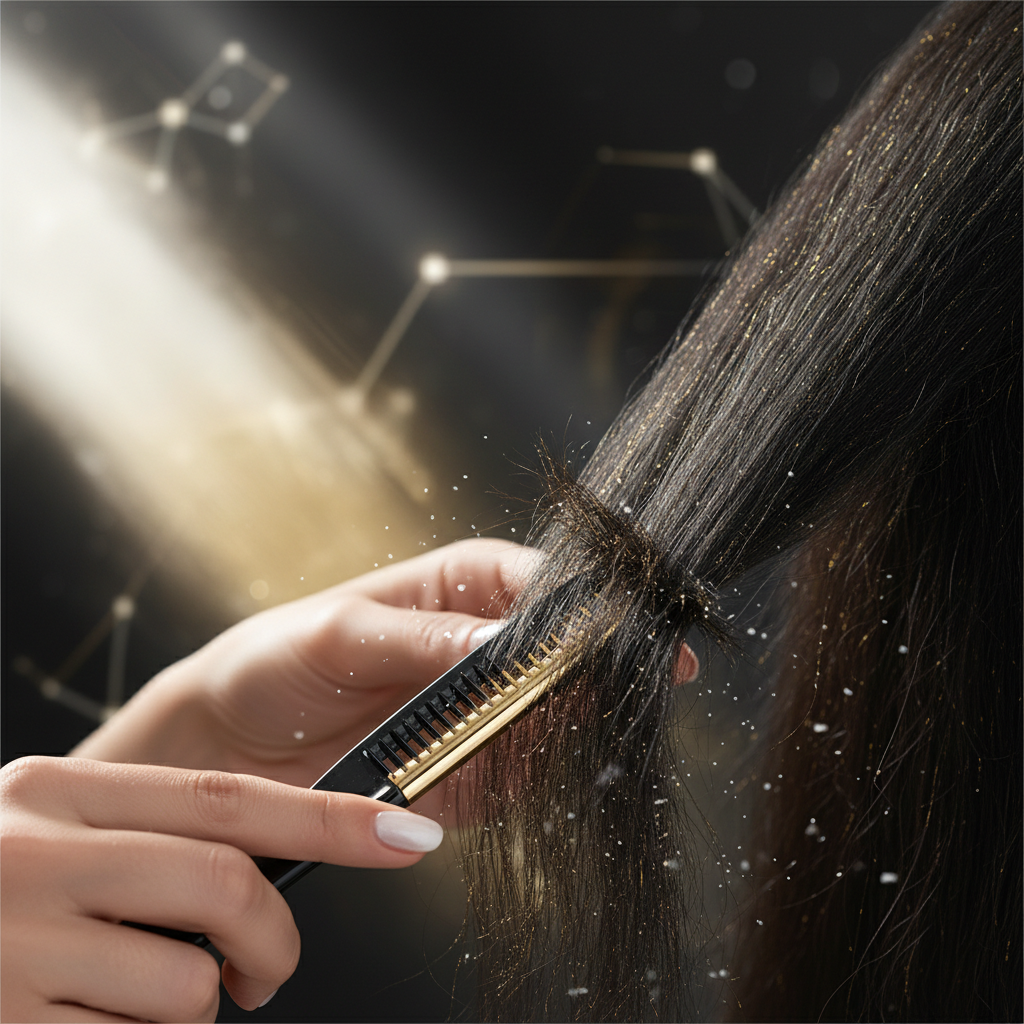
When hair breaks, the protective cuticle has typically worn away, exposing the cortex to environmental and physical friction. Research published in the International Journal of Cosmetic Science shows that when the hydrophobic surface layer (specifically the fatty acid 18-MEA) is stripped by alkaline chemicals or UV exposure, friction between individual strands increases dramatically. This friction generates mechanical stress during simple daily activities like brushing and washing, eventually exceeding the fibre's tensile threshold and causing a physical snap.
Controlled cosmetic studies show that conditioning agents containing cationic surfactants, hydrolysed proteins, and plant oils significantly lower the work required to comb hair. By reducing inter-fibre friction and filling microscopic fissures along the damaged cuticle, these formulations reinforce the fibre against sudden mechanical failure.
Breakage versus shedding: identifying the difference
A critical mistake in haircare is confusing snapped fibres with natural hair shedding. Humans shed roughly 50 to 100 hairs per day as follicles cycle out of the telogen (resting) phase.
| Diagnostic Feature | Hair Breakage | Natural Shedding (Telogen) |
|---|---|---|
| Anatomical origin | Anywhere along the shaft | Follicle bulb at the scalp |
| Visible white bulb | Absent (ends are blunt, frayed, or split) | Present (small keratinised white bulb intact) |
| Strand length | Uneven, short, fragmented pieces | Full length of your normal hair strand |
| Overall hair density | Thinning towards the mid-lengths and ends | Diffuse thinning across the scalp or crown |
| Primary trigger | Heat, chemical processing, rough handling | Hormonal shifts, stress, illness, nutritional gaps |
| Effective solution | Conditioning, gentle handling, haircuts | Medical assessment, nutritional review, time |
The mechanisms that cause hair to fracture
Hair fibres snap under mechanical tension, but underlying degradation primes them for failure long before they break.
Chemical disruption
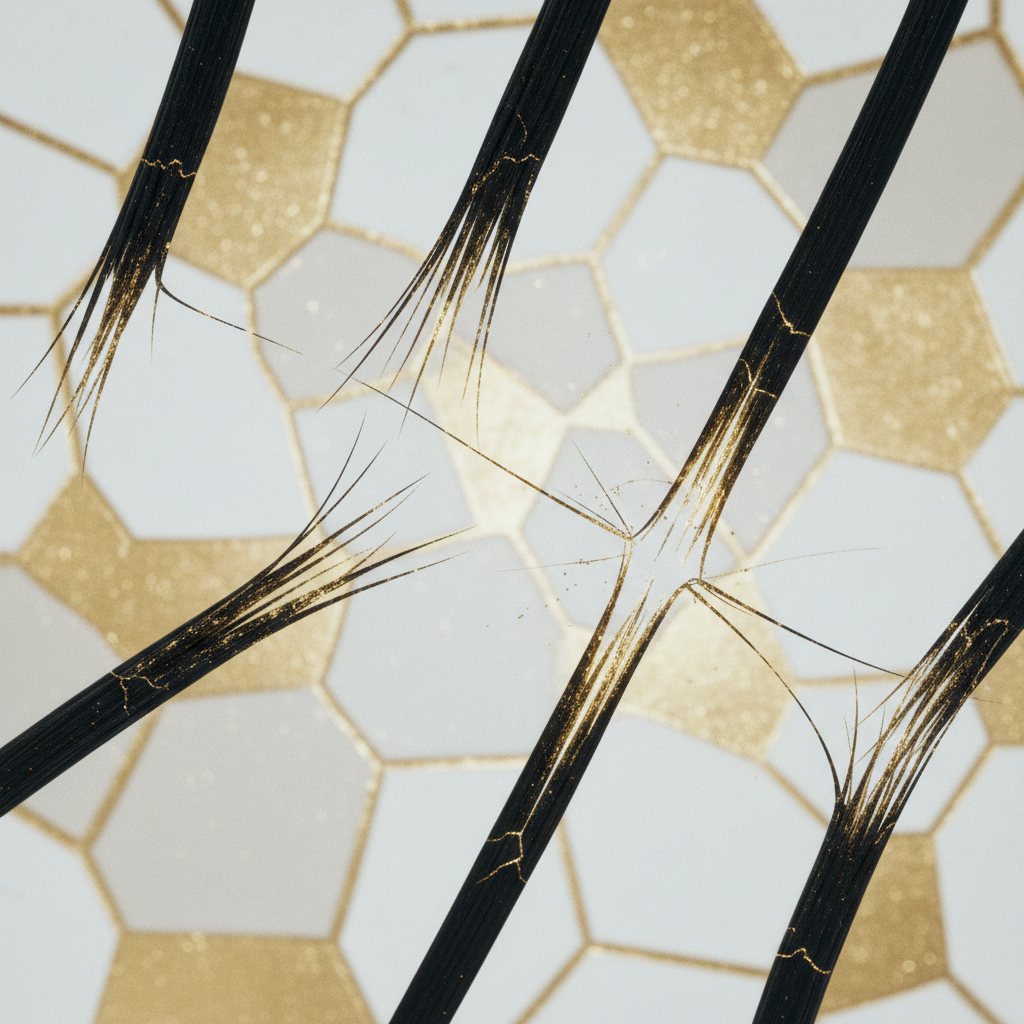
Bleaching, permanent hair dye, and chemical relaxers alter the hair's natural pH, which normally sits between 4.5 and 5.5. High-alkaline formulations swell the cuticle to penetrate the cortex. Bleaching oxidises cystine disulfide bonds, permanently reducing the cortex's structural integrity. Relaxers break these disulfide bonds to reshape curls, permanently reducing the tensile strength of the fibre.
Thermal trauma
Applying curling wands, straighteners, or high-heat hair dryers without protection causes rapid moisture evaporation. Temperatures above 180 degrees Celsius degrade keratin proteins and convert water trapped inside the cortex into steam. This can form internal micro-cavities, a condition clinically termed bubble hair, which snaps under minimal tension.
Hygral fatigue
Hair absorbs up to 30 percent of its weight in water when saturated. Continuous swelling and deswelling caused by frequent washing without lipid protection damages the cell membrane complex (CMC) that glues cuticle cells together. Over time, this leads to cuticle delamination, leaving the cortex exposed and vulnerable.
Practical steps for managing hair breakage
Rebuilding tensile resilience involves reducing mechanical friction while reinforcing the hair's surface barrier:
- Minimise wet combing friction: Wet hair has lower structural stiffness than dry hair. Never drag fine-toothed combs through wet hair. Apply a leave-in conditioner or slip agent and work through knots using a wide-toothed comb or flexible detangling brush, starting from the tips and working upward.
- Lower heat tool temperatures: Keep styling irons below 180 degrees Celsius and always apply a silicone- or polymer-based thermal protectant beforehand to buffer heat transfer.
- Optimise drying methods: Avoid rubbing hair with terrycloth towels, which have coarse loops that lift cuticle scales. Squeeze excess water using a smooth microfibre towel or cotton T-shirt.
- Choose gentler accessories: Replace metal-clasp elastics with silk or satin scrunchies. Sleep on silk or satin pillowcases to eliminate the abrasive friction caused by tossing and turning on cotton.
- Schedule regular trims: Frayed split ends (trichoptilosis) naturally run up the hair shaft like a run in a pair of tights. Trimming 5 to 10 millimetres every 8 to 12 weeks stops vertical splits from destroying healthy mid-lengths.
The role of cosmetic treatments and Watermans
Topical haircare cannot bring biological vitality to non-living hair shafts, but modern cosmetic science offers genuine support. Formulations that combine moisturising humectants with bio-compatible hydrolysed proteins temporarily deposit into porous cuticle gaps. This smooths down jagged scales and restores the strand's natural slide.
For those focusing on total strand resilience, pairing gentle handling with high-performance formulas makes a noticeable difference. Watermans incorporates targeted botanical extracts, proteins, and scalp-supporting nutrients into its shampoos, conditioners, and elixirs. By cleansing without stripping away essential surface lipids and providing substantive conditioning to the hair length, Watermans helps support smoother, stronger-feeling hair that resists everyday breakage and comb stress.
Frequently asked questions about Managing Hair Breakage
Can deep conditioning reverse split ends?
No. Split ends are complete physical fractures of the hair fibre. While deep conditioning treatments containing silicones, polymers, and oils can temporarily glue the split cuticle together to improve appearance and combability, the underlying structural break remains. Trimming with sharp professional scissors is the only permanent solution.
How do I know if my breakage is caused by protein or moisture issues?
Test a clean, damp strand by gently pulling it between your fingers. If the hair stretches slightly and bounces back, it is well balanced. If it stretches continuously without returning and then snaps, it lacks structural protein. If it shows no stretch at all, feels rough, and snaps immediately, it lacks conditioning lipids and moisture.
Does hard water contribute to managing hair breakage?
Hard water contains dissolved calcium and magnesium ions that bind to the negative charges on hair keratin. Over time, this mineral buildup creates a stiff, rough coating that blocks conditioning agents and increases surface friction. Incorporating a chelating shampoo once every few weeks removes these mineral deposits, making hair noticeably softer and far less prone to snapping.
Why is managing hair breakage harder on afro and textured hair?
Afro and curly hair textures have elliptical fibre geometries with natural twists and turns along the shaft. Cuticle cells do not lie completely flat at these curvature points, creating natural areas of mechanical vulnerability. Natural sebum also struggles to travel down tight coils. Textured hair therefore requires substantially more emollient lubrication and careful protective styling to prevent snapping.
A balanced approach to stronger lengths
Successfully managing hair breakage comes down to consistent protection rather than miracle cures. Because every millimetre of hair extending from your scalp is non-living keratin, it carries the cumulative wear and tear of every wash, brush, colour service, and heat styling session it has ever faced. By swapping aggressive habits for gentler detangling techniques, protecting fibres from thermal stress, and using restorative cosmetic conditioning, you preserve your hair's structural integrity. Be patient, treat fragile ends with respect, and let your length flourish.
Sources and references
- Robbins, C. R. (2012). Chemical and Physical Behavior of Human Hair (5th ed.). Springer-Verlag.
- International Journal of Cosmetic Science (2015). "The effect of hair weathering on the properties of hair fibres."
- British Association of Dermatologists (2021). "Hair breakage versus hair loss: clinical distinctions."
- Journal of the Society of Cosmetic Chemists (1993). "Measurement of tensile properties of human hair."
- American Academy of Dermatology (2022). "Styling without damage: Dermatologist recommendations."