Low Porosity Hair Care Routine: The Evidence-Based Guide
8 min read ·
Master your Low Porosity Hair Care Routine with science-backed advice on cuticle structure, thermal hydration, and avoiding heavy, product-laden build-up.
Quick answer: A successful Low Porosity Hair Care Routine focuses on opening tightly overlapping cuticle scales using gentle warmth and lightweight hydration, rather than heavy occlusives. Low porosity hair resists water absorption, causing products to sit on the surface and lead to rapid build-up. By using clarifying washes, humectants like glycerin, and moderate heat during conditioning, you can hydrate the inner cortex effectively. The main limitation is that cuticle architecture is largely genetic, meaning routines manage moisture access rather than permanently altering porosity.
Key takeaways
- Low porosity hair features tightly bound, overlapping cuticle tiles that resist moisture penetration and take hours to dry.
- The foundation of this regimen relies on indirect heat (such as warm water or steam) to temporarily lift the cuticle layer for conditioning.
- Heavy plant butters and thick waxes should be swapped for lightweight, water-soluble hydrators and smaller-molecule oils like argan or jojoba.
- Regular clarifying is essential because low porosity hair accumulates product residue rapidly on its outer sheath.
- True low porosity hair requires minimal protein treatments, as excess protein can cause the fibre to become rigid and brittle.
Low Porosity Hair Care Routine: what the evidence shows
Building an effective Low Porosity Hair Care Routine requires working with the physical properties of intact hair cuticles rather than fighting them. In virgin or minimally processed hair, the cuticular envelope consists of multiple layers of flattened, keratinised cells sealed by the 18-methyleicosanoic acid (18-MEA) lipid layer. This outer barrier is naturally hydrophobic, meaning it repels water.
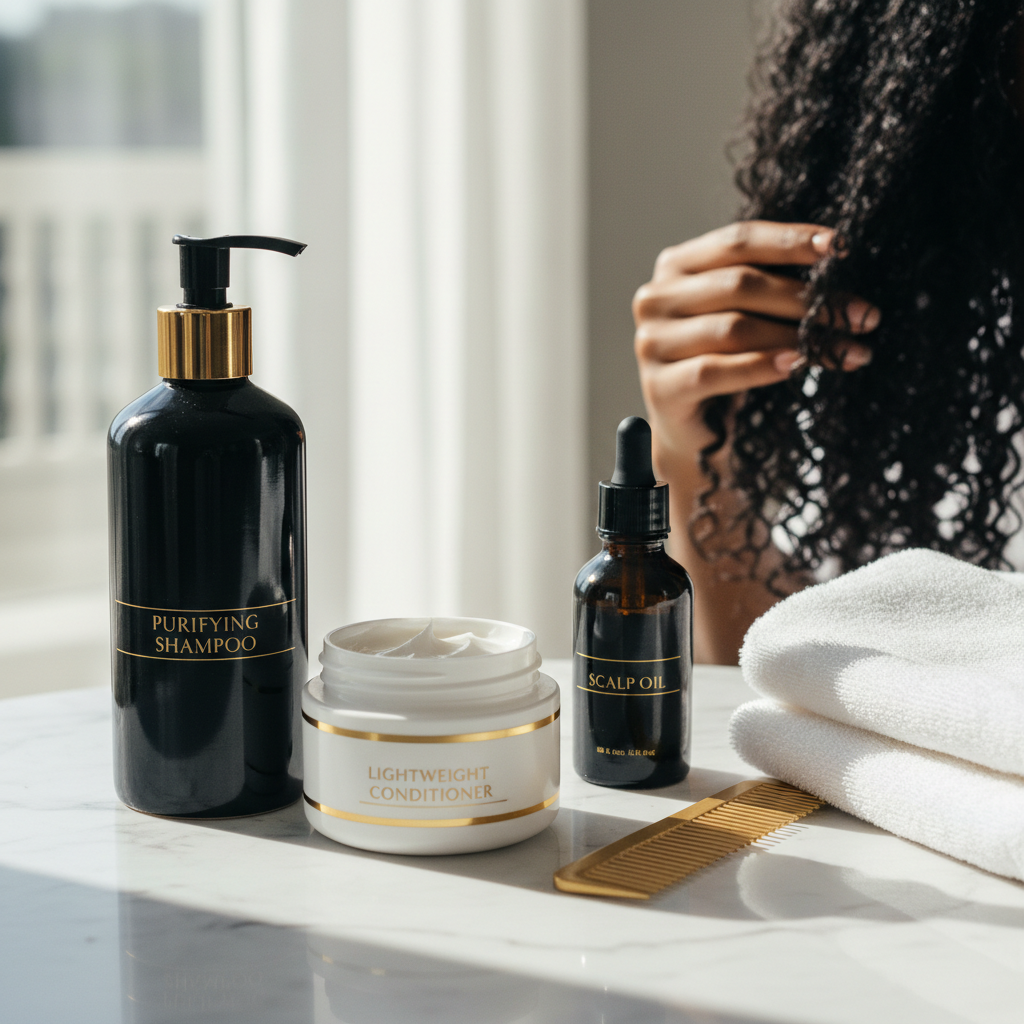
In low porosity hair, these cuticle layers lie unusually flat and overlap tightly. Studies published in the Journal of Cosmetic Science show that while this structure provides exceptional mechanical strength and natural shine, it drastically reduces the rate of water diffusion into the cortex.
When you apply standard hair products, the ingredients cannot penetrate the tight exterior. Instead, emulsions dry on the surface, creating a film that attracts environmental debris and causes hair to feel coated, stiff, or greasy. An evidence-led routine therefore relies on thermal expansion: using warm water and heated caps to physically swell the cuticle slightly, permitting entry of water and conditioning agents before rinsing with lukewarm water.
 LOW POROSITY CUTICLE (Tightly Packed)
 [======][======][======][======] <- Water beads up; heat needed to lift
 --------------------------------
 CORTEX
How cuticle architecture dictates moisture absorption
The human hair cuticle consists of roughly 6 to 10 overlapping cellular scales. In low porosity strands, the endocuticle and cell membrane complex (CMC) between these scales are densely cemented.
Research demonstrates that hair swelling is temperature-dependent. Below 30 degrees Celsius, an intact low porosity cuticle remains closed. When exposed to temperatures between 35 and 42 degrees Celsius (the safe range for warm shower water or heated caps), the lipid layers soften and the keratin structure allows modest water absorption through the CMC pathways.
Without this thermal intervention, water applied to low porosity hair beads on the surface. If you step out of the shower and leave heavy oils on the hair, you essentially trap the internal fibre in a dehydrated state while the surface remains coated.
| Feature | Low Porosity Hair | High Porosity Hair |
|---|---|---|
| Cuticle Structure | Flat, tightly packed, intact 18-MEA layer | Lifted, chipped, or missing cuticle scales |
| Water Absorption | Very slow (water beads on surface initially) | Rapid (absorbs water instantly) |
| Drying Time | Very long (often several hours to a full day) | Fast (loses water just as quickly as it enters) |
| Product Reaction | Prone to surface build-up and stiffness | Drinks up rich creams and heavy oils quickly |
| Protein Needs | Minimal; excess causes brittle snap | High; benefits from frequent structural reinforcement |
| Optimal Heat Use | Requires gentle heat to admit moisture | Needs cool water to seal cuticles down |
What the evidence does not show
There is no scientific backing for the popular internet claim that you can "fix" or permanently transform low porosity hair into medium porosity hair. Porosity in undamaged hair is determined by your genetics, your follicle shape, and the density of your cuticle layers.
Furthermore, social media often promotes the "float test" (placing a shed hair in a glass of water) as a diagnostic tool. Cosmetic chemists have repeatedly debunked this test. Surface tension, residual sebum, and product coatings cause high porosity hair to float and clean low porosity hair to sink depending entirely on how the strand is dropped. Reliable assessment comes from how your hair behaves when wet, how long it takes to saturate, and how it responds to product.
Finally, low porosity hair is not inherently damaged hair. In fact, low porosity hair is typically the healthiest hair structurally, as it retains its protective lipid barrier. Breakage in low porosity strands is rarely caused by chemical porosity; it is almost always caused by mechanical dryness and product stiffness.
Step-by-step: the optimal daily and weekly routine
To maintain hydration without causing build-up, structure your routine around these evidence-based steps:
1. The Pre-Cleanse and Clarification
Because low porosity cuticles shed residue poorly, clarifying every 2 to 3 weeks is mandatory. Use a chelating or clarifying shampoo containing gentle surfactants (such as sodium C14-16 olefin sulfonate or cocamidopropyl betaine) to strip away mineral deposits and product coatings. On alternate wash days, opt for a sulfate-free, pH-balanced cleanser (pH 4.5 to 5.5).
2. Warm Conditioning with Indirect Heat
Apply your rinse-out conditioner to soaking wet hair. Look for formulas containing low molecular weight humectants such as glycerin, propylene glycol, or aloe vera extract.
- Put on a plastic shower cap.
- Apply indirect warmth using a warm towel, a steamer, or a microwavable deep conditioning cap for 15 to 20 minutes.
- This heat loosens the lipid layer, allowing humectants to pull water past the CMC into the cortex.
3. Lightweight Leave-in Hydration
Skip thick, butter-heavy styling creams. Instead, use a water-based leave-in spray or a light milk. Ingredients should list water (aqua) first, followed by light emollients.
4. Sealing with Micro-Oils
If you choose to seal in moisture, avoid raw shea butter, petrolatum, or coconut oil, which sit on the cuticle and solidify at room temperature. Choose oils rich in linoleic acid or light squalane, argan oil, or jojoba esters. These coat the strand in a sheer, breathable film that slows moisture loss without suffocating the fibre.
When hair issues are caused by something else
It is common to confuse low porosity hair with other hair and scalp conditions:
- Hard water calcification: If your hair feels dry, brittle, and coated regardless of what you apply, dissolved minerals (calcium and magnesium carbonate) may be crystallising on your cuticles. This mimics low porosity behaviour even in high porosity hair.
- Protein overload: Using restructuring shampoos or keratin masks on low porosity hair coats the intact cuticle in excess proteins. The strand becomes stiff, straw-like, and snaps easily under tension.
- Follicular shedding: If you notice hair falling out from the root with a white bulb attached, this is follicular shedding (such as telogen effluvium), not breakage from dryness. Product porosity routines only affect the fibre, not the biological hair cycle inside the scalp.
The Watermans perspective on fibre conditioning
When managing hair that repels standard conditioning agents, your choice of scalp and fibre nutrition matters. Heavy, synthetic-laden treatments often suffocate the scalp microenvironment while failing to penetrate low porosity lengths.
Watermans focuses on balanced, nutrient-dense scalp formulas like Grow Me Shampoo and Condition Me Conditioner. Because Condition Me is engineered with bio-active humectants, hydrolysed lupin protein, and lightweight botanical extracts rather than dense, heavy waxes, it delivers conditioning agents directly to the hair shaft without leaving a suffocating coating. It works cleanly on both the scalp skin and the hair fibre, ensuring that your hair receives vital hydration while maintaining the clean, lightweight environment needed to encourage healthier-looking, stronger-feeling growth.
When to consult a professional
If you experience persistent breakage despite adjusting your moisture routine, consult a trichologist or a licensed stylist experienced in structural hair analysis. They can examine your hair fibres under magnification to check for cuticle weathering or internal cortex fissures.
Similarly, if your hair difficulties are accompanied by scalp irritation, burning, redness, or patchy hair loss, consult a GP or dermatologist. Porosity is a cosmetic characteristic of the dead hair shaft; inflammatory conditions require clinical diagnosis.
Frequently asked questions about Low Porosity Hair Care Routine
How often should you wash your hair with a Low Porosity Hair Care Routine?
Most people with low porosity hair benefit from washing their hair every 4 to 7 days. Because the tightly sealed cuticles allow oils and leave-in products to sit on the exterior, waiting longer often leads to heavy build-up. Regular washing with warm water re-saturates the cortex and clears away old product residue.
Does low porosity hair need protein treatments?
Low porosity hair requires very little protein compared to colour-treated or damaged hair. Its cuticle is already intact, meaning there are few structural gaps for large protein molecules to fill. Stick to lightweight, hydrolysed proteins used sparingly (once every 4 to 6 weeks) to prevent hair from becoming hard and brittle.
Why does water sit on my hair without soaking in?
Water beads on low porosity hair due to an intact layer of 18-methyleicosanoic acid (18-MEA), a natural fatty acid bound to the cuticle surface that makes it water-repellent. To help the hair absorb water, use warm water in the shower to soften the outer lipids and gently expand the cuticular boundaries.
Can coconut oil be used in a Low Porosity Hair Care Routine?
Coconut oil is generally not recommended for low porosity hair. It is rich in lauric acid, a saturated fatty acid that easily binds to hair proteins, but on tightly closed cuticles, it often solidifies at room temperature. This can create a stiff, greasy shield that blocks water from entering the inner shaft.
Conclusion
Mastering a Low Porosity Hair Care Routine comes down to patience, temperature control, and lightweight moisture. Because your hair naturally holds its cuticle closed, your objective is not to batter it with dense products, but to use warm water, humectants, and targeted clarification to guide hydration where it belongs. Once you strip away heavy waxes and embrace breathable, water-based formulations, low porosity hair reveals its true strengths: exceptional natural shine, resilience, and lasting internal hydration.
Sources and references
- Journal of Cosmetic Science: "The effects of heat and humectants on hair shaft swelling and water uptake" (2018)
- Robbins, C. R., Chemical and Physical Behavior of Human Hair, 5th ed., Springer (2012)
- International Journal of Trichology: "Hair Cosmetics: An Overview" (2015)
- British Association of Dermatologists: "Hair Structure and Common Cuticle Disorders" (2020)
Find these ingredients in Watermans products
- Aloe Vera: you will find this ingredient in our Curly Hair Conditioner.