Keratin and Hair Fibre Anatomy: The Ultimate Evidence-Based Guide
9 min read ·
Explore Keratin and Hair Fibre Anatomy to understand how cuticle, cortex, and medulla work together, and learn how to prevent structural hair damage.
Quick answer: Understanding Keratin and Hair Fibre Anatomy reveals how human hair achieves its mechanical strength, elasticity, and surface resilience. Hair is composed of roughly 65 to 90 percent keratin proteins arranged into three concentric physical zones: the protective outer cuticle, the structural cortex, and the central medulla. While keratin treatments and topical proteins can temporarily patch cracks and smooth outer layers, cosmetic products cannot permanently rebuild biological bonds or alive cellular structures once internal keratin chains suffer severe chemical or heat degradation.
Key takeaways
- Human hair fibres consist predominantly of fibrous, cysteine-rich keratin proteins alongside water, structural lipids, and melanin pigments.
- The fibre has three primary architectural zones: the protective overlapping cuticle, the load-bearing cortex, and the discontinuous central medulla.
- Disulphide bonds formed by cysteine residues provide permanent mechanical tensile strength, whereas weaker hydrogen and salt bonds contribute to temporary styling shape.
- Chemical services (such as bleaching or alkaline relaxers) and extreme heat break disulphide linkages, leading to cuticle erosion and fibre breakage.
- Topical cosmetic proteins cannot biologically re-grow or permanently replace lost native cortex structure, though they provide vital temporary surface conditioning and reduce daily friction.
Keratin and Hair Fibre Anatomy: what the evidence shows
Research into human hair morphology shows that hair is a complex biological composite material produced by dividing matrix cells inside the hair follicle. Understanding Keratin and Hair Fibre Anatomy requires looking past cosmetic marketing to examine how proteins assemble on a microscopic level.
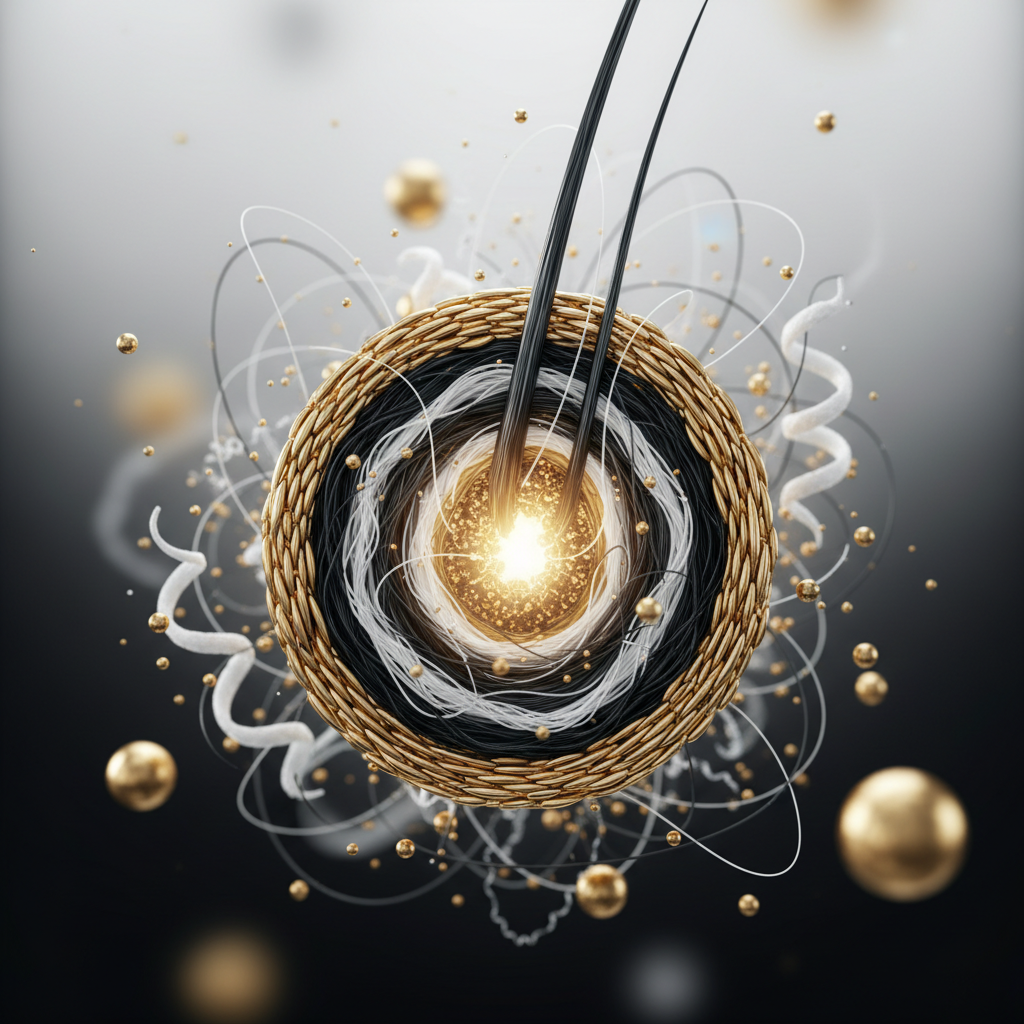
By weight, a healthy human hair fibre consists of approximately 65 to 90 percent keratin and keratin-associated proteins (KAPs), up to 15 percent water (depending on ambient humidity), 1 to 9 percent lipids, and trace minerals with variable quantities of melanin.
+-----------------------------------------------------------------+
| HAIR FIBRE CROSS-SECTION |
| |
| [ CUTICLE ] 5 to 10 overlapping scale layers (Beta-keratin)|
| | |
| v |
| [ CORTEX ] Macrofilaments -> Intermediate Filaments |
| | Alpha-helical Keratins + Disulphide Bonds |
| v |
| [ MEDULLA ] Porous central core (amorphous, variable) |
+-----------------------------------------------------------------+
The Three Structural Layers
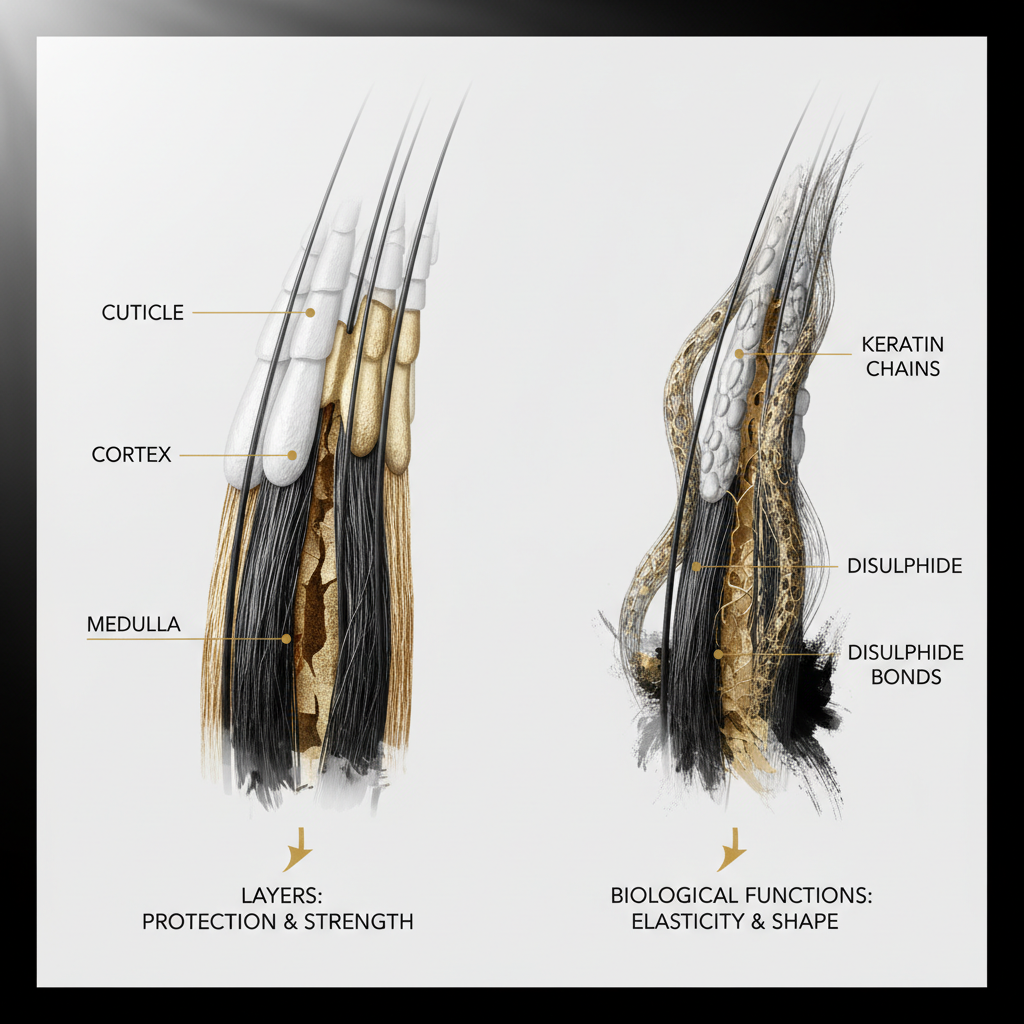
- The Cuticle: The outermost sheath consists of 5 to 10 overlapping, flattened, dead scales pointing from root to tip. It is divided into the epicuticle, A-layer, exocuticle (all rich in cross-linked cysteine), and the endocuticle. The surface is naturally coated with 18-methyleicosanoic acid (18-MEA), a covalently bound fatty acid layer that renders healthy virgin hair naturally hydrophobic.
- The Cortex: Making up roughly 75 to 85 percent of total fibre volume, the cortex gives hair its mechanical tensile strength, flexibility, and colour. Cortical cells contain closely packed macrofibrils, which are bundles of intermediate filaments embedded in an amorphous, high-sulphur protein matrix.
- The Medulla: Situated at the core of medium to coarse terminal hairs, the medulla consists of loose, porous, vacuolated cells with low cysteine content. Fine hair often lacks a continuous medulla entirely, and it contributes minimally to the mechanical strength of the shaft.
Chemical bonding: what gives the fibre strength
The architecture of the hair shaft relies on three primary types of chemical cross-links between amino acid chains:
- Disulphide bonds: Covalent linkages between cysteine residues. These are the strongest bonds in the cortex, accounting for the natural spring, elasticity, and permanence of hair's shape. They resist water, shampooing, and moderate thermal exposure, breaking only under strong reducing agents (perm solutions) or aggressive oxidation (bleach, high-volume peroxides).
- Hydrogen bonds: Weak physical bonds formed between electronegative atoms (oxygen, nitrogen) and hydrogen. Though easily broken by water and re-formed as hair dries, their immense quantity provides flexibility and allows for temporary mechanical styling, like blow-drying or curling.
- Salt (ionic) bonds: Weak ionic linkages between positive and negative amino acid side chains. These bonds depend heavily on pH. The hair fibre's isoelectric point (where electrical charges balance) sits between pH 3.67 and 5.5. Strong alkaline environments (pH above 8.0) swell the cuticle and destabilise ionic bonds, leaving the cortex exposed to friction.
Structural comparison: layers and their biological functions
| Structural Layer | Main Component | Protein Characteristic | Primary Biological Role | Vulnerability |
|---|---|---|---|---|
| Cuticle | Keratin scales & 18-MEA lipid layer | Highly cross-linked, rigid beta-keratin | Environmental barrier, manages moisture, provides slip | Mechanical friction, alkaline swelling, thermal lifting |
| Cortex | Cortical cells, macrofibrils, matrix | Alpha-helical keratin and high-sulphur KAPs | Tensile strength, elasticity, elongation, holds pigment | Oxidation from bleach, high heat degradation, perms |
| Medulla | Vacuolated cells and air spaces | Amorphous protein with low cysteine | Thermal insulation, modifies optical light reflection | High chemical porosity, hollow collapse under pressure |
What the evidence does not show about fibre repair
Cosmetic advertising frequently uses terms like "keratin reconstruction" and "molecular repair." However, scientific literature consistently demonstrates that once a hair fibre exits the scalp surface, it is biologically non-living tissue.
Topical products cannot biologically regenerate lost cortex matrix or restore the native 18-MEA lipid layer once it has been stripped by chemical bleaching. While hydrolysed proteins (derived from wheat, soy, or keratin) can temporarily deposit within micro-fractures of the cuticle and outer cortex to improve temporary tensile feel and reduce combing friction, they rinse out over successive washes. Furthermore, products claiming to permanently re-link all broken disulphide bonds only restore a modest percentage of original tensile strength under laboratory stress testing.
Mechanisms of hair fibre damage
Fibre degradation occurs through distinct pathways:
- Chemical stress: Alkaline hair dyes, lighteners, and straighteners raise the cuticle scales by breaking hydrogen and salt bonds, permitting chemicals to alter cortical melanin or disulphide bonds. Excessive oxidation permanently converts cysteine into cysteic acid, reducing overall tensile integrity and creating brittle zones.
- Thermal degradation: Applying heat tools above 185 to 200 degrees Celsius begins to denature alpha-helical proteins in the cortex, converting them into disordered beta-sheet configurations. Moisture trapped in the cortex can boil, creating micro-cavities (bubble hair).
- Mechanical friction: Wet hair has high elasticity but lower resistance to abrasive friction because hydrogen bonds are temporarily disrupted. Aggressive brushing or rough towel-drying strips away individual cuticle scales, exposing the fibrous cortex to environmental splits.
Everyday signs of damaged fibre anatomy
You can identify structural degradation along the hair shaft through several distinct physical signs:
- High porosity and rapid saturation: Hair that absorbs water immediately and takes hours to dry usually possesses lifted, eroded cuticles that no longer maintain a hydrophobic 18-MEA barrier.
- Increased static and tangling: Cuticle scales that are chipped, jagged, or stripped increase the inter-fibre friction coefficient, resulting in persistent matting and knots.
- Loss of elastic rebound: Healthy hair stretches up to 30 percent of its dry length before breaking and returns to its original form. Weakened cortex chains stretch, deform permanently, or snap immediately without recoil.
- Split ends (trichoptilosis): Complete peeling of the protective cuticle layer at the distal tip of the hair shaft, allowing macrofibrils of the cortex to unbundle like frayed rope.
Practical steps to protect fibre integrity
- Maintain acidic pH balance: Use shampoos and conditioners formulated near the hair's natural isoelectric point (pH 4.5 to 5.5). Mildly acidic rinses keep the cuticle compact, smooth, and resistant to mechanical friction.
- Minimise wet manipulation: Because water weakens hydrogen networks, hair is especially fragile when wet. Detangle using a wide-tooth comb or flexible-bristle brush, starting from the ends and working upward while saturated with slip-enhancing conditioner.
- Control thermal thresholds: Limit hot styling tools to below 180 degrees Celsius and always apply a thermal protectant containing polymers that slow heat transfer to internal cortical cells.
- Use targeted topical proteins: Incorporate leave-in conditioners or rinse-out treatments containing low-molecular-weight hydrolysed proteins to temporarily patch minor cuticle defects without causing protein build-up.
Supporting hair health with Watermans
While the outer hair shaft is biologically non-living, the biological engine producing healthy keratin structures sits beneath the scalp surface within the hair follicle. Nourishing the scalp creates the ideal environment for the follicular matrix cells that synthesize new hair fibres.
Watermans Grow Me Shampoo and Conditioner are formulated with this biological foundation in mind. Featuring a carefully calibrated blend of biotin, rosemary, caffeine, niacinamide, and hydrolysed lupin protein, these formulations respect the scalp's natural pH and help strengthen the physical feel of hair fibres. Regular use cleanses away residue without aggressively stripping essential protective surface lipids, supporting hair that looks fuller, feels resilient, and resists daily grooming breakage.
Frequently asked questions about Keratin and Hair Fibre Anatomy
What is the primary protein inside human hair?
Alpha-keratin is the primary protein in human hair, constituting the structural backbone of the cortex. These proteins are rich in the amino acid cysteine, which forms cross-linking disulphide bonds that give the fibre its physical resilience, elasticity, and resistance to environmental stress.
Can salon keratin treatments permanently repair hair fibre anatomy?
No. Salon keratin treatments typically coat the outer cuticle layer with hydrolysed proteins and silicone polymers, often sealed using high heat and cross-linking aldehydes. They do not permanently reconstruct internal disulphide bonds within the cortex and will wash out over several months.
How does moisture affect Keratin and Hair Fibre Anatomy?
Water penetrates porous cuticles and temporarily breaks hydrogen bonds within the cortex, making the fibre swollen, more elastic, and significantly more vulnerable to mechanical friction. Excessive water absorption without adequate lipid protection can lead to hygral fatigue, weakening the fibre over time.
Why is the cuticle layer so important for hair health?
The cuticle serves as the physical shield for the entire hair shaft. Its overlapping scales and hydrophobic lipid coating keep environmental moisture, pollutants, and abrasive forces from directly degrading the delicate, load-bearing cortex underneath.
Does fine hair have the same internal anatomy as coarse hair?
Fine hair contains the same cuticle and cortex structures as coarse hair, but it typically has a much narrower cortex diameter and often lacks a central medulla entirely. This makes fine hair more susceptible to mechanical breakage and chemical damage.
Summary of Keratin and Hair Fibre Anatomy
Mastering Keratin and Hair Fibre Anatomy underscores the balance between biological growth and daily cosmetic preservation. While your hair follicles continuously assemble resilient, disulphide-linked keratin chains, the exposed shaft is a non-renewable biological composite that endures constant physical, chemical, and thermal wear. By supporting the scalp environment that produces these fibres and respecting the delicate cuticle that shields them, you can minimise fibre breakage and keep your hair performing at its structural best.
Sources and references
- Robbins, C. R. (2012). Chemical and Physical Behavior of Human Hair (5th ed.). Springer-Verlag.
- Dawber, R. (1996). Hair: Its structure and response to cosmetic preparations. Clinics in Dermatology, 14(1), 105-112.
- Cruz, C. F., Costa, C., Gomes, A. C., & Cavaco-Paulo, A. (2016). Human hair characteristics and methods of hair surface analysis. International Journal of Cosmetic Science, 38(5), 437-446.
- Wolfram, L. J. (2003). Human hair: A unique physicochemical composite. Journal of the American Academy of Dermatology, 48(6), S106-S114.
- National Center for Biotechnology Information (NCBI). Hair Keratins: Structure and Function. PubMed Central.
Find these ingredients in Watermans products
- Niacinamide: you will find this ingredient in our Hair Mask.