Hygral Fatigue Mechanisms: How Moisture Cycling Breaks Down Hair
9 min read ·
Learn how hygral fatigue mechanisms cause structural hair breakage through chronic moisture cycling, and discover proven ways to restore hair strength.
Quick answer: Hygral fatigue mechanisms describe the structural breakdown of the hair fibre caused by repeated, excessive swelling and contracting as water enters and exits the cortex. When hair absorbs water, its diameter swells by roughly 14% to 16%, straining the cuticle layer and cell membrane complex. Over time, this cycling degrades internal proteins, leaving strands gummy, weak, and prone to breakage. However, hygral fatigue is strictly a hair shaft issue, not a follicle condition, so it never causes root hair loss.
Key takeaways
- Hygral fatigue occurs when constant moisture cycling forces the hair fibre to repeatedly swell and shrink, degrading structural proteins.
- Water expands the hair shaft diameter by up to 16%, lifting cuticle scales and weakening the intercellular lipids of the cell membrane complex.
- Symptoms include a limp, mushy, or gummy feel when wet, excessive elasticity that does not snap back, and breakage along the mid-lengths.
- Porous, chemically treated, or mechanically damaged hair is significantly more vulnerable because its lipid barrier is already compromised.
- Treatment requires restoring the moisture-protein balance through hydrolysed proteins, film-forming conditioning agents, and reducing soak times.
Hygral Fatigue Mechanisms: what the evidence shows
Understanding hygral fatigue mechanisms requires examining the microscopic anatomy of human hair. The hair shaft consists of an outer protective cuticle, an inner cortex composed of keratin bundles, and an intercellular cement known as the cell membrane complex (CMC). Under normal ambient conditions, hair naturally holds roughly 10% to 15% water by weight. When submerged, healthy virgin hair can absorb upwards of 30% of its dry weight in water.
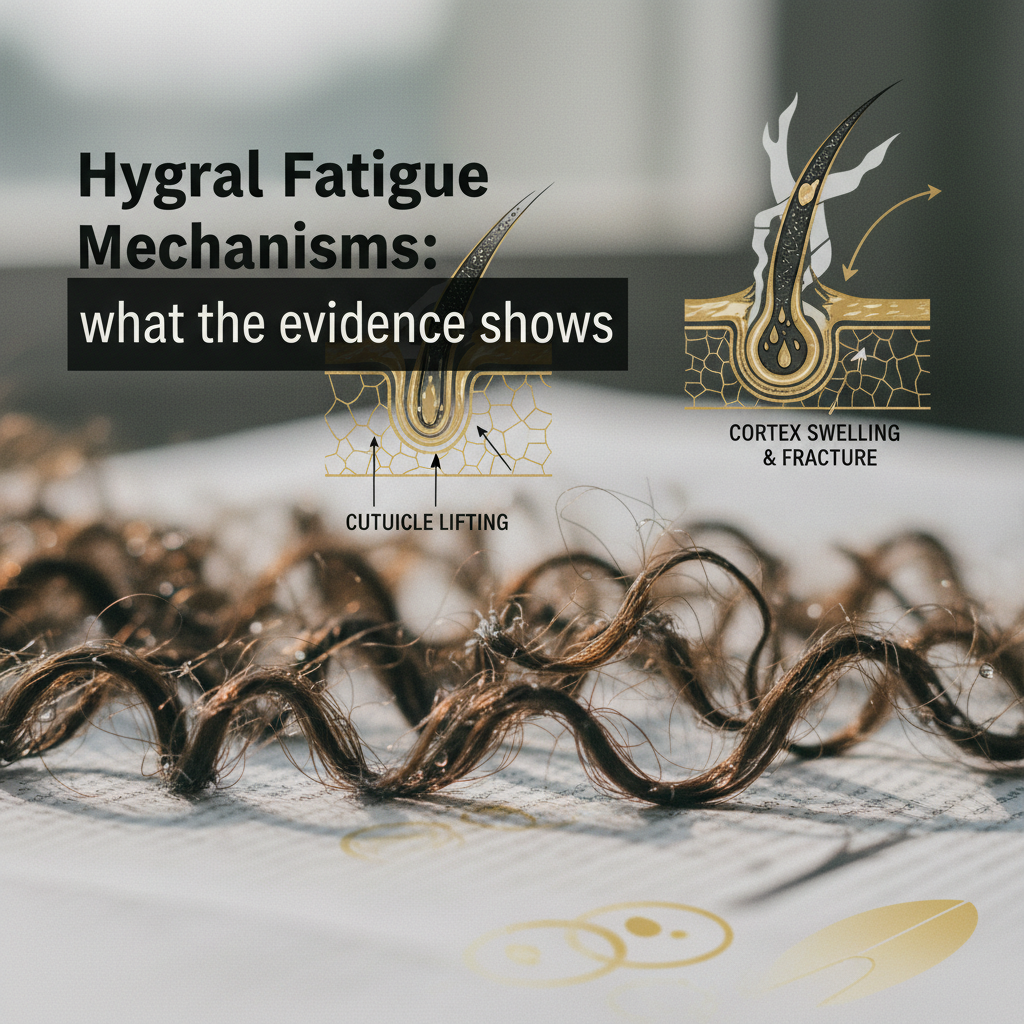
Cosmetic chemistry research demonstrates that this water uptake is driven by the hydrophilic nature of keratin. As water molecules penetrate the cortex, they disrupt the secondary hydrogen bonds that stabilise keratin protein chains. This intake forces the shaft to swell radially by roughly 14% to 16%, while length increases by only 1% to 2%. When the hair dries, water evaporates, the hydrogen bonds reform, and the fibre contracts back to its original dimensions.
Hygral fatigue mechanisms become destructive when this swelling and deswelling cycle happens too frequently or persists for prolonged periods. The repeated mechanical stress fractures the cell membrane complex, which acts as the biological glue holding the cortical cells together. Over time, the outer cuticle scales become deformed and cannot lie flat against the shaft, leaving the vulnerable cortex permanently exposed.
Moisture Cycling Stress Cycle:
Excessive Water Influx -> Disrupted Hydrogen Bonds -> 14-16% Radial Swelling
 ^ |
 | v
Fibre Weakening & Breakage <- Protein Loss <- Cuticle Delamination & CMC Strain
How water damages hair structure: the biological process
The degradation caused by hygral fatigue operates through three distinct physical stages:
1. Lipid stripping and barrier erosion
The outer surface of healthy hair is covered by the 18-methyleicosanoic acid (18-MEA) layer, a covalently bound lipid barrier that makes virgin hair hydrophobic. Chemical treatments (such as bleaching, permanent dyeing, and alkaline relaxing) strip this fatty layer. Without 18-MEA, the hair shifts from hydrophobic to hydrophilic, absorbing water rapidly and unevenly.
2. Disruption of hydrogen bonding and the cell membrane complex
As water rushes into the cortex, it displaces the hydrogen bonds between polypeptide chains. This makes wet hair naturally weaker than dry hair: wet keratin has roughly one-third lower tensile strength than dry keratin. In addition, the delta-layer of the cell membrane complex swells disproportionately, creating internal shearing forces between adjacent cortical cells.
3. Cuticle buckling and delamination
As the inner cortex swells outwards, it pushes against the rigid, non-expanding outer cuticle scales. With repeated wetting cycles, the margins of the cuticle scales crack and lift. When the fibre shrinks during drying, the lifted scales fail to seat back down smoothly, resulting in chipped edges, split ends, and surface friction.
Signs and symptoms: diagnosing hygral fatigue
Hygral fatigue is frequently misdiagnosed because its symptoms can mimic protein overload or simple dryness. However, tactile testing provides clear distinctions.
| Physical Characteristic | Healthy Hair | Hygral Fatigue | Protein Overload |
|---|---|---|---|
| Wet Texture | Smooth, firm, resilient | Mushy, gummy, limp, excessively soft | Stiff, rough, straw-like |
| Wet Elasticity | Stretches 20% to 30%, returns to shape | Stretches far beyond 30%, does not snap back, breaks | Does not stretch; snaps almost immediately |
| Drying Time | Moderate | Takes an unusually long time to dry fully | Dries very quickly |
| Curl Definition | Defined, bouncy coil or wave | Elongated, lifeless, stringy pattern | Brittle, frizzy, rigid pattern |
| Breakage Pattern | Minimal, occurs under extreme force | Snaps mid-strand under light tension | Shatters or snaps cleanly under bending |
What the evidence does not show
There is no scientific evidence that hygral fatigue causes hair loss from the follicle. Conditions like androgenetic alopecia, telogen effluvium, and alopecia areata originate within the living dermal papilla beneath the scalp surface. Hygral fatigue is entirely a mechanical and cosmetic phenomenon limited to the non-living hair shaft. While broken fragments shed during washing may look alarming, they do not have the white keratinous bulb characteristic of a shed telogen hair.
Furthermore, hygral fatigue is not caused by merely using rinse-out conditioners or washing your hair daily, provided the hair dries efficiently. The primary drivers are leaving hair wet or damp for extended periods, such as sleeping with soaking wet hair, prolonged overnight deep-conditioning routines, and wearing tightly wrapped, wet protective styles.
Practical strategies: how to prevent and repair fibre swelling
Reversing the structural damage of hygral fatigue requires reinforcing the internal protein framework while limiting unnecessary water uptake.
Limit prolonged water exposure
Never leave deep conditioners or conditioning masks on your hair overnight. Research indicates that standard hair conditioners achieve their primary benefits within 3 to 5 minutes, with heavy masks plateauing around 15 to 30 minutes. Leaving hair saturated for hours keeps the cortex in a swollen, weak state, accelerating the hygral fatigue mechanisms.
Apply pre-wash penetrating oils
Applying a small amount of non-polar oil, such as pure coconut oil, before shampooing can significantly reduce fibre swelling. Because coconut oil is rich in lauric acid, it has a low molecular weight and a straight hydrocarbon chain that can penetrate past the cuticle and into the cortex. By occupying space inside the fibre, it reduces the amount of water the cortex can absorb during washing, blunting the 14% to 16% expansion shock.
Use targeted hydrolysed proteins
Rinse-out treatments formulated with hydrolysed wheat, silk, keratin, or vegetable proteins help temporarily patch damaged sites along the hair shaft. Because these proteins have been broken down into smaller molecular weights (typically between 500 and 2,000 Daltons), they can deposit along micro-fissures in the cuticle and outer cortex, restoring tensile strength and elasticity.
Balance pH levels
Hair products should ideally sit at an acidic pH between 4.5 and 5.5. Alkaline environments cause the cuticle to flare open, inviting unrestrained water ingress. Acidic formulations contract the cuticle layers, smoothing the surface and sealing the shaft against excessive environmental moisture.
When breakage has another cause
If your hair is breaking despite moderate wash routines and balanced protein-moisture regimens, other factors may be at play:
- Thermal damage: Excessive flat iron or blow dryer heat (above 180°C) denatures cortical keratin into amorphous forms and boils moisture trapped within the fibre, creating "bubble hair".
- Severe oxidative damage: Bleaching and perming break disulphide bonds chemically, which cannot be repaired simply by controlling moisture.
- Follicular shedding: If you are seeing full-length strands with a small, white bulb at the root, you are experiencing shedding (such as telogen effluvium), not shaft breakage from moisture cycling.
If you notice patches of scalp show-through, sudden diffuse thinning across the scalp, or scalp irritation and flaking, consult a qualified trichologist or dermatologist for an accurate scalp assessment.
Support your hair with Watermans
When managing fibre strength and maintaining an optimal scalp environment, gentle care is essential. Watermans products are developed to support healthy-looking hair without harsh stripping agents. Formulated with premium botanical extracts, hydrolysed lupin protein, caffeine, and biotin, Watermans Hairbursting collections work to cleanse the scalp gently while reinforcing the hair surface. By supporting moisture balance and washing away mineral buildup, Watermans helps keep the hair shaft resilient, shiny, and less vulnerable to external stresses.
Frequently asked questions about Hygral Fatigue Mechanisms
Can leaving conditioner on overnight cause hygral fatigue?
Yes. Leaving wet conditioner on your hair for hours or sleeping in a plastic cap forces the hair fibre into an unnaturally prolonged state of radial expansion. As the cortex swells with water and water-based emulsions for eight hours or more, it strains the cell membrane complex and cuticle scales. Deep treatments should strictly follow manufacturer timeframes, usually capping benefit at 15 to 30 minutes.
Does hygral fatigue cause permanent damage to the hair?
The damage to the hair shaft is permanent in that dead keratin fibres cannot biologically regenerate or self-heal. However, the symptoms can be managed cosmetically until new hair grows in. You can reinforce the weakened cuticle and cortex using hydrolysed protein treatments, acidic rinses to smooth cuticle scales, and light penetrating oils that limit future water-induced swelling.
What is the primary difference between hygral fatigue and protein overload?
Hygral fatigue makes hair feel limp, mushy, and overly elastic when wet, stretching excessively before snapping. Protein overload produces the opposite sensation: the hair feels rigid, rough, straw-like, and snaps almost instantly when bent or pulled, showing virtually zero elasticity. Hygral fatigue needs hydrolysed protein and structure, while protein overload needs protein-free moisture and lubricating emollients.
Why do hygral fatigue mechanisms affect bleached hair more severely?
Bleaching oxidises and removes the hair's protective 18-MEA lipid layer, turning the fibre from water-repellent (hydrophobic) to water-absorbing (hydrophilic). In addition, bleaching dissolves a portion of the cortex's natural disulphide bonds, leaving the internal framework porous. When bleached hair is wet, it absorbs water much faster and in larger volumes, causing sudden, violent structural swelling that rapidly induces hygral fatigue.
Conclusion
Understanding hygral fatigue mechanisms provides the scientific clarity needed to stop treating hair with continuous, unmonitored hydration. Hair fibre resilience depends entirely on a fine balance between cortical moisture and structural keratin integrity. By reducing soak times, avoiding prolonged wetness, applying protective pre-wash lipids, and using balanced hydrolysed protein treatments, you can prevent structural water damage and keep your hair shafts strong, supple, and resistant to breakage.
Sources and references
- Robbins, C. R. (2012). Chemical and Physical Behavior of Human Hair. 5th Edition, Springer-Verlag.
- Ruetsch, S. B., et al. (2001). "Investigation of the penetration of coconut oil into human hair fibres using secondary ion mass spectrometry." Journal of Cosmetic Science, 52(3), 169-184.
- Keis, K., et al. (2005). "Investigation of oil uptake into human hair fibres using optical microscopy." Journal of Cosmetic Science, 56(5), 283-295.
- Evans, T., & Wickett, R. R. (2012). Practical Modern Hair Science. Allured Business Media.
- Cruz, C. F., et al. (2016). "Human hair characteristics: A review." International Journal of Trichology, 8(3), 115-121.
Find these ingredients in Watermans products
- Biotin: you will find this ingredient in our Hair Growth Shampoo.