Cell Membrane Complex Hair Structure: The Science of Hair Cement
9 min read ·
The Cell Membrane Complex Hair Structure acts as the biological glue bonding hair cells together. Learn how it works, what depletes it, and how to protect it.

Quick answer: The Cell Membrane Complex Hair Structure (CMC) is the biological intercellular cement that bonds cuticular scales and cortical cells together within the hair shaft. Accounting for roughly 3 to 5 percent of the total hair mass, it regulates water absorption, maintains elastic flexibility, and acts as the primary diffusion pathway for treatments and moisture. However, because the CMC is non-living tissue once formed, chemical over-processing, bleaching, and excessive thermal styling can permanently deplete its lipid layers, leading to brittle, unmanageable hair.
Key takeaways
- The Cell Membrane Complex (CMC) acts as the intercellular glue holding cuticular layers and cortical cells together.
- It consists of a lipid-rich central delta layer flanked by two protein-dense beta layers, creating a semi-permeable boundary.
- 18-Methyleicosanoic acid (18-MEA) is the critical surface lipid anchored to the cuticular CMC that provides natural hydrophobicity.
- Chemical bleaching, alkaline relaxers, and high heat degrade CMC lipids, transforming hair from water-repellent to water-absorbing and porous.
- Cosmetic conditioning agents can temporarily mimic or replace lost lipid function, but natural CMC tissue cannot regenerate biologically.
Cell Membrane Complex Hair Structure: what the evidence shows
Understanding the Cell Membrane Complex Hair Structure requires looking at hair under high-magnification electron microscopy. Rather than being a solid, continuous cylinder of keratin, human hair is a laminated composite of cells. The CMC occupies the microscopic spaces between these cells, forming a continuous network throughout both the cuticle (the outer protective armour) and the cortex (the structural core of the fibre).
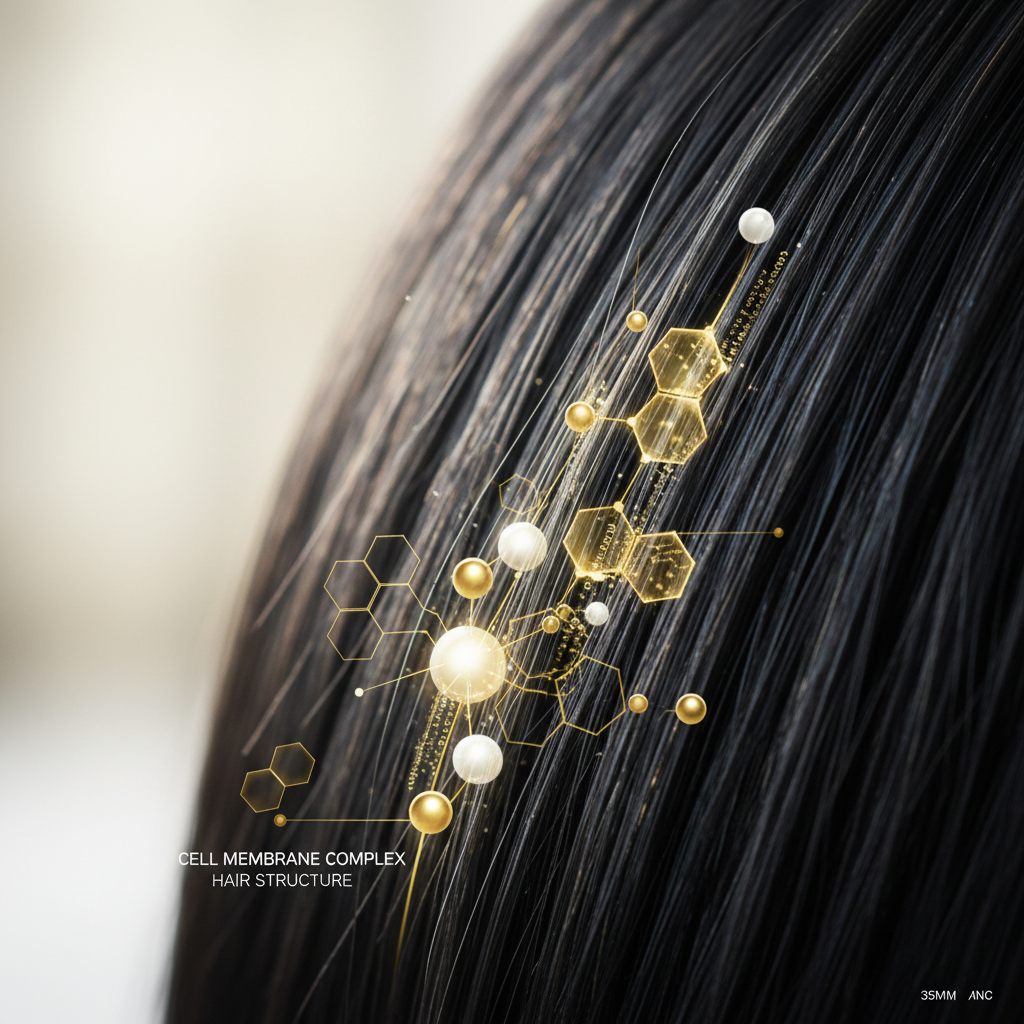
Structurally, the CMC is arranged as a trilayer roughly 25 to 30 nanometres thick. It features a central hydrophilic (water-attracting) layer called the delta layer, sandwiched between two hydrophobic (water-repelling) lipid layers known as beta layers.
Scientific literature identifies three distinct zones of the CMC depending on where it sits in the fibre:
- Cuticle-Cuticle CMC: The junctions bonding overlapping cuticle scales together. This area contains high concentrations of 18-methyleicosanoic acid (18-MEA), a branched-chain fatty acid covalently bound to the underlying protein. It creates a slick, protective barrier against mechanical abrasion and water penetration.
- Cortex-Cortex CMC: The cement holding macrofibrils and cortical spindle cells together inside the shaft. This region is lower in lipids and richer in proteins, providing structural elasticity and allowing the hair shaft to bend without snapping.
- Cuticle-Cortex CMC: The transitional boundary connecting the innermost layer of the cuticle to the outermost cortical cells.
Cosmetic scientists recognise that the CMC serves as the primary gateway into the hair shaft. Because the keratinised cells themselves are densely cross-linked with disulphide bonds, cosmetic active ingredients, permanent dyes, and moisture penetrate the fibre predominantly through the lipid-protein channels of the Cell Membrane Complex.
The biological mechanism of CMC degradation
The integrity of your hair depends heavily on the condition of the CMC. When hair emerges from the scalp, the outer beta layer is rich in 18-MEA. This lipid layer gives healthy hair its naturally hydrophobic character. Drops of water bead up on healthy virgin hair because this surface energy is exceptionally low.
When hair undergoes chemical treatments, such as permanent colouring, bleaching, perming, or alkaline straightening, the chemical processing strips away this protective lipid layer:
- Alkaline exposure: High-pH solutions (pH 9.0 to 11.0) cause the cuticular scales to swell, lifting the edges and exposing the delicate delta layer of the CMC.
- Oxidation: Bleaching and hydrogen peroxide break the covalent thioester bonds anchoring 18-MEA to the hair surface. A single bleaching session can strip the majority of surface 18-MEA from the cuticular CMC.
- Internal lipid extraction: Harsh surfactants, repeated thermal styling above 180 degrees Celsius, and UV radiation gradually strip away internal free fatty acids, ceramides, and cholesterol from the cortex-cortex CMC.
Once the CMC loses its lipid content, hair becomes hydrophilic. Instead of repelling water, the hair fibre absorbs liquid like a sponge, swelling rapidly when wet. This rapid swelling and subsequent contraction during drying creates mechanical stress known as hygral fatigue, which weakens the entire fibre architecture.
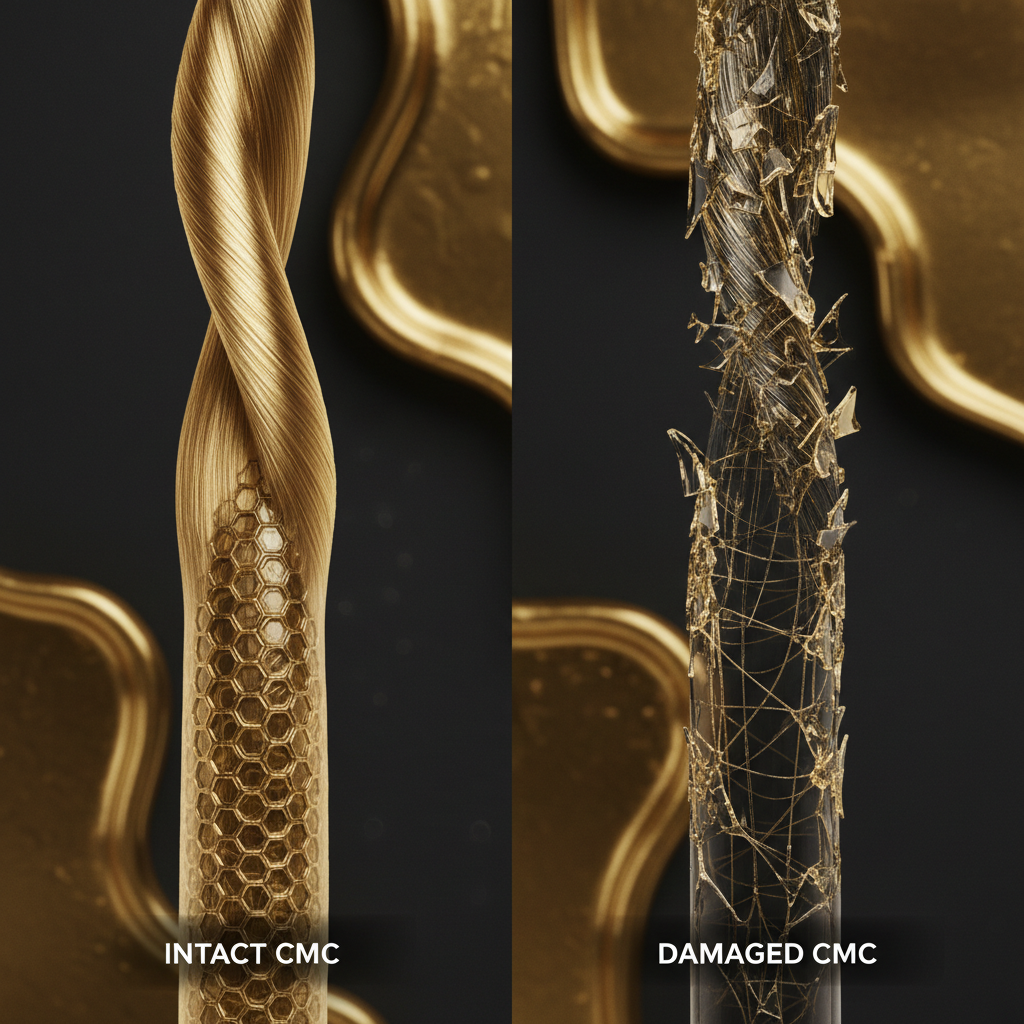
Comparison: Intact CMC vs Damaged CMC
| Feature | Intact Cell Membrane Complex | Damaged or Depleted Cell Membrane Complex |
|---|---|---|
| Water Behaviour | Hydrophobic (repels water; droplets bead on surface) | Hydrophilic (readily absorbs water; swells excessively) |
| Cuticle Adhesion | Scales lie flat, tight, and securely bonded | Scales lift, buckle, chip, and break away easily |
| Elasticity & Flexibility | High; fibres stretch and return without cracking | Poor; hair feels stiff, brittle, and snaps under tension |
| Porosity | Low to moderate balanced porosity | High porosity; uneven chemical uptake and fast colour fade |
| Friction & Combing | Low friction coefficient; smooth glide when wet or dry | High friction coefficient; tangling, knotting, and rough texture |
| Primary Causes of State | Virgin hair, gentle washing, physical sun protection | Bleach, permanent dyes, high heat, harsh surfactants |
What the evidence does not show
There is no scientific evidence that topical haircare products can permanently rebuild the biological Cell Membrane Complex once it has been destroyed. Marketing claims that promise to "permanently repair the cellular cement" or "cure split ends by regenerating the CMC" misrepresent biological reality.
Hair is non-living keratinised tissue. It lacks metabolic activity, blood vessels, and living cells once it leaves the scalp follicle. While biomimetic lipids (such as synthetic ceramides, 18-MEA analogues, and specific fatty acids) can effectively deposit into the gaps left by a degraded CMC, these treatments are cosmetic and temporary. They wash out over time and require consistent replenishment.
Additionally, internal CMC degradation should not be confused with hair loss or shedding. The CMC is an architectural element of the hair shaft, not the hair follicle. Damage to the CMC causes fibre breakage, split ends, and texture loss, but it does not cause follicular conditions such as androgenetic alopecia or telogen effluvium.
Practical steps to protect and support the Cell Membrane Complex
Because the body cannot naturally restore lost CMC lipids, prevention and targeted cosmetic maintenance are essential.
1. Minimise lipid stripping during cleansing
Select shampoos formulated around a physiological pH (between 4.5 and 5.5). Alkaline cleansers force the cuticle scales open, accelerating the loss of soluble CMC components. Wash hair with lukewarm water rather than hot water, as high temperatures increase lipid dissolution.
2. Introduce biomimetic lipids and ceramides
Look for leave-in treatments and deep conditioners containing ingredients that mimic the natural composition of the CMC:
- Ceramides: Lipid molecules that slot into the voids between cortical cells, reducing moisture evaporation.
- Fatty acids: Stearic, palmitic, and behenic acids help restore suppleness.
- Hydrolysed proteins: Low-molecular-weight amino acids and peptides can penetrate the porous delta pathway to temporarily reinforce structural strength.
3. Guard against heat degradation
Keep hot styling tools below 180 degrees Celsius. Thermal tools used at 200 degrees Celsius or higher can melt structural lipids and denature the delicate beta layers of the CMC, leaving the cuticle scales permanently detached from the cortex. Always use a silicone or polymer-based heat protectant to create a sacrificial surface barrier.
4. Manage chemical processing
If you bleach or colour your hair, ask your colourist to use lower-volume developers and incorporate bond-protecting additives. Space chemical services at least 8 to 10 weeks apart to give you time to reinforce fibre integrity using lipid-rich cosmetic care.
Targeted support: Watermans haircare approaches
While cosmetic products cannot regenerate non-living tissue, maintaining a clean, balanced environment at the scalp supports the development of robust hair shafts as they emerge from the follicle.
Watermans focuses on formulas that support optimal scalp wellness and fibre resilience. By utilising gentle, balanced cleansing agents alongside fortifying botanical extracts and proteins, Watermans products help keep the scalp revitalised while providing conditioning slip that minimises mechanical friction on the delicate outer layers of the hair shaft. Incorporating non-stripping cleansers into your regimen helps protect the fragile boundary layers of your hair from premature wear.
When to seek professional advice
If your hair is breaking off in large amounts along the shaft, experiencing extreme tangling, or turning gummy and stretchy when wet, consult an experienced professional colourist or a registered trichologist.
A trichologist can perform a microscopic examination of your hair shaft to determine whether breakage is being caused by CMC breakdown, structural cuticle loss, or an underlying systemic issue affecting the formation of keratin in the follicle.
If you notice hairs falling out from the root with the white bulb attached, or notice distinct thinning patches on your scalp, this is hair shedding or loss rather than CMC breakage. In such cases, see a GP or dermatologist to explore systemic, hormonal, or nutritional factors.
Frequently asked questions about Cell Membrane Complex Hair Structure
What is the primary role of the Cell Membrane Complex Hair Structure?
The primary role of the Cell Membrane Complex Hair Structure is to serve as the adhesive matrix that holds cuticular scales and cortical cells together. It acts as an elastic cushion that allows fibres to bend without breaking, provides a diffusion pathway for essential moisture, and maintains the surface hydrophobicity that protects hair against environmental and mechanical damage.
How does bleaching damage the Cell Membrane Complex?
Bleaching relies on an alkaline pH and strong oxidising agents like hydrogen peroxide. This process permanently cleaves the covalent chemical bonds holding 18-MEA to the outer beta layer of the CMC. As a result, the protective lipid barrier is stripped away, making the hair porous, rough, and prone to rapid moisture loss.
Can olaplex or bond builders rebuild the CMC?
Bond builders are primarily designed to rebuild disulphide bonds within the cortical keratin proteins, not the lipid layers of the Cell Membrane Complex. While cross-linking broken protein bonds improves internal tensile strength, it does not restore the specific fatty acids, cholesterol, and ceramides that make up the intercellular CMC cement.
Why does hair with a damaged CMC feel gummy when wet?
When the lipid-rich beta layers of the CMC are stripped, the hydrophilic delta layer becomes exposed to excess water. The hair shaft absorbs excessive amounts of moisture, swelling far beyond its normal capacity. This extreme swelling softens the structural bonds, causing the hair fibre to feel mushy, gummy, and unnaturally stretchy when wet.
Maintaining fibre strength and lipid balance
The Cell Membrane Complex Hair Structure is one of the most critical yet frequently overlooked components of hair health. Far more than simple dead weight, this microscopic, lipid-rich adhesive dictates how hair responds to moisture, heat, and physical stress. While everyday styling and chemical services inevitably wear away at these delicate layers, understanding how the CMC functions allows you to make informed decisions about your haircare routine. By prioritising pH-balanced cleansing, replenishing lost lipids with biomimetic conditioning treatments, and reducing thermal stress, you can protect this vital intercellular cement and keep your hair resilient, flexible, and soft.
Sources and references
- Journal of Cosmetic Science: "The Cell Membrane Complex and Its Influence on the Physical Properties of Hair."
- International Journal of Cosmetic Science: "The role of 18-methyleicosanoic acid in the structure and surface properties of human hair."
- Robbins, C. R. (2012). Chemical and Physical Behavior of Human Hair. 5th Edition, Springer-Verlag.
- Swift, J. A. (1999). "The hair surface and its role in hair health." Journal of Cosmetic Science, 50(4), 241-248.
- Society of Cosmetic Chemists: Monograph on Hair Fibre Microstructure and Lipid Transport.