How Hygral Fatigue Damages Hair: The Science of Fibre Breakdown
8 min read ·
Hygral fatigue occurs when hair repeatedly swells with water and contracts, leading to cuticle chipping, cortex weakening, and severe breakage along the length.
Quick answer: Understanding how hygral fatigue damages hair reveals why over-moisturising leads to weakened fibres. Hygral fatigue occurs when the hair shaft repeatedly swells with water and contracts as it dries. This cyclic mechanical stress disrupts the protective cuticle scales, degrades structural cell membrane complex lipids, and exposes the inner cortex to fracturing. While often mistaken for root-based hair shedding, the main limitation of hygral fatigue is that it exclusively causes cosmetic hair shaft breakage along the length, never follicular alopecia.
Key takeaways
- Hygral fatigue is mechanical fibre damage caused by excessive, repeated swelling and deswelling of the hair shaft.
- Wet hair can absorb over 30% of its dry weight in water, expanding radially and stressing the cuticle.
- The condition weakens the lipid-rich cell membrane complex, causing cuticle chipping and cortex exposure.
- Classic signs include a mushy, gummy texture when wet, lack of curl bounce, and snapping under tension.
- Hygral fatigue causes hair breakage, not follicle-level hair loss or shedding.
- Restoring fibre integrity requires balanced protein treatments, reducing soaking time, and sealing with film-forming lipids.
How Hygral Fatigue Damages Hair: what the evidence shows
Textile and cosmetic scientists describe hair as a complex hydrophilic composite fibre. When water enters the hair shaft, it penetrates the cuticle layer and binds to keratin proteins in the cortex. This causes the fibre to expand by roughly 14 to 16 percent in diameter and roughly 1 to 2 percent in length.
Research published in cosmetic science literature confirms that hair is naturally designed to handle occasional hydration cycles. However, problems arise when swelling occurs excessively or continuously. Understanding how hygral fatigue damages hair centres on cyclic mechanical strain. When hair absorbs water repeatedly, particularly during prolonged deep conditioning, overnight soaking, or frequent washing without adequate lipid protection, the repeated expansion and contraction pulls the cuticle scales outward. Over time, these scales chip, curl, and lift away. Once the protective outer casing fractures, water rushes into the cortex even faster, accelerating the cycle of degradation.
Crucially, how hygral fatigue damages hair is distinct from genetic thinning or follicular shedding. The damage is entirely confined to the dead protein structure of the hair shaft. The follicle beneath the scalp remains completely unaffected.
+-------------------------------------------------------------+
| THE CYCLE OF HYGRAL FATIGUE |
+-------------------------------------------------------------+
| 1. Water enters cortex -> Fibre swells radially (up to 16%) |
| 2. Cuticle scales lift and stretch under internal pressure |
| 3. Fibre dries -> Shaft contracts rapidly |
| 4. Repeated cycles fracture the Cell Membrane Complex |
| 5. Cuticles chip off -> Cortical micro-tears -> Breakage |
+-------------------------------------------------------------+
The biological and physical mechanism
The primary structural anchor between hair cuticle cells and cortical cells is the cell membrane complex (CMC). The CMC is made of proteins and intercellular lipids, primarily 18-methyleicosanoic acid (18-MEA), ceramides, and free fatty acids.
When hair absorbs excessive water, hydrophilic groups within cortical keratin form hydrogen bonds with water molecules instead of maintaining salt bridges with neighbouring proteins. This temporary disruption allows keratin chains to slide past one another, lowering the fibre's tensile strength by up to 50 percent while wet.
Repeated swelling exerts perpendicular shear stress against the CMC. Eventually, this lipid-protein cement fractures. As lipids are leached from the fibre, the cuticle layers lose their adhesive bond to the cortex. Under scanning electron microscopy, hair suffering from hygral fatigue displays:
- Missing, lifted, or cracked cuticle margins.
- Fibrillated, exposed cortical bundles.
- Longitudinal micro-fissures running along the shaft.
- Significant loss of natural hydrophobicity (the hair absorbs water instantly instead of repelling it).
Signs and symptoms: how to spot hygral fatigue
Because hygral fatigue presents similarly to general chemical damage, stylists look for specific tactile and mechanical cues.
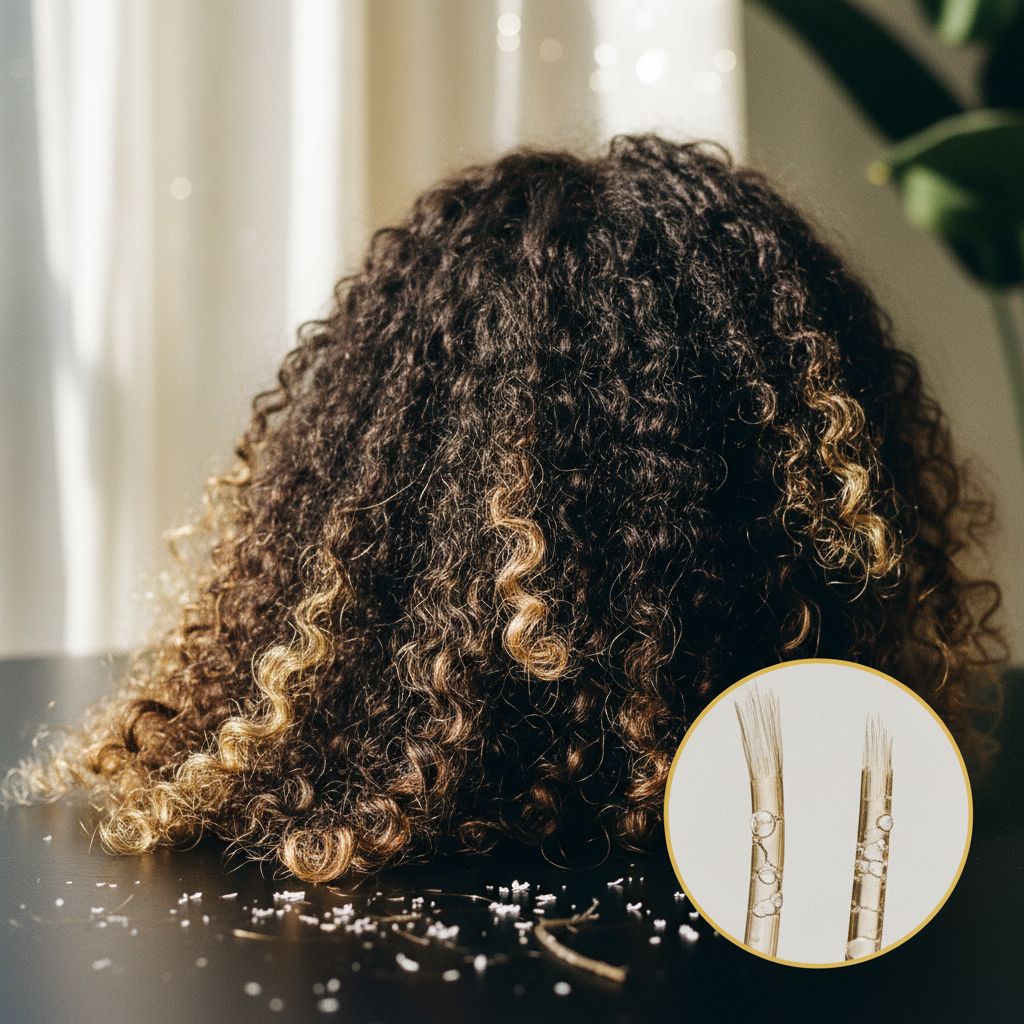
- Gummy or mushy texture when wet: When saturated with water, the hair feels unusually soft, limp, and lacks natural structural resistance.
- Excessive, inelastic stretching: If you gently stretch a small group of wet strands, they stretch far beyond their normal length without snapping back into shape, eventually disintegrating or breaking under minimal tension.
- Loss of natural curl pattern: Wavy, curly, and coily hair loses definition, appearing loose, stringy, and dull even when wet.
- Extreme frizz upon drying: As the lifted cuticles dry out, the hair flares outward, resulting in rough, matte frizz that resists smoothing.
- Mid-shaft snapping: Small, fragmented pieces of hair shed onto clothing or sinks without a white bulb at the end, confirming structural shaft breakage rather than telogen shedding.
Hygral fatigue vs protein overload
A frequent diagnostic challenge in hair care is differentiating between hygral fatigue and protein overload. Both conditions cause breakage, but they require opposite corrective measures.
| Characteristic | Hygral Fatigue | Protein Overload |
|---|---|---|
| Primary cause | Excessive water absorption, prolonged wetness | Excessive keratin, collagen, or wheat protein deposition |
| Wet feel | Mushy, limp, slippery, excessively soft | Stiff, rough, straw-like, tangled |
| Wet elasticity | Stretches excessively without returning, then snaps | Minimal to zero stretch, snaps instantly |
| Fibre state | Protein deficient, depleted lipid membrane | Keratin saturated, dehydrated, brittle |
| Dry texture | Fluffy, limp, shapeless frizz | Coarse, wire-like, unmanageable stiffness |
| Primary remedy | Hydrolysed protein, acidic rinses, sealing oils | Deep moisturising, clarifying, protein cessation |
What the evidence does not show
The term hygral fatigue has become widely used across online hair communities, but it is important to distinguish established science from common misconceptions:
- It does not cause scalp alopecia: Hygral fatigue does not affect the dermal papilla, follicular stem cells, or cellular turnover. It cannot cause pattern baldness, alopecia areata, or telogen effluvium.
- It does not happen from standard washing alone: Washing your hair daily with a balanced shampoo and conditioner does not cause hygral fatigue if the hair is allowed to dry within a reasonable window. The phenomenon requires prolonged immersion, extreme cuticle porosity, or repeated overnight wet styling.
- Water is not a toxin: Hydration is essential for hair flexibility. The issue is not the presence of water, but the absence of structural lipids and intact cuticles that regulate moisture flux.
What you can do to prevent and reverse damage
Reversing hygral fatigue requires reinforcing the internal protein structure and rebuilding the protective outer lipid layer to reduce water intake.
- Shorten wet time: Do not leave your hair wet for hours. Never sleep in wet hair or wear deep conditioning treatments overnight. Gently squeeze excess water out with a microfibre towel and diffuse or dry on low to medium heat.
- Apply hydrolysed proteins: Small-chain hydrolysed keratin, silk, or wheat proteins can penetrate the outer cortex and temporarily fill structural voids, restoring internal tensile strength.
- Use coconut or penetrating oils pre-wash: Studies show that lauric acid in coconut oil has a high affinity for hair proteins and a low molecular weight. Applying it as a pre-shampoo treatment reduces water absorption by up to 20 percent, directly shielding the cortex from rapid swelling.
- Lower the pH: Formulations with a pH between 4.5 and 5.5 help contract the cuticle layer, tightening the scales against the shaft and preventing uncontrolled water ingress.
- Incorporate ceramides: Ceramides and plant oils rich in fatty acids replenish the cell membrane complex, restoring cuticle cohesion.
Supporting hair density and scalp health with Watermans
While addressing the physical mechanics of hygral fatigue on the hair shaft, maintaining a robust scalp environment remains essential for healthy new growth. Watermans Grow Me shampoo provides a targeted, sulphate-free cleanse that avoids stripping essential surface lipids from vulnerable lengths while delivering biotin, rosemary, caffeine, and hydrolysed lupin protein to support fuller-looking hair. Pairing this with Watermans Condition Me conditioner provides cholesterol and niacinamide, strengthening fibre resistance and smoothing the cuticle without weighing limp strands down.
When the cause may be something else
If your hair is breaking, shedding, or changing texture, hygral fatigue may only be part of the picture. Other contributing factors include:
- Chemical processing: High-lift bleaching, permanent waving, and relaxers dissolve disulphide bonds and destroy the protective 18-MEA layer, mimicking or compounding hygral fatigue symptoms.
- Heat styling: Temperatures above 180 degrees Celsius convert moisture inside the cortex into steam, creating sub-surface vacuoles (bubble hair) that lead to immediate fracture.
- Hard water build-up: High concentrations of calcium and magnesium react with sebum to form insoluble mineral deposits on the shaft, making hair feel brittle and stiff.
- Nutritional or systemic shedding: If you notice sudden, diffuse shedding with white bulbs attached to the roots, consult a GP or dermatologist to evaluate ferritin, thyroid function, or recent acute stressors.
Frequently asked questions about How Hygral Fatigue Damages Hair
Can hygral fatigue cause permanent hair loss?
No. Hygral fatigue affects only the non-living hair shaft. It causes mid-shaft snapping and split ends, which can reduce visible hair density and length retention, but it has no impact on follicular hair production or permanent growth cycles.
How quickly does hygral fatigue happen?
Hygral fatigue typically develops over several weeks or months of repeated excessive water exposure. It most commonly occurs when people frequently leave deep conditioners on overnight, practice daily co-washing without protein, or swim regularly without protective barriers.
Can low-porosity hair experience hygral fatigue?
Yes, but it is less common. Low-porosity hair has tightly sealed cuticles that resist water absorption. However, if low-porosity hair is repeatedly subjected to heat-assisted conditioning, prolonged soaking, or alkaline cleansers, the cuticles lift, eventually leaving it susceptible to the same swelling damage.
Does hygral fatigue damage all hair types equally?
Afro-textured, curly, and bleached hair are far more vulnerable to how hygral fatigue damages hair. Curly fibres naturally have elliptical cross-sections with inherent points of structural weakness, and bleached hair lacks the hydrophobic 18-MEA lipid layer, allowing rapid, unhindered water absorption.
How do I fix mushy, over-moisturised hair quickly?
Begin by clarifying your hair with a gentle sulphate-free cleanser to remove heavy conditioning films. Follow with a targeted hydrolysed protein reconstructor, rinse with cool water, and apply an acidic leave-in product (pH 4.5 to 5.5). Allow your hair to dry thoroughly using low heat rather than air-drying.
Managing fibre integrity and long-term hair health
Mastering the balance between protein strength and moisture flexibility is essential for healthy, resilient hair. By understanding how hygral fatigue damages hair, stylists and consumers can avoid over-soaking practices that compromise the cell membrane complex and cuticle alignment. Prioritising controlled drying times, lipid replenishment, and balanced cleansing ensures the hair fibre retains its tensile resilience and shine without succumbing to preventable breakage.
Sources and references
- Journal of Cosmetic Science: "Secondary ion mass spectrometric investigation of the penetration of coconut and mineral oils into human hair fibres" (2001).
- International Journal of Trichology: "Hair Cosmetics: An Overview" (2015).
- Journal of the Society of Cosmetic Chemists: "The mechanical properties of hair" (1983).
- British Journal of Dermatology: "Structural changes in human hair keratin induced by cosmetic treatments" (2004).
Find these ingredients in Watermans products
- Biotin: you will find this ingredient in our Hair Growth Shampoo.
- Niacinamide: you will find this ingredient in our Hair Mask.