How to Choose the Right Hairbrush: A Science-Based Guide
9 min read ·
Learn how to choose the right hairbrush for your hair type, curl pattern, and diameter to prevent mechanical cuticle damage and breakage based on cosmetic science.
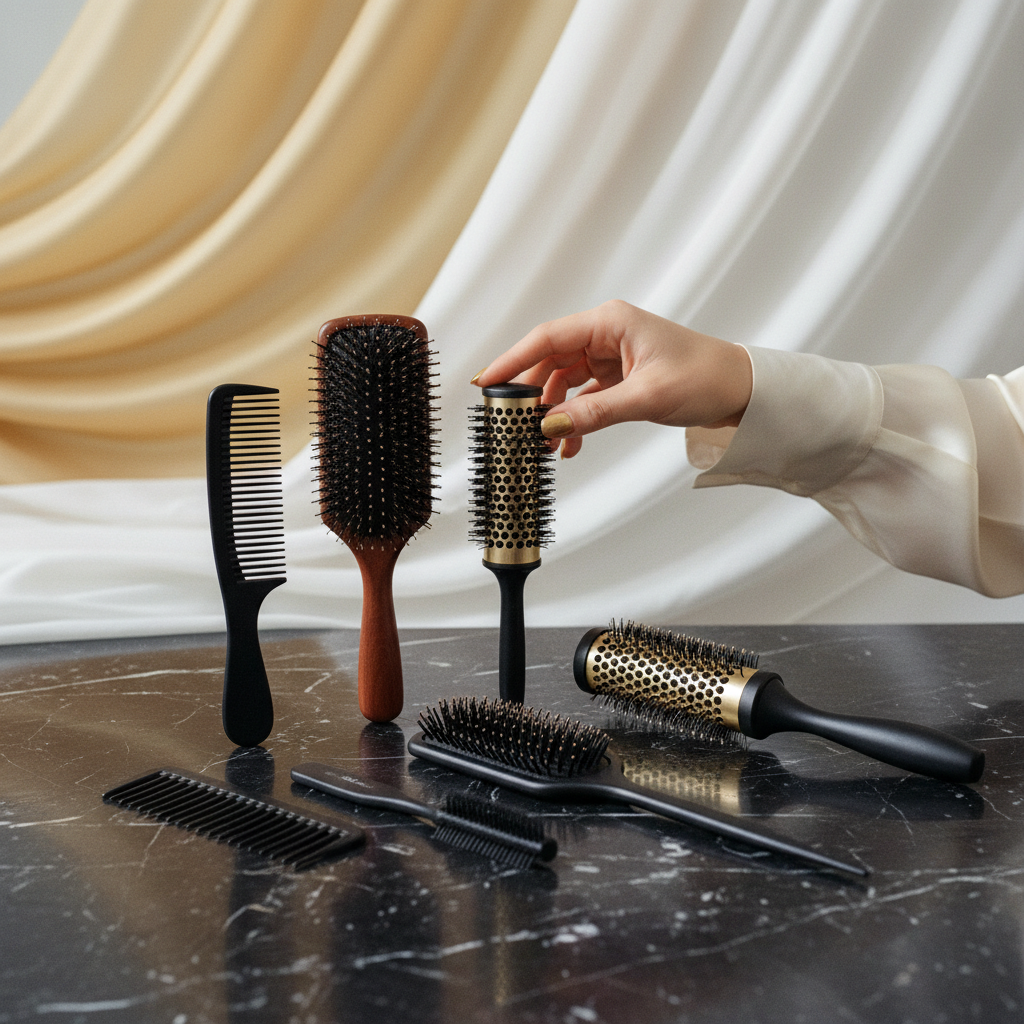
Quick answer: Learning how to choose the right hairbrush requires matching your hair diameter, curl pattern, and scalp sensitivity to bristle density, material, and base construction. Fine or thinning hair needs soft natural bristles or flexible pins to prevent mechanical cuticle damage, while dense curls require wide-spaced, seamless synthetic teeth. While knowing how to choose the right hairbrush significantly reduces mechanical breakage along the hair shaft, it cannot alter biological hair growth cycles or stop follicle-level hair loss such as androgenetic alopecia.
Key takeaways
- Bristle material dictates friction: natural boar bristles redistribute scalp sebum along straight-to-wavy fibres, while smooth nylon or carbon pins prevent snagging on textured or fragile hair.
- Base construction alters tension: cushioned pads yield under pressure to protect delicate scalps, whereas vented or ceramic barrels speed heat styling by allowing airflow.
- Mechanical breakage is not follicular hair loss; brushing with improper tools snaps the hair shaft but does not cause telogen effluvium or pattern baldness.
- Detangling must begin at the ends and work upward toward the roots, preferably using wide-spaced, seamless teeth on damp hair coated with slip-enhancing conditioner.
- Routine sanitisation is essential: sebum, dead skin cells, and product residues accumulate on bristle beds, creating reservoirs for microbial growth that can irritate the scalp.
How to Choose the Right Hairbrush: what the evidence shows
Learning how to choose the right hairbrush begins with understanding the tribological properties of hair. Tribology is the study of friction, lubrication, and wear between interacting surfaces. When a brush passes through your hair, it exerts shear stress across the cuticle, the outermost layer of overlapping keratin scales. A 2007 study published in the Journal of Cosmetic Science demonstrated that repeated combing and brushing wear down the cuticular scale edges, eventually leading to cuticle loss, cortical exposure, and transverse shaft fracture, commonly known as breakage.
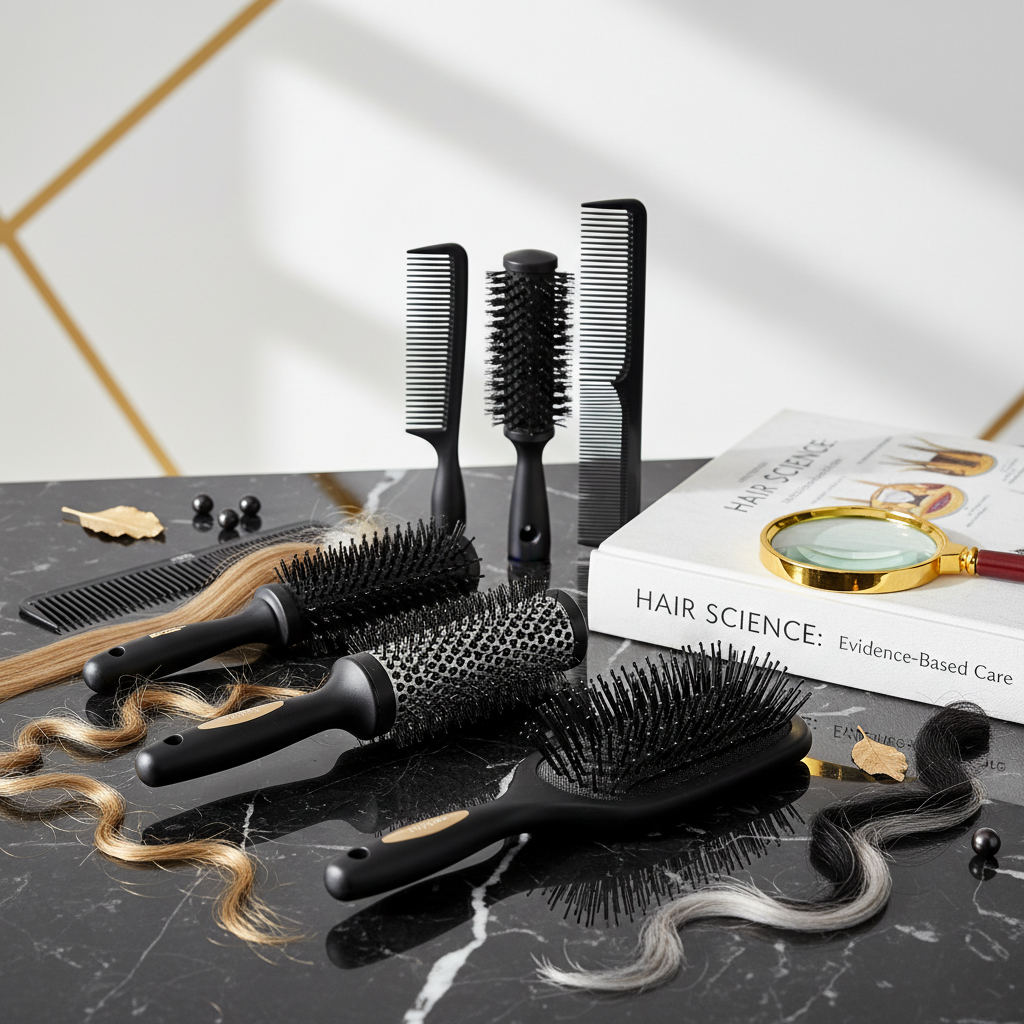
Your choice of tool dictates how much mechanical energy transfers into the hair fibre. Fine hair fibres measure roughly 50 micrometres in diameter, possessing fewer cortical cells and a thinner cuticle barrier than coarse fibres, which can exceed 100 micrometres. Brushes with stiff, closely packed bristles apply excessive pull force to fine strands. When that tension exceeds the fibre's tensile strength (approximately 150 to 200 grams of force for healthy dry hair), the shaft snaps.
Furthermore, hair diameter and texture change how sebum moves. Sebaceous glands secrete natural triglycerides, wax esters, and squalene to coat the hair fibre. On straight hair (type 1), gravity and capillary action allow oils to migrate downward, a process enhanced by natural boar bristles. On curly, coily, or afro-textured hair (types 3 and 4), the elliptical cross-section and angular bends create natural points of friction, blocking sebum migration. Using dense boar bristles on dry type 4 hair generates severe shear stress, causing rapid mechanical breakage. Textured hair requires smooth, flexible, widely spaced synthetic bristles that glide through twists without snagging.
+------------------+------------------------+---------------------+-------------------------------+
| Hair Type | Recommended Brush Type | Bristle Material | Primary Benefit |
+------------------+------------------------+---------------------+-------------------------------+
| Fine or Thinning | Cushioned paddle | Soft boar or | Minimises shear stress, |
| | | flexible thin nylon | protects delicate cuticles |
+------------------+------------------------+---------------------+-------------------------------+
| Straight, Medium | Classic styling or | Boar and nylon mix | Distributes natural oils, |
| | oval flat brush | | provides moderate tension |
+------------------+------------------------+---------------------+-------------------------------+
| Wavy (Type 2) | Wide paddle or vented | Ball-tipped nylon | Detangles without flattening |
| | | or flexible plastic | natural wave pattern |
+------------------+------------------------+---------------------+-------------------------------+
| Curly (Type 3) | Flexible detangler or | Widely spaced, | Separates clumps, reduces |
| | modified row brush | seamless nylon pins | knotting when conditioned |
+------------------+------------------------+---------------------+-------------------------------+
| Coily (Type 4) | Wide-tooth comb or | Ultra-flexible, | Glides through tight coils, |
| | dynamic flexi-brush | joint-free polymers | prevents catastrophic tension |
+------------------+------------------------+---------------------+-------------------------------+
| Blow-Drying | Ceramic vented radial | Heat-resistant | Maximises airflow, speeds |
| | or round brush | ionic nylon | moisture evaporation safely |
+------------------+------------------------+---------------------+-------------------------------+
Anatomy of a hairbrush: materials and designs
Evaluating brush components allows you to make an informed decision based on your hair's physical architecture.
Bristle materials
- Natural boar bristles: These contain microscopic scales that mirror human hair cuticles. They excel at lifting dust and distributing sebum along the shaft. However, their density makes them unsuitable for detangling dense knots or coarse textures.
- Nylon and synthetic pins: Synthetically engineered bristles offer controlled flexibility, uniform smooth surfaces, and high heat tolerance. Rounded or ball-tipped nylon pins protect the scalp skin from abrasion. If the protective ball breaks off, the remaining sharp plastic edge will slice the hair cuticle.
- Hybrid bristles: Combining boar bristles with longer nylon pins gives you the sebum-distributing benefits of natural hair alongside the penetrative detangling power of synthetic pins. This combination works best on medium-to-thick straight or wavy hair.
Cushioning and base mechanics
Pneumatic cushioned bases feature an air pocket beneath a rubber or silicone membrane, usually with a single ventilation hole. When you strike a dense knot, the cushion compresses, relieving pressure from the hair shaft and scalp. Solid wooden or plastic bases provide rigid use, which increases tension during blow-drying or smoothing but raises the risk of snapping fragile hair if used for detangling.
Barrel shape and airflow
Flat paddle brushes provide a wide surface area for smoothing long lengths quickly. Cylindrical radial brushes create tension and curl during thermal styling; wooden barrels retain gentle heat, while tourmaline or ceramic-coated aluminium barrels radiate heat evenly to set styles. Vented brushes feature open slots across the body, letting blow-dryer air pass directly through the hair bundle to speed drying and prevent localised thermal hot spots.
What the evidence does not show
There is no scientific basis for the historic advice to brush your hair with 100 strokes every night. Research conducted at the Princeton-based Textile Research Institute established that mechanical brushing creates cumulative surface abrasion. Brushing 100 times daily accelerates outer cuticle loss, strips away the protective 18-methyleicosanoic acid (18-MEA) lipid layer, and increases split ends. Brushing should be used purely for detangling, styling, and light scalp grooming, never as an endurance ritual.
Similarly, brushing cannot treat follicular hair loss, reverse male or female pattern baldness, or awaken dormant follicles. While vigorous brushing increases superficial cutaneous blood flow to the scalp temporarily, there is no controlled clinical evidence demonstrating that this transient microcirculation stimulates new hair growth or counters dihydrotestosterone (DHT) activity. Excessive brushing on thinning hair merely causes traction and mechanical breakage, making the hair look thinner.
Signs your current brush is damaging your hair
Recognising the physical signs of brush-induced trauma prevents long-term fibre degradation:
- Short, white-tipped hairs on your clothes: If the hairs falling during brushing lack a small white bulb at the root end, they are broken fibre pieces, not naturally shed telogen hairs.
- Increased split ends (trichoptilosis): High-friction bristles strip cuticles and cause cortical fibres to separate at the ends or along mid-lengths.
- Snapping noises during detangling: Audible clicking or snapping indicates you are exceeding the elastic limit of the keratin cortex, causing permanent fibre rupture.
- Scalp soreness or erythema: Scratched, red, or tender scalp skin points to sharp bristle seams, missing protective ball tips, or excessive downward pressure.
- Frizz immediately following brushing: Brushes that generate electrostatic charge lift the cuticles, forcing fibres to repel one another and creating surface frizz.
How to detangle correctly: technique matters
The best brush will still damage hair if used with incorrect mechanical technique. Wet hair behaves differently to dry hair: water penetrates the cortex, breaking temporary hydrogen bonds and increasing the fibre's elongation capacity by up to 30 to 50 percent, but reducing its breaking threshold.
- Apply slip first: Never detangle dry curly or coily hair, and avoid detangling completely dry, damaged hair. Apply a leave-in conditioner, hair oil, or detangling mist containing silicones, fatty alcohols, or plant oils to lower inter-fibre friction.
- Work from bottom to top: Section the hair into four manageable quadrants. Begin brushing the bottom two inches. Once free of tangles, move up another two inches and brush down through the cleared section. Never drag a brush straight from the scalp down through tangled lengths.
- Control your speed and angle: Brush with slow, deliberate strokes. Holding the brush vertically (pins aligned in columns) creates less resistance through the hair than holding it horizontally (pins aligned in rows), which presents a dense wall to tangles.
When shedding or thinning is caused by something else
If you notice excessive hair collecting in your brush, it is crucial to separate fibre breakage from systemic hair shedding. A healthy human scalp sheds 50 to 100 telogen hairs each day as part of the natural hair cycle. In these hairs, you will see a tiny, solid white bulb at the proximal end.
If you observe diffuse shedding of intact hairs across the entire scalp, the underlying trigger is often physiological rather than mechanical. Telogen effluvium can occur following severe physical illness, hormonal shifts, nutritional deficiencies (such as ferritin or vitamin D), thyroid disorders, or intense psychological stress. Localised thinning along the crown, frontal hairline, or temples usually reflects androgenetic alopecia. Changing your hairbrush will not resolve these conditions. If shed hairs display root bulbs, shedding persists beyond eight weeks, or you notice patchy bald spots, consult a trichologist, dermatologist, or your GP.
Supporting hair strength with Watermans
Reducing hair breakage requires a two-sided approach: minimising external friction with the right brush and reinforcing the hair's surface environment. Watermans products are formulated to support the feel, manageability, and cosmetic resilience of strands vulnerable to mechanical stress.
Using Watermans GrowMe Shampoo delivers moisture and scalp-cleansing agents, including biotin, rosemary, caffeine, and niacinamide, creating a balanced surface for hair to thrive. Pair this with Watermans ConditionMe Conditioner, which infuses hydrolysed lupin protein and natural oils to smooth the outer cuticle scales. Smoothing the cuticle reduces the friction coefficient between individual strands and brush bristles, allowing your chosen tool to glide easily and reducing breakage during daily styling.
Frequently asked questions about How to Choose the Right Hairbrush
What is the most important factor in how to choose the right hairbrush?
The single most important factor is matching the bristle material and spacing to your hair fibre diameter and curl pattern. Fine or brittle hair requires flexible, soft bristles to prevent cuticle erosion, while dense, tightly curled hair needs widely spaced, smooth synthetic pins to navigate coils without causing high-tension breakage.
Should I use a different hairbrush on wet hair versus dry hair?
Yes. Wet hair is structurally vulnerable because water weakens the cortex's hydrogen bonds, allowing the fibre to stretch and snap under less tension. On wet hair, use a dedicated wet detangler with flexible, widely spaced teeth and plenty of conditioner slip. Save dense boar bristle or rigid styling brushes exclusively for dry hair.
How often should I clean and sanitise my hairbrush?
You should remove trapped shed hair after every two to three uses and wash the brush thoroughly every two weeks. Soak plastic and synthetic brushes in warm water with a clarifying shampoo to dissolve sebum, dead skin cells, and product residue. Wooden brushes and natural boar bristles should be washed briefly without submerging the wooden base, then laid bristle-side down to air-dry.
Can choosing the wrong hairbrush cause permanent hair loss?
No, a brush cannot cause permanent follicular hair loss or pattern baldness unless used with such extreme, continuous traction that it triggers traction alopecia. However, an abrasive brush will snap the hair shaft along its length, creating thinning, frizzy, split ends that mimic the visual appearance of reduced hair volume.
Are wooden combs better than plastic or nylon brushes?
High-quality, seamless wooden combs generate less static electricity than cheap moulded plastic brushes, which often have microscopic raised seams that cut hair cuticles. However, high-grade, seamless nylon brushes with flexible cushioned pads offer superior shock absorption compared to rigid wooden combs when working through stubborn tangles.
Summary
Mastering how to choose the right hairbrush comes down to matching your hair's unique tensile resilience, diameter, and curl pattern with the proper bristle composition and mechanical base. By selecting smooth, flexible materials that respect the hair cuticle and abandoning outdated, abrasive brushing rituals, you can minimise mechanical breakage and protect the long-term structural integrity of your hair.
Sources and references
- Journal of Cosmetic Science: Hair breakage: brushing and combing interactions and cuticle damage, 2007.
- British Journal of Dermatology: The physical properties of human hair fibres and the effect of grooming, 2012.
- International Journal of Trichology: Hair cosmetics: An overview, 2015.
- Clinical and Experimental Dermatology: Telogen effluvium: a review of science and clinical management, 2020.
Find these ingredients in Watermans products
- Biotin: you will find this ingredient in our Hair Growth Shampoo.
- Vitamin D: you will find this ingredient in our Hair Vitamins.
- Niacinamide: you will find this ingredient in our Hair Mask.