High Porosity Hair Care Guide: Structural Causes and Routine Solutions
9 min read ·
Explore this High Porosity Hair Care Guide to understand cuticle damage, moisture loss, and evidence-based routines using proteins and acidic pH balancing.
Quick answer: A comprehensive High Porosity Hair Care Guide focuses on managing a hair cuticle layer that is lifted, chipped, or structurally compromised. High porosity hair absorbs moisture rapidly but loses it just as fast, leading to chronic dryness, tangling, and mechanical breakage. The primary limitation to understand is that topical haircare cannot permanently rebuild damaged cuticle tiles. Instead, targeted care relies on acidic pH balancing, hydrolysed proteins, and rich occlusive sealing to temporarily fortify the fibre and slow moisture loss.
Key takeaways
- High porosity hair features gaps, tears, or raised scales in the protective outer cuticle layer.
- Water passes easily into the hair shaft, but internal hydration evaporates rapidly, causing chronic dryness.
- Chemical treatments (bleaching, relaxing), excessive heat styling, UV radiation, and genetics all cause high porosity.
- Acidic formulations (pH 4.5 to 5.5) help contract the cuticle layer and smooth the fibre surface.
- Hydrolysed proteins offer temporary reinforcement by lodging in cuticle fissures to reduce mechanical snapping.
- Hair porosity relates strictly to the condition of the hair fibre, not to follicular hair shedding or medical hair loss.
High Porosity Hair Care Guide: what the evidence shows
The scientific study of hair porosity examines how water, lipids, and chemical agents penetrate the hair fibre. In healthy virgin hair, the outermost cuticle consists of roughly 6 to 10 overlapping cellular layers bound by a lipid-rich cell membrane complex. The surface is naturally hydrophobic (water-repelling) due to a covalently bound layer of 18-methyleicosanoic acid (18-MEA).
When hair experiences significant weathering, alkaline lifting, or oxidative damage, this lipid layer degrades. Scanning electron microscopy demonstrates that high porosity hair possesses lifted cuticle edges, fragmented scales, and exposed cortical tissue. This High Porosity Hair Care Guide details how this structural change shifts the hair from hydrophobic to hydrophilic (water-loving).
Because the protective barrier is compromised, high porosity hair acts like an open sponge. It readily absorbs water vapour from humid air, leading to rapid swelling of the cortex and frizz. Conversely, in dry environments, free water evaporates out of the shaft just as quickly, leaving the fibre stiff, dull, and prone to breakage.
Topical interventions cannot permanently knit damaged keratin back together. However, cosmetic chemistry confirms that lower-pH conditioners, film-forming humectants, hydrolysed proteins, and substantive lipids temporarily plug structural gaps, reduce cuticle friction, and retard water transmission.
What the evidence does not show
Porosity is frequently misunderstood in popular haircare circles, leading to several persistent myths:
- Porosity does not dictate hair loss: Cuticle degradation is a hair shaft condition. It causes breakage along the length of the strand. It has no direct influence on follicular miniaturisation, androgenetic alopecia, or telogen effluvium shedding at the scalp level.
- Topical products cannot permanently "seal" or heal cuticles: Once cuticular scales break off, they cannot regenerate. Products containing ceramides or quaternised polymers can mimic lost intercellular cement, but these rinse away over time and require ongoing reapplication.
- The "water glass float test" is scientifically unreliable: Dropping a shed hair into a glass of water to see if it floats or sinks is heavily confounded by surface tension, natural scalp sebum, and styling product residue. It rarely reflects true cuticle integrity.
The biological and chemical mechanisms of high porosity
Hair porosity is dictated by the physical integrity of the cuticle and the cell membrane complex. Under normal conditions, hair swells by roughly 15 to 20 percent in diameter when fully saturated with water. In high porosity hair, damaged cuticle scales allow excessive water to rush into the cortex, causing the fibre to swell past its structural tolerance. This cycle of swelling when wet and shrinking when dry is known as hygral fatigue.
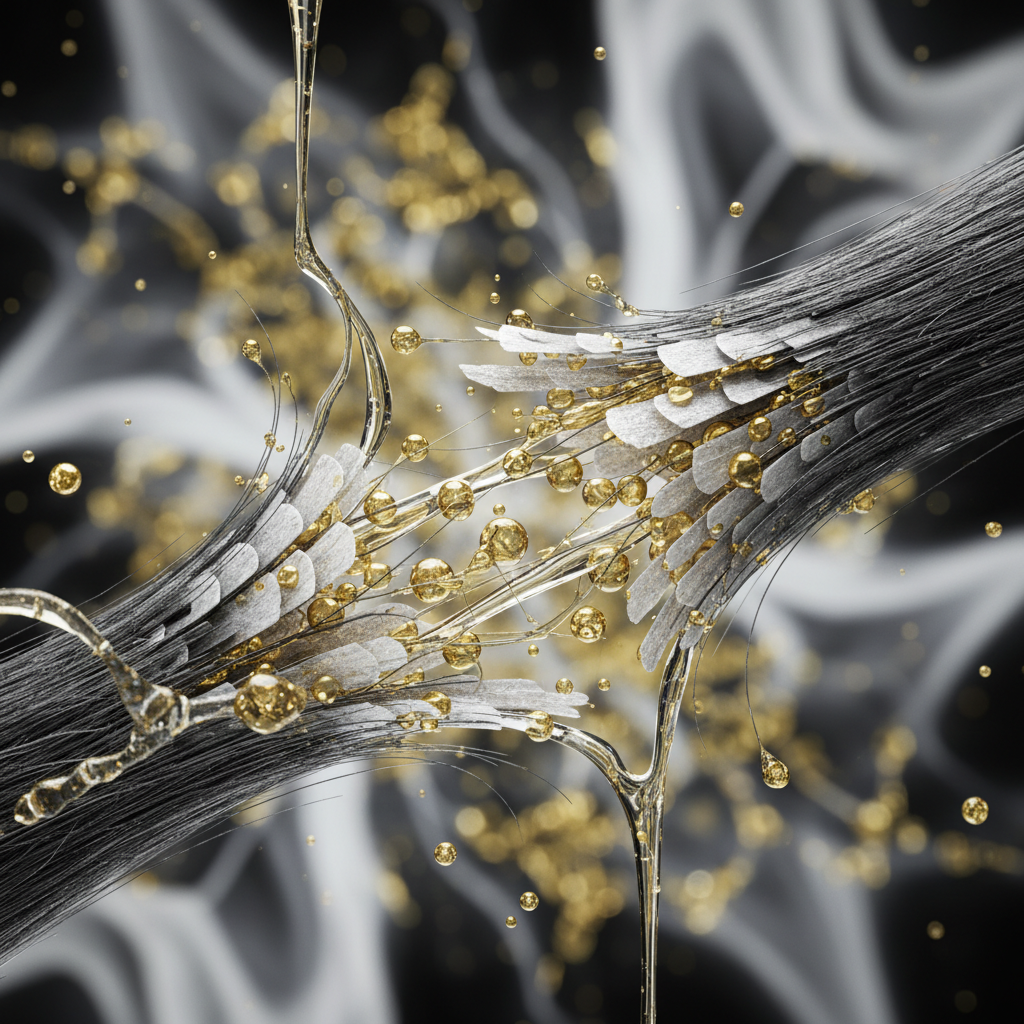
Repeated hygral fatigue strains the cortical keratin chains. As water moves freely back and forth, it washes out water-soluble amino acids and degrades internal salt bonds.
Furthermore, hair fibres carry an electrical charge. Healthy hair has an isoelectric point around pH 3.67. Alkaline chemical processes (such as permanent hair colours at pH 9.0 to 10.5 or relaxers at pH 12.0 to 13.5) raise the negative surface charge of the hair. This electrostatic repulsion forces cuticle scales to fan outward. Without acidic neutralisation and conditioning agents to restore lubricity, the cuticles remain elevated, leaving the hair permanently high in porosity.
Physical signs of high porosity hair
To identify high porosity hair without laboratory equipment, look for the following mechanical and sensory indicators:
- Rapid wetting and rapid drying: Strands become instantly saturated under a shower stream, yet dry to a parched, brittle state in an unusually short window.
- Frequent tangling and matting: Lifted cuticle scales act like tiny barbs. Strands snag against one another, creating persistent friction knots.
- Matte, lustreless appearance: Cuticle scales that do not lay flat cannot reflect light evenly, resulting in a dull surface even when clean.
- High vulnerability to humidity: Hair absorbs atmospheric moisture within minutes of stepping outside, causing instant frizz and loss of styling definition.
- Noticeable breakage: White bulbs are absent from the ends of short shed pieces, indicating the strand snapped along the weakened shaft rather than releasing from the follicle.
| Characteristic | Low Porosity Hair | High Porosity Hair |
|---|---|---|
| Cuticle structure | Tightly bound, overlapping flat scales | Lifted, cracked, or missing scales |
| Water absorption | Slow; water often beads on the surface | Very fast; absorbs immediately |
| Drying time | Prolonged; takes hours to air-dry | Extremely fast air-drying time |
| Elasticity | Normal to resilient | Low; prone to mechanical snapping |
| Feel along shaft | Smooth and glassy when sliding upward | Rough, bumpy, or gritty |
| Primary focus | Heat-assisted penetration, light hydration | Protein reinforcement, heavy occlusives |
Practical steps: managing high porosity hair
Caring for high porosity hair requires a routine that strengthens the cortex, smooths the cuticle layer, and physically slows the loss of moisture.
1. Maintain an acidic pH environment
Shampoos, conditioners, and leave-in products should ideally sit between pH 4.5 and 5.5. Mildly acidic conditions neutralise residual negative charges on the hair surface, helping the cuticle scales lay flatter against the hair shaft. Avoid alkaline soaps or harsh clarifying shampoos unless immediately followed by an intensive acidic conditioning treatment.
2. Incorporate hydrolysed proteins
Because high porosity hair has physical voids in its structure, low molecular weight hydrolysed proteins (such as hydrolysed wheat, silk, or keratin protein) can enter the outer cortex and cuticle fissures. These proteins form temporary hydrogen bonds, supporting tensile strength and reducing mechanical snapping during styling. Balance protein treatments with conditioning emollients to prevent the hair from feeling overly rigid.
3. Layer products using the LOC or LCO method
The Liquid-Oil-Cream (LOC) or Liquid-Cream-Oil (LCO) technique is particularly effective for this hair type:
- Liquid: Water or a water-based leave-in conditioner to supply core hydration.
- Cream: A rich emollient containing fatty alcohols (cetyl, stearyl) to smooth the rough cuticle.
- Oil/Butter: A heavier occlusive lipid (such as shea butter or plant oils) to create a hydrophobic barrier that limits moisture evaporation.
4. Minimise mechanical and thermal stress
Friction is the enemy of lifted cuticles. Detangle hair only when thoroughly lubricated with a high-slip conditioner, using a wide-tooth comb or flexible wet brush starting from the ends upward. Limit the use of heated styling tools. When heat is necessary, keep temperatures below 180 degrees Celsius and always apply a thermal protectant. Sleeping on a satin or silk pillowcase reduces cuticle abrasion overnight.
When the cause may be something else
It is common to confuse high porosity with other hair and scalp issues. If your hair appears thin, dry, or sparse, consider these distinctions:
- Weathering versus thinning: If your hair feels dry and breaks off at the ends, you are dealing with porosity and mechanical wear. If you notice your parting widening or your ponytail circumference shrinking at the scalp, this points toward follicular hair shedding or alopecia, not cuticle damage.
- Hard water mineral buildup: High levels of calcium and magnesium in domestic tap water can coat the hair fibre, leaving it feeling stiff, rough, and dry. This mineral crust can mimic the rough texture of high porosity hair. In such cases, a chelating shampoo is needed to strip the mineral film rather than extra protein treatments.
- Natural hair texture: Coarse, tightly coiled afro hair has natural elliptical bends along the fibre where cuticle scales naturally lift slightly. This is structural, not necessarily a sign of chemical damage.
Supporting hair condition: Watermans
When managing high porosity hair, overall fibre resilience and a balanced scalp environment are essential. Watermans focuses on evidence-led hair and scalp formulations designed to keep hair looking healthy, strong, and full of body.
Using gentle, sulphate-free cleansers alongside nutrient-dense conditioning agents can help reduce wash-day friction for delicate, high-porosity strands. By prioritising ingredients that care for both the scalp microbiome and the hair fibre, you establish an optimal foundation to minimise routine breakage and support everyday strand vitality.
When to get professional advice
Consult a qualified trichologist or dermatologist if you experience sudden, diffuse hair shedding (more than 100 to 150 hairs daily with intact roots), bald patches, scalp redness, itching, or painful inflammation. While high porosity hair can be managed using the steps in this High Porosity Hair Care Guide, true follicular disorders require clinical assessment and targeted medical intervention rather than cosmetic adjustments.
Frequently asked questions about High Porosity Hair Care Guide
Can high porosity hair be permanently reversed?
No. Once the cuticle scales are chipped, torn, or stripped away by chemical or physical damage, the hair fibre cannot biologically regrow or heal itself. This High Porosity Hair Care Guide highlights that all treatments, including hydrolysed proteins and occlusive sealing oils, provide temporary cosmetic support that must be maintained through consistent care until new, undamaged hair grows from the root.
How often should high porosity hair receive protein treatments?
Most high porosity hair responds well to protein treatments every 2 to 4 weeks. If the hair feels mushy, overly stretchy, or lifeless when wet, it often benefits from hydrolysed protein. However, if strands start to feel stiff, dry, or brittle, discontinue protein applications temporarily and focus purely on moisturising, emollient conditioners to restore balance.
Does cold water really close high porosity cuticles?
Cold water has a negligible effect on closing hair cuticles. The physical movement of the cuticle layer is primarily driven by pH and moisture, not temperature. While a cool rinse will not harm the hair and can help preserve styling smoothness, using an acidic conditioner (pH 4.5 to 5.5) is the scientifically verified method to contract cuticle scales.
Is coconut oil suitable for high porosity hair?
Coconut oil has a high affinity for hair proteins and a low molecular weight, allowing it to penetrate inside the hair cortex. While this can reduce protein loss during washing, some high porosity hair finds pure coconut oil leaves strands feeling brittle or stiff. Many people achieve better results using it as an overnight pre-shampoo treatment rather than a leave-in styler.
Managing your hair with confidence
Understanding hair porosity transforms how you approach everyday styling and product selection. By recognising that high porosity stems from a lifted or depleted cuticle layer, you can move away from aggressive habits and adopt supportive routines. Use this High Porosity Hair Care Guide to balance gentle acidic cleansing, fortifying proteins, and protective sealants, giving compromised strands the strength, smoothness, and moisture retention they need to thrive.
Sources and references
- Robbins, C. R. (2012). Chemical and Physical Behavior of Human Hair. 5th ed. Springer-Verlag.
- Davis-Sivasothy, A. (2011). The Science of Black Hair: A Comprehensive Guide to Textured Hair Care. S逸 Press.
- Swift, J. A. (1999). Human hair cuticle: mechanically robust or easily damaged? Journal of Cosmetic Science, 50(4), 241-247.
- Evans, T., & Wickett, R. R. (2012). Practical Modern Hair Science. Allured Business Media.
- Cruz, C. F., et al. (2016). Human hair characteristics and methods to investigate hair physical properties. International Journal of Trichology, 8(3), 110-120.
Find these ingredients in Watermans products
- Shea Butter: you will find this ingredient in our Curly Hair Conditioner.