Heat Damage and Thermal Protection Mechanics: An Evidence-Based Guide
8 min read ·
Understand heat damage and thermal protection mechanics, how high temperatures break down hair keratin, and how protective sprays reduce structural breakage.
Quick answer: Understanding Heat Damage and Thermal Protection Mechanics reveals how high temperatures physically alter hair keratins and moisture levels. Heat from styling tools degrades structural alpha-keratin into disordered beta-keratin, melts surface lipids, and vaporises internal moisture, causing irreversible fibre breakage. Thermal protectants cannot block 100 percent of heat; instead, their mechanics rely on distributing thermal energy, slowing heat transfer rates, and smoothing cuticle scales to reduce friction. While protective sprays significantly mitigate damage, they cannot make hair impervious to excessive temperatures.
Key takeaways
- Structural damage begins around 140°C with moisture loss and cuticle cracking, while direct protein denaturation accelerates above 190°C.
- Wet or damp hair subjected to heated tools risks "bubble hair", a phenomenon where internal moisture rapidly boils and forms microscopic structural voids.
- Thermal protectants function by conducting heat evenly, providing a sacrificial insulating barrier, and reducing mechanical friction from hot plates.
- Silicone polymers, hydrolysed proteins, and conditioning agents typically reduce thermal degradation by roughly 30 to 50 percent, but cannot prevent it entirely.
- True heat damage is irreversible structural breakage along the fibre shaft; it does not constitute follicular hair loss.
Heat Damage and Thermal Protection Mechanics: what the evidence shows
Scientific research into Heat Damage and Thermal Protection Mechanics shows that thermal styling fundamentally reshapes the cortex and cuticle. The hair fibre is primarily composed of alpha-helical keratin proteins embedded in an amorphous matrix of high-sulfur proteins. When you apply temperatures above 140°C, the hair loses free and bound water. Once temperatures climb toward 190°C to 230°C, the alpha-keratin helix physically denatures, transitioning into a permanently disordered beta-sheet configuration.
This protein denaturation permanently weakens tensile strength. Surface lipids, specifically 18-methyleicosanoic acid (18-MEA), are stripped away by heat and oxidation. This loss increases surface friction and makes the cuticles lift, chip, and peel.
Thermal protectants mitigate this by intervening in heat transfer kinetics. Polymers such as dimethicone, amodimethicone, and polyquaternium compounds have lower thermal conductivity than bare protein fibres. By coating the shaft, they slow down heat absorption, prevent local hot-spots, and seal moisture against flash evaporation.
Thermal Exposure -> Moisture Evaporation -> Lipid Stripping -> Keratin Unfolding -> Fibre Fracture
What the evidence does not show
Controlled cosmetic trials do not show that any thermal spray provides total immunity from heat. Marketing claims suggesting you can iron your hair at 230°C without harm as long as you use a serum are unsupported by hair science. Every thermal cycle exerts cumulative wear on protein bonds.
Furthermore, thermal damage does not cause follicular hair loss or alopecia. Heat tools snap hair fibres along the shaft, which represents physical breakage, not shedding from the root. Unless a heated tool physically burns the scalp skin and induces scarring, heat styling does not affect follicular cycling or cause telogen effluvium.
The physical mechanisms of heat degradation
Heat compromises the hair fibre across three distinct structural zones:
1. Cuticle breakdown and lipid degradation
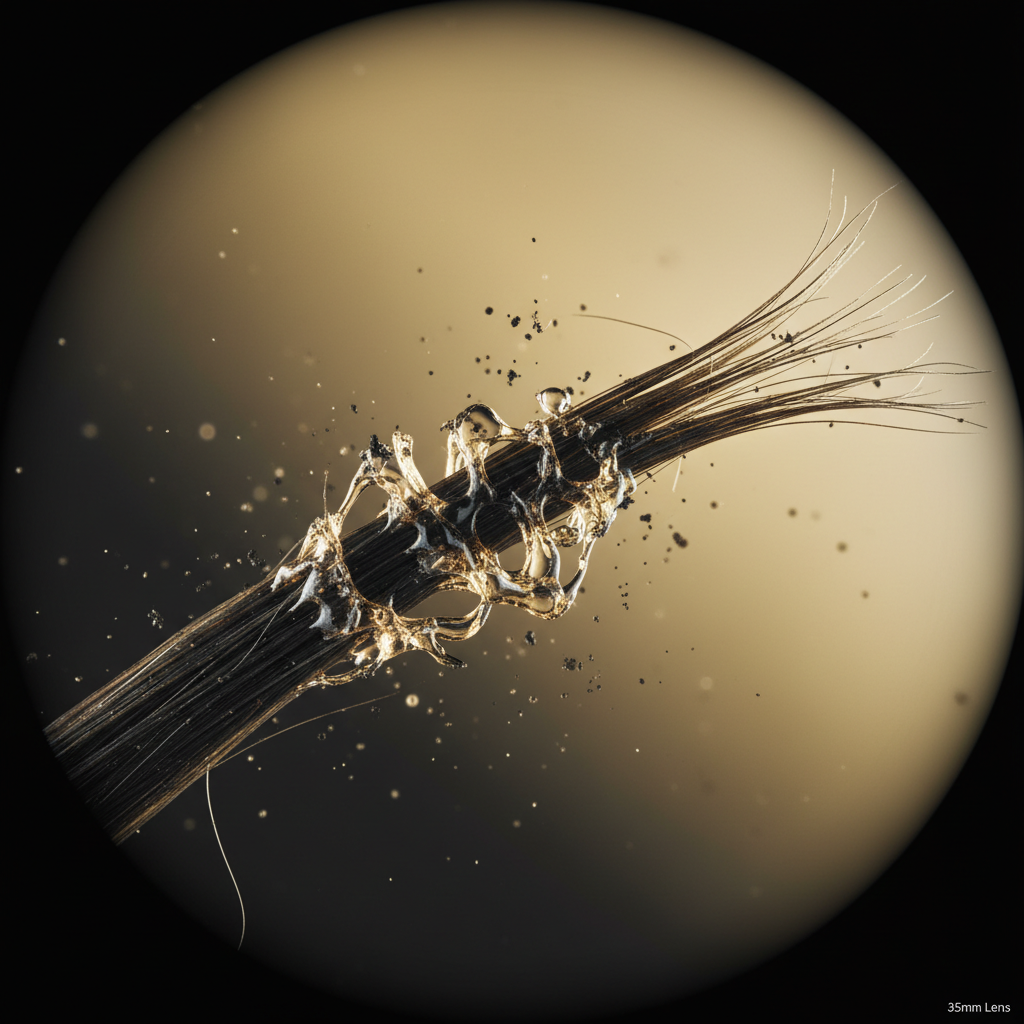
The epicuticle contains a bound lipid layer composed of 18-MEA, which gives virgin hair its natural hydrophobicity and low-friction glide. Temperatures above 150°C oxidise and erode this lipid barrier. Without it, the cuticle scales lift, curl at the edges, and become brittle. This leads to snagging, split ends, and rapid moisture loss.
2. Cortical protein denaturation
The cortex provides hair with its elasticity, tensile strength, and curl pattern. The crystalline alpha-helical keratins melt and denature between 215°C and 235°C in dry hair. In chemically treated or bleached hair, this threshold drops significantly, often starting below 180°C. Once the cortex denatures, the internal matrix loses elasticity, resulting in limp fibres that stretch and snap under minimal tension.
3. Rapid moisture vaporisation ("Bubble hair")
When flat irons or curling wands clamp onto damp hair, trapped water within the cortex instantly vaporises. Steam occupies roughly 1,600 times the volume of liquid water. This sudden expansion creates microscopic cavities or bubbles within the cortex, an acquired deformity known as pili gemini or bubble hair. These hollow pockets create severe weak points where the fibre fractures cleanly.
| Temperature Range | Physical Effect on Hair Fibre | Reversibility |
|---|---|---|
| Below 140°C | Temporary hydrogen bond rearrangement; minor surface dehydration | Fully reversible with conditioning |
| 140°C to 180°C | Loss of bound water; lifting of cuticle edges; lipid degradation | Irreversible surface wear |
| 180°C to 210°C | Tryptophan oxidation; disulfide bond stress; melanin degradation | Irreversible protein damage |
| 210°C to 235°C | Alpha-keratin denatures into beta-keratin; cortex melting | Irreversible structural breakdown |
| Wet hair at 100°C+ | Instantaneous steam expansion creating cortical bubbles ("bubble hair") | Irreversible physical fracturing |
How thermal protectants function
Thermal protective formulations rely on four main physical mechanics:
- Lowering thermal conductivity: Film-forming polymers disperse heat across the surface rather than allowing it to penetrate instantaneously into the cortex.
- Heat redistribution: Silicones like amodimethicone and dimethicone create a uniform barrier that prevents concentrated hot spots from heating plates.
- Surface lubricity: Lowering the coefficient of friction allows hot styling plates to slide smoothly across the hair, minimising mechanical shear forces that rip lifted cuticles.
- Moisture retention: Humectants and conditioning agents provide a sacrificial moisture layer, absorbing initial heat energy through water evaporation before structural keratins take the brunt.
Signs of thermal damage to look for
Thermal damage presents gradually before escalating into severe structural failure. Look for these distinct physical indicators:
- Loss of elasticity: The hair stretches when wet but fails to return to its original shape, snapping instead.
- Altered curl patterns: Wavy and curly hair types often display straight, limp, or frizzy patches that refuse to form cohesive clumps.
- Rough, raspy texture: Sliding fingers upward along a hair shaft feels rough and uneven due to chipped and lifted cuticles.
- Colour fading and brassiness: High heat oxidises both natural melanin and synthetic dyes, causing dark hair to develop a bleached, red-orange cast.
- Mid-shaft split ends: Small white dots along the strand indicate cortical fractures where the fibre has partially snapped.
What you can do to protect your hair
Minimising heat degradation requires adjusting both your styling technique and your product regimen:
- Dry hair completely before high-heat styling: Never use flat irons or curling wands on damp hair. Blow-dry on medium heat until the hair is 100 percent dry before applying direct contact tools.
- Lower your styling temperatures: Keep irons between 150°C and 180°C for fine or colour-treated hair, and never exceed 200°C for thick, coarse textures.
- Apply thermal protectant evenly: Section your hair and mist a silicone or polymer-based thermal protectant throughout, combing it through to ensure every strand is coated.
- Minimise contact time: Move tools smoothly down the shaft without stopping. A single, controlled two-second pass causes far less thermal strain than multiple slow passes over the same section.
- Incorporate structural conditioning: Use targeted masks containing hydrolysed wheat or pea proteins and conditioning lipids to temporarily fill fissures in the cuticle.
When the cause may be something else
If your hair is breaking or thinning rapidly, thermal styling might only be part of the equation. Chemical processing, such as bleaching, permanent waving, or chemical relaxing, cleaves disulfide bonds and drastically lowers the hair's thermal resistance.
True shedding from the scalp, marked by full-length hairs with white bulbs at the end, points to physiological changes like telogen effluvium, hormonal shifts, nutritional deficiencies, or pattern hair loss. Thermal styling causes snapped fragments without bulbs. If you notice wide partings, receding temples, or increased scalp visibility, you are observing follicular shedding rather than heat breakage.
When to seek professional advice
Consult a qualified trichologist or dermatologist if you experience sudden, widespread hair shedding, persistent scalp irritation, burning sensations, or bald patches. If your hair is severely heat-damaged, a professional salon stylist can trim away irreversible split ends and recommend structured bond-building treatments to preserve remaining healthy growth.
Supporting thermal resilience with Watermans
When heat styling has compromised your hair's protective lipid envelope, a targeted cosmetic routine can help restore the feel of smoothness and reduce further mechanical breakage. Watermans GrowMe Shampoo and ConditionMe Conditioner deliver hydrolysed lupin protein, niacinamide, caffeine, and argan oil to replenish surface lipids and reinforce fibre resilience. While these products do not replace thermal sprays, they leave the cuticle lying flatter, improving manageability so hot tools encounter less friction during styling.
Frequently asked questions about Heat Damage and Thermal Protection Mechanics
Can thermal protectants prevent 100 percent of heat damage?
No. Thermal protectants reduce damage by roughly 30 to 50 percent, but they cannot block heat entirely. They work by slowing thermal transfer and lowering plate friction. Even with premium protection, applying styling tools above 200°C degrades keratins over time.
How do Heat Damage and Thermal Protection Mechanics differ on wet versus dry hair?
Applying direct heat to wet hair boils internal water instantly, creating microscopic voids known as bubble hair. Dry hair can tolerate higher temperatures before structural keratins denature. Thermal protectant mechanics are designed for dry or nearly dry fibres to manage surface heat transfer safely.
Is heat damage reversible with protein treatments?
No, true heat damage is structurally irreversible. Once alpha-keratin denatures into disordered beta-keratin, it cannot refold into its original state. Bond builders and protein treatments temporarily patch damaged cuticles and bolster tensile strength, but the physical degradation remains until trimmed away.
What is the maximum safe temperature for flat irons?
Most stylists and trichologists recommend staying below 185°C. Healthy, coarse hair can sometimes withstand up to 200°C for brief passes, but fine, bleached, or chemically treated hair begins degrading structurally at temperatures as low as 150°C.
Why does heat make coloured hair turn brassy?
High temperatures oxidise both natural melanin and synthetic colour molecules. Heat also strips the cuticle's protective 18-MEA lipids, creating porosity that lets pigments wash out rapidly. This leaves the underlying warm, brassy base tones exposed to light.
Managing heat styling effectively
Understanding Heat Damage and Thermal Protection Mechanics clarifies why heated tools must be used with care. High temperatures inevitably change hair proteins, but using lower tool settings, thorough drying, and quality film-forming protectants protects your hair's structural integrity. Respecting the physical limits of the hair fibre ensures your styles stay smooth without sacrificing long-term strength.
Sources and references
- Journal of Cosmetic Science, "Thermal degradation of hair protein and effects of heat styling tools", 2011.
- International Journal of Cosmetic Science, "The effect of thermal treatments on the hair surface and internal structure", 2004.
- Society of Cosmetic Chemists, "Chemical and physical properties of human hair: thermal analysis and mechanics", 2012.
- British Journal of Dermatology, "Bubble hair: an acquired abnormality of the hair shaft", 1992.
Find these ingredients in Watermans products
- Caffeine: you will find this ingredient in our Hair Growth Shampoo.
- Niacinamide: you will find this ingredient in our Hair Mask.