Hair Porosity and Protein Treatments: The Essential Scientific Guide
8 min read ·
Master the science of Hair Porosity and Protein Treatments. Learn how cuticle condition impacts protein absorption, signs of overload, and how to stop hair breakage.
Quick answer: Understanding Hair Porosity and Protein Treatments is essential for maintaining strong hair fibres, because your cuticle condition dictates how much structural support your hair actually requires. High porosity hair has raised, damaged cuticles that rapidly absorb and lose moisture, benefiting significantly from regular hydrolysed protein treatments to temporarily fill structural gaps. Low porosity hair possesses tightly overlapping cuticles that resist water and can stiffen if overloaded with protein. Protein treatments reinforce broken keratin bonds cosmetically, but they cannot permanently rebuild damaged hair.
Key takeaways
- Hair porosity describes your hair fibre's ability to absorb and retain moisture, driven primarily by the integrity of the outer cuticle layer.
- High porosity hair loses internal moisture quickly and needs hydrolysed proteins to patch cuticle gaps, reducing friction and snapping.
- Low porosity hair requires light, infrequent protein applications alongside humectants, as excess protein causes brittle fibre stiffness.
- Protein treatments do not repair dead cellular matter permanently; they provide temporary substantive reinforcement that washes away over several shampoo cycles.
- True follicular hair loss or shedding (telogen effluvium) happens at the scalp level and cannot be resolved by applying protein to the hair shaft.
Hair Porosity and Protein Treatments: what the evidence shows
Research into the biophysics of human hair demonstrates that cuticle architecture governs porosity. The outer cuticle consists of flattened, overlapping cells pointing towards the tip, protected by a bound layer of 18-methyleicosanoic acid (18-MEA). When thermal styling, ultraviolet radiation, bleaching, or chemical relaxing strips this lipid barrier and lifts the cuticle scales, porosity rises.
Peer-reviewed studies in cosmetic science confirm that hydrolysed proteins (such as keratin, wheat, silk, and collagen) possess molecular weights small enough (typically between 500 and 2,000 Daltons) to penetrate slightly beneath lifted cuticles and adhere electrostatically to damaged, negatively charged sites along the keratin cortex. This adhesion temporarily boosts the hair shaft's tensile strength, reduces porosity, and decreases moisture loss.
However, intact hair fibres with low porosity have tightly packed, flat cuticles with an intact 18-MEA layer. Hydrolysed proteins cannot penetrate these fibres easily. Instead, larger protein fragments dry on the exterior shaft, creating a rigid film that leads to stiffness, dullness, and mechanical breakage when flexed.
What the evidence does not show
Cosmetic science does not support several common marketing claims regarding hair porosity:
- Proteins do not permanently repair split ends: No cosmetic treatment can knit severed hair fibres back together permanently. Hydrolysed proteins only glue split ends temporarily until your next thorough wash.
- Porosity tests like the "float test" are unreliable: Dropping hair strands into a glass of water is scientifically flawed. Surface tension, residual sebum, and styling product residue affect whether hair floats far more than actual cuticle porosity.
- Protein treatments do not stimulate follicle growth: Fibre treatments act entirely on the non-living hair shaft. They do not reverse genetic pattern hair loss (androgenetic alopecia) or halt shedding from the hair follicle.
The biological mechanism of porosity and protein uptake
The human hair shaft is composed of roughly 85% to 90% keratin proteins, held together by disulphide, hydrogen, and ionic bonds. When chemical treatments or high heat damage the cortex, disulphide bonds oxidise into cysteic acid groups. Cysteic acid carries a strong negative electrical charge.
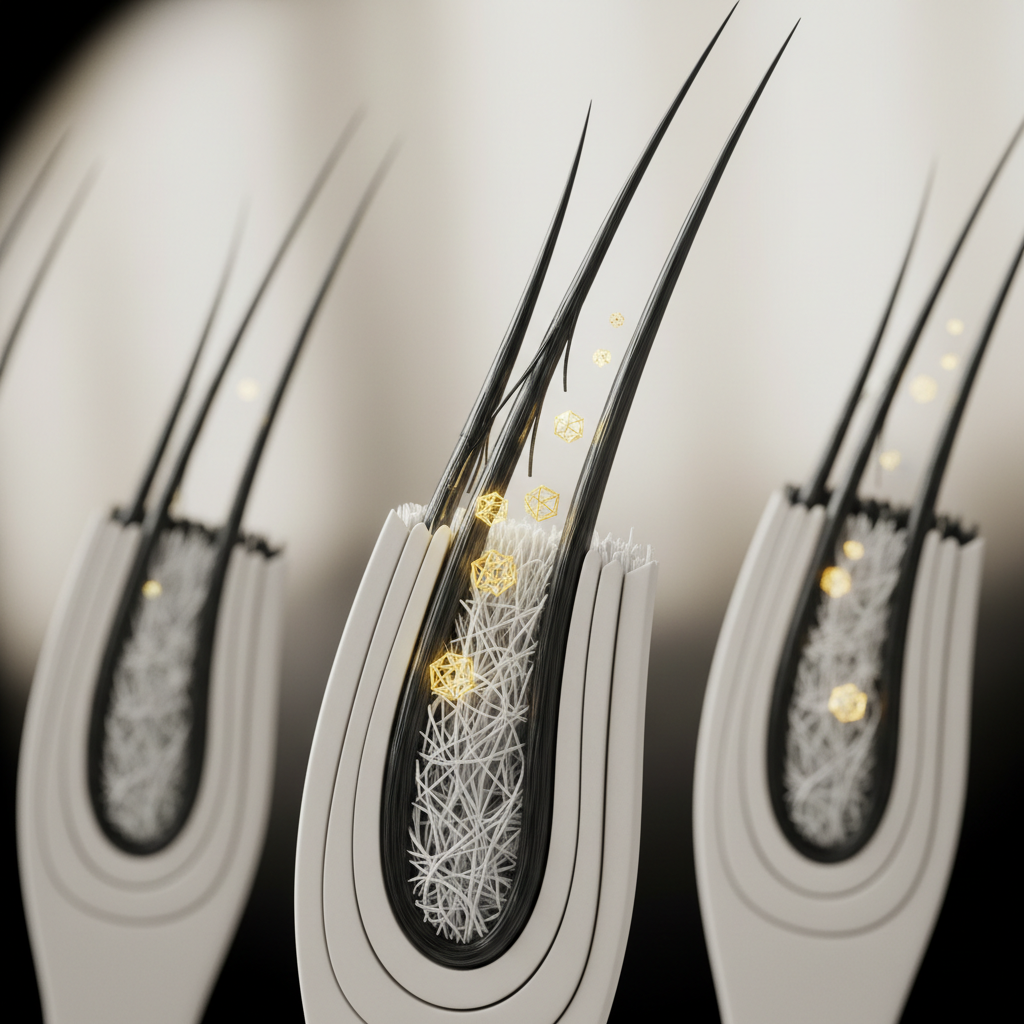
Hydrolysed proteins used in conditioning formulations are amphoteric or quaternised, carrying net positive charges at typical cosmetic pH levels (pH 4.0 to 5.5). Through ionic attraction, these positively charged protein fragments bind directly to the negatively charged damage sites.
High porosity hair has abundant negative sites due to lifted cuticles and oxidised cortex proteins. It welcomes this substantive deposition, which fills voids and temporarily restores mechanical resistance to stretching. Conversely, low porosity hair lacks these exposed negative sites. Applying concentrated protein to low porosity strands causes exterior protein buildup, disrupting the natural moisture balance and leaving hair straw-like.
| Hair Porosity Level | Cuticle Condition | Water Absorption Rate | Moisture Retention | Recommended Protein Type and Frequency |
|---|---|---|---|---|
| Low Porosity | Tightly packed, flat cuticles; intact 18-MEA layer | Very slow (water beads on surface) | High once hydrated | Hydrolysed silk or wheat peptides; once every 4 to 6 weeks |
| Medium Porosity | Normal overlapping scales; minimal lipid loss | Moderate and steady | Balanced retention | Balanced keratin or vegetable protein; once every 2 to 4 weeks |
| High Porosity | Chipped, raised, or missing cuticle scales | Extremely rapid | Very poor (dries instantly, feels rough) | Hydrolysed keratin, collagen, or quinoa; every 1 to 2 weeks |
Signs of protein deficiency versus protein overload
Because hair fibre needs a balance between elasticity (moisture) and structural integrity (protein), identifying your strand's current state avoids fibre damage:
- Signs you need protein (High Porosity / Elastic Weakness): Hair feels limp, mushy, or gummy when wet. It stretches excessively without bouncing back, tangles easily, and breaks under minimal tension. Bleached, permed, or heat-ravaged hair almost always falls into this category.
- Signs you have protein overload (Stiff / Brittle Fibre): Hair feels hard, dry, crunchy, and rough to the touch, whether wet or dry. It snaps cleanly with zero stretch when gently pulled. It appears dull because the light cannot reflect evenly off uneven protein deposits.
Practical steps: tailoring treatments to your porosity
Matching your routine to your fibre type ensures you gain tensile strength without causing brittleness:
Low Porosity Strategy
- Clarify regularly: Use an amphoteric or mild anionic clarifying shampoo once a month to remove product films that block hydration.
- Use indirect heat: Apply deep conditioning treatments under a warm towel or steamer. Warmth gently lifts tightly bound cuticles to allow moisture entry.
- Choose small-chain peptides: Avoid heavy, whole-protein masks. Look for ingredients listed as "hydrolysed silk" or "hydrolysed amino acids", keeping treatments infrequent.
High Porosity Strategy
- Incorporate regular hydrolysed proteins: Apply intensive protein reconstructors containing hydrolysed keratin or wheat protein every 7 to 14 days.
- Seal with emollient lipids: High porosity hair cannot hold onto moisture alone. Layer plant oils, fatty alcohols (such as cetyl or stearyl alcohol), or leave-in creams over hydrated hair to physically plug cuticle gaps.
- Control pH: Use acidic rinses or balanced styling formulas (pH 4.5 to 5.5) to encourage raised cuticles to flatten down against the cortex.
When breakage is mistaken for shedding
A common issue in salon consultations is confusing snapping hair fibres with hair shedding. If you find short, jagged fragments on your shoulders or in your sink without a tiny white bulb on the end, you are experiencing hair breakage due to structural porosity issues and protein imbalance.
If the strands coming out have a white keratin bulb attached to the root, the fibre has detached from inside the follicle. This is natural shedding (such as telogen effluvium) or patterned hair loss. Protein treatments applied along the hair lengths will do nothing to stop true shedding or stimulate inactive follicles.
Supporting hair health from scalp to strand: Watermans
While cosmetic reconstructors work on the outer lengths of the hair shaft, healthy hair growth requires support at the scalp level. This is where Watermans provides a complementary, dual-action approach.
Watermans Grow Me Shampoo and Condition Me Conditioner are formulated without harsh sulphates, using balanced blends of hydrolysed lupin protein, biotin, caffeine, and rosemary extract. For high porosity hair prone to breakage, Condition Me delivers moisturising lipids and restorative peptides to smooth damaged cuticles. Meanwhile, the scalp-stimulating actives in Grow Me support an ideal follicle environment, ensuring emerging hair fibres grow in with strong, healthy cuticle layers from day one.
Frequently asked questions about Hair Porosity and Protein Treatments
How do I accurately find my hair porosity?
The most reliable way is observing how your hair behaves when clean and dry. If water beads on your hair and it takes hours to dry naturally, you likely have low porosity hair. If your hair absorbs water instantly, dries remarkably quickly, and feels rough, you have high porosity hair. Professional stylists can also perform a wet stretch test to assess elasticity.
Can low porosity hair ever use protein treatments?
Yes, low porosity hair still contains keratin and can benefit from occasional protein, particularly if exposed to sun or blow-drying. The key is using hydrolysed amino acids or lightweight proteins no more than once a month, followed immediately by a moisturising, humectant-rich conditioner to maintain fibre flexibility.
What should I do if I have protein overload?
Stop using all products containing hydrolysed proteins, amino acids, or keratin immediately. Wash your hair with a clarifying shampoo to strip excess surface proteins, then follow with an intensive, protein-free moisturising mask containing humectants like glycerin, panthenol, and aloe vera. Restore flexibility before reintroducing light proteins.
What is the primary difference in Hair Porosity and Protein Treatments for bleached hair?
Bleached hair is artificially high porosity because chemical lighteners dissolve the protective 18-MEA layer and oxidise cortex bonds. Bleached fibres desperately need hydrolysed protein treatments to replace lost mass and stop breakage, requiring far more frequent treatments than virgin hair.
Balancing porosity and protein for resilient hair
Navigating Hair Porosity and Protein Treatments comes down to understanding your hair's unique architecture. High porosity strands crave the mechanical reinforcement that hydrolysed proteins provide, whereas low porosity strands require careful restraint to avoid protein buildup and snapping. By matching the molecular weight and frequency of your treatments to your cuticle's condition, you can protect the hair shaft from environmental wear and tear, maintaining smooth, strong, and flexible hair.
Sources and references
- Robbins, C. R. (2012). Chemical and Physical Behavior of Human Hair. 5th Edition, Springer-Verlag.
- Cruz, C. F., et al. (2016). "Human hair characteristics: A review of the impact of treatments on the structural and mechanical properties of hair." International Journal of Cosmetic Science, 38(3), 227-238.
- Tinoco, A., et al. (2018). "Proteins and peptides for hair care products: An overview." Cosmetics, 5(3), 44.
- Dawber, R. (1996). "Hair: Its structure and response to cosmetic preparations." Clinics in Dermatology, 14(1), 105-112.
- Evans, A. O., & Wickett, R. R. (2012). "Mechanisms of keratin repair by cosmetic active ingredients." Journal of the Society of Cosmetic Chemists, 63(6), 473-487.
Find these ingredients in Watermans products
- Panthenol (Provitamin B5): you will find this ingredient in our Heat Protection Spray.
- Aloe Vera: you will find this ingredient in our Curly Hair Conditioner.