Hair Miniaturisation Explained: The Biology of Thinning Follicles
8 min read ·
Hair Miniaturisation Explained: learn the biological mechanisms, early signs, and clinical differences between thinning follicles and hair shedding.
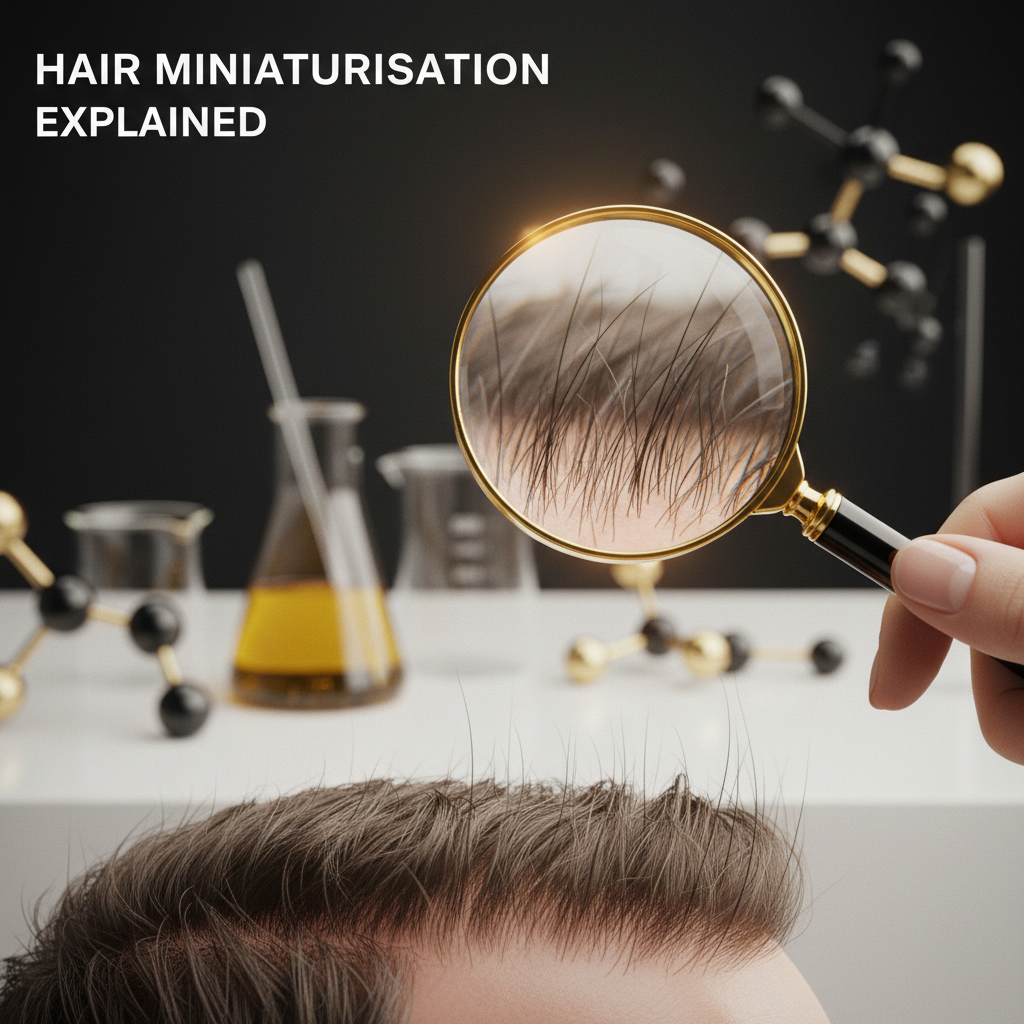
Quick answer: With Hair Miniaturisation Explained in clinical terms, it refers to the biological process where hair follicles progressively shrink over successive growth cycles, producing thinner, shorter, and less pigmented strands until growth may halt entirely. Driven primarily by genetic sensitivity to dihydrotestosterone (DHT) in androgenetic alopecia, follicle miniaturisation transforms robust terminal hairs into fragile vellus hairs. The primary limitation is that once a follicle undergoes complete fibrosis and ceases activity entirely, the miniaturisation process cannot be reversed cosmetically.
Key takeaways
- Follicular miniaturisation is the hallmark physical mechanism of androgenetic alopecia (pattern hair loss) in both men and women.
- The growth phase (anagen) becomes shorter with each cycle, while the resting phase (telogen) remains the same or lengthens.
- The androgen dihydrotestosterone (DHT) binds to susceptible dermal papilla receptors, triggering miniaturisation in genetically predisposed follicles.
- Miniaturisation causes terminal hairs (thick and pigmented) to gradually regress into vellus-like hairs (fine, short, and pale).
- Early detection via dermoscopy allows for intervention before follicular scarring or complete atrophy takes place.
Hair Miniaturisation Explained: what the evidence shows
When trichologists and dermatologists evaluate thinning hair, follicular miniaturisation is the most common diagnostic finding. In a healthy scalp, roughly 85 to 90 percent of follicles reside in the anagen (growth) phase at any given time, lasting between 2 and 7 years. Each healthy terminal follicle produces a thick shaft measuring roughly 0.06 to 0.08 millimetres in diameter.
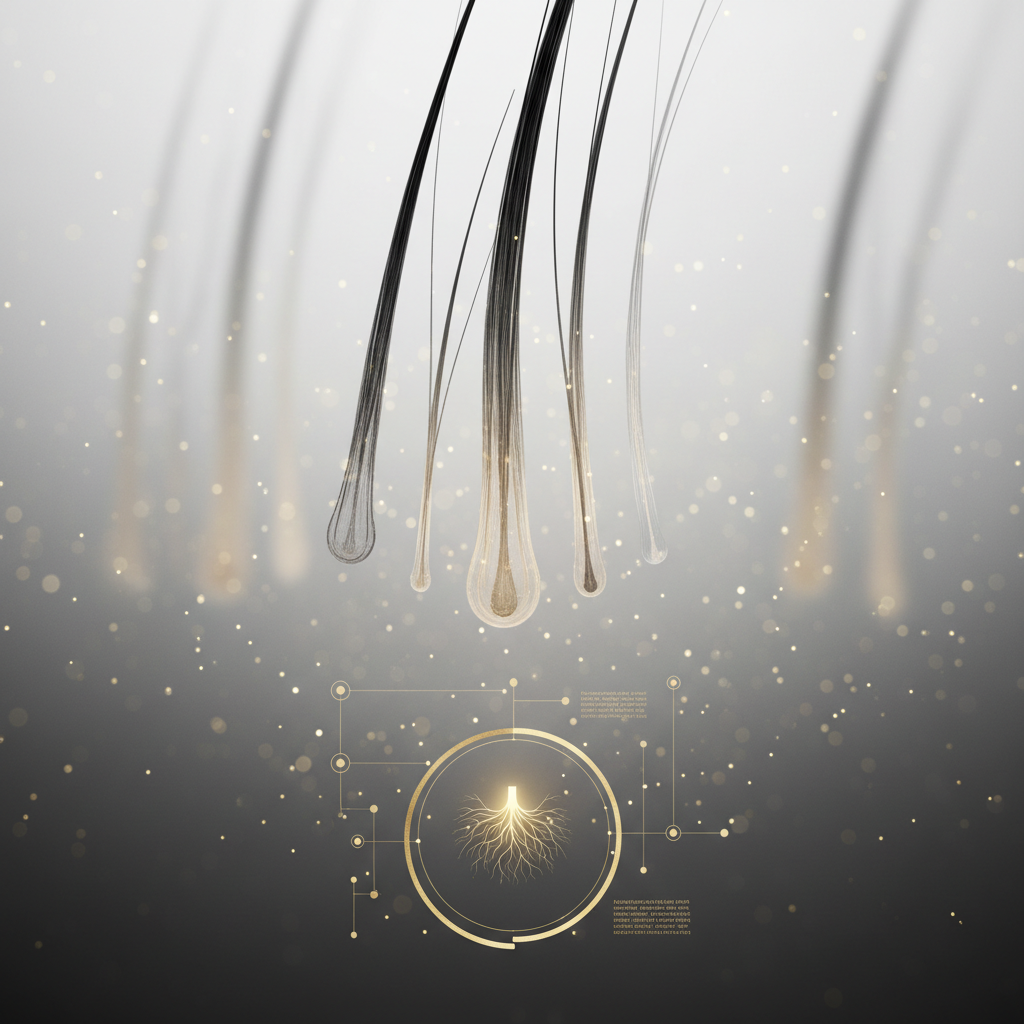
With Hair Miniaturisation Explained through biological mapping, this dynamic changes fundamentally. The dermal papilla cells at the base of the follicle shrink in volume. Consequently, the anagen duration shortens dramatically, sometimes reducing to mere months or weeks, while the latent lag period (kenogen) extends.
Because the hair fibre spends far less time actively building keratin matrices, the resulting hair cannot achieve its previous calibre or length. Over successive cycles of shedding and regrowth, the follicle yields fibres measuring under 0.03 millimetres in diameter. Eventually, these strands resemble vellus hair (the barely visible fuzz found across the body) before the follicle risks becoming dormant or fibrotic.
The biological mechanism: hormones, enzymes, and receptors
The primary biological driver of hair miniaturisation is the systemic hormone testosterone converting into the potent androgen dihydrotestosterone (DHT). This reaction occurs locally in the scalp tissue and is catalysed by the enzyme 5-alpha reductase (primarily Type II in hair follicles).
DHT binds with high affinity to androgen receptors situated in the dermal papilla of the follicle. In genetically susceptible individuals, this binding event triggers an intracellular cascade of inhibitory signalling molecules, notably transforming growth factor beta (TGF-beta) and Dickkopf-1 (DKK-1).
These signalling proteins induce premature termination of the anagen phase by promoting apoptosis (programmed cell death) within follicular epithelial cells. Over time:
- The blood supply via the capillary network feeding the dermal papilla diminishes.
- The extracellular matrix around the lower follicle degrades.
- The physical diameter of the hair bulb contracts.
- Melanocyte activity drops, meaning the emerging thinner hair also loses its natural pigmentation and appears lighter.
Crucially, this is not an allergic reaction or an external fungal event. It is a slow, receptor-mediated morphological change that can take years to become visually obvious without clinical tools.
What the evidence does not show
There are persistent myths surrounding miniaturisation that clinical research does not support:

- It is not caused by clogged sebum pores: Excess sebum, styling wax, or dirty scalp conditions do not drive follicular miniaturisation. While sebum contains small amounts of DHT, washing away surface oil does not alter the genetic androgen receptors inside the follicle.
- It is not hair breakage: Breakage occurs along the hair shaft due to mechanical stress, heat, or bleaching chemicals. Miniaturisation is a root-level, follicular defect that alters how the hair is formed at the source.
- It does not happen overnight: A sudden shedding of 300 hairs per day across the entire scalp is typically telogen effluvium, not miniaturisation. Miniaturisation is a gradual, chronic progression that unfolds over multiple growth cycles.
- Shampoos do not cure androgenetic alopecia: Cosmetic products and clarifying washes can improve scalp environment and hair feel, but cosmetic cleansers do not permanently rewrite genetic hormonal sensitivity.
Signs of miniaturisation: what to look for
Because humans lose up to 50 percent of their hair density in a given region before thinning becomes visible to the naked eye, spotting the early signs of miniaturisation is crucial.
- Hair diameter diversity (anisotrichosis): In a healthy scalp, hairs within a single follicular unit share an identical, uniform thickness. When miniaturisation begins, a single pore will often produce one thick hair alongside one or two significantly thinner, weaker hairs.
- Increased shedding of short, wispy hairs: Shedding long, mature hairs is normal. If you notice an influx of short, fine, baby-like hairs shedding before they ever reach length, those hairs are operating on an unnaturally truncated anagen cycle.
- Loss of styling volume and density: Ponytails feel noticeably thinner in circumference, or the scalp becomes visible under direct overhead lighting along the crown, vertex, or frontal hairline.
- Visible widening of the central parting: In women, miniaturisation typically presents as diffuse thinning across the mid-scalp and frontal crown, leading to a widening parting line while the occipital hairline is preserved.
Miniaturised hair versus healthy terminal hair
Understanding the physical and biological differences between these hair types clarifies why miniaturisation alters appearance so drastically.
| Feature | Healthy Terminal Hair | Miniaturised / Intermediate Hair | True Vellus Hair |
|---|---|---|---|
| Shaft Diameter | 0.06 to 0.08 mm | 0.03 to 0.05 mm | Less than 0.03 mm |
| Anagen Duration | 2 to 7 years | Several months to 1 year | 1 to 2 months |
| Pigmentation | Fully pigmented | Reduced / lighter | Completely unpigmented |
| Internal Medulla | Present and continuous | Fragmented or absent | Completely absent |
| Follicular Depth | Deep in the subcutis (4 to 5 mm) | Upper dermis (2 to 3 mm) | Superficial dermis (under 1 mm) |
| Reversibility | Normal baseline | Potentially restorable | Extremely difficult or irreversible |
What you can do: clinical and cosmetic approaches
Addressing miniaturisation requires a dual perspective: clinical interventions that target the underlying biology, and supportive cosmetic care that protects the existing hair fibres.
Clinical interventions
For halting or slowing active follicular miniaturisation, medical guidelines point to proven pharmaceutical therapies. Topical or oral 5-alpha reductase inhibitors and potassium channel openers are the gold standard treatments evaluated by regulatory bodies like NICE and the MHRA. Platelet-rich plasma (PRP) and low-level laser therapy (LLLT) also have emerging clinical support for stimulating dermal papilla cellular activity in mild-to-moderate stages.
Scalp health and supportive care
While cosmetics cannot alter androgen genetics, maintaining an optimal scalp environment supports follicular productivity. Chronic inflammation, microbial dysbiosis (such as excess Malassezia yeast), and oxidative stress are known secondary aggravators that can accelerate anagen shortening.
Gentle cleansing routines, clarifying agents, and nutrient-dense topical formulas support the scalp skin barrier. For instance, Watermans approaches hair wellness by focusing on the external scalp ecosystem. Products formulated with targeted botanicals, niacinamide, rosemary, and caffeine help invigorate the scalp skin, encourage microcirculation, and reinforce fragile, thinning strands against everyday friction and breakage.
When the cause may be something else
Miniaturisation is characteristic of androgenetic alopecia, but other conditions can mimic general thinning:
- Telogen Effluvium: A reactive shedding episode triggered by physiological stress, severe illness, rapid weight loss, or iron deficiency. It causes sudden, diffuse shedding across the entire scalp without permanent follicle shrinkage.
- Alopecia Areata: An autoimmune disorder where the immune system targets the hair follicle, typically causing distinct, round, smooth bald patches rather than diffuse shaft thinning.
- Cicatricial (Scarring) Alopecia: Inflammatory conditions such as lichen planopilaris or frontal fibrosing alopecia destroy the hair follicle stem cells and replace them with scar tissue, often accompanied by erythema, itching, or scalp scaling.
- Traction Alopecia: Mechanical tension caused by tight hairstyles, extensions, or braids that physically damages the follicle root over prolonged periods.
When to seek professional advice
If you observe progressive thinning along your crown, temples, or parting line, consult a dermatologist or qualified trichologist early.
A specialist will perform a dermoscopy (trichoscopy) examination. Under magnification, a clinician evaluates the percentage of miniaturised hairs. If more than 20 percent of hairs in an androgen-dependent zone exhibit diameter diversity, a diagnosis of androgenetic miniaturisation can be confirmed. Seeking guidance early is essential because follicles that have undergone complete perifollicular fibrosis cannot be reactivated.
Frequently asked questions about Hair Miniaturisation Explained
Can miniaturised hair follicles recover their original thickness?
If a follicle has only partially miniaturised, medical therapies that inhibit DHT or stimulate follicular blood flow can often extend the anagen phase, restoring noticeable calibre. However, if miniaturisation has progressed to full atrophy or scarring, recovery is rarely possible.
How does Hair Miniaturisation Explained help distinguish hair loss from shedding?
With Hair Miniaturisation Explained by specialists, the distinction is clear: hair shedding (telogen effluvium) involves normal, fully formed terminal hairs falling out in excess, whereas miniaturisation is an ongoing biological process where the emerging hairs physically grow back thinner, weaker, and shorter every cycle.
Does DHT affect every hair follicle on the head?
No. Follicles located on the occipital scalp (the back and lower sides of the head) lack high concentrations of sensitive androgen receptors. This is why pattern hair loss spares the back of the head, and why these DHT-resistant donor hairs are used in surgical hair transplants.
At what age does follicular miniaturisation usually begin?
Miniaturisation can begin any time after puberty when systemic androgen levels rise. While it commonly manifests visually in a person's twenties, thirties, or forties, the microscopic process of follicle narrowing often precedes noticeable thinning by several years.
Conclusion
Understanding the cellular mechanics behind thinning hair removes the guesswork from diagnosis and care. In this breakdown of Hair Miniaturisation Explained, the process has been clarified as a receptor-driven, progressive shortening of the hair growth cycle rather than a sudden or external occurrence. By identifying miniaturisation early through trichoscopy, separating true follicular shrinkage from everyday breakage, and implementing evidence-based care, you give your follicles the best opportunity to maintain density and structural resilience over the long term.
Sources and references
- British Association of Dermatologists. Guidelines for the management of alopecia areata and androgenetic alopecia. British Journal of Dermatology, 2018.
- National Institute for Health and Care Excellence (NICE). Alopecia androgenetica: Clinical knowledge summaries. 2021.
- Sinclair, R. Male androgenetic alopecia: Mechanisms and management. The Lancet, 2004.
- Ramos, P. M., & Miot, H. A. Female pattern hair loss: a clinical and pathophysiological review. Anais Brasileiros de Dermatologia, 2015.
- Trueb, R. M. Molecular mechanisms of androgenetic alopecia. Experimental Gerontology, 2002.
Find these ingredients in Watermans products
- Caffeine: you will find this ingredient in our Hair Growth Shampoo.
- Niacinamide: you will find this ingredient in our Hair Mask.