Telogen Effluvium vs Pattern Hair Loss: Differences, Causes, and Regrowth
10 min read ·
Understand the differences in Telogen Effluvium vs Pattern Hair Loss, covering biological mechanisms, shedding timelines, diagnosis, and evidence-based management.

Quick answer: The core distinction in Telogen Effluvium vs Pattern Hair Loss lies in their biological mechanism, timeline, and distribution. Telogen effluvium is acute, diffuse shedding triggered by physiological stress that shifts anagen follicles prematurely into the telogen resting phase, usually resolving spontaneously within six months. In contrast, pattern hair loss (androgenetic alopecia) is a chronic, progressive condition driven by dihydrotestosterone (DHT) sensitivity that causes follicular miniaturisation along distinct anatomical zones. Accurate clinical identification is critical, as cosmetic interventions cannot halt genetic miniaturisation.
Key takeaways
- Different biological pathways: Telogen effluvium represents a disruption of the hair cycle causing excessive shedding, whereas pattern hair loss involves progressive follicular miniaturisation.
- Shedding versus thinning: Telogen effluvium sheds full-thickness hairs evenly across the entire scalp, while pattern hair loss gradually replaces thick terminal hairs with fine vellus hairs in specific zones.
- Trigger timelines: Telogen effluvium typically begins two to three months after an inciting physiological or psychological shock. Pattern hair loss develops quietly over years or decades.
- Reversibility profiles: Acute telogen effluvium is usually self-correcting once the systemic trigger resolves. Pattern hair loss requires continuous, targeted intervention to slow or arrest progression.
- Coexistence is possible: A sudden bout of telogen effluvium can unmask underlying pattern hair loss, causing both conditions to occur simultaneously.
Telogen Effluvium vs Pattern Hair Loss: what the evidence shows
Dermatological research confirms that telogen effluvium and pattern hair loss represent entirely separate biological processes, despite frequently being confused by patients in their early stages.
The normal human scalp contains roughly 100,000 hair follicles. At any given moment, healthy scalp physiology dictates that 85% to 90% of these follicles reside in the anagen (growth) phase, 1% to 2% in the catagen (regression) phase, and 10% to 15% in the telogen (resting) phase. Normal physiological shedding accounts for roughly 50 to 100 telogen hairs per day.
In telogen effluvium, an acute metabolic shock, illness, high fever, surgery, severe nutritional deficit, or emotional trauma disrupts this equilibrium. The biological signal forces up to 30% to 50% of active anagen follicles to terminate their growth cycle prematurely. Because the telogen phase naturally lasts approximately 100 days, the clinical shedding manifests roughly two to four months after the triggering event. The shed fibres are club hairs, identifiable by a small, white keratinised bulb at the proximal root.
Pattern hair loss, or androgenetic alopecia, does not stem from an abrupt shift into the resting phase. Instead, genetically susceptible hair follicles express high levels of androgen receptors and the enzyme 5-alpha reductase. This enzyme converts circulating testosterone into dihydrotestosterone (DHT). Over repeated hair cycles, DHT binds to follicular receptors, shortening the anagen phase and triggering progressive follicular miniaturisation. Terminal hairs (thick, pigmented fibres) are gradually replaced by intermediate hairs, and eventually by fine, non-pigmented vellus hairs. The follicle remains alive, but its physical output shrinks until visible scalp emerges.
What the evidence does not show
Understanding what clinical science disproves is just as valuable as understanding established mechanisms.
First, evidence does not show that telogen effluvium permanently destroys hair follicles. Unless accompanied by an underlying primary scarring alopecia or untreated severe endocrine failure, the follicular stem cell niche in the hair bulge remains intact. The shedding is dramatic, but the underlying machinery for regrowth is preserved.
Second, research does not show that frequent shampooing, brushing, or everyday cosmetic styling causes either condition. While aggressive mechanical tension causes traction alopecia, washing simply dislodges hairs that have already detached from the dermal papilla weeks prior.
Finally, clinical trials do not show that topical cosmetic shampoos, scalp oils, or over-the-counter vitamin supplements can reverse genetic pattern hair loss. While scalp hygiene and nutrient sufficiency support optimal hair growth environments, they cannot alter genetic androgen receptor sensitivity.
Key biological differences: a direct comparison
Evaluating clinical signs side by side clarifies how these two conditions diverge across clinical presentation, onset, and pathology.
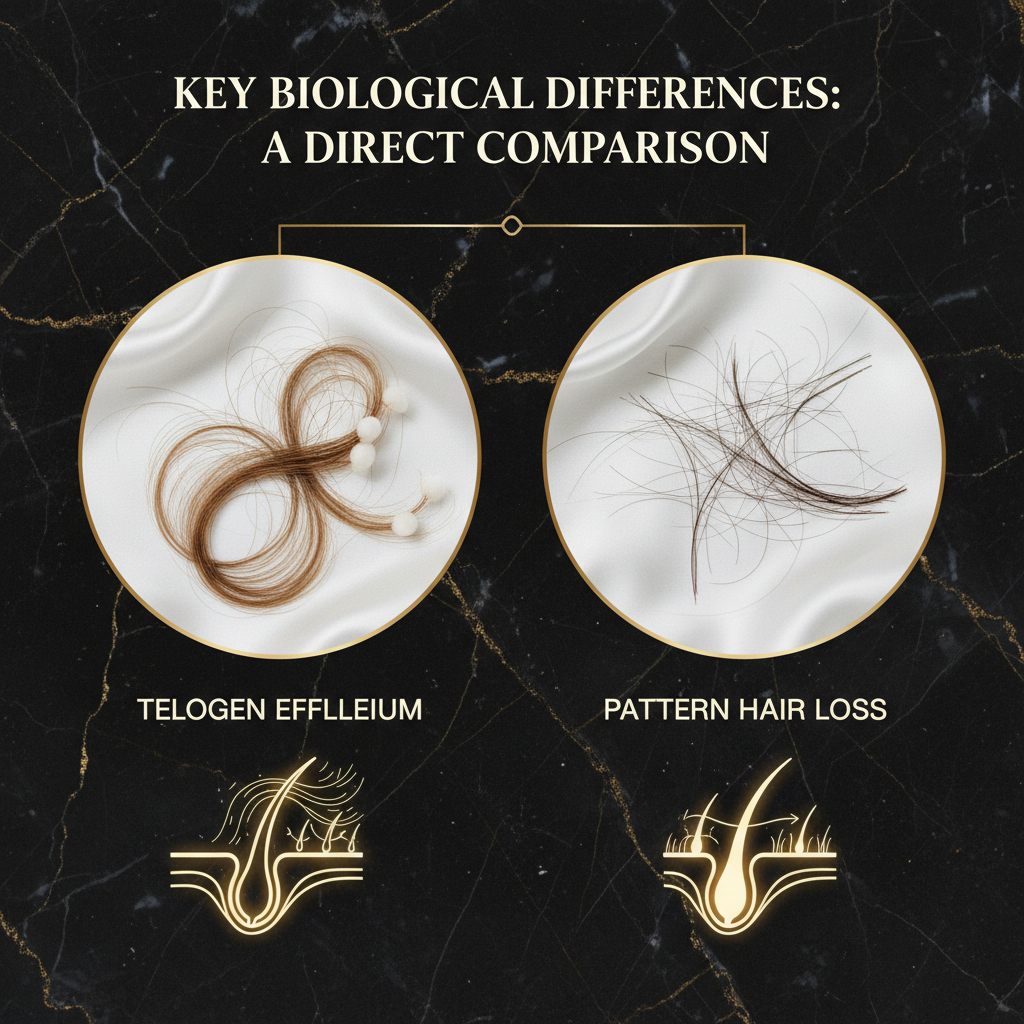
| Diagnostic Factor | Telogen Effluvium | Pattern Hair Loss (Androgenetic Alopecia) |
|---|---|---|
| Primary Mechanism | Premature transition of anagen fibres into telogen phase | Progressive follicular miniaturisation driven by DHT sensitivity |
| Onset Speed | Sudden, acute onset (often noticeable over 1 to 2 weeks) | Slow, insidious progression over months to years |
| Pattern / Distribution | Diffuse thinning across the entire scalp, including sides and back | Distinct anatomical zones: temples, crown, vertex, or midline part |
| Hair Fibre Diameter | Uniform thickness; shed hairs are fully formed terminal club hairs | High diameter diversity (hair shaft miniaturisation and vellus hairs) |
| Daily Hair Shedding | Greatly elevated (often 200 to 400+ hairs per day) | Typically normal to mildly elevated (30 to 100 hairs per day) |
| Trigger Origin | Identifiable systemic shock 2 to 3 months prior | Polygenic inheritance combined with systemic androgens |
| Spontaneous Recovery | High; typically resolves within 3 to 6 months of trigger removal | Very low; progressive condition requiring ongoing management |
Signs to look for: clinical presentation
Identifying which condition you are observing involves assessing three factors: distribution, shed fibre morphology, and scalp visibility patterns.
Signs of Telogen Effluvium
- Diffuse reduction in volume: You notice a sudden reduction in the density of your ponytail or overall hair volume, with equal thinning at the nape of the neck, sides, and crown.
- Dramatic daily shedding: Copious amounts of full-length hair come away on pillows, in shower drains, and on hairbrushes.
- Uniform bulb morphology: Dislodged hairs display a prominent, firm white bulb at the root, indicating a completed telogen phase without structural shaft breakage.
- Positive hair pull test: A clinician gently grasping 40 to 60 hairs from the scalp and pulling lightly extracts more than 10% of the fibres (more than 4 to 6 hairs) across multiple scalp regions.
Signs of Pattern Hair Loss
- Zonal recession and thinning: In men, the frontal hairline recedes into an "M" shape, accompanied by vertex (crown) thinning. In women, the frontal hairline remains intact while the central parting visibly widens (the Ludwig pattern).
- Diameter variability (anisotrichosis): Under magnification, hairs growing in the affected areas show starkly different thicknesses. Healthy thick hairs sit alongside fine, wispy hairs.
- Minimal shedding: Sufferers often report little to no dramatic shedding in the shower. The hair simply appears thinner because each successive growth cycle produces a smaller fibre.
- Negative pull test: A standard hair pull test away from the active thinning zone is typically negative.
When the cause may be something else
Not all diffuse shedding is telogen effluvium, and not all zonal thinning is pattern hair loss. Differential diagnoses must rule out other follicular conditions.
Diffuse alopecia areata (alopecia areata incognita) mimics telogen effluvium by presenting with sudden, widespread shedding without round patches. Dermoscopic evaluation often reveals yellow dots and short exclamation-mark hairs.
Cicatricial (scarring) alopecias, such as frontal fibrosing alopecia or lichen planopilaris, can mimic pattern loss around the frontal hairline or crown. These involve irreversible destruction of the stem cell niche, accompanied by erythema, follicular hyperkeratosis, or loss of follicular ostia.
Systemic conditions must also be excluded. Hypothyroidism, hyperthyroidism, severe iron deficiency (serum ferritin below 30 micrograms per litre), systemic lupus erythematosus, and rapid post-bariatric weight loss all manifest with diffuse shedding patterns that require targeted medical bloodwork to identify.
Practical steps: what you can do
Management depends entirely on a correct differential assessment.
If you suspect Telogen Effluvium:
- Identify the timeline: Look back 60 to 90 days before shedding began. Did you experience severe psychological stress, high fever, viral illness, general anaesthesia, crash dieting, or stop taking a hormonal contraceptive?
- Review nutritional biomarkers: Request a blood panel covering full blood count, serum ferritin, zinc, vitamin D, and thyroid-stimulating hormone (TSH). Correcting nutritional deficiencies supports the returning anagen phase.
- Minimise physical stress on the fibre: Avoid tight hairstyles, aggressive backcombing, and chemical processing that cause mechanical breakage alongside the physiological shedding.
- Practice watchful waiting: Once the underlying cause resolves, shedding typically normalises within three to six months, with visible regrowth trailing by several months.
If you suspect Pattern Hair Loss:
- Seek early medical evaluation: Miniaturisation is much easier to stabilise than it is to reverse once the follicle has fully atrophied.
- Consult evidence-based therapies: Clinical guidelines support medical treatments such as topical or oral minoxidil, and 5-alpha reductase inhibitors like finasteride or dutasteride (under medical supervision for appropriate patient profiles).
- Differentiate cosmetic support: Maintain realistic expectations regarding shampoos and topicals. Focus cosmetic care on fibre strengthening and scalp health, not false promises of genetic reversal.
Supporting the scalp environment with Watermans
While cosmetic products do not treat clinical medical conditions like androgenetic alopecia or acute telogen effluvium, maintaining an optimal scalp environment supports the quality of emerging hair fibres.
Watermans Grow Me Shampoo and Condition Me Conditioner are formulated without harsh sulphates, providing a gentle cleansing base that respects the scalp barrier. Featuring biotin, rosemary, caffeine, and niacinamide, the range delivers cosmetic conditioning to reinforce fragile fibres along the shaft, helping reduce mechanical hair breakage while follicles navigate their natural growth cycles.
When to seek professional advice
You should consult a GP, registered trichologist, or consultant dermatologist if you observe:
- Sudden, patchy hair loss forming round or oval bare spots.
- Shedding accompanied by scalp burning, tenderness, severe scaling, or intense itching.
- Diffuse shedding that continues unabated for longer than six months (which points toward chronic telogen effluvium).
- Hair loss accompanied by systemic symptoms such as extreme fatigue, unexplained weight changes, or irregular menstrual cycles.
Frequently asked questions about Telogen Effluvium vs Pattern Hair Loss
Can you have both Telogen Effluvium and Pattern Hair Loss at the same time?
Yes. It is common for a bout of acute telogen effluvium to trigger or unmask previously unnoticed pattern hair loss. A patient with mild, subclinical genetic miniaturisation may experience an acute stressor, triggering massive telogen shedding. When the hair regrows, areas genetically predisposed to pattern hair loss may return noticeably finer or fail to recover their original density.
How does hair shed in Telogen Effluvium vs Pattern Hair Loss?
In telogen effluvium, hair sheds abruptly and profusely from all areas of the scalp, yielding club hairs with clear white bulbs. In pattern hair loss, daily shedding is often within normal limits (under 100 hairs per day). The thinning in pattern hair loss occurs because shed hairs are replaced by progressively thinner, shorter fibres rather than falling out in large clumps.
How long does it take for hair to grow back after Telogen Effluvium?
Telogen effluvium shedding generally subsides three to six months after the inciting metabolic or psychological trigger has been addressed. Once shedding slows to normal baseline levels, regrowth becomes visible as short, upright terminal hairs along the scalp, growing at the normal human rate of roughly one to 1.2 centimetres per month.
Does a receding hairline indicate Telogen Effluvium or Pattern Hair Loss?
A distinct receding hairline at the temples almost always indicates pattern hair loss rather than telogen effluvium. Telogen effluvium causes generalised, diffuse density loss across the entire scalp, preserving the original geometric shape of the hairline. Distinct recession of the temporal angles is a classic hallmark of androgen-driven miniaturisation.
Does dermoscopy help tell the difference between the two conditions?
Yes, dermoscopy (trichoscopy) is a standard diagnostic tool used by dermatologists to distinguish between the two. The primary diagnostic sign of pattern hair loss is hair diameter diversity (anisotrichosis) exceeding 20% in the affected zones. Telogen effluvium exhibits uniform hair shaft diameters across the scalp with empty hair follicles and upright regrowing hairs.
Summary
Distinguishing between Telogen Effluvium vs Pattern Hair Loss is the foundational step in addressing scalp density concerns. Telogen effluvium is a temporary, diffuse cycling disturbance that resolves when internal physiological balance is restored, whereas pattern hair loss represents a lifelong, localized miniaturisation governed by genetics and hormones. Recognising whether you are experiencing active shedding or progressive thinning ensures you seek the appropriate clinical guidance, preserve follicular health, and adopt an effective care routine tailored to your specific hair needs.
Sources and references
- British Association of Dermatologists. Guidelines for the management of alopecia areata and telogen effluvium.
- National Institute for Health and Care Excellence (NICE). Alopecia androgenetica: clinical knowledge summary.
- Headington, J. T. Telogen effluvium: New concepts and review. Archives of Dermatology, 1993.
- Sinclair, R. Diffuse hair loss: an approach to diagnosis. Australian Family Physician, 2005.
- American Academy of Dermatology Association. Hair loss: Who gets and causes.
Find these ingredients in Watermans products
- Niacinamide: you will find this ingredient in our Hair Mask.