Hair Growth Cycle Stages: Biology, Phases, and Follicle Health
8 min read ·
Explore the biological Hair Growth Cycle Stages: anagen, catagen, telogen, and exogen. Learn the mechanisms behind shedding, growth timing, and scalp health.
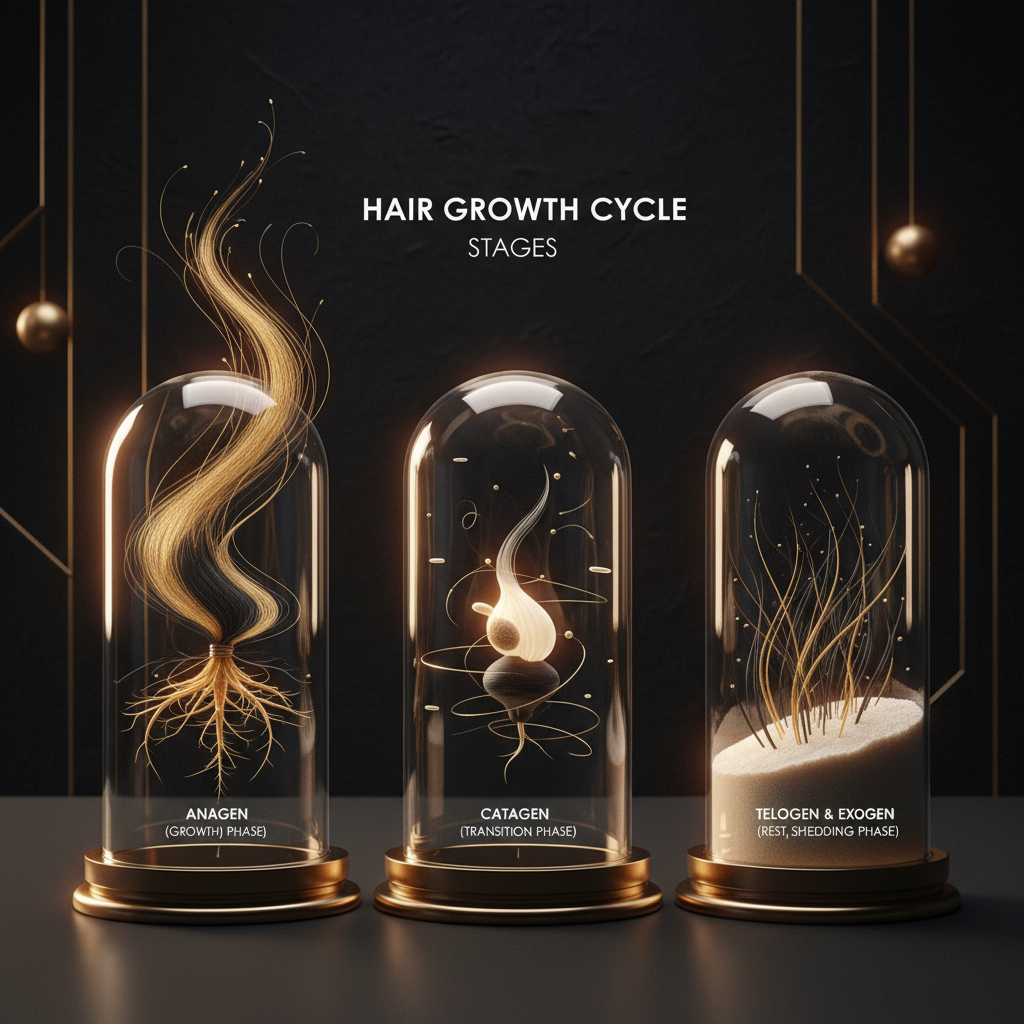
Quick answer: The Hair Growth Cycle Stages consist of four distinct biological phases: anagen (active growth), catagen (follicular regression), telogen (resting), and exogen (active shedding). Every individual follicle on your scalp operates on its own independent timeline, ensuring you maintain a full head of hair rather than shedding in seasonal molts. While topical products cannot alter your genetically determined cycle length or cure genetic pattern loss, understanding these phases helps identify whether unexpected thinning stems from temporary physiological shedding or chronic follicular changes.
Key takeaways
- Human scalp follicles cycle independently through anagen, catagen, telogen, and exogen phases.
- The anagen phase determines maximum hair length and lasts between 2 and 7 years on average.
- Approximately 85 to 90 percent of scalp hairs are growing at any given moment, while 10 to 15 percent rest or shed.
- Normal daily shedding ranges from 50 to 100 hairs as part of the natural exogen phase.
- Distinguishing between hair shedding (telogen effluvium), hair loss (androgenetic miniaturisation), and mechanical breakage is essential for correct care.
Hair Growth Cycle Stages: what the evidence shows
Dermatological research demonstrates that every hair follicle undergoes a continuous, asynchronous regenerative cycle throughout human life. The Hair Growth Cycle Stages control the cellular proliferation, regression, and resting states of each individual fibre. Because human hair follicles do not synchronise their cycles, humans do not undergo dramatic seasonal coats like other mammals. Instead, each follicle repeats this sequence between 10 and 30 times over a typical lifespan.
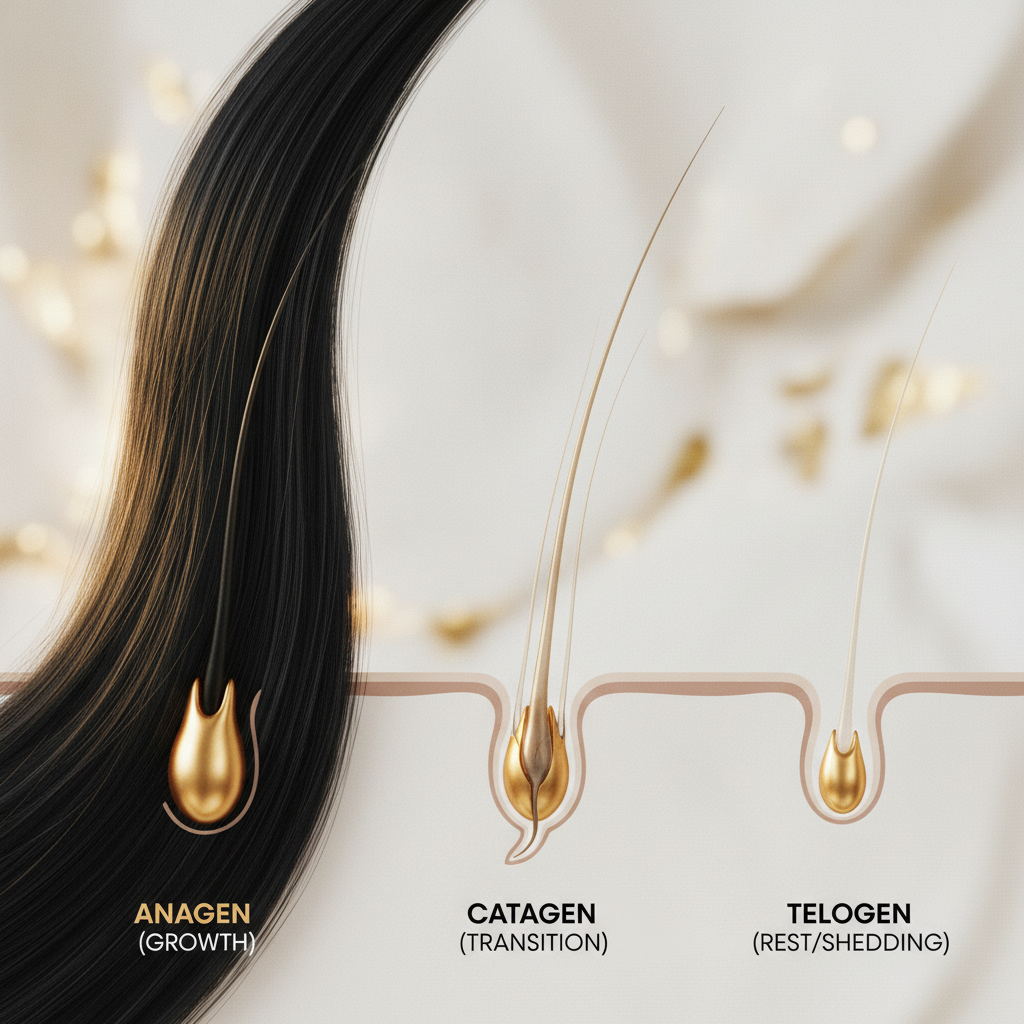
The biological cycle is governed by precise molecular signalling pathways, including Wnt/beta-catenin, bone morphogenetic proteins (BMP), and fibroblast growth factors (FGF). These chemical triggers tell follicular stem cells in the bulge region when to divide, when to rest, and when to regress.
| Stage | Biological Activity | Duration | Typical Scalp Percentage |
|---|---|---|---|
| Anagen | Rapid cellular division at the dermal papilla; active shaft production | 2 to 7 years | 85% to 90% |
| Catagen | Apoptosis in outer root sheath; lower follicle shrinks; bulb detaches | 2 to 3 weeks | 1% to 2% |
| Telogen | Follicular quiescence; dermal papilla enters resting state | 2 to 4 months | 9% to 14% |
| Exogen | Proteolytic cleavage of base; club hair sheds as new anagen fibre emerges | Days to weeks | Normal daily loss (50 to 100 hairs) |
1. The Anagen Phase (Active Growth)
During anagen, matrix cells in the follicle bulb divide rapidly. These dividing cells push upward, keratinise, and harden to form the hair shaft and internal root sheath. Hair grows roughly 1 centimetre to 1.2 centimetres per month during this stage. The duration of your anagen phase dictates how long your hair can physically grow before shedding; someone with a 2 year anagen phase will rarely grow hair past their shoulders, while someone with a 7 year phase can reach their waist.
2. The Catagen Phase (Regression)
Catagen is a brief transitional window lasting 2 to 3 weeks. Here, cellular division ceases entirely. The lower section of the follicle regresses via apoptosis (programmed cell death), shrinking to roughly one-sixth of its original depth. The base of the hair shaft rounds out into a firm, white structure known as a "club hair," and the dermal papilla condenses and moves upward toward the follicle bulge.
3. The Telogen Phase (Resting)
Once the club hair is formed, the follicle enters telogen for roughly 2 to 4 months. The follicle sits completely dormant. The dermal papilla rests detached from the hair shaft, preparing the chemical signals required to trigger the next growth cycle. Under normal conditions, roughly 10 percent of your scalp hairs occupy this phase simultaneously.
4. The Exogen Phase (Shedding)
Many clinical classifications now separate exogen as an active fourth phase rather than a passive sub-phase of telogen. During exogen, specific proteolytic enzymes dissolve the desmosomes anchoring the club hair to the follicular wall. The hair falls away freely during brushing, washing, or gentle traction, often propelled forward by a newly emerging anagen hair germ developing underneath.
What the evidence does not show
Scientific evidence does not show that cosmetic treatments can reset, alter, or permanently accelerate the genetic duration of your anagen phase. Shampoos, scalp oils, and conditioners cannot convert a resting telogen follicle back into an anagen follicle ahead of its biological schedule.
Furthermore, evidence does not show that daily shedding signifies baldness. Losing 50 to 100 club hairs per day is healthy, normal exogen activity. The presence of a small white bulb at the root of a shed hair simply indicates a mature club hair, not that the living follicle has been pulled out by the root. The living stem cells remain safe within the scalp tissue.
How disruptions alter the cycle
External and internal stresses can knock the hair cycle out of rhythm. The most common disruption is telogen effluvium. In this condition, a physiological shock, such as high fever, severe psychological distress, surgery, rapid weight loss, or childbirth, causes a large proportion of growing anagen hairs (sometimes up to 30 to 50 percent) to prematurely enter catagen and telogen simultaneously.

Because the telogen phase naturally lasts 2 to 4 months, the excessive shedding does not begin immediately after the trigger. It appears 8 to 12 weeks later. This delay often makes it difficult for individuals to connect the sudden shedding with the original triggering event. Fortunately, acute telogen effluvium is usually self-limiting; once the stressor resolves, the follicles reset to anagen within 6 to 9 months.
In contrast, androgenetic alopecia does not shorten telogen. Instead, dihydrotestosterone (DHT) binds to susceptible follicles, progressively shortening the anagen phase while elongating the latency period (sometimes termed "kenogen") between exogen and the start of the next cycle. Over successive cycles, the follicle physically shrinks, producing finer, shorter vellus hairs rather than thick terminal fibres.
What you can do to support healthy cycling
While you cannot alter your baseline genetics, you can create the optimal scalp environment to prevent premature cycle interruption:
- Maintain nutritional sufficiency: Follicular matrix cells possess some of the highest metabolic turnover rates in the human body. Deficiencies in iron (specifically serum ferritin below 30 to 50 micrograms per litre), vitamin D3, zinc, and dietary protein can force follicles into premature telogen.
- Minimise scalp micro-inflammation: Seborrhoeic dermatitis and oxidative stress on the scalp generate inflammatory cytokines that destabilise follicle anchorage. Regular cleansing with balanced formulas maintains a clean, balanced scalp microbiome.
- Handle hair gently: Avoid tight hairstyles that exert chronic physical traction. Traction alopecia causes mechanical inflammation that can eventually scar follicles, permanently extinguishing their ability to cycle.
- Differentiate shedding from breakage: Inspect shed strands. A shed hair has a rounded white club bulb at one end. A broken strand has jagged ends, no root bulb, and is often noticeably shorter than your typical hair length.
Cosmetic support from Watermans
For individuals seeking to optimise their daily haircare regimen, topical products support the external scalp environment. Watermans GrowMe Shampoo delivers stimulating botanicals and functional ingredients, including biotin, rosemary extract, caffeine, and niacinamide, directly to the scalp. While cosmetic formulas do not cure medical hair loss conditions, regular use supports a clean, invigorated scalp surface, helps reduce mechanical breakage along the shaft, and ensures hair looks visibly fuller and thicker as it progresses through its natural growth rhythm.
When to seek professional medical advice
You should consult a GP or a registered trichologist if you observe any of the following clinical indicators:
- Sudden, diffuse shedding that persists beyond 6 months without slowing down.
- Distinct, patchy circular bald spots appearing on the scalp or facial hair.
- Visible scalp redness, scaling, burning sensations, or pustules accompanying hair fall.
- Loss of eyebrows or eyelashes alongside scalp shedding.
- Significant widening of the central parting or recession at the temples.
A medical professional can order blood panels to examine full blood count, ferritin levels, thyroid function (TSH), and hormone profiles, ensuring any underlying endocrine or autoimmune issues are correctly diagnosed.
Frequently asked questions about Hair Growth Cycle Stages
Can you extend the anagen stage with scalp massage or vitamins?
There is no clinical proof that scalp massage or over-the-counter dietary supplements can extend your genetic anagen duration beyond its natural biological ceiling. Nutritional supplements will only aid anagen persistence if you are correcting an underlying, blood-tested clinical deficiency, such as low ferritin or severe vitamin D deficiency.
Why do shed hairs have a white bulb on the end?
The white bulb at the root of a shed hair is keratinised protein tissue that formed during the catagen phase, creating a club hair. It is a natural sign of the exogen phase within the Hair Growth Cycle Stages. It does not mean the living follicle was pulled out; the follicular stem cells remain intact in the scalp.
How many hairs is it normal to lose each day?
Losing between 50 and 100 hairs per day is considered typical for an adult with an average scalp density of 100,000 follicles. Individuals who wash their hair less frequently may notice a larger accumulation of loose fibres on wash days, as naturally shed exogen hairs remain trapped within the surrounding strands until rinsed.
How long does it take for hair to grow back after stress shedding?
Once the underlying physiological or emotional trigger is resolved, hair follicles usually reset to the active anagen phase within 3 to 6 months. However, because hair grows at roughly 1 centimetre per month, it can take 12 to 18 months to notice a visible return of fullness throughout your hair's overall length.
Final perspectives on follicular health
Understanding the biological Hair Growth Cycle Stages removes the mystery and alarm surrounding natural shedding. Follicles are dynamic micro-organs that naturally balance rapid growth, planned regression, rest, and renewal. By supporting your body with adequate nutrition, maintaining a clean scalp, and protecting your lengths from physical breakage, you give your follicles the foundation they need to cycle smoothly through every phase of life.
Sources and references
- British Association of Dermatologists (BAD). Telogen Effluvium: An Overview and Diagnostic Guide. Clinical Guidelines.
- National Institute for Health and Care Excellence (NICE). Alopecia: Management and Clinical Assessment (Clinical Knowledge Summaries).
- Paus, R., & Cotsarelis, G. (1999). The Biology of Hair Follicles. The New England Journal of Medicine, 341(7), 491-497.
- Stenn, K. S., & Paus, R. (2001). Controls of Hair Follicle Cycling. Physiological Reviews, 81(1), 449-494.
- Higgins, C. A., et al. (2009). The exogen phase: biological mechanisms of hair shedding. Experimental Dermatology, 18(9), 741-748.
Find these ingredients in Watermans products
- Niacinamide: you will find this ingredient in our Hair Mask.