Androgenetic Alopecia: Understanding Genetic Hair Thinning
8 min read ·
Androgenetic Alopecia is the most common form of progressive hair thinning, primarily driven by genetic predisposition and hormonal influences, though its exact mechanisms are still being researched.
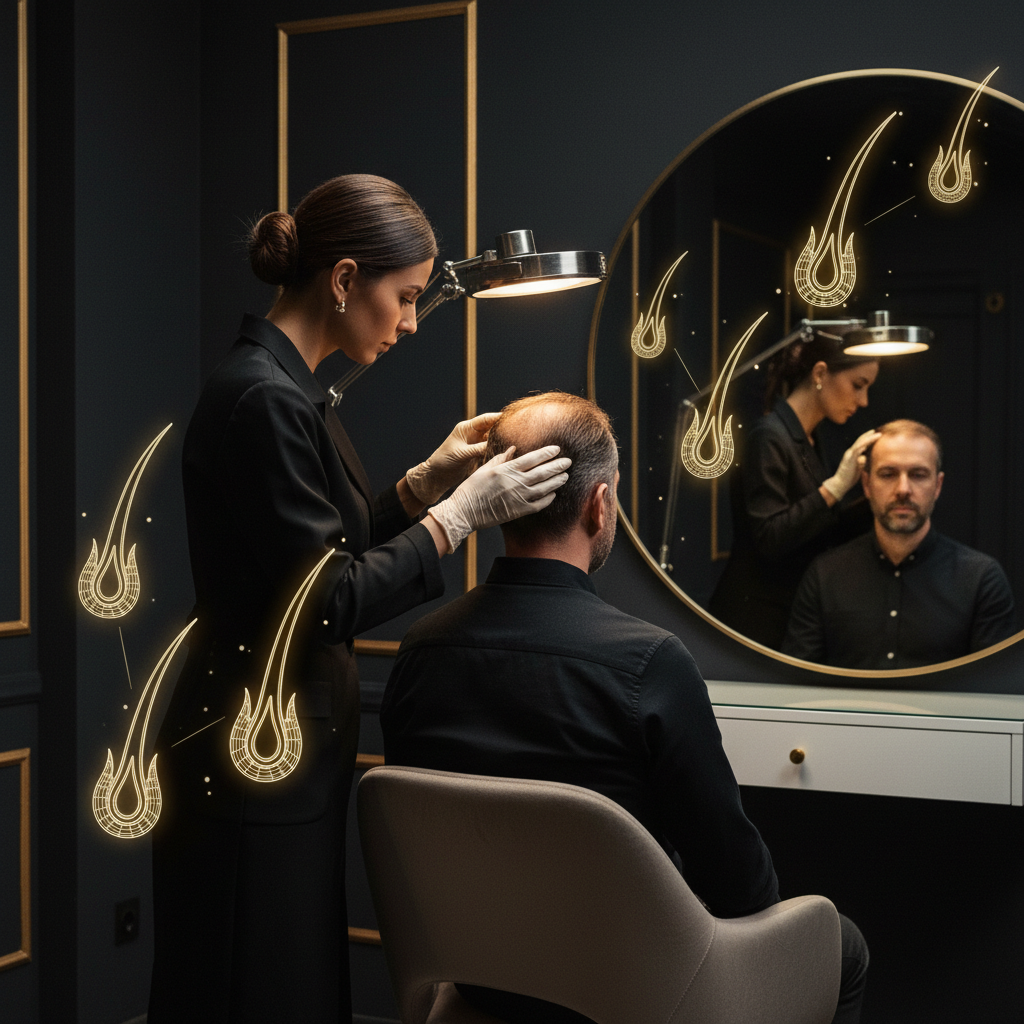
Quick answer: Androgenetic Alopecia is a genetically determined, progressive form of hair thinning affecting both men and women, often referred to as male or female pattern hair loss. It results from hair follicles becoming sensitive to specific hormones, leading to miniaturisation and finer, shorter hairs over time. While its genetic and hormonal basis is clear, fully reversing the process remains a significant challenge, with current treatments focusing on slowing progression or promoting some regrowth.
Key takeaways
- Androgenetic Alopecia is the most common cause of progressive hair thinning, affecting both sexes.
- It's primarily caused by a combination of genetic inheritance and hormonal sensitivity, particularly to dihydrotestosterone (DHT).
- Hair follicles progressively shrink, producing finer, shorter hairs until they may cease production.
- Symptoms differ between sexes: men often experience receding hairlines and crown thinning; women typically see diffuse thinning on the crown while maintaining their frontal hairline.
- Early diagnosis and intervention can help manage the condition and potentially slow its progression.
- Consulting a healthcare professional, such as a dermatologist, is crucial for accurate diagnosis and to discuss treatment options.
Androgenetic Alopecia: what the evidence shows
Androgenetic Alopecia (AGA) is a chronic, progressive form of hair thinning that accounts for the vast majority of cases of hair loss worldwide. It's characterised by a specific pattern of hair loss and is largely influenced by genetics and androgens (male hormones). While often called "male pattern baldness" or "female pattern hair loss", it is the same underlying condition.
The core mechanism involves a process called follicular miniaturisation. This means that over time, affected hair follicles on the scalp shrink, leading to shorter, finer, and less pigmented hair strands. Eventually, these follicles may become dormant, ceasing hair production altogether. Unlike hair shedding, where hair falls out from a healthy follicle, or hair breakage, where the hair fibre snaps, AGA is a condition that impacts the hair growth cycle itself, reducing the duration of the anagen (growth) phase and increasing the telogen (resting) phase.
The role of genetics and hormones in Androgenetic Alopecia
The primary hormonal driver in AGA is dihydrotestosterone (DHT), a potent derivative of testosterone. In individuals genetically predisposed to AGA, an enzyme called 5-alpha-reductase converts testosterone into DHT within the hair follicles. DHT then binds to androgen receptors in susceptible follicles. This binding triggers the miniaturisation process, shortening the hair's growth phase and leading to thinner, shorter hairs with each cycle.
The genetic component of Androgenetic Alopecia is complex. It's not due to a single "baldness gene" but rather a polygenic inheritance pattern, meaning multiple genes contribute to susceptibility. A family history of hair thinning, from either side of the family, increases an individual's likelihood of developing AGA. However, the exact pattern and severity can vary considerably, even among close relatives.
Androgenetic Alopecia: what the evidence does not show
While the roles of genetics and hormones are well-established, many popular beliefs about hair thinning are not supported by scientific evidence. For example, there is no evidence to suggest that wearing hats, frequent shampooing, or specific hairstyles directly cause or worsen Androgenetic Alopecia. Similarly, cosmetic products, including most shampoos and conditioners, cannot reverse the miniaturisation process or stimulate significant hair regrowth beyond supporting existing hair health, unless they contain specific active ingredients with clinically proven efficacy.
Controlled research has not found a direct link between diet alone and the onset or progression of AGA, beyond ensuring adequate nutrition for general hair health. Likewise, stress is primarily linked to temporary hair shedding conditions like telogen effluvium, not the progressive, genetic miniaturisation seen in AGA.
Recognising the signs of Androgenetic Alopecia
The signs of Androgenetic Alopecia develop gradually and differ in presentation between men and women.
Androgenetic Alopecia in Men (Male Pattern Hair Loss)
For men, AGA typically begins with a receding hairline at the temples and/or thinning on the crown (vertex) of the scalp. These areas gradually expand. Over time, the hairline may take on an "M" shape, or the crown may become completely bald, leaving hair primarily on the sides and back of the head. The Norwood-Hamilton scale is widely used by dermatologists to classify the stages of male pattern hair loss.
Androgenetic Alopecia in Women (Female Pattern Hair Loss)
In women, Androgenetic Alopecia usually manifests as a diffuse thinning over the top and crown of the scalp. The frontal hairline typically remains intact, or recedes much less severely than in men. Women rarely experience complete baldness. Instead, hair density decreases, and the scalp may become more visible through the hair, especially when hair is parted. The Ludwig scale is commonly used to grade female pattern hair loss.
What you can do about Androgenetic Alopecia
Early intervention is often key to managing Androgenetic Alopecia. While there's no outright cure, various approaches can help slow progression or stimulate some regrowth. It's important to consult a healthcare professional, such as a dermatologist, to confirm the diagnosis and discuss the most appropriate course of action for your individual situation.
Commonly recommended approaches include:
- Topical Treatments: Minoxidil is an over-the-counter medication applied directly to the scalp. It is believed to work by widening blood vessels, improving blood flow to the follicles, and potentially prolonging the anagen phase of hair growth. It can slow hair loss and, for some, stimulate partial regrowth.
- Oral Medications: For men, finasteride is a prescription oral medication that inhibits the 5-alpha-reductase enzyme, thereby reducing DHT levels in the scalp. This can effectively slow hair loss and encourage regrowth for many men. For women, oral medications are sometimes prescribed, but require careful consideration due to potential side effects and contraindications.
- Lifestyle Considerations: While lifestyle changes don't directly treat AGA, maintaining a balanced diet, managing stress, and protecting your hair from damage (see Heat Styling Safety Best Practices) can support overall hair health. Ensuring your scalp is healthy (see Understanding Scalp Health and Scalp Exfoliation) can also create a better environment for hair growth.
When the cause may be something else
It's important to distinguish Androgenetic Alopecia from other causes of hair loss or thinning. While AGA is very common, other conditions can mimic its symptoms or occur concurrently. A medical professional can help differentiate between them.
- Telogen Effluvium: This is a temporary condition causing excessive hair shedding, often triggered by significant stress, illness, childbirth, or severe nutritional deficiencies. Unlike AGA, it typically resolves once the trigger is removed.
- Alopecia Areata: An autoimmune condition causing patchy, often sudden, hair loss on the scalp or body.
- Thyroid Disorders: Both an overactive and underactive thyroid can lead to diffuse hair thinning.
- Nutritional Deficiencies: Deficiencies in iron, zinc, or biotin can impact hair growth and cause shedding. This is generally reversible with supplementation.
- Traction Alopecia: Hair loss caused by chronic pulling or tension on the hair follicles, often due to tight hairstyles (see Protective Styling: A Comprehensive Guide).
- Scarring Alopecias: A group of inflammatory conditions that destroy hair follicles, leading to permanent hair loss and scarring.
When to get professional advice
If you notice significant or unusual hair thinning, it's always advisable to consult a healthcare professional. A dermatologist specialising in hair and scalp conditions can provide an accurate diagnosis, rule out other potential causes, and discuss appropriate management strategies. Early diagnosis is particularly beneficial for Androgenetic Alopecia, as treatments tend to be more effective when started before extensive miniaturisation has occurred.
Frequently asked questions about Androgenetic Alopecia
Can Androgenetic Alopecia be reversed?
While complete reversal of Androgenetic Alopecia is not typically possible once miniaturisation has significantly progressed, current treatments can often slow down or halt further hair loss. In some cases, partial regrowth of hair that was miniaturising is achievable, particularly with early and consistent intervention. Consistency with prescribed treatments is key for managing the condition.
Is Androgenetic Alopecia hereditary?
Yes, Androgenetic Alopecia has a strong hereditary component. It is influenced by multiple genes inherited from both parents. While a family history increases your risk, the specific pattern and severity of hair thinning can vary within families due to the complex interaction of these genes and other factors.
Does stress cause Androgenetic Alopecia?
Stress itself does not directly cause Androgenetic Alopecia. AGA is a genetic and hormonal condition. However, severe or prolonged stress can trigger another type of hair loss called telogen effluvium, which is characterised by increased hair shedding. It is possible to experience both conditions simultaneously, making diagnosis by a professional important.
How long does it take for Androgenetic Alopecia treatments to work?
Treatments for Androgenetic Alopecia, such as topical minoxidil or oral finasteride, typically require consistent use over several months before any noticeable results appear. It often takes 3 to 6 months to observe reduced hair shedding and 6 to 12 months to see potential regrowth. Continued use is usually necessary to maintain benefits.
Can women get Androgenetic Alopecia?
Absolutely. While often called "male pattern baldness," women also experience Androgenetic Alopecia, known as female pattern hair loss. The presentation differs, with women typically experiencing diffuse thinning over the crown and top of the scalp, rather than a receding hairline or complete baldness, and the frontal hairline usually remains intact.
Understanding and managing Androgenetic Alopecia
Androgenetic Alopecia is a prevalent and progressive condition rooted in genetics and hormonal influences, leading to characteristic hair thinning. While it presents differently in men and women, the underlying process of follicular miniaturisation is the same. There is no instant cure, but with early diagnosis and consistent adherence to evidence-based treatments, it is often possible to slow its progression and improve hair density. Consulting a dermatologist is the most effective first step for anyone concerned about their hair thinning, to get an accurate diagnosis and develop a personalised management plan.
Where Watermans fits
Supporting overall scalp and hair health can complement medical treatments for Androgenetic Alopecia. While Watermans products are not designed to treat or cure medical conditions, they are formulated to create an optimal environment for existing hair, helping it feel stronger and look fuller.
Watermans Grow Me Hair Growth Shampoo and Conditioner are formulated with ingredients like hydrolysed lupin protein and niacinamide. These can help to improve the appearance of hair density, support hair strength, and moisturise the scalp, contributing to a healthier-looking scalp and hair fibre. The products are designed to cleanse gently and provide essential nutrients to the hair and scalp, reducing breakage and improving overall hair condition.
Sources and references
- American Academy of Dermatology Association, Hair Loss: Diagnosis and Treatment, Year not specified, aad.org
- National Institute of Arthritis and Musculoskeletal and Skin Diseases (NIAMS), National Institutes of Health, Hair Loss: An Overview, 2023, niams.nih.gov
- Mayo Clinic, Hair loss (Androgenetic alopecia), Year not specified, mayoclinic.org
- UpToDate, Androgenetic alopecia in males: Pathogenesis, clinical features, and diagnosis, Year not specified, uptodate.com
- UpToDate, Androgenetic alopecia in females: Pathogenesis, clinical features, and diagnosis, Year not specified, uptodate.com
Find these ingredients in Watermans products
- Zinc: you will find this ingredient in our Hair Vitamins.
- Niacinamide: you will find this ingredient in our Hair Mask.