Disulphide Bonds and Chemical Processing: The Science of Hair Integrity
9 min read ·
Understand the role of disulphide bonds and chemical processing in hair strength, curl pattern, and structural breakage with evidence-based insights.
Quick answer: Understanding Disulphide Bonds and Chemical Processing is essential for maintaining hair integrity, as these covalent sulphur linkages provide human hair with its structural strength, elasticity, and shape. Chemical services like perming, relaxing, bleaching, and permanent colouring deliberately alter or break these bonds to reform hair fibre architecture or lighten melanin. However, chemical processing is irreversible: once disulphide bonds are broken, standard salon neutralisers can only reconnect a fraction of them, leaving the cortex permanently weakened and more susceptible to mechanical breakage.
Key takeaways
- Disulphide bonds are strong covalent bonds formed between pairs of cysteine amino acid residues within the hair's keratin cortex.
- Chemical processing deliberately breaks these bonds via alkaline reduction (perms and relaxers) or uncontrolled oxidation (bleach and high-lift colours).
- Relaxers permanently convert disulphide bonds into non-reconnectable lanthionine bonds, permanently altering fibre integrity.
- Re-oxidation steps in perm systems restore roughly 80 to 90 percent of reduced bonds, meaning some structural deficit is unavoidable.
- Bleaching degrades cystine into cysteic acid, stripping the fibre of tensile strength, increasing porosity, and promoting hair breakage.
- Bond-building cosmetics help temporarily reinforce damaged keratin networks, but they do not biologically regrow or fully reverse shattered fibres.
Disulphide Bonds and Chemical Processing: what the evidence shows
Human hair fibres are primarily composed of keratin proteins rich in the sulphur-containing amino acid cysteine. When two cysteine molecules cross-link within the polypeptide chain, they form cystine, which features a robust covalent disulphide bond (-S-S-). These bonds account for the hair's rigidity, mechanical strength, and chemical stability. Unlike weak hydrogen or salt bonds that wash out with plain water, disulphide bonds resist normal washing, moisture, and heat up to roughly 215 degrees Celsius.
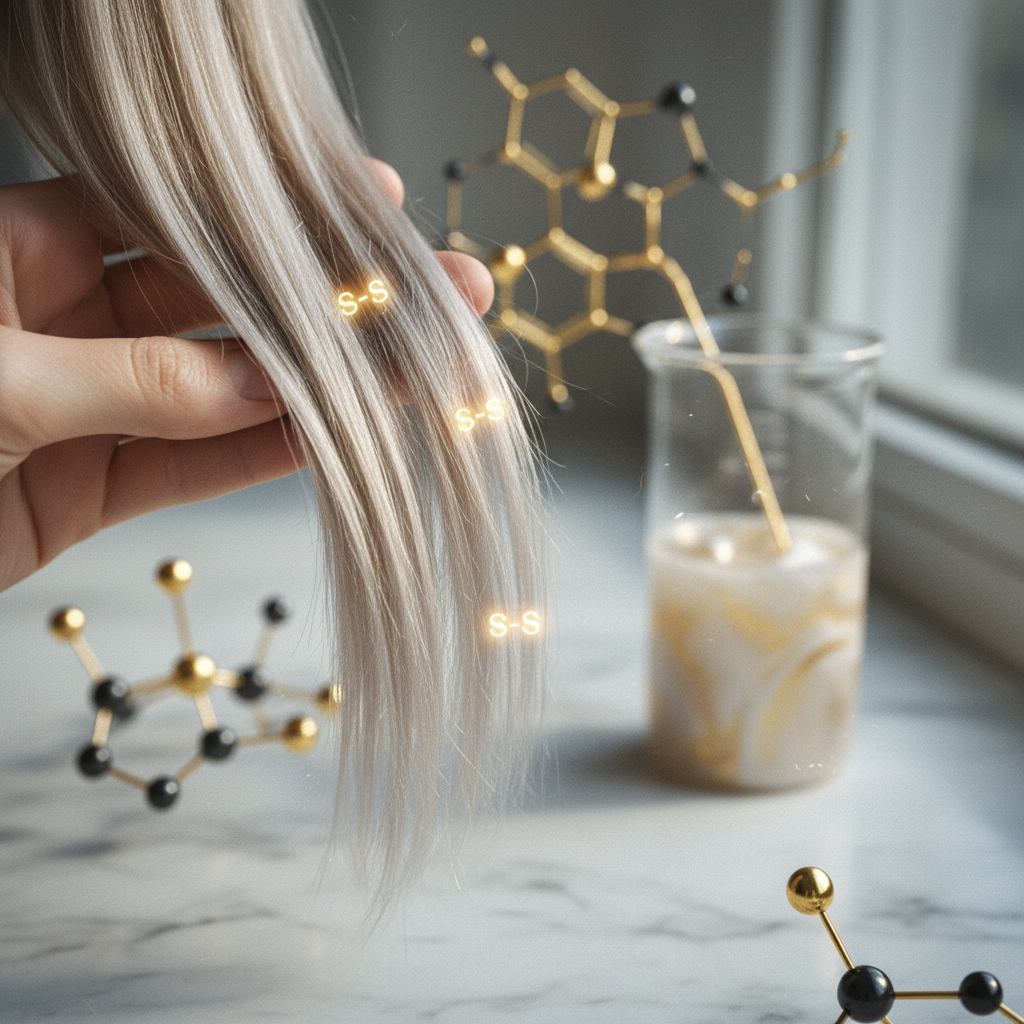
In professional salons, Disulphide Bonds and Chemical Processing are inextricably linked. Every major chemical restructuring or high-lift colouring service relies on intentionally breaking these links:
- Permanent waving (perms): Reducing agents like ammonium thioglycolate (typically pH 8.5 to 9.5) or glyceryl monothioglycolate (pH 6.5 to 8.2) donate hydrogen ions. This cleaves the disulphide bridge into two distinct thiol (-SH) groups. Once the hair conforms to a curler, an oxidising neutraliser (usually hydrogen peroxide at pH 3.0 to 4.0) removes the hydrogen, reforming new disulphide bonds in their new positions.
- Permanent chemical relaxing: Strong alkaline relaxers containing sodium hydroxide (lye, pH 12 to 14) or guanidine hydroxide (no-lye, pH 11.5 to 13.5) break disulphide bonds via beta-elimination. Instead of re-forming disulphide links, this reaction removes one sulphur atom to produce a permanent lanthionine cross-link (-S-). This alters the mechanical flexibility of the cortex indefinitely.
- Bleaching and high-lift colouring: Alkaline persulphate bleaches and peroxide developers (pH 9.0 to 11.0) target dark melanin pigments inside the cortex. As collateral damage, free-radical oxidation attacks adjacent cystine bridges. This converts disulphide bonds into cysteic acid residues, leaving unbonded, negatively charged sites that swell excessively when wet.
What the evidence does not show: myths and realities
Salon marketing frequently claims that specialised treatments can fully "repair", "reconnect", or "undo" the chemical damage caused to hair bonds. The scientific literature shows otherwise.
Controlled biochemical studies reveal that no post-chemical salon treatment fully restores the original, virgin keratin structure. Cosmetic bond builders, which often use small synthetic cross-linkers like bis-aminopropyl diglycol dimaleate or maleic acid copolymers, bridge certain free thiol groups or support hydrogen bonding networks. While these reduce wet comb force and minimise immediate fracture points, they do not reconstitute the dense, native crystalline protein matrix.
Furthermore, products cannot cure hair loss at the follicle level by mending disulphide bonds on the shaft. Disulphide degradation causes hair breakage along the strand, not follicular shedding or medical alopecias.
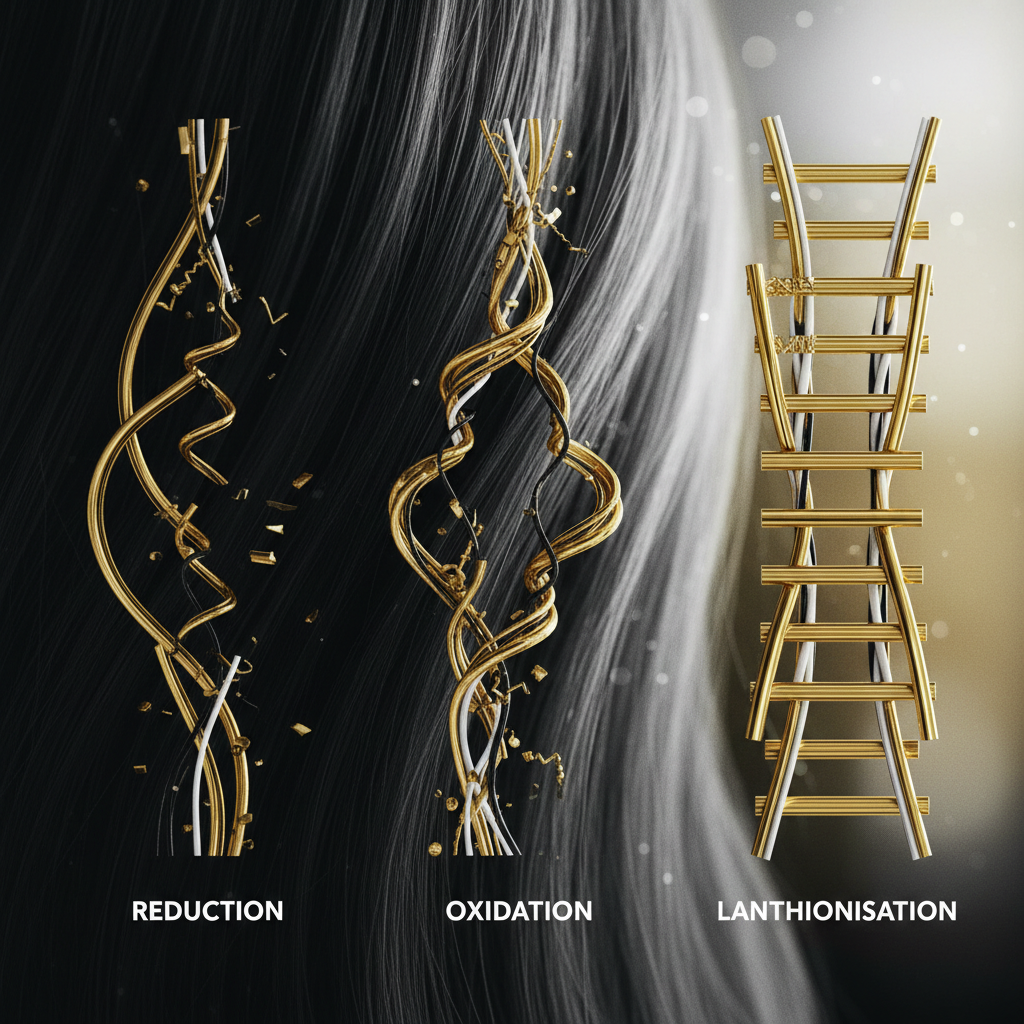
The mechanism: reduction, oxidation, and lanthionisation
To understand how processing alters structural integrity, consider the direct chemical reactions taking place within the cortex:
| Chemical Process | Active Chemistry | Primary Mechanism on Disulphide Bonds | Bond Outcome & Fibre Recovery |
|---|---|---|---|
| Alkaline Perm | Ammonium thioglycolate (pH 8.5 to 9.5) | Chemical reduction adding hydrogen to cleave cystine | Around 80 to 90 percent re-form after oxidation; 10 to 20 percent remain cleaved. |
| Acid Perm | Glyceryl monothioglycolate (pH 6.5 to 8.2) | Slower reduction, gentler cuticular swelling | Re-oxidation leaves fewer free thiols, but curl formation is softer. |
| Hydroxide Relaxing | Sodium hydroxide or guanidine (pH 12 to 14) | Beta-elimination of sulphur; irreversible lanthionisation | 0 percent re-formation of original cystine; fibre acquires non-elastic lanthionine bonds. |
| Bleaching / Lightening | Ammonium persulphate + $H_2O_2$ (pH 9.5 to 11) | Direct oxidative destruction of cystine molecules | Irreversible; converted into hydrophilic cysteic acid, creating significant structural porosity. |
When cystine turns into cysteic acid through bleaching, the isoelectric point of the hair fibre drops. The hair carries a strong negative charge, repels natural hydrophobic lipids (like 18-methyl eicosanoic acid), absorbs excessive ambient humidity, and loses its tensile elastic limit.
Signs of severe disulphide bond degradation
Stylists and individuals can detect severe bond disruption without a laboratory spectrometer. Watch for these distinct mechanical indicators:
- Excessive wet elasticity (gummy texture): Hair that stretches excessively when wet without springing back, feeling spongy or gummy, has suffered profound disulphide cleavage.
- Micro-breakage and snapping: Small fragments of hair snapping off during gentle detangling or towel drying point to loss of cortex tensile strength.
- Extreme porosity: Hair that soaks up water instantly, takes hours to dry, or absorbs colour unevenly indicates cuticular damage alongside cysteic acid formation.
- Loss of natural curl definition: Wavy or curly hair that becomes unevenly flat, limp, or frizzy across specific mid-lengths usually carries severe bond trauma from repeated overlap.
What you can do: protection and damage mitigation
Because lost disulphide bonds cannot naturally regrow along dead keratinised tissue, your focus must sit on prevention and cosmetic preservation:
- Avoid chemical overlapping: Never apply bleach, permanent colour, perms, or relaxers over previously processed hair. Limit processing strictly to the virgin regrowth.
- Respect processing times and concentrations: Use the lowest effective volume of developer (such as 10 or 20 volume rather than 40 volume) to minimise radical oxidation of non-target proteins.
- Incorporate dicarboxylic acid treatments: Use bond-building rinses containing maleic, itaconic, or citric acid variants. These form temporary bridging complexes across split protein chains to lower wet snapping risks.
- Counterbalance with hydrolysed proteins and lipids: Hydrolysed wheat, soy, or keratin proteins temporarily patch gaps in the cuticle, while lipid-rich conditioning agents coat the hydrophobic layer to prevent friction-induced snapping.
- Calibrate thermal styling: Set thermal tools below 180 degrees Celsius. Damaged fibres with lower cystine content denature at lower temperatures than virgin hair.
When the cause may be something else
If you notice excessive hair collecting in your brush or shower drain, determine whether the hair is breaking or shedding:
- Check for the bulb: Shed hairs feature a white keratinised bulb (the club root) at one end, indicating the strand completed its telogen cycle and detached naturally from the follicle. This points to telogen effluvium, hormonal shifts, or genetic pattern hair loss, not chemical processing.
- Check for fractured ends: Broken strands are shorter than your overall hair length, lack a root bulb, and frequently display frayed, white-flecked tips (trichorrhexis nodosa). This is direct mechanical evidence of compromised disulphide bonds.
When to seek professional advice
Seek guidance from a qualified trichologist or colourist if your hair snaps spontaneously under zero tension, or if chemical applications cause burning, weeping, or erythema on the scalp. Chemical burns from high-pH relaxers or persulphate bleaches can damage follicular stem cells, leading to irreversible scarring alopecia if left unaddressed by a medical professional.
Supporting vulnerable strands with Watermans
When chemical processing has compromised your hair's structural core, reducing external mechanical friction and supporting healthy scalp conditions is vital for new growth. The Watermans range provides cosmetic support designed to reinforce brittle, chemically stressed strands:
- Watermans Grow Me Shampoo: Formulated with hydrolysed lupin protein, biotin, caffeine, and rosemary extract, this revitalising wash cleanses the scalp gently without stripping fragile, porous mid-lengths.
- Watermans Condition Me Conditioner: Packed with cholesterol, shea butter, and niacinamide, it deposits crucial biomimetic conditioning agents over disrupted cuticles, smoothing the exterior and reducing daily mechanical breakage during combing.
While no shampoo or conditioner can magically re-tie severed disulphide links, combining gentle handling with rich, non-stripping cosmetic formulations keeps weakened lengths supple while fresh, resilient roots emerge.
Frequently asked questions about Disulphide Bonds and Chemical Processing
Can damaged disulphide bonds be permanently repaired?
No, broken disulphide bonds cannot be permanently re-fused back to their virgin biological state. Salon neutralisers only re-form a portion of reduced bonds, while oxidation from bleach permanently destroys cystine into cysteic acid. Cosmetic treatments provide temporary cross-linking and structural reinforcement, but they cannot reverse the chemical damage entirely.
What happens to disulphide bonds during bleaching?
During bleaching, alkaline persulphates and peroxide developers undergo an aggressive oxidation reaction. While their goal is to degrade melanin pigments, they oxidise cystine cross-links as well. This converts strong disulphide bonds into cysteic acid, significantly reducing fibre elasticity and increasing porosity.
How does hair relaxing differ from perming at a molecular level?
Perming uses reducing agents like thioglycolates to reversibly break bonds, allowing oxidisers to re-link most of them into a new curl pattern. Relaxing uses high-alkalinity hydroxides (pH 11.5 to 14) that permanently convert cystine into lanthionine, permanently stripping one sulphur atom and changing the cortex matrix forever.
Why does chemically processed hair break more easily when wet?
Water naturally disrupts weak hydrogen bonds within the cortex, increasing hair elasticity. In virgin hair, strong disulphide bonds hold the overall framework steady. In chemically processed hair, the disulphide network is already depleted, so adding water leaves the fibre without sufficient structural support, leading to over-stretching and breakage.
Does high heat damage disulphide bonds?
Yes. Exposing hair to temperatures exceeding 200 to 215 degrees Celsius causes thermal degradation of keratin. High heat oxidises cystine, dehydrates structural moisture, and denatures protein helices, leaving the fibre brittle and accelerating mechanical breakage.
Preserving fibre integrity through scientific awareness
Navigating Disulphide Bonds and Chemical Processing requires understanding that every chemical service involves a direct structural trade-off. Disulphide cross-links give human hair its remarkable strength, yet altering or lightening hair inevitably leaves fewer intact bonds behind. By approaching perming, relaxing, and bleaching with conservative processing times, avoiding overlapping applications, and shielding vulnerable hair with protective cosmetic routines, you can achieve your desired aesthetic style while keeping structural breakage to an absolute minimum.
Sources and references
- Robbins, C. R. (2012). Chemical and Physical Behavior of Human Hair (5th ed.). Springer-Verlag.
- Wolfram, L. J. (2001). "Human hair: A unique physicochemical composite." Journal of the American Academy of Dermatology, 45(3), S60-S64.
- Cruz, C. F., et al. (2016). "Human hair characteristics and methods to evaluate hair damage: An overview." International Journal of Cosmetic Science, 38(5), 443-455.
- American Academy of Dermatology. (2022). "Hair styling without damage." AAD Public Health Resources.
- Swift, J. A. (1999). "The mechanics of fracture of human hair." International Journal of Cosmetic Science, 21(4), 227-239.
Find these ingredients in Watermans products
- Biotin: you will find this ingredient in our Hair Growth Shampoo.
- Niacinamide: you will find this ingredient in our Hair Mask.
- Shea Butter: you will find this ingredient in our Curly Hair Conditioner.