Cysteine and Disulphide Bonds in Hair: Structure, Strength, and Repair
9 min read ·
Learn how cysteine and disulphide bonds in hair create strength, define your natural curl pattern, and why broken bonds cause mechanical hair breakage.

Quick answer: Understanding cysteine and disulphide bonds in hair explains how your strands hold their curl, maintain mechanical strength, and resist daily physical stress. Cysteine is a sulphur-rich amino acid that makes up roughly 10 to 18 percent of hair keratin. When two cysteine units oxidise, they form a covalent disulphide bond (cystine), creating the structural scaffolding of the hair fibre. However, once broken by bleach, perm chemicals, or high heat, disulphide bonds do not naturally reassemble, leading to mechanical breakage.
Key takeaways
- Hair keratin is unusually rich in cysteine, an amino acid containing a thiol (sulphur-hydrogen) group.
- Two cysteine residues bond covalently to form cystine, producing disulphide bonds that give hair its permanent shape and tensile strength.
- Disulphide bonds are covalent and cannot be broken by water alone, unlike temporary hydrogen bonds.
- Chemical processes such as bleaching, permanent waving, and alkaline relaxers intentionally or collateral-damage these bonds.
- Severe disulphide bond depletion changes the hair fibre from elastic and resilient to gummy, brittle, and prone to snapping.
- Cosmetic treatments and bond-builders can support or temporarily bridge broken fibres, but they cannot fully restore virgin cross-link density.
Cysteine and Disulphide Bonds in Hair: what the evidence shows
The role of cysteine and disulphide bonds in hair has been documented across decades of cosmetic chemistry and dermatological research. Human hair consists of roughly 65 to 95 percent protein by dry weight, almost entirely composed of keratin and keratin-associated proteins (KAPs).
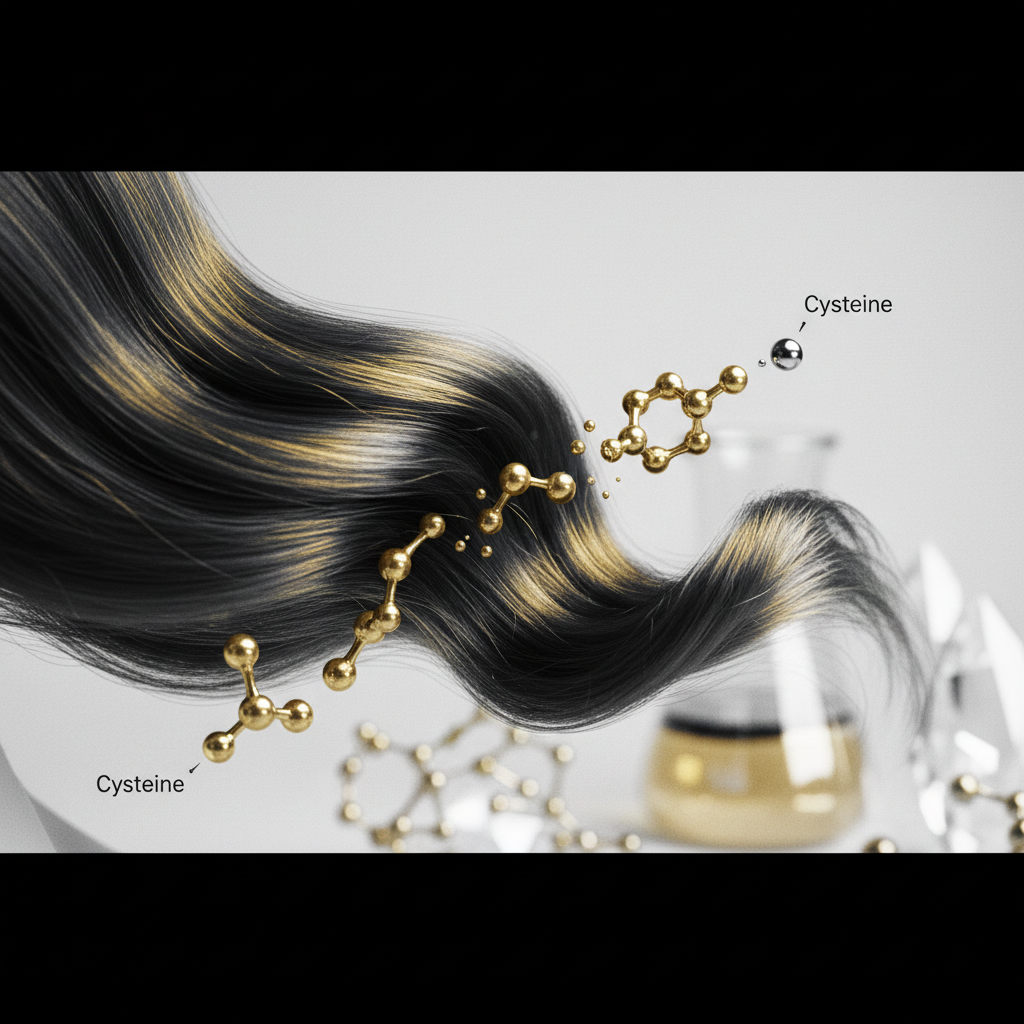
Keratin is distinguished from other structural proteins, such as collagen, by its extraordinarily high content of cysteine. Cysteine accounts for approximately 10 to 18 percent of the total amino acid profile in human hair. Each cysteine molecule contains a reactive thiol group (a sulphur atom bonded to a hydrogen atom, written as -SH).
When hair fibres synthesise inside the follicle bulb, these neighbouring thiol groups undergo an oxidation reaction. The hydrogen atoms detach, and the two sulphur atoms forge a strong, covalent link: a disulphide bond (-S-S-). Once joined, this paired structure is called cystine.
Cosmetic science separates hair stability into three primary bond types:
- Hydrogen bonds: Weak, physical bonds formed between polar groups. These break instantly when hair gets wet and reform as it dries.
- Salt (ionic) bonds: Moderate electrostatic attractions between positive and negative amino acid side chains. These break when hair shifts outside its natural isoelectric point (roughly pH 3.67).
- Disulphide bonds: Strong, covalent chemical bonds. They resist water, heat up to roughly 215 degrees Celsius, and everyday tension. They dictate whether your hair grows straight, wavy, or coily.
Because disulphide bonds reside heavily in both the hair cortex (the thick inner core) and the outer cuticle layers (specifically the exocuticle and A-layer), they govern how much tension your hair can withstand before snapping.
The molecular mechanism of bond manipulation and damage
Disulphide bonds do not break during normal washing or gentle styling. Breaking them requires targeted chemical reduction or aggressive oxidative destruction.
Intact Hair (Strong):
Keratin-CH2-S, , S-CH2-Keratin (Disulphide Bond / Cystine)

Chemical Reduction (Perms / Relaxers):
Keratin-CH2-S-S-CH2-Keratin + 2[H] --> 2 Keratin-CH2-SH (Two Cysteine Residues)

Oxidative Destruction (Bleach / Sunlight):
Keratin-CH2-S-S-CH2-Keratin + [O] --> Keratin-CH2-SO3H (Cysteic Acid / Permanent Loss)
In permanent waving or chemical straightening, reducing agents such as ammonium thioglycolate donate hydrogen atoms to the cystine cross-links. This splits the disulphide bonds back into two separate cysteine thiols (-SH). The stylist physically rearranges the hair on rods or with boards. Next, an oxidising neutraliser (usually hydrogen peroxide) is applied to remove the hydrogen and reform new disulphide bonds in their altered positions. Studies indicate that chemical perming typically reforms only 70 to 85 percent of the original bonds, leaving the remaining sites open or misaligned.
Bleaching and high-lift colouring act much more destructively. Alkaline persulphates and high-volume peroxide penetrate the cortex to dissolve melanin pigment. As a side reaction, they indiscriminately oxidise disulphide bonds past the point of reversibility, converting cysteine into cysteic acid (cysteine sulphonic acid). Cysteic acid carries a permanent negative charge and cannot re-form a disulphide bridge. As cysteic acid levels rise, hair loses tensile strength, absorbs water erratically, and becomes fragile.
| Bond Type | Bond Classification | Broken By | Reformed By | Influence on Hair |
|---|---|---|---|---|
| Disulphide | Covalent chemical | Alkaline reduction, bleach, extreme heat (>220°C) | Chemical neutraliser (partially), synthetic cross-linkers | Permanent curl pattern, mechanical elasticity |
| Salt (Ionic) | Electrostatic | Extreme pH changes (pH <3.0 or >6.0) | Returning fibre to isoelectric point (pH ~4.5 to 5.5) | Fibre firmness, wet manageability |
| Hydrogen | Physical / Dipole | Water, moisture, mild heat | Drying, cooling, re-evaporation of water | Temporary styling (blow-drying, roller sets) |
What the evidence does not show
There are persistent misconceptions regarding cysteine and disulphide bonds in hair that cosmetic science has disproven.
First, cosmetic products cannot "completely rebuild" broken disulphide bonds back to a virgin state. While synthetic bond-building ingredients can create artificial cross-links between free cysteine sites or deposit supportive polymers inside the cortex, they do not turn the biological clock back. Cysteic acid cannot be converted back into intact cystine by a rinse-off conditioner or salon service.
Second, topical cysteine treatments in salons (often marketed as "cysteine smoothing" or "keratin alternatives") do not permanently graft into your hair's internal structural matrix. These treatments typically use free L-cysteine or cysteine derivatives alongside heat to coat the fibre surface and temporarily alter surface charges, smoothing the cuticle for 8 to 12 weeks. They do not permanently regenerate the internal cortical cystine network.
Finally, disulphide bond breakdown does not cause follicular hair loss or medical alopecia. Disulphide cross-links exist exclusively in the dead, fully keratinised hair shaft. If your bonds are ruined by bleach or relaxers, your hair will snap along the shaft (mechanical breakage), but the living follicle under your scalp remains undamaged.
Visible signs of disulphide bond depletion
When the internal cystine scaffolding degrades, the physical properties of the fibre shift unmistakably:
- The "wet chewing gum" sensation: Hair stretches excessively when wet without springing back, feeling soft, mushy, or gummy between your fingers.
- Loss of natural curl definition: Wavy or coily hair appears limp, loose, or flat in over-processed areas, indicating that the cross-links holding its shape have collapsed.
- Fibre snapping under low tension: Hair snaps during gentle detangling or towel drying rather than shedding naturally with a visible white bulb at the root.
- Extreme porosity and water retention: The hair absorbs enormous volumes of water almost instantly, takes hours to dry naturally, yet feels dry and straw-like once moisture evaporates.
Practical ways to support compromised hair fibres
Once disulphide bonds degrade into cysteic acid, you must shift your routine toward protection, protein reinforcement, and friction reduction.
Maintain optimal pH
Hair thrives when the cuticle scales lay flat at an acidic pH between 4.5 and 5.5. Alkaline shampoos expand the cuticle, leaving the cortex vulnerable. Using low-pH conditioners and leave-in rinses contract the cuticle cells, shielding remaining internal bonds from environmental degradation.
Utilise synthetic bond builders and protein complexes
Hydrolysed proteins (wheat, soy, keratin) possess low molecular weights (between 150 and 1,500 Daltons) that allow them to penetrate the hair cortex. While they do not reform covalent disulphide bonds, they temporarily fill voids within the protein matrix, reinforcing tensile strength through ionic and hydrogen networks.
Respect thermal ceilings
Thermal styling tools operated above 185 to 200 degrees Celsius degrade keratin, oxidising cysteine residues into cysteic acid through heat alone. Keep hot tools below 180 degrees Celsius and always use thermal protectants containing silicones or heat-stable polymers.
The Watermans approach to hair vitality
When external processing causes hair breakage, supporting the scalp environment ensures that new growth emerges healthy and structurally sound. Watermans GrowMe Shampoo delivers stimulating botanicals, biotin, rosemary, and hydrolysed lupin protein directly to the scalp without harsh sulphates that dry out stressed hair fibres. Pairing this with Watermans ConditionMe Conditioner provides hydrolysed proteins and cholesterol to smooth lifted cuticles, helping protect fragile, chemically depleted strands from mechanical friction and mid-shaft breakage.
When the cause is something else
If you notice hairs accumulating on your brush or shower drain, check the ends of the fallen fibres.
If the strands have a tiny white bulb attached at one end, the hair has shed from the follicle, which points toward biological hair shedding (such as telogen effluvium, hormonal shifts, or nutritional deficiencies) rather than bond degradation.
If the strands are short, irregular in length, and lack a root bulb, the culprit is mechanical hair breakage driven by disulphide bond depletion, excessive bleaching, or rough handling.
When to seek professional advice
Seek advice from a qualified trichologist or dermatologist if you experience sudden, widespread shedding, thinning patches, or scalp irritation, itching, or inflammation.
If your issues are strictly mechanical (your hair feels gummy, snaps during brushing, or has suffered severe chemical burns from over-bleaching), consult an experienced professional colourist. A skilled stylist can evaluate the remaining tensile strength of your hair, perform an in-salon reconstructive service, or advise a safe cut to remove unsalvageable lengths.
Frequently asked questions about Cysteine and Disulphide Bonds in Hair
What is the primary role of cysteine and disulphide bonds in hair?
The primary role of cysteine and disulphide bonds in hair is to provide structural strength, elasticity, and shape. Cysteine molecules join together through oxidation to form covalent disulphide bonds. These durable bridges cross-link keratin chains within the cortex, dictating your curl pattern and preventing the hair fibre from snapping under mechanical tension.
Can broken disulphide bonds be permanently repaired?
No, broken disulphide bonds cannot be permanently repaired. Once chemical reduction, bleaching, or excessive heat converts cystine into cysteic acid, the reaction cannot naturally reverse. Synthetic bond-building treatments can create artificial cross-links or patch damaged cortex regions, but they offer cosmetic reinforcement rather than true biological regeneration.
How does hair bleach affect disulphide bonds?
Bleach aggressively oxidises the melanin inside the cortex, but it also attacks the sulphur atoms in cystine. It breaks the disulphide link and converts cysteine into cysteic acid. This permanent degradation reduces hair's tensile elasticity, leaving fibres porous, brittle, and prone to breaking off.
Is cysteine used in salon smoothing treatments?
Yes, L-cysteine and cysteine derivatives are common active ingredients in modern smoothing systems. They provide a milder alternative to traditional formaldehyde-based relaxers. These treatments soften surface hydrogen and disulphide bonds temporarily, allowing stylists to blow-dry and iron hair into a smoother, frizz-free state without aggressively destroying the internal cortex.
Summary: Protecting your hair's structural integrity
A comprehensive understanding of cysteine and disulphide bonds in hair clarifies why aggressive chemical processing causes lasting damage. As the primary covalent cross-link inside keratin, cystine provides the strength, elasticity, and structure that keeps hair intact. While no product can fully reconstitute severed disulphide bonds, you can protect what remains by managing thermal stress, keeping cuticle layers smooth with acidic pH formulas, and maintaining a healthy scalp foundation to support robust, newly emerging growth.
Sources and references
- Robbins, C. R. (2012). Chemical and Physical Behavior of Human Hair (5th ed.). Springer-Verlag Berlin Heidelberg.
- Feughelman, M. (1997). Mechanical Properties and Structure of Alpha-keratin Fibres: Wool, Human Hair and Related Fibres. UNSW Press.
- Popescu, C., & Wortmann, F. J. (2010). Hair - fine chemical and physical structure. Journal of Cosmetic Science, 61(6), 481-487.
- Cruz, C. F., Fernandes, M. M., & Cavaco-Paulo, A. (2016). Keratins and keratin-associated proteins in hair. International Journal of Cosmetic Science, 38(5), 446-455.
- Naito, S., et al. (1996). The effect of chemical treatments on human hair cortex. Journal of the Society of Cosmetic Chemists, 47, 105-115.
Find these ingredients in Watermans products
- Biotin: you will find this ingredient in our Hair Growth Shampoo.