Cuticle Health and Surface Lipids: The Science of Hair Fibre Protection
9 min read ·
Explore the science of Cuticle Health and Surface Lipids, how 18-MEA protects hair fibres from friction and breakage, and how to preserve your hair barrier.
Quick answer: Understanding Cuticle Health and Surface Lipids is essential for protecting the hair fibre against daily friction, moisture loss, and mechanical breakage. The hair cuticle consists of overlapping keratin scales coated by an integral fatty acid layer known as 18-methyleicosanoic acid (18-MEA). While this natural lipid layer repels ambient moisture and preserves smoothness, it cannot biologically regenerate once stripped away by chemical processing, high heat, or alkaline cleansing, requiring cosmetic replenishment to mimic its protective barrier.
Key takeaways
- The hair cuticle features 5 to 10 overlapping cellular layers that shield the internal cortex.
- Surface lipids, primarily 18-methyleicosanoic acid (18-MEA), provide a hydrophobic barrier that repels water and reduces inter-fibre friction.
- Chemical bleaching, permanent dyeing, and alkaline relaxers strip surface lipids by breaking covalent thioester bonds.
- Lost surface lipids cannot naturally regrow along the non-living hair fibre; they must be managed with biomimetic conditioning agents.
- Stripped lipids leave the hair hydrophilic, meaning it swells rapidly in water, tangles easily, and becomes vulnerable to breakage.
Cuticle Health and Surface Lipids: what the evidence shows
Peer-reviewed cosmetic dermatology demonstrates that Cuticle Health and Surface Lipids form the primary defence mechanism of the human hair shaft. Human hair is not living tissue once it emerges from the scalp. Therefore, preserving the structural architecture of the cuticle determines how resilient, shiny, and manageable hair remains over months or years.
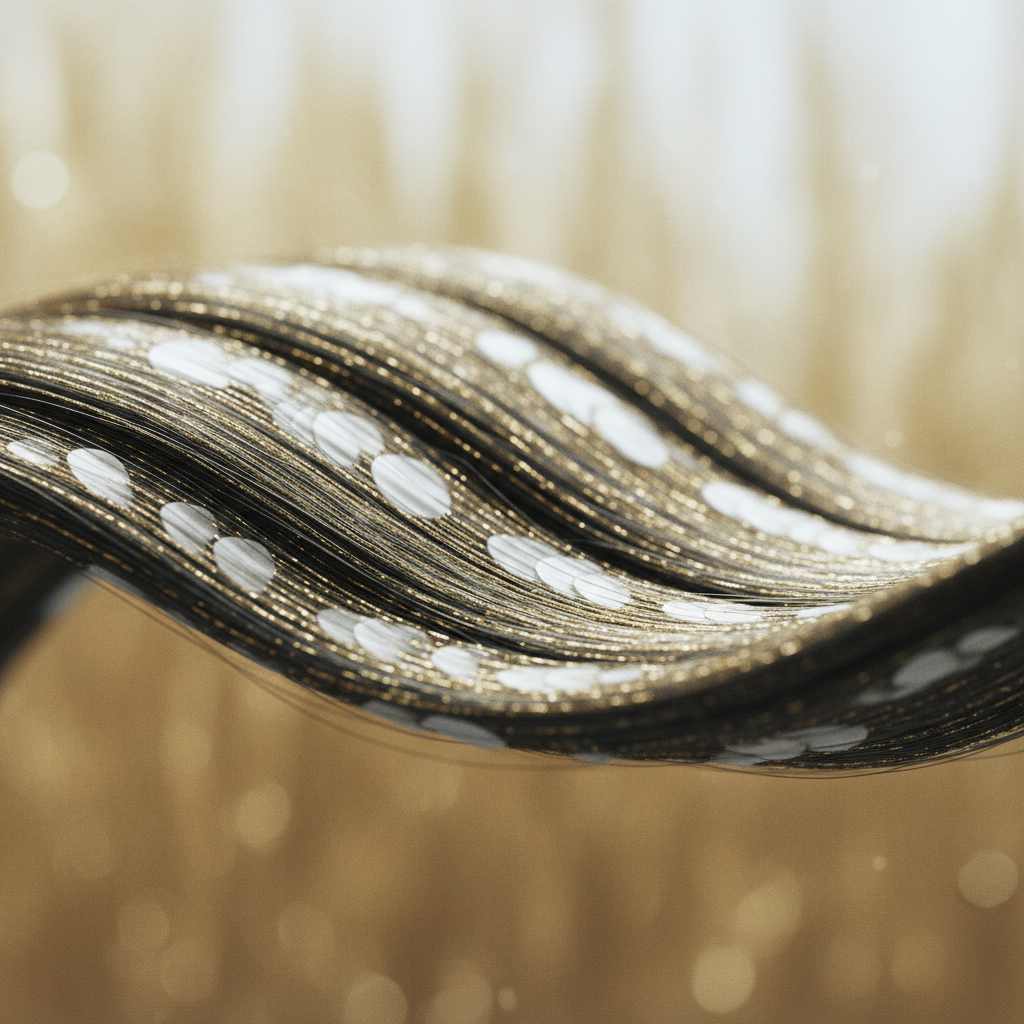
Electron microscopy studies reveal that virgin hair exhibits a tight, shingle-like arrangement of flattened cuticle cells pointing toward the tip. Each cuticle cell is roughly 0.3 to 0.5 micrometres thick. Cementing the outermost layer is the epicuticle, covered by an extremely thin lipid monolayer comprised mostly of 18-methyleicosanoic acid (18-MEA) along with free fatty acids like palmitic, stearic, and oleic acids.
This lipid layer creates a hydrophobic surface. Hydrophobic hair naturally repels environmental humidity and prevents rapid water absorption during washing. When water enters hair unchecked, the cortex swells, stretching the cuticle outward and promoting micro-cracks. Intact surface lipids lower the coefficient of friction between individual strands, allowing hairs to glide past each other without snagging, snapping, or forming knots.
Virgin Hydrophobic Surface (Intact 18-MEA)
 │
 ├── Alkaline / Chemical / Heat Insult
 │
 ▼
Damaged Hydrophilic Surface (Stripped Lipids)
 │
 ├── Increased Water Absorption
 ├── Elevated Friction & Tangling
 └── Cuticle Chipping & Cortical Breakage
The structural mechanism of cuticle layers and lipids
To understand cuticle degradation, you need to examine the cross-section of a single cuticle cell. Each cell contains three distinct protein layers beneath the surface lipid envelope:
- The Epicuticle: The outermost semi-permeable membrane, roughly 2.5 to 5 nanometres thick, to which the 18-MEA lipid layer is covalently bound via thioester linkages.
- The Exocuticle: A rigid layer rich in cystine (around 30% of its amino acid content), providing high structural rigidity and resistance to physical pressure.
- The Endocuticle: An interior layer with very low cystine content (around 3%), making it softer, more swelling-prone, and mechanically vulnerable when wet.
When the 18-MEA barrier is intact, water moves slowly into the fibre. When chemical processes (such as bleaching with hydrogen peroxide or permanent relaxing at pH 11 to 13) hydrolyse the thioester bonds holding 18-MEA in place, the epicuticle is breached. The soft endocuticle beneath swells dramatically when exposed to water, pushing the exocuticle outward. This causes the edges of the scales to lift, crack, and break away, exposing the fragile structural cortex beneath.
What the evidence does not show
There is no clinical evidence that surface lipids can be regenerated organically by the hair shaft. Because the hair fibre is biologically non-living protein, no nutritional supplement, systemic vitamin, or scalp oil treatment can "re-grow" 18-MEA onto an existing strand once those chemical bonds are cleaved.
Furthermore, evidence does not show that natural plant oils (such as pure coconut, argan, or olive oil) duplicate the exact molecular organisation of native 18-MEA. While plant oils can temporarily coat the fibre and reduce friction, they do not covalently bond to the epicuticle. Uncontrolled saturation with heavy oils can also cause buildup without correcting the underlying hydrophilic porosity of chemically processed hair.
Comparing intact versus damaged cuticle architecture
| Feature | Intact Cuticle & Lipids | Compromised Cuticle & Stripped Lipids |
|---|---|---|
| Surface State | Hydrophobic (repels liquid water) | Hydrophilic (absorbs water rapidly) |
| Friction Level | Low coefficient of friction; strands glide | High friction; strands snag and mat |
| Contact Angle | High water droplet contact angle (> 90°) | Low contact angle (< 45°); droplet flattens |
| Cuticle Margin | Flat, smooth, edges closely aligned | Lifted, jagged, chipped scale edges |
| Primary Risk | None; normal physiological shedding | Fibre snap, split ends, severe breakage |
| pH Sensitivity | Tolerates mild mechanical handling | Swells and frays rapidly above pH 5.5 |
Signs of depleted surface lipids and damaged cuticles
Identifying loss of surface lipids early helps you modify your hair maintenance routine before cuticle loss turns into structural breakage along the shaft:
- Instant wetting: When you submerge healthy hair, water beads on the surface for a moment. Lipid-depleted hair wets out almost instantly.
- Prolonged drying times: Hair stripped of protective lipids absorbs excessive core water, causing it to take twice as long to blow-dry or air-dry.
- Persistent roughness: Rubbing a strand from the tip upward toward the root feels abrasive, catching against your fingertips.
- Static and flyaways: Without natural surface fatty acids to balance surface conductivity, individual hair strands accumulate static electrical charges easily.
- High wet tangling: Strands knot tightly when shampooed, requiring excessive force to comb through.
Practical steps to protect and mimic surface lipids
Because 18-MEA cannot regrow, your cosmetic regimen must aim to prevent lipid degradation and deposit biomimetic substitutes:
1. Maintain an acidic pH balance
The natural isoelectric point of hair fibre is roughly pH 3.67, while a normal scalp surface sits around pH 5.5. Cleansers formulated above pH 6.0 swell the cuticle scales and accelerate lipid loss. Use shampoos and conditioners buffered to an acidic pH (between 4.5 and 5.5) to keep cuticle scales contracted and flat.
2. Use biomimetic conditioning agents
Cationic surfactants (such as behentrimonium chloride or cetrimonium chloride) carry positive charges that bind electrostatically to the negative charges exposed on lipid-depleted hair. Formulations containing functionalised 18-MEA analogues, amino acids, and hydrolysed wheat or pea proteins help patch micro-voids in the cuticle wall.
3. Mitigate thermal degradation
Direct heat styling above 180°C directly degrades surface lipids and denatures cortical keratin. Always apply leave-in conditioning formulas containing dimethicone, amodimethicone, or plant-derived lipid films to distribute thermal energy evenly and reduce heat transfer shocks.
4. Limit aggressive chemical processing
Bleaching agents oxidise the sulphur atoms within the cuticle's thioester bonds, turning them into cysteic acid groups. If you dye or lighten your hair, space sessions at least 8 to 10 weeks apart and avoid overlapping bleach applications onto previously processed hair lengths.
When the cause may be something else
It is vital to distinguish between hair fibre damage and true follicular conditions. Losing hair at the root (shedding) is biologically separate from hair snapping mid-shaft due to cuticle failure:
- Telogen Effluvium: Marked by a sudden increase in whole hairs falling from the scalp, identifiable by a white bulb at the root end. This is a physiological shedding response to systemic stress, illness, or hormonal shifts, not a cuticle problem.
- Androgenetic Alopecia: Characterised by progressive follicular miniaturisation and thinning along the parting or crown. The cuticle of the fine hair may be structurally healthy, but the follicle is producing a thinner diameter fibre.
- Trichorrhexis Nodosa: A condition where the cuticle is entirely worn away in localised swollen nodes, causing the inner cortex fibres to splay like two paintbrushes pressed together. This is an advanced manifestation of mechanical or chemical breakage.
When to seek professional advice
Consult a certified trichologist or consultant dermatologist if you notice sudden shedding from the scalp exceeding 100 to 150 hairs daily, patchy bald spots, scalp inflammation, tenderness, or scaling.
Conversely, if your scalp is calm but your hair lengths are visibly fraying, snapping upon gentle combing, or failing to retain length past a certain point, visit a professional salon stylist trained in hair structural preservation. A stylist can trim split ends before cracks propagate upwards, evaluate your chemical processing schedule, and recommend salon-grade acidic treatments.
Watermans: supporting complete hair and scalp care
While preserving the cuticle safeguards the hair shaft, healthy hair growth begins at the follicle. Watermans approaches haircare through comprehensive scalp and root support. Products formulated with natural active ingredients, caffeine, biotin, and restorative botanicals create an optimal scalp environment for emerging fibres, helping you maintain vitality from root to tip alongside your cuticle care routine.
Maintaining Cuticle Health and Surface Lipids over time
Sustaining Cuticle Health and Surface Lipids requires consistent, defensive daily care rather than occasional deep treatments. The human hair fibre is an intricate biological composite that relies entirely on an ultra-thin barrier of fatty acids to resist environmental wear. By using pH-balanced products, reducing thermal exposure, avoiding unnecessary chemical over-processing, and treating wet hair with gentle mechanical care, you can preserve the structural integrity of your cuticles and prevent premature breakage.
Frequently asked questions about Cuticle Health and Surface Lipids
Can surface lipids regrow naturally on damaged hair?
No, surface lipids cannot regenerate naturally along the hair shaft. Hair is non-living tissue, so once 18-MEA fatty acids are stripped by chemical bleaching or high heat, the biological connection cannot re-form. You must use cosmetic conditioners and biomimetic lipids to artificially seal the cuticle scales.
How does pH level affect Cuticle Health and Surface Lipids?
Alkaline products with a pH above 7.0 force the cuticle scales to lift and swell, straining the epicuticle membrane and stripping fatty acids. Acidic products with a pH between 4.5 and 5.5 keep the cuticle layers compressed and smooth, protecting Cuticle Health and Surface Lipids against mechanical friction.
What is 18-MEA, and why is it important for the cuticle?
The lipid 18-methyleicosanoic acid (18-MEA) is the primary fatty acid covalently bound to the outer epicuticle layer of hair. It creates an essential hydrophobic barrier that repels water, prevents cortical swelling, and lowers friction between strands to prevent mechanical breakage.
Does brushing wet hair damage the cuticle?
Yes. Wet hair swells, lifting the cuticle edges and weakening the internal hydrogen bonds of the cortex. Brushing wet hair creates high friction and mechanical tension, which easily chips the delicate scale margins and pulls vulnerable fibres past their elastic limit.
Sources and references
- Robbins, C. R. (2012). Chemical and Physical Behavior of Human Hair. 5th edition. Springer-Verlag.
- Swift, J. A. (1999). Human hair cuticle: mechanically strong or biologically weak? International Journal of Cosmetic Science, 21(4), 227-239.
- Breakspear, S., et al. (2022). The 18-MEA lipid layer of human hair: distribution, loss, and cosmetic mitigation. Journal of Cosmetic Dermatology, 21(8), 3410-3419.
- Gavazzoni Dias, M. F. (2015). Hair cosmetics: An overview. International Journal of Trichology, 7(1), 2-15.
- Sinclair, R. D. (2007). Healthy hair: what is it? Journal of Investigative Dermatology Symposium Proceedings, 12(2), 2-5.
Find these ingredients in Watermans products
- Biotin: you will find this ingredient in our Hair Growth Shampoo.