Cuticle Damage and Weathering: Mechanisms, Prevention, and Care
9 min read ·
Cuticle damage and weathering causes rough texture, tangles, and breakage. Learn the biological mechanisms behind hair weathering and how to protect your strands.
Quick answer: Cuticle damage and weathering describes the progressive physical and chemical breakdown of the hair fibre's outermost protective layer from environmental exposure, mechanical grooming, and heat. As the overlapping scales wear away from root to tip, the inner cortex is exposed to moisture loss and structural decay. While cosmetic treatments can smooth the surface, seal lifted edges, and significantly reduce friction, severed or completely stripped cuticle scales cannot biologically regenerate because hair is non-living keratinised tissue.
Key takeaways
- Hair weathering is an inevitable, progressive process that naturally increases along the length of the shaft from scalp to ends.
- The cuticle consists of 5 to 10 overlapping cellular layers bound by a lipid membrane rich in 18-methyleicosanoic acid (18-MEA).
- Environmental ultraviolet radiation, chemical processing, thermal styling, and daily mechanical friction accelerate cuticle erosion.
- Cuticle breakdown leads to increased porosity, tangled strands, rough texture, and eventually mid-shaft breakage or split ends (trichoptilosis).
- Hair cannot self-repair once the cuticle layer is degraded; maintenance relies entirely on protective styling habits and biomimetic conditioning agents.
Cuticle damage and weathering: what the evidence shows
Cuticle damage and weathering represents the gradual erosion of the hair shaft caused by cumulative environmental and grooming stresses. In trichology and cosmetic dermatology, "weathering" specifically denotes the physical and chemical alterations that take place as hair grows away from the scalp. Because human scalp hair grows roughly 1 to 1.25 centimetres per month, a shoulder-length strand has survived two to three years of daily exposure to UV light, water, friction, and heat.
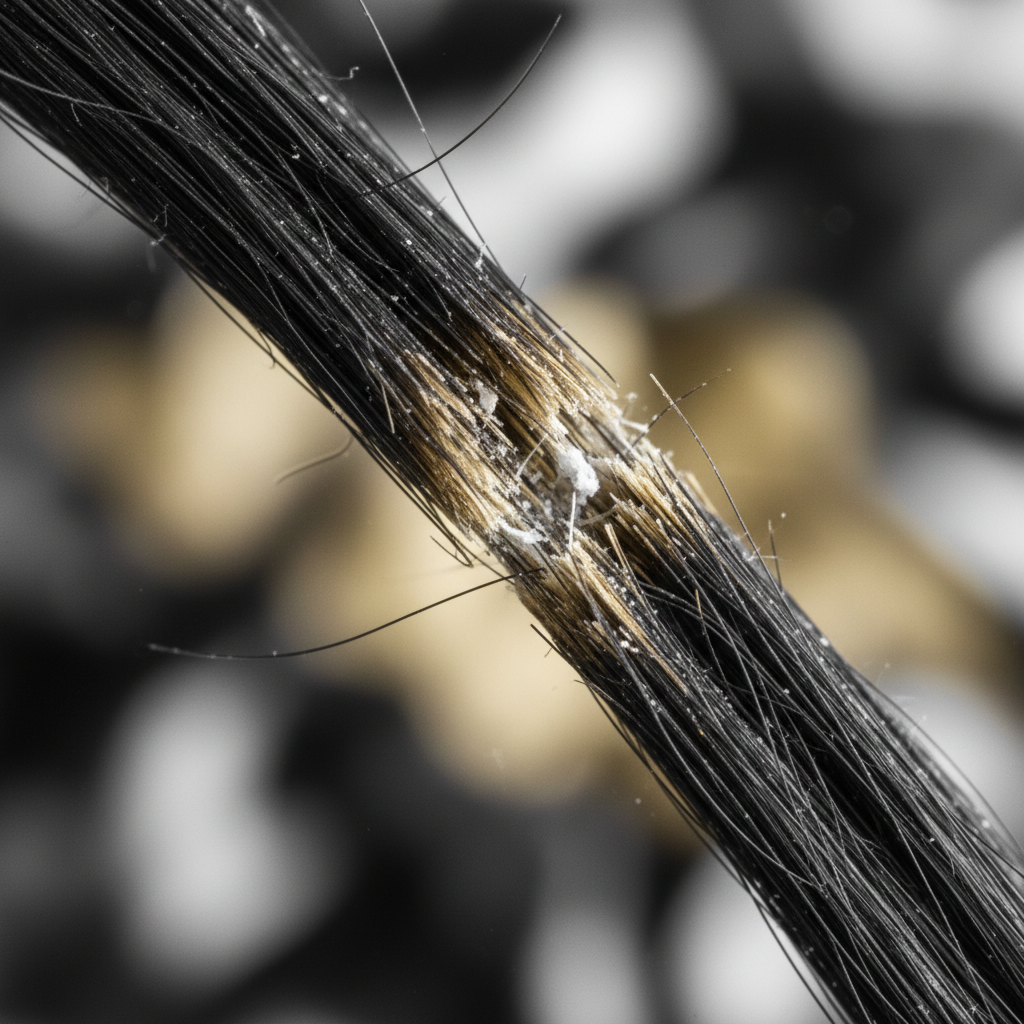
Research published in the International Journal of Cosmetic Science and the Journal of the Society of Cosmetic Chemists shows that virgin, unweathered hair near the root possesses a smooth, intact cuticle with well-defined margins. As you move towards the tip, mechanical forces such as brushing and towel-drying combine with UV radiation to crack, lift, and chip these protective tiles. Over time, the outer layers wear away entirely, leaving the delicate, fibrous cortex unprotected.
Crucially, the evidence shows that weathering is distinct from follicular hair loss conditions such as androgenetic alopecia or telogen effluvium. Weathering affects the non-living hair shaft. It produces fibre breakage, fraying, and loss of tensile strength, but it does not cause the hair follicle to stop producing new fibres.
What the evidence does not show
Controlled studies do not support the idea that cosmetic products can permanently "heal" or rebuild eroded cuticle scales back to their biological state. Cosmetic terminology often promises to "repair damaged hair fibres", but dead, keratinised cells lack cellular machinery. Once the outer cuticle layers are physically stripped away, topical formulas cannot regrow them.
Furthermore, evidence does not show that hard water or everyday sunlight instantly destroys virgin cuticles in a single exposure. Rather, weathering is strictly cumulative. A single day at the beach or one aggressive brushing session causes minor microscopic shifts, but visible deterioration requires repeated mechanical and environmental stress over weeks and months.
The biological mechanism of hair weathering
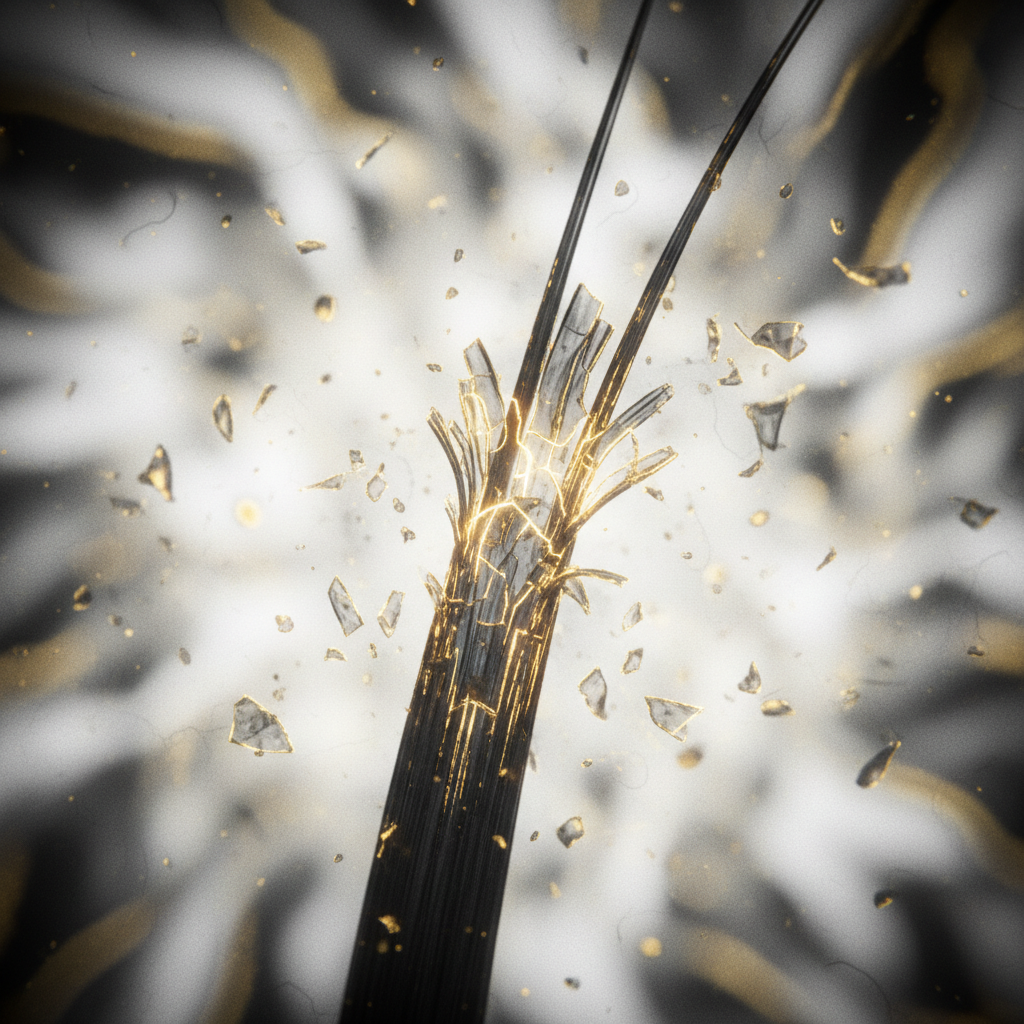
To understand how weathering occurs, you have to look at the anatomy of the cuticle. The cuticle forms a protective sheath around the hair cortex, comprising roughly 10 percent of the fibre's total weight. It consists of 5 to 10 flat, overlapping scales arranged like roof tiles, pointing outward from root to tip.
Each cuticle cell contains distinct proteinaceous layers:
- The Epi-cuticle: A thin outer membrane covered by the F-layer, a monolayer of fatty acids dominated by 18-methyleicosanoic acid (18-MEA). This lipid layer gives healthy hair its natural hydrophobicity, causing water to bead off the surface.
- The A-layer: A high-cystine, cross-linked protein structure (over 30 percent cystine) that provides chemical and mechanical resistance.
- The Exo-cuticle: Another cystine-rich region (roughly 15 percent cystine) that maintains structural rigidity.
- The Endo-cuticle: A low-cystine, soft protein layer that swells readily when exposed to water.
Weathering begins when chemical treatments, alkaline products (above pH 6.0), or ultraviolet radiation oxidise the lipid F-layer. The removal of 18-MEA strips the hair of its water-repellent barrier, turning it from hydrophobic to hydrophilic. Without this protective lipid seal, water easily penetrates the endocuticle, causing it to swell dramatically. As the hair dries, the endocuticle contracts. This cyclic expansion and contraction, known as hygral fatigue, places intense mechanical stress on the brittle outer layers, eventually causing the cuticle edges to lift, crack, and break away.
[Intact Cuticle: Root]
├── Hydrophobic F-layer (18-MEA intact)
├── Sealed, overlapping scales
└── Cortex fully shielded

[Weathered Cuticle: Mid-shaft to Ends]
├── F-layer oxidised (hair becomes hydrophilic)
├── Cuticle margins lift, chip, and erode
└── Cortex exposed to moisture loss, UV, and tensile snapping
Signs of cuticle damage to look for
Identifying cuticle damage early helps you adjust handling techniques before irreversible structural breakage takes place:
- Rough, abrasive texture: Running your fingers from the ends up toward the roots creates a distinct friction or rough, rasping sensation.
- Dullness and loss of shine: Healthy cuticle scales lie flat, forming a smooth, uniform surface that reflects light specularly. Lifted or eroded scales scatter light diffusely, making the hair look matte or lifeless.
- Chronic tangling and knotting: Lifted cuticle margins hook onto adjacent strands like tiny barbs, leading to severe friction knots and comb resistance, especially when wet.
- High porosity: Damaged hair absorbs water almost instantly when wet, yet loses that hydration just as fast, leaving the fibre feeling brittle and dry shortly after washing.
- Split ends (trichoptilosis): Complete erosion of the cuticle allows cortical macrofibrils to unravel, splitting the tip into two or more distinct filaments.
Cuticle erosion compared across hair zones
| Characteristic | Root zone (proximal) | Mid-shaft zone (medial) | End zone (distal) |
|---|---|---|---|
| Cuticle layers | 6 to 10 intact layers | 3 to 6 worn layers | 0 to 2 eroded layers |
| Surface chemistry | Hydrophobic (18-MEA intact) | Moderately hydrophilic | Highly hydrophilic |
| Light reflection | High specular shine | Moderate, patchy shine | Low, diffuse reflection |
| Tensile resistance | Maximum structural elasticity | Moderate elasticity | High risk of transverse snapping |
| Typical porosity | Low porosity | Normal to high porosity | Extreme porosity |
What you can do: protective habits and cosmetic management
Because stripped cuticle tissue cannot regenerate, successful management focuses on slowing further degradation and temporarily mimicking the lost protective lipid layer.
1. Maintain an optimal acidic pH
The natural pH of the hair shaft sits between 3.67 and 5.5. Washing with alkaline soaps or clarifying formulas raises the cuticle scales, accelerating mechanical wear during lathering. Using shampoos and conditioning rinses balanced between pH 4.5 and 5.5 keeps the cuticle compact and minimises swelling.
2. Replenish surface lubricity
Conditioning formulations containing cationic surfactants (such as behentrimonium chloride or cetrimonium chloride), fatty alcohols, and lightweight plant oils adhere electrostatically to negatively charged, damaged hair sites. These ingredients lower the friction coefficient, allowing hair fibres to slide past one another without snagging.
3. Minimize mechanical trauma
- Never rub wet hair vigorously with rough cotton towels; squeeze gently with a smooth microfibre cloth instead.
- Detangle hair using wide-tooth combs or flexible-bristle brushes, beginning at the tips and working slowly upward toward the roots.
- Avoid excessive dry brushing, which creates mechanical friction that physically chips delicate scale margins.
4. Thermal and environmental shielding
Heat tools set above 180 degrees Celsius break down structural keratin and rapidly degrade remaining cuticle layers. Always apply heat protectants containing film-forming polymers before blow-drying or straightening. When exposed to strong sunlight, wearing wide-brimmed hats or applying leave-in products with UV filters shields the cystine bonds in the cuticle from photo-oxidation.
When the cause may be something else
If you notice significant shedding from the scalp where hairs fall out with a white bulb attached, the root cause is not weathering. Telogen effluvium, nutritional deficiencies (such as iron or ferritin deficits), thyroid imbalances, and androgenetic alopecia occur within the dermal papilla inside the scalp.
Similarly, if hair snaps within a few millimetres of emerging from the follicle, explore potential chemical burns from recent bleach, or genetic shaft disorders such as trichorrhexis nodosa or monilethrix. Weathering typically displays a clear, gradual gradient along the length of the fibre, with the worst damage always concentrated at the older ends.
Watermans approaches to fibre care
For those seeking to support their daily haircare regimen, Watermans provides carefully balanced, nutrient-dense formulas designed to invigorate the scalp while preserving the physical integrity of fragile strands. Products such as Watermans Grow Me Shampoo and Condition Me Conditioner blend natural hydrolysed proteins, cholesterol, and essential botanical extracts.
These formulas help replenish surface conditioning and reduce the friction that leads to mechanical breakage. By delivering targeted ingredients directly to the hair and scalp without aggressive sulphates, they help maintain a clean, resilient environment for hair to flourish through every stage of its growth cycle.
Frequently asked questions about Cuticle Damage and Weathering
Can deep conditioners permanently repair cuticle damage and weathering?
No. Deep conditioning products cannot permanently reverse cuticle damage and weathering because hair contains dead keratinised tissue. However, quality conditioning masks deposit biomimetic lipids, cationic conditioning polymers, and hydrolysed proteins onto the hair shaft. This forms a temporary protective film that smooths the rough exterior, reduces comb friction, and seals lifted edges until your next wash.
How does weathering differ from genetic hair thinning?
Weathering is an external, mechanical, and environmental deterioration of the hair shaft itself, leading to rough textures, split ends, and mid-shaft snapping. Genetic hair thinning (androgenetic alopecia) is a follicular process where DHT causes the follicle to miniaturise over successive cycles, eventually producing finer, shorter hairs directly at the scalp level.
Why does sun exposure accelerate cuticle weathering?
Sun exposure exposes hair to UVA and UVB radiation. Photons penetrate the outer layers and generate reactive oxygen species, oxidising the cystine-rich proteins and stripping the protective 18-MEA lipid coating. This photo-oxidation makes cuticle scales brittle, dry, and prone to flaking away under everyday brushing.
Can trimming regularly stop hair weathering completely?
Trimming does not stop weathering from occurring, but it removes the oldest, most eroded sections before split ends travel upward into healthier segments of the hair shaft. Regular micro-trims every 8 to 12 weeks prevent distal splitting from compromising the structural strength of the mid-lengths.
Practical steps to protect your hair
Managing cuticle damage and weathering comes down to preserving the structural barrier your hair was grown with. You cannot replace worn-away cuticle cells once they have detached from the cortex, but you can alter your daily routine to dramatically cut down on future wear and tear. By using pH-balanced cleansers, detangling gently with appropriate slip, shielding hair from UV and thermal extremes, and regularly trimming weathered ends, you protect the internal core of your hair fibre and keep your strands looking smooth, healthy, and resilient.
Sources and references
- Robbins, C. R. (2012). Chemical and Physical Behavior of Human Hair. 5th ed. Springer-Verlag New York. DOI: 10.1007/978-3-642-25611-0.
- Dawber, R. (1996). Hair: Its structure and response to cosmetic preparations. Clinics in Dermatology, 14(1), 105-112.
- Sinclair, R. D. (2007). Healthy hair: what is it? Journal of Investigative Dermatology Symposium Proceedings, 12(2), 2-5. DOI: 10.1038/sj.jidsymp.5650046.
- Swift, J. A. (1999). The mechanics of fracture of human hair. International Journal of Cosmetic Science, 21(4), 227-239.
- Trueb, R. M. (2009). Oxidative stress in ageing of hair. International Journal of Trichology, 1(1), 6-14. DOI: 10.4103/0974-7753.51923.