The Chemistry of Disulphide Bonds in Hair: Structure, Function, and Damage
10 min read ·
Discover the chemistry of disulphide bonds in hair: how covalent sulphur linkages dictate curl, strength, and elasticity, and how chemical processing affects them.
Quick answer: The Chemistry of Disulphide Bonds in Hair centres on covalent linkages formed between sulphur atoms in cysteine amino acid residues within the cortex. These covalent bonds account for roughly one third of hair strength, determining permanent wave pattern, elasticity, and resistance to chemical degradation. While physical hydrogen and salt bonds break easily with water and heat, disulphide bonds require specific chemical oxidation-reduction reactions or high-temperature processing to alter. Their primary limitation is irreversibility under severe oxidative damage, leading to permanent protein loss and structural fibre breakage.
Key takeaways
- Disulphide bonds are covalent chemical linkages (S-S) formed between two cysteine molecules to create cystine within the hair cortex.
- They are responsible for hair's mechanical strength, shape stability, and curl pattern, remaining completely unaffected by water alone.
- Chemical treatments like perming and relaxing deliberately cleave disulphide bonds via reduction, reshuffle the keratin matrix, and reform them via neutralising oxidation.
- Over-bleaching and excessive thermal exposure convert cystine into irreversible cysteic acid, causing permanent fibre weakness and breakage.
- Bond-building cosmetic ingredients can temporarily cross-link damaged keratin networks, but they cannot fully restore natural biological cystine bonds once severe protein loss occurs.
The Chemistry of Disulphide Bonds in Hair: what the evidence shows
Hair is composed of roughly 65% to 95% protein, predominantly alpha-keratin. Understanding The Chemistry of Disulphide Bonds in Hair requires looking deep inside the hair cortex, where polypeptide chains assemble into protofilaments, microfibrils, and intermediate filament networks.
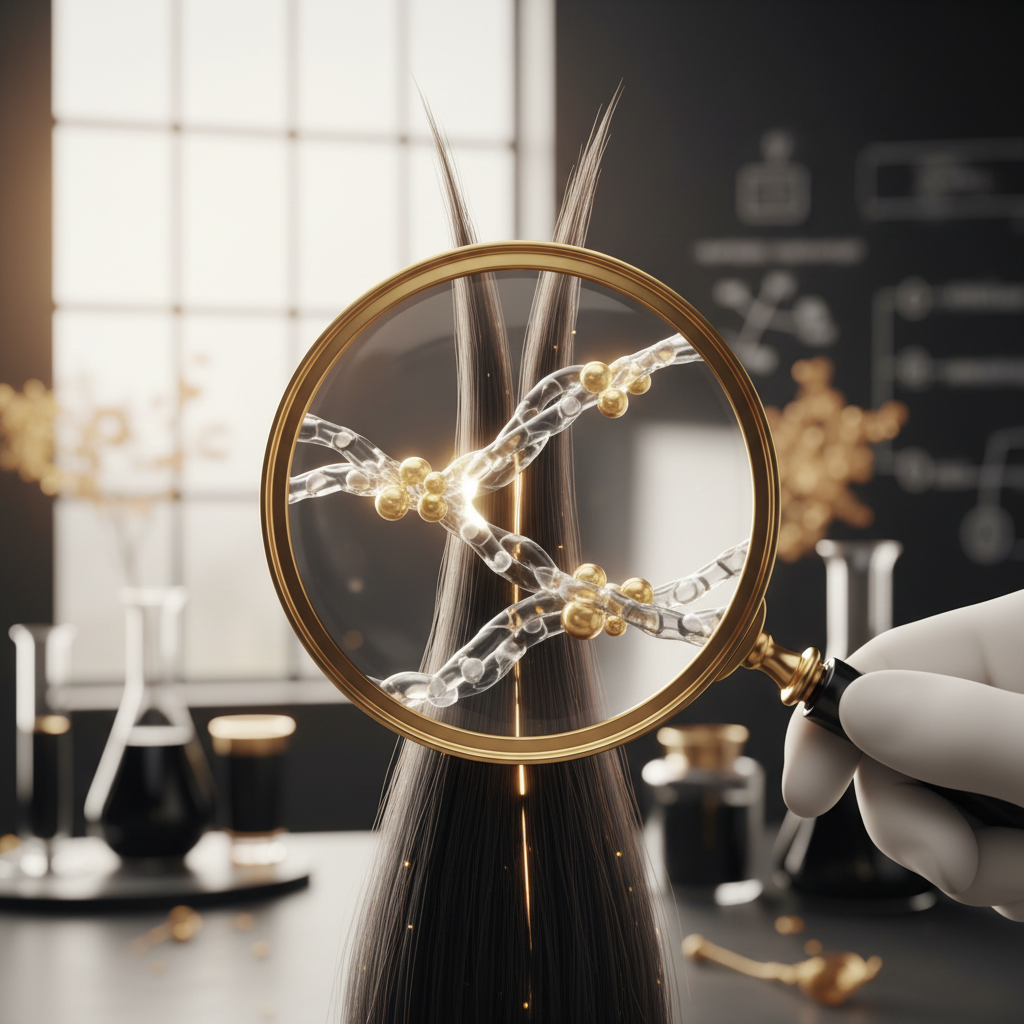
Keratin is unusually rich in cysteine, a sulphur-containing amino acid. When two cysteine residues on adjacent or identical polypeptide chains oxidise, their thiol (-SH) groups react. This reaction creates a stable, covalent sulphur-to-sulphur bond (S-S), yielding the composite amino acid known as cystine. Human hair typically contains between 14% and 18% cystine by weight, providing an extraordinary degree of structural cross-linking that prevents the hair fibre from simply dissolving or unravelling when wet.
In the physical structure of the fibre, three primary types of bonds support the keratin matrix:
- Hydrogen bonds: Weak, non-covalent bonds broken readily by water, moisture, and temporary heat styling.
- Salt (ionic) bonds: Electrostatic linkages between acidic and basic amino acid side chains, dependent heavily on pH (hair's isoelectric point sits around pH 3.67).
- Disulphide bonds: Extremely durable covalent bonds that resist physical stretching, water saturation, and standard environmental temperatures.
Because disulphide bonds are covalent, they require significant energy or chemical reagents to break. This chemistry underpins every permanent chemical service conducted in hairdressing salons, as well as the fundamental mechanisms of severe cosmetic chemical damage.
The molecular mechanism: cleavage, reshaping, and reforming
The manipulation of disulphide bonds follows classical reduction-oxidation (redox) chemistry.
Chemical reduction (bond cleavage)
In chemical waving (perms) or chemical straightening, a reducing agent donates hydrogen atoms and electrons to the disulphide bridges. Common reducing agents include alkaline formulations of ammonium thioglycolate (pH 8.5 to 9.5) or cysteine-based derivatives.
When the reducing agent penetrates the swollen cortex, the reaction cleaves the covalent S-S bond into two separate, free sulfhydryl or thiol (-SH) groups. Once roughly 20% to 30% of these cortical disulphide bonds are broken, the polypeptide chains can physically slide past one another. Stylists mechanically rearrange the hair fibre around a curling rod or stretch it straight.
Chemical oxidation (bond reformation)
To fix the hair in its newly arranged geometry, stylists apply an oxidising neutraliser, typically a dilute solution of hydrogen peroxide (around 1.5% to 2.5%, roughly 5 to 8 volume) at an acidic pH (3.0 to 4.0).
The oxidising agent strips the hydrogen atoms from the adjacent thiol groups, prompting the sulphur atoms to link together again and form new disulphide bridges. Because the hair fibres are held in their new physical configuration, the reformed bonds stabilise the new curl or straight alignment. However, this process is never 100% efficient. In practice, only 70% to 85% of the original disulphide bonds successfully reform in their natural paired state. The remaining sulphur groups remain as unbonded free thiols or progress into oxidation by-products.
The damage pathway: cysteic acid formation
When hair undergoes high-lift bleaching, repeated colouring, or prolonged exposure to ultraviolet radiation, oxidation goes too far. Rather than simply oxidising free thiols back into cystine, aggressive oxidisers (such as persulphate salts combined with concentrated hydrogen peroxide) directly break disulphide bonds and oxidise the sulphur atoms into cysteic acid.
Cysteic acid is a strongly acidic, negatively charged sulphonic acid group ($-\text{SO}_3\text{H}$). Once disulphide bonds convert to cysteic acid, the process is completely irreversible. The sulphur atoms cannot be reduced back into active thiols, and they cannot reform natural cystine linkages. As the density of cysteic acid increases, the hair cortex loses internal tensile cohesion, swells uncontrollably when wet, and eventually snaps under normal brushing tension.
| Bond Type | Bond Mechanism | Energy Required to Break | Breaking Agents | Reversibility |
|---|---|---|---|---|
| Hydrogen Bond | Dipole attraction between hydrogen and electronegative atoms | Very low (approx. 20 kJ/mol) | Water, steam, high ambient humidity | Reversible upon drying |
| Salt (Ionic) Bond | Electrostatic attraction between positive and negative side chains | Low to moderate (approx. 40 to 80 kJ/mol) | Strong acids, strong bases (pH shifting outside 4.0 to 6.0) | Reversible upon restoring isoelectric pH (3.67 to 5.5) |
| Disulphide Bond | Covalent sharing of electron pairs between sulphur atoms | High (approx. 210 to 250 kJ/mol) | Reducing agents (thiols), high-lift oxidisers, temperatures over 220°C | Partially reversible chemically; irreversible when oxidised to cysteic acid |
What the evidence does not show
There are persistent myths surrounding disulphide chemistry in the salon industry:
- Shampoos and conditioners do not repair broken disulphide bonds directly. Standard surfactants, fatty alcohols, and quats provide lubricity, reduce cuticle friction, and smooth the surface. They do not possess the reactive chemistry required to generate covalent sulphur linkages inside the cortex.
- Bond-building cosmetics do not regenerate true cystine. While modern cross-linking agents (such as bis-aminopropyl diglycol dimaleate or biomimetic peptides) form bridge-like connections between broken protein fragments, peer-reviewed spectroscopic research confirms they create secondary covalent or hydrogen adducts. They do not magically turn cysteic acid back into native cysteine.
- Disulphide bond damage does not equal follicular hair loss. Disulphide breakage is strictly a structural fibre phenomenon occurring along the hair shaft. It causes cosmetic hair breakage (snapping). It has no direct biological bearing on follicle cycling, androgenetic alopecia, or telogen effluvium.
Signs of disulphide bond degradation
Stylists and consumers can identify when disulphide integrity has been compromised along the hair shaft:
- Loss of wet elasticity: Healthy wet hair can stretch up to 30% of its resting length and return cleanly to its baseline. Severely bond-depleted hair stretches excessively (like wet chewing gum) without springing back, snapping under minor load.
- Excessive porosity and water absorption: When disulphide bonds degrade, the structural matrix loosens, allowing the cortex to soak up vast amounts of water quickly while taking hours to dry.
- Loss of natural curl definition: Wavy or curly hair that becomes limp, flat, or frizzy after lightening services has lost the cross-linking tension that maintains natural coiling.
- Mid-shaft snapping: Small, white dots (trichorrhexis nodosa) appearing along the shaft, followed by clean breakage points when running a comb through damp hair.
Supporting hair with compromised bonds
If the disulphide matrix has suffered chemical or thermal trauma, management focuses on preventing mechanical stress and reinforcing remaining structural elements:
- Minimise wet mechanical handling: Wet hair with depleted disulphide integrity is in an exceptionally fragile, low-elasticity state. Use wide-tooth combs, avoid brush tension when wet, and gently squeeze water out using microfibre cloths rather than rough towel-drying.
- Apply acidic formulations: Using products formulated near hair's natural isoelectric range (pH 4.0 to 5.5) contracts the cuticle and reinforces secondary salt bonds, helping to compensate for cortical weakness.
- Employ heat protection: Thermal tools operating above 180°C accelerate oxidative cleavage of disulphide linkages. Keep styling tools under 180°C and use silicone- or polymer-based thermal protectants.
- Schedule adequate service intervals: Allow at least 8 to 12 weeks between chemical services (such as bleaching or relaxers) to avoid overlapping treatments on already-compromised hair lengths.
Dedicated support from Watermans
While internal disulphide bonds cannot be permanently re-fused once severe cysteic oxidation occurs, maintaining the surrounding scalp environment and preventing routine fibre breakage remains critical. Watermans provides targeted, cosmetic hair care solutions designed to support fibre strength and scalp vitality.
Watermans GrowMe Shampoo and ConditionMe Conditioner deliver nutrient-rich cosmetic formulas featuring hydrolysed lupin protein, biotin, caffeine, rosemary extract, and argan oil. The hydrolysed proteins help deposit film-forming moisture across porous, chemically processed hair, smoothing the cuticle layer and significantly reducing mechanical comb drag. This physical protection helps minimise premature snapping along structurally vulnerable fibres while ensuring the scalp surface remains balanced, refreshed, and clear of product build-up.
When to seek professional advice
If hair is breaking off in significant quantities during gentle washing or styling, consult an experienced professional colourist or a registered trichologist. A stylist can evaluate remaining tensile strength using wet-stretch analysis and determine whether hair can safely tolerate future colouring.
If thinning occurs directly at the scalp level, or if shedding involves full hairs shedding with an intact white bulb at the root, the issue is follicular shedding rather than shaft-level disulphide breakage. In these cases, consult a GP, dermatologist, or qualified trichologist to investigate underlying systemic, nutritional, or hormonal causes.
Frequently asked questions about The Chemistry of Disulphide Bonds in Hair
What is the primary role of The Chemistry of Disulphide Bonds in Hair?
The primary role of disulphide bonds in hair is to provide structural strength, mechanical rigidity, and permanent shape retention. Formed between cysteine amino acid residues within the cortex, these covalent linkages prevent keratin chains from separating. They allow hair fibres to resist environmental stressors, water absorption, and routine physical pulling forces without falling apart.
Can water break disulphide bonds?
No, water cannot break disulphide bonds. Water only breaks physical hydrogen bonds and disrupts some ionic salt bonds in the hair shaft. Because disulphide bonds are strong covalent linkages, they require reducing chemical agents, strong alkaline conditions, or temperatures exceeding 220°C to alter or cleave their molecular structure.
Does bleaching permanently destroy disulphide bonds?
Yes, high-lift bleaching oxidises disulphide bonds into cysteic acid. Once a disulphide bond undergoes this irreversible oxidation pathway, the sulphur atoms can no longer recombine into natural cystine. This causes a permanent loss of cortical tensile strength, resulting in increased porosity, reduced elasticity, and potential hair fibre breakage.
How do bond-repairing products interact with disulphide bonds?
Bond-repairing cosmetic formulations typically introduce synthetic cross-linking molecules or hydrolysed protein chains into the cortex. These molecules bridge the gaps between severed keratin fragments using artificial chemical links or hydrogen networks. While they temporarily improve elasticity and reduce breakage, they do not turn cysteic acid back into natural biological disulphide bonds.
Why do perms smell like sulphur during processing?
Perms smell like sulphur because reducing agents cleave disulphide bonds into free sulfhydryl (-SH) thiol groups. These volatile organic sulphur compounds release hydrogen sulphide-like odours into the air during processing. Once the stylist applies the neutraliser and re-oxidises the bonds, the odour drops significantly.
Overview of disulphide chemistry
Mastering The Chemistry of Disulphide Bonds in Hair allows both stylists and consumers to make informed choices about chemical processing, thermal styling, and post-service care. While disulphide linkages give human hair its remarkable physical resilience and shape, their capacity to withstand oxidative insults has clear limits. Treating chemically altered hair with gentle mechanical habits, pH-balanced conditioning formulas, and appropriate service spacing ensures that remaining covalent bonds stay intact, keeping fibres resilient, shiny, and fracture-free.
Sources and references
- Robbins, C. R. (2012). Chemical and Physical Behavior of Human Hair (5th ed.). Springer-Verlag.
- Wolfram, L. J. (2003). Human hair: A unique physicochemical composite. Journal of the American Academy of Dermatology, 48(6), S106-S114.
- Feughelman, M. (1997). Mechanical Properties and Structure of Alpha-Keratin Fibres. UNSW Press.
- Cruz, C. F., Costa, C., Gomes, A. C., Matamá, T., & Cavaco-Paulo, A. (2016). Human hair keratin: Molecular structure and changes induced by hair styling. Journal of Cosmetic Science, 67(4), 227-235.
- Society of Cosmetic Chemists (SCC). Monograph on Hair Alteration and Keratin Chemistry.
Find these ingredients in Watermans products
- Biotin: you will find this ingredient in our Hair Growth Shampoo.