Chemical Damage and Disulphide Bonds: The Haircare Guide
9 min read ·
Understand the science of Chemical Damage and Disulphide Bonds, how bleaching and relaxers alter hair structure, and practical ways to manage fragile hair.
Quick answer: Chemical Damage and Disulphide Bonds are fundamentally linked because chemical treatments such as bleaching, permanent dyeing, perming, and relaxing alter or cleave the covalent cystine linkages responsible for hair strength. Bleaching oxidises these bridges into cysteic acid, while relaxers and perms break and reshape them. While bond-building treatments help reform some links and improve tensile strength, they cannot fully restore virgin hair structure once extensive cleavage has occurred.
Key takeaways
- Disulphide bonds are covalent chemical bonds formed between two cysteine amino acids, creating cystine, which gives hair fibre its structural rigidity and elastic recovery.
- Bleach and high-lift colours permanently destroy disulphide bonds through oxidation, converting cystine into non-functional cysteic acid.
- Perms and relaxers intentionally break disulphide bonds to alter the fibre's shape, but relaxers permanently convert them into lanthionine bonds, which lack the original elasticity.
- Severe chemical damage manifests as increased porosity, rubbery stretching when wet, cuticle loss, and hair breakage along the shaft (not hair loss from the follicle).
- Bond-building cosmetic technologies, protein treatments, and gentle conditioning help protect remaining structural integrity, but severely degraded keratin cannot completely regenerate.
Chemical Damage and Disulphide Bonds: what the evidence shows
Scientific trichology and cosmetic chemistry clearly show that Chemical Damage and Disulphide Bonds cannot be understood separately. The human hair shaft is composed of roughly 65 to 90 percent protein, primarily fibrous alpha-keratins. These keratin chains are held together by three types of cross-links: hydrogen bonds, ionic (salt) bonds, and disulphide bonds.
Hydrogen and salt bonds are physical and temporary. They break easily in the presence of water or heat and reform as the hair dries. In contrast, disulphide bonds are strong, covalent chemical bonds formed between sulfur atoms in two cysteine amino acid residues, forming cystine. They account for the tensile strength, shape retention, and resistance to environmental stress that human hair exhibits.
When salon chemicals penetrate the cuticle to alter pigment or reshape the cortex, they directly compromise these linkages:
- Alkaline swelling: Chemical processes typically operate at high pH (often between pH 9.0 and 11.0, or even pH 12.0 to 14.0 for hydroxide relaxers). This lifts the cuticle scales and swells the cortex, exposing the internal keratin matrix.
- Oxidative breakdown: In bleaching and permanent hair colouring, hydrogen peroxide and persulfate salts generate free radicals. These oxidise the disulfide bridge, stripping sulfur and producing cysteic acid residues. Cysteic acid cannot reconnect to form structural bonds.
- Reductive cleaving: In permanent waving, reducing agents (such as ammonium thioglycolate) systematically cleave disulphide bonds into free sulfhydryl (thiol) groups. Although neutralisers (oxidising rinses) are applied to reform the bonds in the new shape, studies show only about 85 to 90 percent of the original bonds successfully reconnect.
- Lanthionisation: Hydroxide relaxers strip a sulfur atom from cystine entirely, converting it into a monosulfide linkage called lanthionine. This alteration is irreversible and leaves hair significantly weaker than virgin fibres.
The mechanism of disulphide bond degradation
The hair cortex consists of intermediate filaments packed inside an amorphous, sulfur-rich matrix. The disulphide cross-links within this matrix act like horizontal rungs on a rope ladder. When you break these rungs, the vertical ropes lose their alignment and structural stability.
In healthy virgin hair, cystine makes up approximately 16 to 18 percent of the total amino acid content. After an aggressive chemical bleaching session, analytical amino acid testing reveals a steep drop in cystine levels and a corresponding surge in cysteic acid.
Cysteic acid carries a negative electrical charge. As these negatively charged sites accumulate inside the cortex, they repel each other, creating voids in the matrix. This dramatically increases the hair fibre's porosity. Porous, oxidized hair absorbs excessive water when washed (up to 40 percent more than virgin hair), leading to hygral fatigue, while simultaneously losing the ability to retain internal moisture once dry.
Signs of disulphide bond breakdown
When disulphide bonds undergo chemical degradation, the hair changes visibly and mechanically:
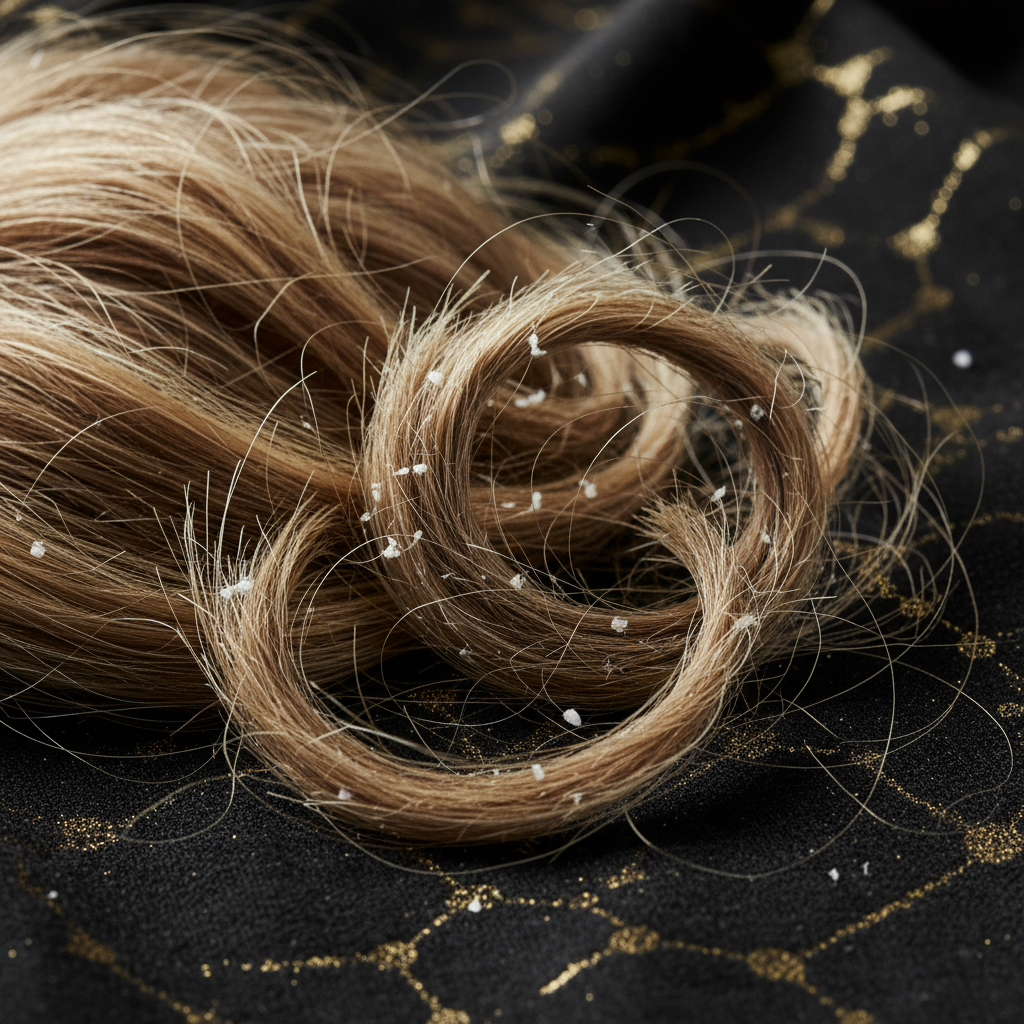
- Excessive wet elasticity: Wet hair normally stretches by about 20 to 30 percent of its length and bounces back. Chemically compromised hair with broken disulphide bonds will stretch far beyond this, feeling gummy or rubbery, and will fail to spring back.
- High wet friction and tangling: With the cuticle stripped and internal proteins degraded, wet strands drag against each other, leading to severe matting.
- Mid-shaft snapping (hair breakage): Because the cortex has lost its tensile strength, daily combing or brushing causes the fibre to snap cleanly along the shaft. This is mechanical breakage, not hair loss originating from the follicle.
- Split ends and trichoptilosis: The ends of the hair, being the oldest and most chemically treated, fray into multiple strands as cortical fibres unravel.
- Loss of natural curl pattern: In naturally wavy or curly hair, oxidative treatments break the asymmetrical disulphide bonds that dictate curl architecture, leaving curls limp, uneven, or completely straight in bleached sections.
| Treatment Type | Primary Chemical Mechanism | Impact on Disulphide Bonds | Long-Term Structural Result |
|---|---|---|---|
| Bleaching / Lightening | Alkaline oxidation (Peroxide + Persulfates) | Oxidises disulphide bonds into cysteic acid permanently | Increased porosity, gummy wet feel, cortex voids |
| Hydroxide Relaxing | Alkaline lanthionisation (pH 12 to 14) | Converts disulphide bonds into lanthionine bonds | Permanent loss of natural curl; lower elastic recovery |
| Thio Perming / Relaxing | Chemical reduction followed by oxidation | Cleaves bonds to thiols; neutraliser reforms 85 to 90% | Shape alteration; permanent 10 to 15% bond loss |
| Direct Dyeing / Toners | Low or no lift deposition (mildly acidic to neutral) | Negligible impact on disulphide bonds | Cuticle-level deposition; preserves cortical strength |
What the evidence shows about repairing disulphide bonds
In recent years, the haircare industry has introduced "bond builders" designed to repair structural damage. Independent cosmetic chemistry literature shows that certain dicarboxylic acids (such as maleic acid or bis-aminopropyl diglycol dimaleate) can bridge broken sulfhydryl groups, acting as an artificial cross-linker.
These active ingredients do improve tensile strength, reduce breakage during subsequent chemical processing, and smooth the hair fibre. However, they do not recreate virgin hair. When disulphide bonds are oxidised into cysteic acid, the sulfur site is chemically capped and cannot participate in new disulphide or artificial bridge formations. Therefore, bond-rebuilding products are maintenance and mitigating agents, not magic erasers for extensive chemical over-processing.
Practical steps to care for chemically damaged hair
Managing hair that has undergone disulphide bond degradation requires a shift toward preserving existing fibres and limiting mechanical friction.
- Switch to mild, pH-balanced cleansing: Use sulfate-free shampoos formulated around pH 4.5 to 5.5. Alkaline cleansers swell weakened fibres, prompting further protein loss.
- Integrate hydrolysed proteins: Small-molecule proteins (hydrolysed wheat, keratin, or silk peptides) temporarily penetrate the hair shaft and adhere to porous gaps, reinforcing the cortex.
- Apply regular lipid replenishers: Bleaching strips the hair's protective 18-methyleicosanoic acid (18-MEA) lipid layer. Deep conditioners containing fatty alcohols, ceramides, and light plant oils help mimic this lost hydrophobic barrier.
- Avoid additional chemical overlapping: Never re-bleach or relax hair that has already been chemically altered. Only treat virgin regrowth at the roots.
- Reduce thermal and mechanical stress: Stop using high-temperature styling tools above 150 degrees Celsius. Detangle gently with a wide-tooth comb starting at the ends, working upward only while saturated with a slip-inducing conditioner.
- Schedule routine micro-trims: Trimming 5 to 10 millimetres off the ends every six to eight weeks stops shaft fractures from traveling up the hair fibre.
When the cause may be something else
It is vital to distinguish between chemical hair breakage and follicular shedding. If you notice an abundance of short, fragmented hair pieces without a white bulb at the root on your bathroom counter or clothes, you are experiencing hair breakage caused by structural chemical damage.
Conversely, if hair strands are falling out intact with a small, white keratin bulb attached to the root, this is hair shedding. Shedding is driven by biological processes within the scalp, such as telogen effluvium (triggered by stress, illness, or hormonal shifts) or androgenetic alopecia (pattern hair loss). Chemical treatments applied to the hair shaft do not cause follicular hair loss unless an aggressive chemical burn occurs directly on the scalp tissue.
When to seek professional salon or clinical advice
Consult a qualified trichologist or dermatologist if you experience chemical burning, persistent scalp erythema, blisters, or sudden patch hair loss after a salon treatment. These signs suggest contact dermatitis or chemical injury to the scalp follicle rather than simple hair shaft damage.
For structural breakage, consult an experienced professional colourist or stylist. A skilled professional can conduct an elasticity and porosity test to determine whether your hair can withstand future treatments, or whether you need a transitional maintenance plan focused solely on bond maintenance, moisture, and trimming.
Supporting chemically stressed hair with Watermans
When managing hair weakened by chemical processes, you need haircare products that focus on scalp health and fibre resilience without harsh surfactants. Watermans offers formulations developed to support hair vitality. Watermans GrowMe Shampoo cleanses gently with a balanced profile, delivering beneficial botanical extracts and hydrolysed proteins that help hair feel stronger and more resilient against daily mechanical stress. Paired with Watermans ConditionMe Conditioner, it replenishes moisture and improves manageability, smoothing the cuticle layer and helping to reduce breakage on fragile, chemically altered strands.
Frequently asked questions about Chemical Damage and Disulphide Bonds
Can Chemical Damage and Disulphide Bonds be completely reversed?
No, chemical damage to disulphide bonds cannot be fully reversed. When bleach or peroxide converts cystine into cysteic acid, that bond is permanently altered. While bond-building treatments can bridge some free sulfhydryl groups and improve tensile strength, they cannot restore the hair fibre to its virgin structural state.
How do relaxers affect disulphide bonds compared to bleach?
Relaxers and bleach break disulphide bonds through entirely different chemical pathways. Bleach uses oxidation, permanently turning cystine into cysteic acid. Sodium hydroxide relaxers use lanthionisation, removing one sulfur atom from cystine to create lanthionine. Both weaken the hair fibre, but lanthionine changes the curl pattern permanently.
Does broken disulphide bonding lead to permanent baldness?
No. Disulphide bond cleavage occurs strictly within the dead keratin fibre of the hair shaft, causing hair breakage rather than follicular hair loss. The hair will continue to emerge healthy from the root, provided the chemical service did not cause chemical burns or severe contact dermatitis on the scalp.
How can you tell if your hair has severe disulphide bond degradation?
The clearest physical sign is a gummy, rubbery texture when hair is wet. If you gently stretch a damp strand and it elongates excessively without springing back, or if it snaps effortlessly under light tension, the cortex has lost a significant percentage of its disulphide bonds.
Can protein conditioners repair broken disulphide cross-links?
Protein treatments do not reform disulphide bonds. Instead, hydrolysed proteins temporarily deposit into the microscopic gaps and voids of the porous cortex. This reinforces the fibre, temporarily boosting tensile strength and reducing breakage, but washes out over time.
Summary of Chemical Damage and Disulphide Bonds
Understanding Chemical Damage and Disulphide Bonds allows you to make informed decisions about your salon routine and at-home maintenance. Disulphide cross-links are the foundation of hair strength and elasticity, yet they are vulnerable to alkaline, oxidative, and reducing chemicals. While no cosmetic product can restore hair to its virgin state once cysteic acid has formed, adopting protective styling, using bond-supporting products, and gentle handling will preserve remaining strength and prevent catastrophic breakage.
Sources and references
- Robbins, C. R. (2012). Chemical and Physical Behavior of Human Hair. 5th ed. Springer-Verlag New York.
- Dawber, R. (1996). Hair: Its structure and response to cosmetic preparations. Clinics in Dermatology, 14(1), 105-112.
- Cruz, C. F., et al. (2016). Human hair characteristics and methods to evaluate hair damage. Cosmetics, 3(3), 26.
- Wolfram, L. J. (2003). Human hair: A unique physicochemical composite. Journal of the American Academy of Dermatology, 48(6), S106-S114.
- Federal Institute for Risk Assessment (BfR). (2020). Health assessment of permanent hair dyes and hair straightening products.