Carrier Oils for Hair Density: Mechanisms, Evidence, and Scalp Health
9 min read ·
Explore the evidence behind using Carrier Oils for Hair Density. Learn which plant lipids strengthen strands, reduce breakage, and support overall scalp health.

Quick answer: Using Carrier Oils for Hair Density involves applying lipid-rich plant oils, such as jojoba, pumpkin seed, or castor oil, to the scalp and lengths to nourish hair follicles and shield hair shafts from physical wear. While carrier oils cannot cure genetic pattern baldness or revive scarred follicles, they improve apparent density by lubricating hair strands to stop mechanical breakage, soothing scalp inflammation, and safely diluting potent essential oils for topical application.
Key takeaways
- Carrier oils are base lipids extracted from nuts, kernels, or seeds used to moisturise the scalp and safely dilute concentrated botanical extracts.
- Genuine hair density depends on the number of active follicular units per square centimetre and the cross-sectional calibre of each hair fibre.
- Most carrier oils improve visual thickness by preventing breakage along the shaft rather than triggering de novo follicle development.
- Certain unrefined plant oils, particularly pumpkin seed oil, contain phytosterols that demonstrate mild 5-alpha reductase inhibition in laboratory models.
- Scalp tolerance varies: heavy polyunsaturated oils can exacerbate seborrhoeic dermatitis by feeding Malassezia yeast species.
Carrier Oils for Hair Density: what the evidence shows
Research into carrier oils reveals that their primary biological benefit lies in skin barrier support, lubrication, and lipid replenishment rather than hormonal reprogramming of the hair cycle. Hair density is defined clinically as the number of hairs emerging per unit area of scalp, alongside the diameter of individual shafts. When individuals look for Carrier Oils for Hair Density, they often hope for an increase in active follicular output.
Controlled human data on carrier oils stimulating follicle growth remains limited. However, a notable 2014 randomised, double-blind, placebo-controlled trial published in Evidence-Based Complementary and Alternative Medicine evaluated oral pumpkin seed oil in 76 men with mild-to-moderate androgenetic alopecia. After 24 weeks, the intervention group showed a 40 percent increase in mean hair count compared to 10 percent in the placebo cohort. While this study investigated oral supplementation rather than topical application, it highlighted how plant phytosterols, such as beta-sitosterol, can influence follicular dynamics.
Topically, carrier oils serve as structural protectors. The hair fibre naturally possesses an exterior lipid envelope composed largely of 18-methyleicosanoic acid (18-MEA). Routine shampooing, chemical processing, and heat styling strip this layer. Applying plant-derived triglycerides, particularly those containing medium-chain fatty acids like coconut oil, allows lipids to penetrate the cuticle into the cortex. This reduces protein loss, maintains moisture balance, and prevents fibre snap. The end result is hair that remains on your head longer at its full terminal length, producing denser-looking volume.
The biological mechanisms behind scalp oils
Plant carrier oils support hair thickness through three distinct pathways: barrier lipid restoration, slip generation, and microenvironmental modulation.
- Cuticle protection and friction reduction: Friction between adjacent hair fibres causes mechanical weathering, cuticle lifting, and eventual fracture. Monounsaturated and saturated plant oils coat the epicuticle, smoothing rough edges. By minimising combing force, you reduce breakage rates substantially.
- Fatty acid nutrition for the stratum corneum: The scalp requires balanced sebum to maintain an acidic protective mantle between pH 4.5 and 5.5. Oils rich in linoleic acid, such as rosehip or safflower, replenish intercellular ceramides without clogging the ostium (the pore opening).
- Vehicle delivery for active compounds: Highly concentrated botanicals, including rosemary and peppermint oils, cannot be applied neat without causing severe irritant contact dermatitis. Carrier oils act as non-volatile diluents that slow the evaporation of active compounds, enabling sustained dermal absorption.
How top carrier oils compare
Choosing the correct carrier oil depends on your scalp sebum profile and your hair porosity. The following table outlines how standard base oils behave on the scalp and fibre.
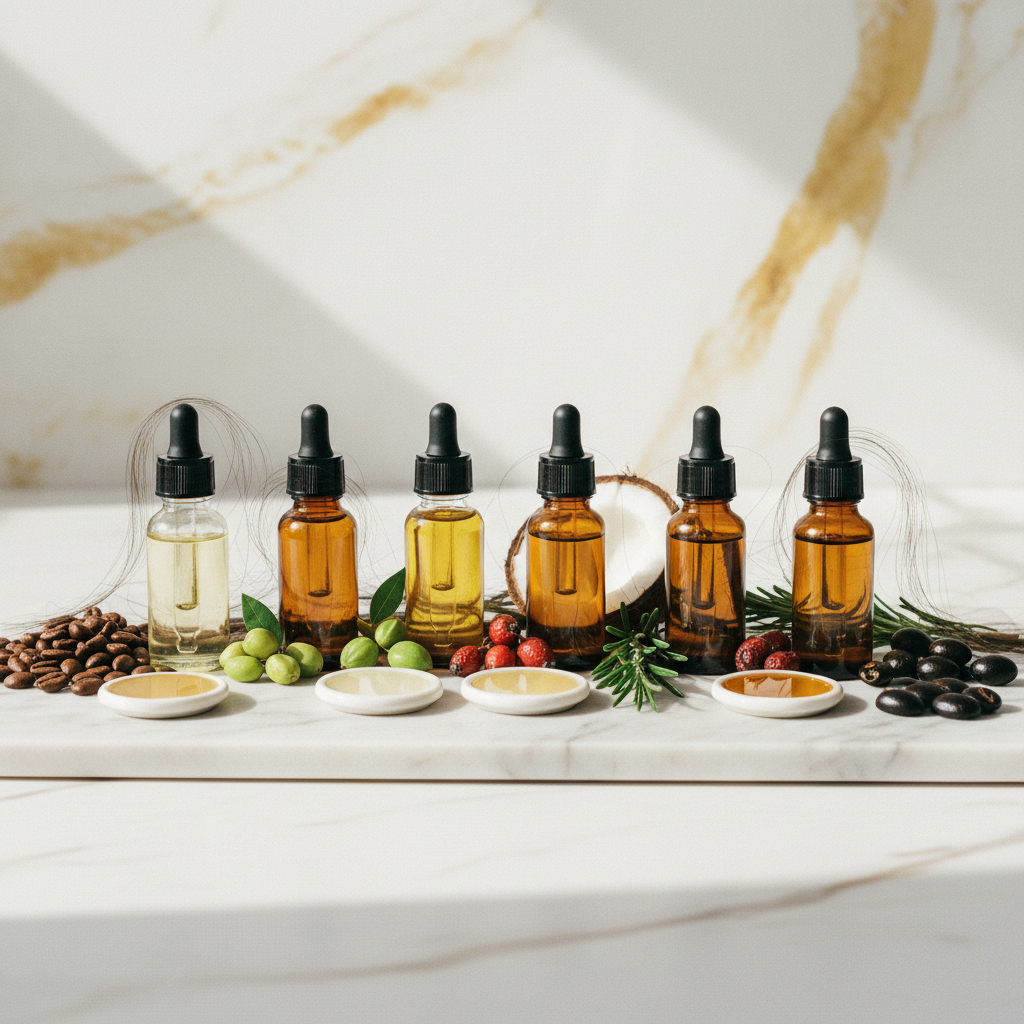
| Carrier Oil | Predominant Fatty Acids | Viscosity & Weight | Scalp Compatibility | Primary Mechanism |
|---|---|---|---|---|
| Jojoba Oil | Gadoleic acid, Erucic acid (Liquid wax ester) | Lightweight | All scalp types, including oily | Mimics natural sebum, balances barrier without clogging pores |
| Pumpkin Seed Oil | Linoleic acid, Oleic acid | Medium | Balanced to dry scalps | Rich in phytosterols; supports follicular environment |
| Castor Oil | Ricinoleic acid | Very heavy, viscous | Dry scalps only (use sparingly) | High humectant properties, enhances fibre shine and coat |
| Argan Oil | Oleic acid, Linoleic acid | Medium-light | Balanced, dry, or ageing scalps | High squalene and vitamin E content, combats oxidative stress |
| Coconut Oil | Lauric acid | Heavy (solid at room temperature) | Dry scalps (avoid on dandruff-prone skin) | Low molecular weight penetrates cortex, stops protein loss |
| Sweet Almond Oil | Oleic acid | Medium | Sensitive, irritated scalps | Softens dry flaking, provides emollient slip |
What the evidence does not show
It is critical to separate structural conditioning from medical interventions. Carrier oils cannot:
- Reverse permanent follicular scarring caused by cicatricial alopecias, such as lichen planopilaris or frontal fibrosing alopecia.
- Match the targeted follicular stimulation of pharmaceutical agents like minoxidil, which acts as an adenosine-triphosphate-sensitive potassium channel opener.
- Neutralise high systemic dihydrotestosterone (DHT) levels to the extent of licensed prescription therapies.
- Accelerate the biological speed of hair growth beyond your genetically determined rate of roughly 1 to 1.25 centimetres per month.
Treating unrefined oils as a standalone cure for progressive thinning often delays necessary clinical diagnosis, allowing ongoing follicle miniaturisation to advance unchecked.
Identifying thinning versus shedding versus breakage
To understand if topical oils will help, you must establish what is causing your loss of density.
- Hair breakage: Short, snapped pieces with no white bulb at the end. This is where carrier oils excel. By lubricating the cuticle, oils prevent daily mechanical failure.
- Hair shedding (Telogen Effluvium): Loose, full-length hairs coming out with a visible keratin bulb at the root, often exceeding 100 to 150 hairs daily. This stems from systemic disruptions such as illness, nutritional deficiency, thyroid changes, or acute stress. Topical carrier oils cannot halt this process.
- Follicular miniaturisation (Pattern Hair Loss): A widening parting, visible scalp at the crown, or receding temples. The hairs become progressively finer over multiple cycles. Carrier oils provide supportive scalp comfort here, but they will not stop underlying hormonal miniaturisation on their own.
How to use carrier oils safely on the scalp
To gain the benefits of carrier oils without causing adverse skin reactions, adopt a methodical application routine:
- Conduct a patch test: Place three drops of your chosen oil on your inner forearm. Wait 24 to 48 hours to check for redness, itching, or swelling.
- Choose the correct dilution: If combining with active essential oils, maintain a safe dilution ratio. A 1 percent to 2 percent dilution is standard: add 3 to 6 drops of essential oil to 15 millilitres (one tablespoon) of carrier oil.
- Target application to the scalp: Part clean, dry or damp hair into sections. Dispense a small amount onto your fingertips and massage the skin using slow, circular motions for three to five minutes. This boosts local cutaneous blood flow through mechanical pressure.
- Time your application: Leave lightweight oils on for 30 to 60 minutes before washing out with a clarifying or balancing shampoo. Avoid leaving thick layers of plant oil on your scalp overnight, as prolonged occlusion can encourage fungal overgrowth.
When the cause may be something else
If your scalp hair continues to thin despite gentle handling and lipid nourishment, systemic or dermatological drivers are likely at play. Iron deficiency with low serum ferritin (below 30 to 50 micrograms per litre) impairs the matrix cell proliferation responsible for fibre synthesis. Hypothyroidism slows metabolic turnover, leading to dry, sparse strands. Autoimmune conditions, polycystic ovary syndrome (PCOS), and severe dietary protein deficits can also trigger widespread shedding. Applying oils externally will not rectify an internal metabolic deficit.
When to seek professional advice
Consult a GP or a registered trichologist if you observe any of the following:
- Patchy, coin-sized areas of complete baldness appearing suddenly.
- Accompanying scalp symptoms such as severe burning, tenderness, visible pustules, or tight scaling.
- Rapid, diffuse shedding that persists for longer than three months.
- Visible scarring where the follicular openings are no longer visible to the naked eye.
Supporting density through targeted formulations
While raw kitchen lipids provide moisture, modern cosmetic science combines lightweight carrier bases with bio-active compounds to target scalp health from multiple angles. For individuals wanting an evidence-led daily routine, Watermans provides specialised formulas designed to optimise the appearance of thinning hair.
The Watermans range incorporates ingredients like biotin, caffeine, rosemary extract, and niacinamide within clarifying, non-comedogenic bases. Rather than leaving heavy oil residues that weigh down fine strands, these formulations rinse cleanly while delivering functional botanicals directly to the follicular surface, helping hair look visibly thicker and full of body.
Frequently asked questions about Carrier Oils for Hair Density
Which is the most effective carrier oil for fine hair?
Jojoba oil is typically the most suitable option for fine textures. Because it is chemically a liquid wax ester matching human sebum, it absorbs without leaving a greasy, suffocating layer on fine follicles. It conditions the scalp skin and provides cuticle slip without flattening root volume.
Can using Carrier Oils for Hair Density cause dandruff?
Yes, certain carrier oils can trigger or worsen seborrhoeic dermatitis. The yeast organism Malassezia globosa feeds on specific free fatty acids found in natural oils, particularly olive and coconut oil. If you have an oily or dandruff-prone scalp, using heavy carrier oils can cause rapid yeast proliferation, leading to scaling, itching, and subsequent shedding.
How often should I apply carrier oils to my scalp?
One to two times per week is plenty for most hair types. Over-applying oils can lead to follicular congestion, product build-up, and scalp irritation. Always follow oil treatments with a thorough double cleanse to remove residual lipids from the scalp surface.
Does castor oil actually speed up hair growth rates?
There is no clinical evidence that castor oil accelerates biological hair growth or generates new follicles. Castor oil contains ricinoleic acid, which gives it a rich, protective consistency. It helps hair appear thicker by heavily coating individual shafts and sealing split ends, which protects existing length from mechanical breakage.
Should I apply carrier oils to wet or dry hair?
For scalp massage and pre-wash treatments, applying to dry or slightly damp hair is ideal, as water can create a barrier that repels hydrophobic oils. If you are using a tiny amount on your lengths to lock in hydration and stop breakage, apply it to damp hair directly after conditioning.
The bottom line on carrier oils
Relying on Carrier Oils for Hair Density is a sound strategy if your goal is to minimise daily breakage, improve structural shine, and protect your scalp barrier. These plant-derived lipids deliver vital fatty acids that shield fragile fibres from external stress, preserving the hair you have. However, carrier oils operate on the cosmetic and structural planes. If your thinning stems from hormonal miniaturisation, chronic shedding, or an inflammatory scalp disorder, pair your topical conditioning with expert medical evaluation.
Sources and references
- Cho, Y. H., et al. (2014). Effect of Pumpkin Seed Oil on Hair Growth in Men with Androgenetic Alopecia: A Randomized, Double-Blind, Placebo-Controlled Trial. Evidence-Based Complementary and Alternative Medicine, 2014, 549721.
- Gavazzoni Dias, M. F. (2015). Hair cosmetics: An overview. International Journal of Trichology, 7(1), 2-15.
- Rele, A. S., & Mohile, R. B. (2003). Effect of mineral oil, sunflower oil, and coconut oil on prevention of hair damage. Journal of Cosmetic Science, 54(2), 175-192.
- British Association of Dermatologists. (2021). Telogen Effluvium: Clinical Guidance and Management.
- National Institute for Health and Care Excellence (NICE). (2022). Alopecia androgenetica: Clinical knowledge summary.
Find these ingredients in Watermans products
- Vitamin E: you will find this ingredient in our Hair Vitamins.
- Castor Oil: you will find this ingredient in our Camellia & Black Castor Hair & Body Oil.
- Niacinamide: you will find this ingredient in our Hair Mask.
- Sunflower Seed Oil: you will find this ingredient in our Heat Protection Spray.