Best Practices for Washing Fragile Hair: Evidence-Based Cleansing Guide
8 min read ·
Discover the essential Best Practices for Washing Fragile Hair to prevent breakage, control hygral fatigue, and protect delicate hair cuticles with science-backed care.

Quick answer: The Best Practices for Washing Fragile Hair centre on minimising mechanical friction and hygral fatigue while preserving the cuticle layer. Fragile hair, whether weakened by chemical processing, heat, ageing, or genetics, absorbs water rapidly and loses structural integrity when wet. Key steps include pre-treating with protective oils or conditioners, using lukewarm water, choosing a low-pH, sulphate-free cleanser, and gently pressing hair dry rather than rubbing. However, correct washing techniques solely reduce cosmetic breakage; they cannot repair severe cortical damage or reverse follicular shedding.
Key takeaways
- Hair can absorb up to 30% of its weight in water, which temporarily weakens hydrogen bonds and increases vulnerability to tensile stress.
- Cleansing fragile hair requires acidic formulations (pH 4.5 to 5.5) to keep the cuticle scale flat and limit friction between fibres.
- Pre-wash conditioning treatments reduce water uptake (hygral fatigue) and cushion hair strands against mechanical abrasion during shampooing.
- Scalp manipulation must remain gentle, focusing fingertips strictly on the skin without piling hair lengths onto the crown.
- Post-wash handling demands microfiber cloths or cotton wraps, as vigorous towel rubbing causes immediate cuticle chipping and shaft snapping.
Best Practices for Washing Fragile Hair: what the evidence shows
Establishing the Best Practices for Washing Fragile Hair requires an understanding of hair biomechanics in wet environments. Hair is primarily composed of keratin fibres cross-linked by disulphide, ionic, and hydrogen bonds. When hair is dry, hydrogen bonds provide substantial structural resistance. When hair is submerged in water, water molecules disrupt these hydrogen bonds, allowing the cortex to swell and stretching capacity to increase while lowering overall break strength.

Research published in the International Journal of Trichology and the Journal of Cosmetic Science demonstrates that wet hair fibres exhibit a significantly higher friction coefficient than dry fibres. Fragile hair typically possesses a compromised epicuticle (the outer hydrophobic lipid layer) and partially lifted cuticle scales. When you introduce surfactants and water, the uplifted cuticles interlock with adjacent fibres. Vigorous circular scrubbing causes cuticle scales to peel off entirely, exposing the delicate cortex underneath and leading directly to hair breakage.
Following evidence-based washing practices systematically reduces both chemical swelling and mechanical shear stress.
| Washing Stage | Standard Hair Practice | Fragile Hair Best Practice | Underlying Mechanism |
|---|---|---|---|
| Pre-Cleansing | Direct saturation with water | Application of a pre-shampoo oil or light conditioner | Lipids minimise excessive water uptake and internal cortical swelling. |
| Water Temperature | Warm to hot (38°C to 42°C) | Lukewarm to cool (32°C to 36°C) | Cooler water limits thermal dilation of the shaft and cuticle lift. |
| Shampoo Method | Lathering root to tip, piling lengths | Scalp massage only; letting suds rinse down lengths | Eliminates fibre-on-fibre friction and mechanical matting. |
| Product pH | Standard commercial (pH 6.0 to 7.0) | Acid-balanced (pH 4.5 to 5.5) | Neutralises negative surface charge and keeps cuticles compact. |
| Drying Technique | Rubbing with terrycloth towel | Squeezing gently with a smooth microfiber towel | Smooth fabric avoids snagging damaged cuticles; zero friction prevents snapping. |
The biomechanical mechanism: hygral fatigue and cuticle damage
Fragile hair often suffers from high porosity, meaning its protective 18-methyleicosanoic acid (18-MEA) lipid layer has been degraded by UV exposure, alkaline hair dyes, bleaching agents, or repetitive heat styling. Without this hydrophobic barrier, water rushes freely into the cortex.
Repeated swelling and contracting of the hair shaft as it absorbs water and dries out is known as hygral fatigue. Over time, this cyclic stress causes micro-fractures along the cell membrane complex (CMC) that glues cuticle scales to one another. Once cuticles chip away, the inner keratin filaments unravel, culminating in trichorrhexis nodosa (node-like swelling that fractures easily) or classic split ends.
Practical step-by-step washing protocol for fragile hair
To protect compromised hair fibres, follow this systematic routine on wash days:
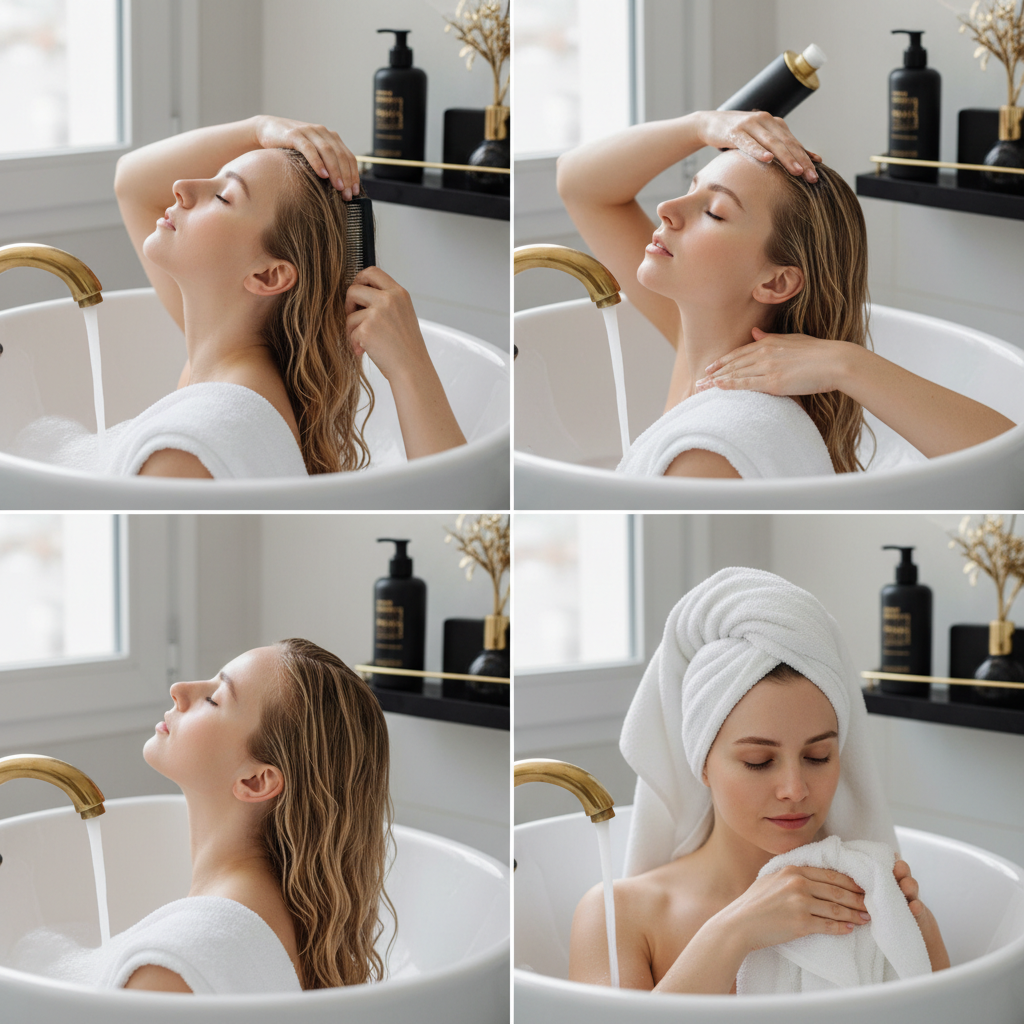
1. Pre-wash barrier protection
Before stepping into the shower, apply a small amount of penetrating natural oil (such as coconut or argan oil) or a dedicated pre-shampoo treatment to dry lengths. Research demonstrates that coconut oil, possessing a low molecular weight and linear chain, penetrates the hair shaft and significantly reduces protein loss during cleansing. Leave it on for 15 to 30 minutes.
2. Temperature regulation
Thoroughly soak the hair with lukewarm water. Water above 38°C dissolves natural scalp sebum excessively and prompts unnecessary swelling of the hair cortex.
3. Scalp-only cleansing
Dilute your shampoo with a splash of water between your palms before application. Work the product strictly across the scalp using the pads of your fingers in slow, linear motions. Avoid circular rubbing, which creates knots. Do not pile your hair onto the top of your head. When you rinse, the diluted lather flowing down the mid-lengths and ends provides sufficient cleansing without stripping lipid barriers.
4. Conditioning with slip
Apply a rich, cationic-surfactant conditioner from mid-lengths to ends. Cationic agents (like behentrimonium chloride or cetrimonium chloride) deposit onto negatively charged damaged sites, restoring lubricity and drastically reducing comb-through friction. Let the conditioner sit for 3 to 5 minutes before rinsing with cool water to firm the fibre structure.
5. Friction-free drying
Never wring, twist, or rub your hair with a traditional terrycloth towel. Terrycloth loops catch on fragile cuticles and snap weakened fibres. Instead, blot and press hair gently using an ultra-fine microfiber towel or a soft cotton t-shirt to absorb excess water.
What the evidence does not show
It is critical to manage expectations regarding hair hygiene. Adopting the best washing protocols will not alter follicular hair density, cure androgenetic alopecia, or reattach split ends that have already separated.
Cosmetic products and careful handling protect the structural integrity of the existing hair shaft and reduce breakage. They do not stimulate the dermal papilla to generate new hair strands. If you are experiencing diffuse shedding or widening part lines, the root cause lies within internal biology rather than external cleansing technique.
Identifying fragile hair versus shedding
Many people mistake hair breakage during washing for hair loss. Understanding the difference prevents unnecessary panic:
- Breakage: Small, uneven segments of hair found in the drain or brush that lack a white bulb at either tip. Breakage indicates mechanical or chemical failure of the hair fibre.
- Telogen shedding: Full-length hair strands that feature a small, solid white bulb at the root end. This signals that the hair has naturally finished its growth cycle and detached from the follicle. Losing 50 to 100 telogen hairs per day is physiologically normal.
- Signs of fragility: Tangling immediately upon contact with water, a dry or rough paper-like texture, poor elasticity (the hair snaps instantly when stretched gently between fingers), and split ends.
When the cause requires medical advice
While fine or chemically treated hair is naturally more fragile, sudden or severe fragility may point to an underlying medical or nutritional condition. You should consult a GP or registered trichologist if you notice:
- Sudden extreme brittleness accompanied by dry skin, fatigue, and unexplained weight changes (possible thyroid dysfunction).
- Excessive breakage accompanied by severe scalp flaking, redness, or painful pustules (potential fungal infection or scarring alopecia).
- Unexplained patchiness or rapid diffuse shedding where hair comes out in large clumps during washing.
- Genetic shaft disorders, such as trichothiodystrophy or monilethrix, which cause marked fragility from early childhood.
Supporting delicate hair with Watermans
When addressing fragile hair, choosing non-stripping, nutrient-rich formulations helps keep both the scalp environment and hair strands balanced. Watermans GroomMore and GrowMe shampoos are formulated without aggressive sulphates, incorporating gentle cleansing agents alongside caffeine, rosemary extract, biotin, and hydrolysed lupin protein.
For strands prone to snapping, Watermans ConditionMe conditioner delivers vital slip and conditioning agents that smooth down lifting cuticles, visibly reducing post-wash tangles and combing breakage while providing body to fine, delicate hair.
Frequently asked questions about Best Practices for Washing Fragile Hair
How often should fragile hair be washed?
Most individuals with fragile hair should wash their hair 1 to 3 times per week. Washing too frequently exposes weakened hair fibres to repeated water swelling (hygral fatigue) and physical handling. If you have an oily scalp, focus your cleanser directly on the roots while keeping ends shielded by conditioner to prevent excessive dryness.
What is the most crucial step among the Best Practices for Washing Fragile Hair?
Minimising friction during and immediately after washing is the single most impactful step. Wet hair has reduced tensile strength, making it vulnerable to shear stress. Avoiding vigorous towel rubbing, refraining from piling hair during shampooing, and applying products with ample slip prevent the vast majority of wet-combing breaks.
Can washing in cold water reverse hair damage?
Cold water cannot reverse existing hair damage or repair broken internal disulphide bonds. However, cool to lukewarm water helps prevent excessive swelling of the hair shaft and does not soften or dislodge the hair's protective lipid layer as aggressively as hot water does.
Should you comb fragile hair while it is wet?
Generally, you should avoid combing fragile hair while soaking wet unless it is fully coated in a slippery conditioner. If detangling in the shower, use a very wide-toothed comb or a flexible detangling brush, working gently from the tips upward to the roots to prevent snapping knots.
Summary
Implementing the Best Practices for Washing Fragile Hair safeguards vulnerable fibres from avoidable mechanical trauma and moisture-induced stress. By swapping harsh scrubbing for gentle scalp cleansing, lowering water temperature, employing pre-wash barriers, and blotting gently with microfiber, you protect the hair cuticle and significantly curb daily breakage. Combine gentle hygiene with appropriate professional diagnostics whenever excessive brittleness or shedding resists cosmetic care.
Sources and references
- International Journal of Trichology: "Shampoo and Conditioners: What a Dermatologist Should Know?" (2015).
- Journal of Cosmetic Science: "Effect of mineral oil, sunflower oil, and coconut oil on prevention of hair damage" (2003).
- British Association of Dermatologists: "Telogen Effluvium and Hair Loss Guidelines" (2021).
- Skin Appendage Disorders: "Hair Shaft Damage from Cleansing and Cosmetic Procedures" (2019).
Find these ingredients in Watermans products
- Sunflower Seed Oil: you will find this ingredient in our Heat Protection Spray.